SGX: M44U | S-REIT ANALYSIS | UPDATED AUGUST 2026
Mapletree Logistics Trust Share Price 2026: Is the Recovery Real?
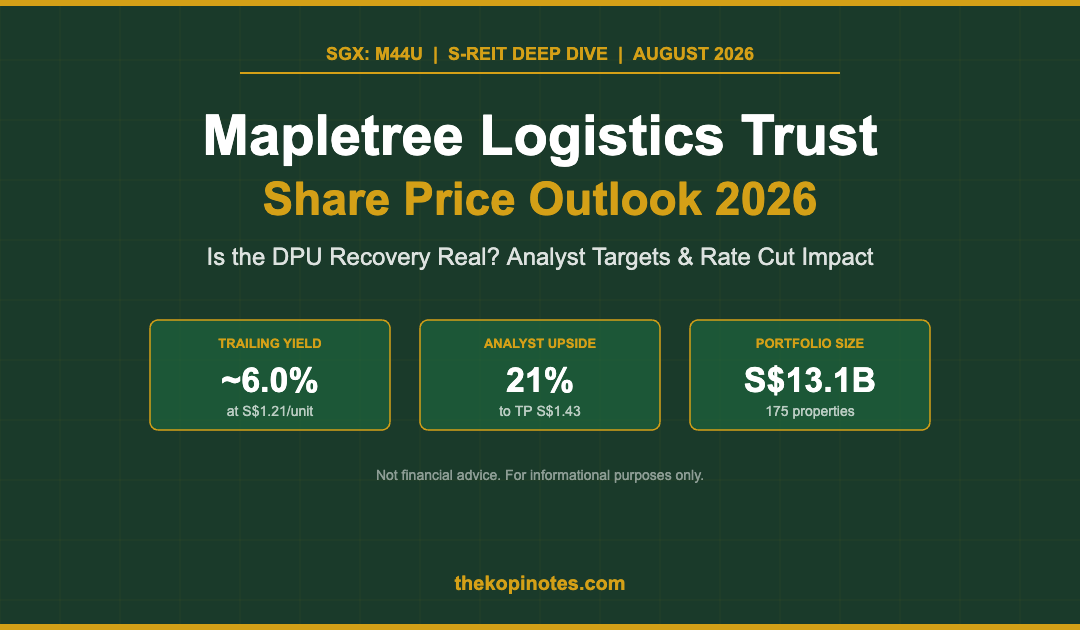
MLT’s DPU just posted its first year-on-year increase since 2024. With the share price at ~S$1.18 and analyst consensus pointing to S$1.43 — a 21% upside — here’s what every Singapore investor needs to know before Jackson Hole.
| Metric | Value |
|---|---|
| SGX Ticker | M44U |
| Share Price (Aug 2026) | ~S$1.18 |
| Analyst Consensus Target | S$1.43 (21% upside) |
| FY25/26 DPU | 7.262 cents (-9.8% YoY) |
| 1QFY26/27 DPU | 1.816 cents (+0.2% YoY) ✓ |
| Trailing Yield | ~6.0% |
| Portfolio AUM | S$13.1B (175 properties, 9 markets) |
| Gearing Ratio | 40.6% |
| Portfolio Occupancy (1QFY26/27) | 96.4% |
📋 Table of Contents
- MLT at a Glance: Share Price, Yield & Portfolio
- The DPU Recovery Story: First YoY Increase Since 2024
- What’s Driving the Recovery
- Key Risk Factors to Watch
- Analyst Price Targets & Recommendations
- Fed Rate Cuts & MLT: How Big Is the Tailwind?
- Should You Buy MLT Now? Decision Framework
- Frequently Asked Questions
MLT at a Glance: Share Price, Yield & Portfolio
Mapletree Logistics Trust (SGX: M44U) is one of Singapore’s largest listed logistics REITs, owning 175 properties across nine markets in Asia-Pacific with a total asset value of S$13.1 billion. If you’ve been tracking the MLT share price trajectory over the past two years, you’ll know it has been a rough ride.
After peaking above S$1.70 in 2022, M44U drifted steadily lower as interest rates rose and DPU declined for multiple consecutive quarters. As of August 2026, MLT trades around S$1.18 — a level that implies:
- A trailing distribution yield of approximately 6.0% based on FY25/26 DPU of 7.262 cents
- A price-to-book ratio near 0.74x — trading at a significant discount to net asset value
- A 21% discount to the analyst consensus 12-month target price of S$1.43
For Singapore retail investors hunting for passive income, MLT’s 6% yield combined with a potential double-digit capital gain makes this one of the more compelling setups in the 2026 S-REIT recovery story. But yield alone is never enough — you need to understand what’s holding up the distributions and what could derail them.
The DPU Recovery Story: First YoY Increase Since 2024
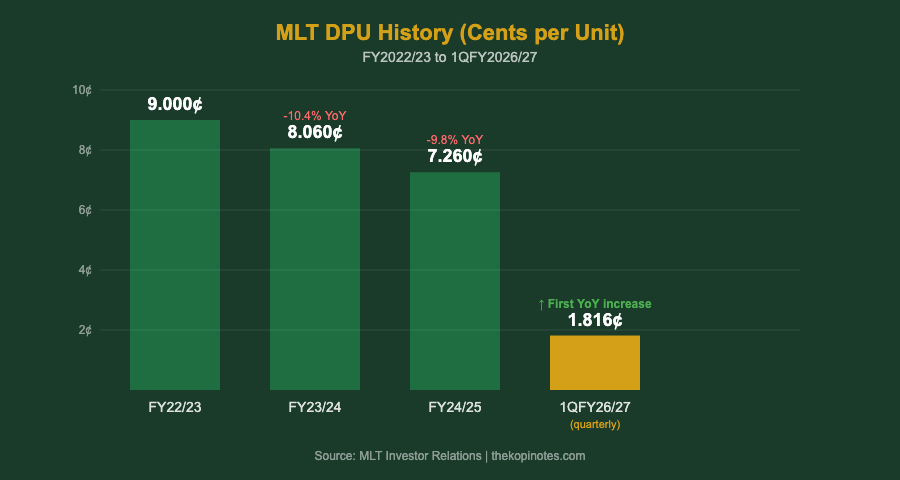
The most significant development in MLT’s 1QFY2026/27 (quarter ended 30 June 2026) was not just the headline numbers — it was what they signalled. For the first time since FY2022/23, MLT posted a year-on-year DPU increase.
The trust declared a DPU of 1.816 cents for the quarter, up 0.2% year-on-year. That’s a modest number, but context matters enormously:
- FY2022/23: 9.00 cents full-year DPU — the peak
- FY2023/24: 8.06 cents — down 10.4% as rates bit
- FY2024/25: 7.262 cents — down another 9.8%
- 1QFY2026/27: 1.816 cents — first quarterly YoY increase in the recovery cycle
The full financials for the quarter reinforced the recovery thesis. Gross revenue rose 0.8% year-on-year to S$178.9 million, while net property income (NPI) grew 2.0% to S$156.4 million — an improving margin. The amount distributable to unitholders grew 1.1% year-on-year to S$92.3 million. See our full 1QFY26/27 results breakdown for a complete deep-dive.
What’s Driving the Recovery
Three structural tailwinds are working in MLT’s favour right now, and understanding each one is key to assessing whether the DPU recovery is sustainable.
1. India Acquisition: A New Growth Engine
MLT’s most notable strategic move in FY2025/26 was its expansion into India — one of the fastest-growing logistics markets in Asia. The recent India acquisition contributed meaningfully to 1QFY26/27 revenue, partially offsetting headwinds from China and currency depreciation. With India’s e-commerce and manufacturing boom driving demand for Grade A warehousing, MLT’s early mover advantage here could generate above-average rental reversions in the medium term.
2. Lower Borrowing Costs
MLT has been proactive in managing its debt. As of 1QFY26/27, 82% of MLT’s debt is hedged to fixed rates, which protects it from short-term rate volatility. More importantly, the trust is beginning to benefit from lower floating rates on the unhedged portion of its debt — and as existing fixed-rate facilities mature and are refinanced, the interest savings will flow directly into distributable income. Our earlier analysis of the perpetual bond refinancing showed how management is actively reducing the cost of capital.
3. Singapore Redevelopment Contribution
A completed redevelopment project in Singapore began contributing its full-quarter income in 1QFY26/27. Given Singapore’s tight industrial land supply and strong leasing demand, this asset adds high-quality, resilient NPI to the portfolio — the type of revenue that supports stable long-term distributions.
Key Risk Factors to Watch
No investment thesis is complete without an honest look at the risks. For MLT, the three most significant risks in the current environment are:
China Portfolio Occupancy Drag
Portfolio occupancy slipped from 96.9% to 96.4% quarter-on-quarter, with Singapore, China, and Australia seeing lower occupancy. China remains MLT’s largest geographic concentration by asset value, and the property market there faces structural headwinds. While MLT has been divesting underperforming China assets (see the Wuxi divestment analysis), residual exposure means any further weakness could pressure occupancy and rental income.
Foreign Currency Depreciation
MLT earns income across nine markets in various currencies — Chinese yuan, Japanese yen, Hong Kong dollar, Korean won, Indian rupee, and more. While approximately 75% of income for the next 12 months is hedged into Singapore dollars, the remaining 25% is exposed to adverse FX movements. A stronger SGD against regional currencies remains a headwind that has trimmed distributions in recent quarters.
Gearing at 40.6% — Adequate But Not Comfortable
MLT’s 40.6% gearing provides roughly 9–14 percentage points of headroom before the MAS 50–55% limit, depending on credit rating. This is adequate, but it limits MLT’s ability to fund large acquisitions with debt alone. Future growth may require equity fundraising (i.e., placement or rights issue), which can dilute existing unitholders if not at an accretive price.
Analyst Price Targets & Recommendations
The analyst community is broadly constructive on MLT. Based on the latest consensus data:
| Broker | Rating | Target Price | Implied Upside* |
|---|---|---|---|
| Maybank Research | BUY | S$1.45 | +23% |
| Analyst Consensus (14 analysts) | BUY | S$1.43 | +21% |
| Range (High) | — | S$1.48 | +25% |
| Range (Low) | — | S$1.30 | +10% |
*Based on share price of approximately S$1.18. Not financial advice. Analyst targets subject to change.
Out of 14 analysts tracked, 8 rate MLT a Buy, 5 Hold, and 1 Sell. The broad Buy consensus, combined with targets clustering between S$1.39–S$1.45, suggests the street sees meaningful value at current levels. Read the full MLT price target deep dive for the detailed valuation methodology behind each call.
Fed Rate Cuts & MLT: How Big Is the Tailwind?
With the Jackson Hole Symposium scheduled for August 27–29, 2026, all eyes are on the Fed’s next move. For rate-sensitive S-REITs like MLT, a clear signal of further cuts could be a significant catalyst. But how exposed is MLT, really?
The Fixed-Rate Buffer
With 82% of MLT’s debt fixed, the trust does not immediately benefit from falling rates on its existing debt. However, this cuts both ways — it’s also protected from any rate reversal. The real benefit of Fed cuts flows through two channels:
- Refinancing tailwind: As fixed-rate facilities mature (2% due in FY26/27), they’ll be refinanced at lower prevailing rates, gradually reducing the cost of debt and boosting distributable income
- Valuation re-rating: Lower risk-free rates compress the discount rate applied to future cash flows. MLT’s NAV per unit and fair value both rise in a falling-rate environment, which typically drives share price higher even before income improves
Historical Precedent
During the 2019–2020 rate cut cycle, MLT’s share price gained significantly as investors repriced the REIT’s long-duration income streams at lower discount rates. If the Fed signals two or more cuts in 2H2026 at Jackson Hole, MLT could see a similar re-rating — purely on valuation grounds, before any income improvement.
For a broader view of how S-REITs are positioned in the current rate environment, see our guide to the best S-REITs for 2026.
Should You Buy MLT Now? A Decision Framework
Rather than a blanket buy or sell, here’s how to think about MLT based on your investor profile:
| If you are… | MLT makes sense if… |
|---|---|
| Income-first investor | ~6% yield is attractive; DPU recovery provides distribution stability |
| Growth + income investor | 21% upside to analyst TP + 6% yield = potential 27%+ total return |
| CPF-OA investor | MLT is CPF-OA investable; yield > 2.5% OA rate offers meaningful spread |
| Risk-averse investor | China concentration risk and FX drag warrant caution; consider trimming China-heavy position |
| Short-term trader | Watch for Jackson Hole catalyst (Aug 27–29); rate cut signal could trigger sharp re-rating |
The most compelling case for MLT is the combination of below-NAV pricing + recovering DPU + rate cut tailwind. That triple convergence doesn’t happen often in S-REIT investing. The biggest risk remains China — if occupancy deteriorates further, the DPU recovery thesis weakens.
For investors looking to add Singapore REIT exposure through a diversified robo-advisor, platforms like Endowus (use code 2V343 for fee rebates), Syfe (use code SRPRFFFCD), and FSMOne (use code P0544985) offer managed S-REIT portfolios that include MLT-type exposure with automatic rebalancing.
Frequently Asked Questions
What is the Mapletree Logistics Trust share price today?
As of August 2026, MLT (SGX: M44U) trades at approximately S$1.18, representing a discount of around 21% to the analyst consensus 12-month target price of S$1.43. Share prices fluctuate daily — check SGX or your brokerage app for the latest quote.
Is Mapletree Logistics Trust a good buy in 2026?
MLT offers a combination of ~6% distribution yield, a recovering DPU trend (first YoY increase in 1QFY26/27), and a 21% upside to analyst consensus targets. The main risks are China portfolio concentration and FX depreciation. For long-term income investors, the current price-to-book below 0.75x and potential Fed rate cut tailwind make it an interesting opportunity — but always assess your own risk tolerance before investing. This is not financial advice.
What is MLT's DPU and dividend yield?
For FY2025/26 (ended March 2026), MLT declared a total DPU of 7.262 cents per unit, representing approximately a 6.0% trailing yield at the S$1.21 share price level. For 1QFY2026/27, MLT declared a quarterly DPU of 1.816 cents (ex-date August 4, 2026) — the first year-on-year increase since 2024.
What is MLT's gearing ratio and is it safe?
MLT’s gearing ratio stands at approximately 40.6% as of 1QFY2026/27. MAS permits S-REITs to gear up to 50% (or 55% with a credit rating). MLT therefore has adequate headroom, though it limits significant debt-funded acquisitions without equity fundraising. Notably, 82% of MLT’s debt is hedged to fixed rates, providing income stability.
Can I invest in MLT using CPF OA funds?
Yes, Mapletree Logistics Trust (M44U) is included on the CPF Investment Scheme (CPFIS-OA) approved list. This means Singapore investors can use their CPF Ordinary Account savings to invest in MLT through a CPFIS-approved broker. The current ~6% distribution yield exceeds the 2.5% CPF OA base rate, providing an income pickup — though REIT unit prices can fall and past distributions do not guarantee future payouts.
How does the Fed rate cut affect MLT's share price?
Fed rate cuts benefit MLT in two ways: (1) as fixed-rate facilities mature and are refinanced at lower rates, MLT’s cost of debt falls and distributable income rises; (2) lower risk-free rates reduce the discount rate applied to MLT’s income stream, increasing its fair value and typically pushing the share price higher. With 82% of debt already fixed, the income benefit accrues gradually — but the valuation re-rating can happen quickly once rate cut expectations are priced in.
Disclaimer: This article is for informational and educational purposes only. It does not constitute financial advice or a recommendation to buy or sell any security. All investment decisions should be made based on your own research and risk tolerance. MLT’s past distributions do not guarantee future payouts. The Kopi Notes may receive referral fees from platforms mentioned.
This article was researched with the help of AI. While we strive to keep all information accurate and up to date, there may be errors. If you notice any discrepancies, please contact us.