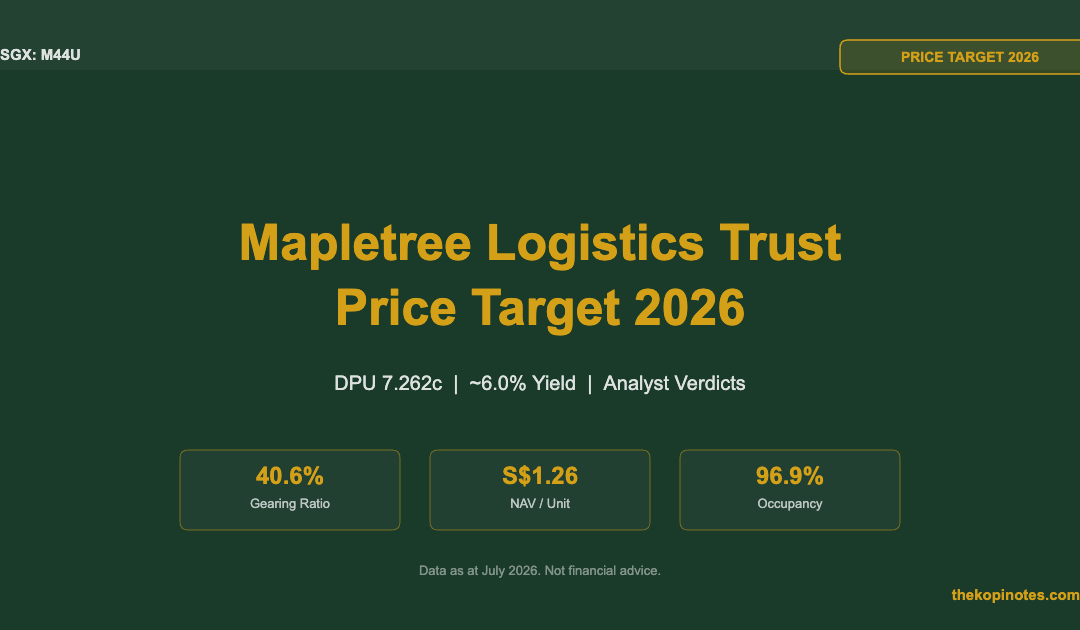
Mapletree Logistics Trust Price Target 2026 (SGX: M44U): DPU 7.26c, ~6% Yield & Analyst Verdicts
A deep-dive for Singapore investors — current price analysis, analyst price targets, DPU outlook, and whether MLT is a buy at todays levels.
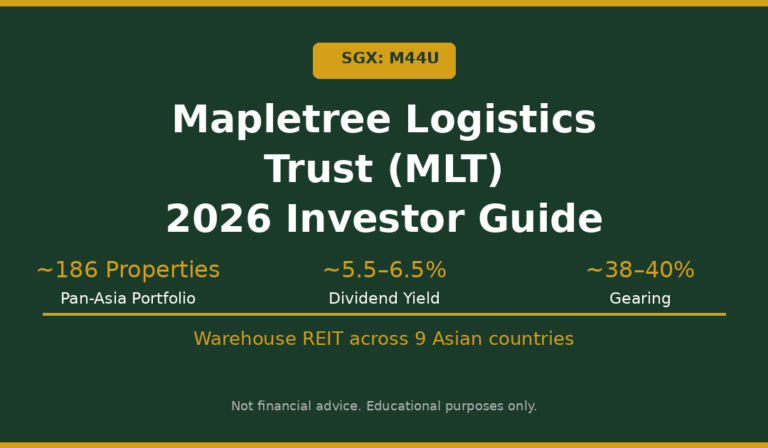
Mapletree Logistics Trust (SGX: M44U) is a pan-Asia logistics S-REIT with 175 warehouses across nine markets. For FY2025/26, MLT posted a Distribution Per Unit (DPU) of 7.262 Singapore cents, down 9.8% year-on-year, for a trailing yield of about 6% at current prices. Analyst price targets range from S$1.30 to S$1.48, implying roughly 7% to 22% upside from the S$1.21 trading range in July 2026.
Not financial advice. All figures are for educational reference only. Data as at July 2026 unless noted.
- MLTs FY25/26 headline DPU fell 9.8% to 7.262 cents, but the drop was mostly because one-off divestment gains from the prior year did not repeat — operating DPU was down only 3.4%.
- At about 6% yield, 40.6% gearing and a slight discount to its S$1.26 NAV, MLT looks fairly valued against its pan-Asia logistics and industrial S-REIT peers.
- Analyst verdict is split: DBS, Maybank and CGS International rate it BUY or ADD with targets S$1.30-S$1.48, while UOB Kay Hian stays at HOLD, citing 21.5% vacancy in China.
Table of Contents
Contents -- Click to expand
- What Is Mapletree Logistics Trust (M44U)?
- Key Facts at a Glance
- DPU History and FY2025/26 Results
- MLT Share Price Analysis 2026
- Analyst Price Targets and Recommendations
- Peer Comparison: MLT vs Other Logistics and Industrial S-REITs
- Buy, Hold or Sell? Verdict for 2026
- How to Buy MLT in Singapore (CPF, SRS, Cash)
- Frequently Asked Questions
What Is Mapletree Logistics Trust (M44U)?
Mapletree Logistics Trust (MLT) was listed on the SGX Mainboard on 28 July 2005, making it one of Singapores oldest logistics-focused REITs. It was also the first Asia-focused logistics REIT to list here, giving it a two-decade head start building relationships with warehouse operators, e-commerce firms and third-party logistics providers across the region.
MLT is managed by Mapletree Logistics Trust Management Ltd, a wholly-owned subsidiary of Mapletree Investments Pte Ltd. Mapletree Investments is one of Asias largest real estate groups and is ultimately backed by Temasek Holdings, giving MLT strong sponsor support for acquisitions, refinancing and asset management expertise.
As at 31 March 2026, MLT owns 175 properties spanning nine markets: Singapore, Australia, China, Hong Kong SAR, India, Japan, Malaysia, South Korea and Vietnam. Total assets under management stand at S$13.1 billion, down 1.6% year-on-year as MLT continued recycling older, lower-yielding assets into newer logistics facilities.
This pan-Asia footprint sets MLT apart from its Mapletree siblings. Mapletree Industrial Trust (MINT) focuses on Singapore industrial space plus US data centres, while Mapletree Pan Asia Commercial Trust (MPACT) holds retail and office assets like VivoCity. MLT is the pure logistics and warehousing play in the family — its income comes from leasing modern, ramp-up warehouse space to tenants moving goods across Asias supply chains.
Key Facts at a Glance
| Metric | Detail |
|---|---|
| Full Name | Mapletree Logistics Trust |
| SGX Ticker | M44U |
| Listed | 28 July 2005 |
| Asset Type | Pan-Asia Logistics / Warehouses |
| Portfolio Value (AUM) | S$13.1 billion (as at 31 March 2026) |
| Number of Properties | 175 across 9 markets |
| FY2025/26 DPU | 7.262 Singapore cents (down 9.8% YoY headline) |
| Trailing Yield | ~6.0% (at S$1.21, July 2026) |
| Gearing Ratio | 40.6% (as at 31 March 2026) |
| NAV Per Unit | S$1.26 (as at 31 March 2026) |
| P/NAV | ~0.96x (at S$1.21) |
| Occupancy / WALE | 96.9% / ~2.7 years |
Source: Mapletree Logistics Trust Investor Relations, FY2025/26 Full Year Results, SGX filings. Data as at 31 March 2026.
DPU History and FY2025/26 Results
MLTs FY2025/26 (year ended 31 March 2026) full-year DPU came in at 7.262 Singapore cents, down 9.8% from the year before. That headline number looks worse than it actually is. A large chunk of the decline is because the prior year included one-off gains from asset divestments that were distributed to unitholders — those gains do not repeat every year. Strip them out, and MLTs core operating DPU was down only 3.4% year-on-year, a much smaller decline driven mainly by higher financing costs and a soft China logistics market.
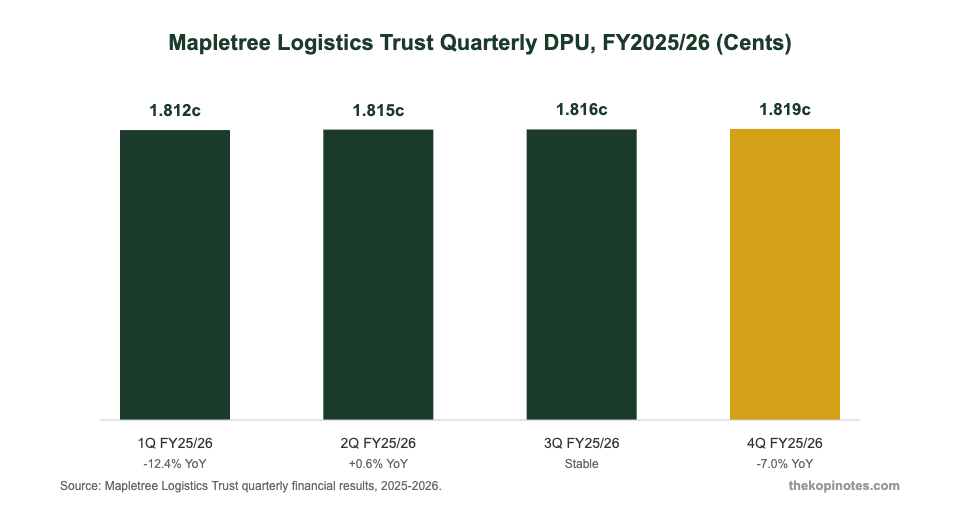
The quarterly trend tells the more useful story. DPU stayed remarkably stable through the year, moving in a narrow 1.812 to 1.819 cent band across all four quarters — not the kind of volatile decline you would see if the underlying business were deteriorating.
| Quarter | DPU (cents) | YoY Change | Occupancy |
|---|---|---|---|
| 1Q FY25/26 (Apr-Jun 2025) | 1.812 | -12.4% | 95.7% |
| 2Q FY25/26 (Jul-Sep 2025) | 1.815 | +0.6% | 96.1% |
| 3Q FY25/26 (Oct-Dec 2025) | 1.816 | Stable | 96.4% |
| 4Q FY25/26 (Jan-Mar 2026) | 1.819 | -7.0% | 96.9% |
| Full Year FY25/26 | 7.262 | -9.8% headline / -3.4% operating | 96.9% |
Source: Mapletree Logistics Trust quarterly financial results, 2025-2026.
Two things stand out. First, occupancy climbed steadily through the year, from 95.7% in April 2025 to 96.9% by March 2026, as MLT backfilled vacancies in Singapore, China, Hong Kong SAR, Japan and South Korea. Second, rental reversions stayed positive outside China — Singapore and Australia both posted positive rental growth through the year, the underlying driver that should support DPU once financing costs stabilise.
Gross revenue for FY2025/26 came in at S$708.3 million, down 2.6% year-on-year, with net property income of S$610.2 million, down 2.4%. Total debt outstanding was approximately S$5.5 billion, with 83.0% of borrowings on fixed rates — meaning MLT is reasonably insulated from near-term rate volatility, though it still faces refinancing risk as fixed-rate loans mature and get repriced.
MLT Share Price Analysis 2026
MLTs unit price stayed under pressure through FY2025/26, tracking the broader S-REIT sectors underperformance as investors waited for clearer signals on US Federal Reserve rate cuts. The counter closed FY2025/26 (31 March 2026) at S$1.15, a roughly 9% discount to its S$1.26 NAV per unit. By mid-July 2026, the price had recovered modestly to around S$1.21, still trading close to book value at approximately 0.96x P/NAV.
| Period | MLT Price (SGD) | Note |
|---|---|---|
| FY25/26 year-end (31 Mar 2026) | S$1.15 | ~9% discount to NAV |
| April 2026 | ~S$1.17 | Post-results stabilisation |
| June 2026 | ~S$1.20 | Ahead of broker updates |
| July 2026 (current) | ~S$1.21 | Trading near book value |
Source: SGX data, broker research notes. Prices are approximate historical reference, not a prediction of future performance.
The key number to watch is the S$1.26 NAV per unit, which itself fell 3.8% year-on-year (from S$1.31) as higher cap rates in China and softer valuations weighed on the portfolio. A REIT trading close to its NAV, with a well-covered ~6% yield, often signals the market has priced in most near-term bad news — but it also means there is limited valuation cushion if China conditions worsen further.
Analyst Price Targets and Recommendations
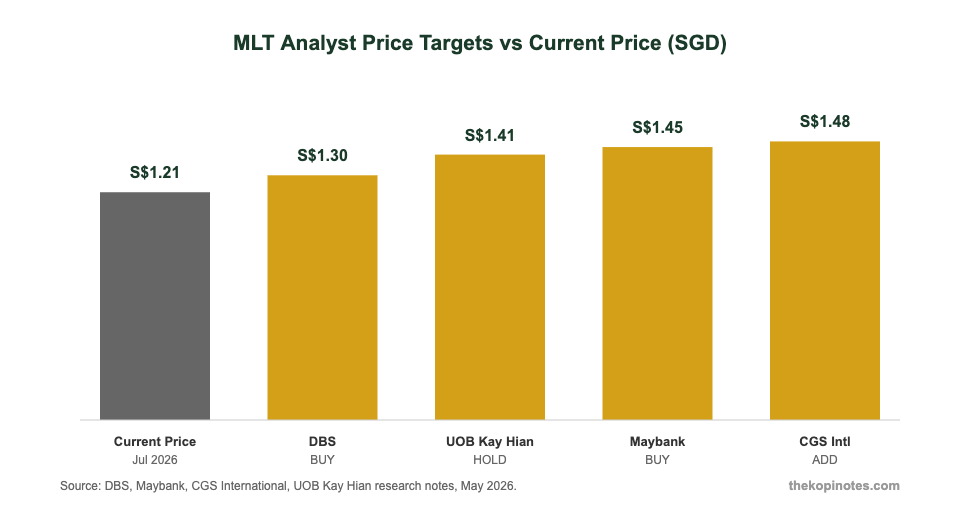
Singapore’s major brokerages are split on MLT heading into the second half of 2026. Three houses rate it BUY or ADD, while one maintains a more cautious HOLD. Here is the current consensus as at May 2026:
| Broker | Rating | Price Target (SGD) | Key Thesis |
|---|---|---|---|
| DBS Bank (Derek Tan) | BUY | S$1.30 | Resilient logistics demand, stable quarterly DPU |
| Maybank Research | BUY | S$1.45 | Fair value at 1.0x P/BV, distribution stabilising |
| CGS International | ADD | S$1.48 (from S$1.68) | China stabilising, ongoing asset recycling |
| UOB Kay Hian (Jonathan Koh) | HOLD | S$1.41 (from S$1.45) | China vacancy at 21.5%, historically elevated |
| Consensus Average (4 brokers) | BUY-leaning | ~S$1.41 | ~17% upside from S$1.21 |
Source: DBS, Maybank, CGS International, UOB Kay Hian via The Edge Singapore research notes, May 2026. Past analyst targets do not guarantee future performance.
This 4-broker average of about S$1.41 sits meaningfully above the broader Street consensus, which pulls in more cautious estimates from the full pool of roughly 14 analysts covering the counter — that wider average lands closer to S$1.32. The gap tells you something useful: the brokers actively publishing fresh notes in mid-2026 lean more bullish than the average of all historical estimates on file, some of which have not been refreshed since MLT traded at higher levels.
The bull case, shared by DBS, Maybank and CGS International, rests on three pillars: quarterly DPU has been essentially flat for a full year rather than declining further, Singapore and Australia are both posting positive rental reversions, and MLT continues recycling older assets into better-yielding acquisitions. If the Fed delivers rate cuts in the second half of 2026, MLTs borrowing costs should ease, supporting a re-rating toward NAV.
The bear case, led by UOB Kay Hian, centres on China. Vacancy in MLTs China portfolio hit 21.5% as at early 2026 — a historical high for the trust — and analyst Jonathan Koh flagged the risk that renewed US-China trade tension could weaken demand further. Chinas negative rental reversion did narrow from -7.5% to -3.0% quarter-on-quarter, a positive sign, but it remains the one segment dragging on an otherwise stable portfolio.
Peer Comparison: MLT vs Other Logistics and Industrial S-REITs
How does MLT compare against its Mapletree siblings and the broader industrial and logistics S-REIT space? Here is a direct comparison on yield, leverage and scale, as at mid-2026:
| REIT | Ticker | Yield | Gearing | AUM | Key Edge |
|---|---|---|---|---|---|
| MLT | M44U | ~6.0% | 40.6% | S$13.1B | Pure pan-Asia logistics, 9 markets |
| Mapletree Industrial Trust | ME8U | ~6.5% | 34.0% | S$8.2B | SG industrial plus US data centres |
| Mapletree Pan Asia Commercial Trust | N2IU | ~6.0% | 36.5% | S$15.2B | VivoCity and Festival Walk anchor assets |
| CapitaLand Ascendas REIT | A17U | ~6.1% | 38.4% | S$17.3B | Largest SG industrial REIT, diversified |
| AIMS APAC REIT | O5RU | ~6.9% | 26.8% | S$2.1B | Lowest gearing, smaller scale |
Source: SGX filings, company announcements, broker research. Yields and gearing are approximate as at mid-2026.
MLT sits at the higher end of the gearing spectrum among its logistics and industrial peers — its 40.6% gearing is the highest in this table, leaving less balance sheet headroom for large acquisitions without a rights issue or divestment-funded recycling. Its ~6.0% yield is roughly in line with MPACT and CLAR but below MINT, whose data centre exposure commands a premium, and well below AIMS APAC REIT, which trades at a higher yield partly due to its smaller scale and less diversified tenant base. Comparing MLT with the broader best S-REITs in Singapore 2026 shows it holds up reasonably on income, if not on balance sheet strength.
Looking for the latest numbers? See our Q1 FY2026/27 results preview for the DPU trend, gearing update and what to watch before MLT reports on 28 July 2026.
Buy, Hold or Sell? Verdict for 2026
Here is the honest breakdown for different types of Singapore investors:
| Investor Profile | Verdict | Rationale |
|---|---|---|
| Long-term income investor (10+ years) | BUY on dips below S$1.20 | ~6% yield, Temasek-linked sponsor, stable quarterly DPU trend |
| Existing unitholder | HOLD | Distribution has stabilised; little reason to sell into a discount-to-NAV price |
| Short-term trader | NEUTRAL | No clear catalyst until China vacancy improves or Fed cuts land |
| CPF/SRS investor building income | SELECTIVE BUY | CPFIS-OA and SRS eligible; ~6% yield vs CPF OA 2.5% is a meaningful pickup |
This is not financial advice. All analysis is for educational purposes only. Consult a licensed financial adviser before making investment decisions.
The single risk worth watching most closely is China. At 21.5% vacancy, MLTs China portfolio is the one segment genuinely dragging on results, and a re-escalation in US-China trade tension could keep pressuring rents there. Everything else — Singapore, Australia, the broader Asia-Pacific footprint — is either stable or improving. For investors building a passive income Singapore portfolio, MLTs ~6% yield and Temasek-linked sponsor make it a reasonable core holding, but position sizing should account for the China concentration risk. Use our Singapore retirement calculator to see how MLTs yield fits your broader retirement income target.
How to Buy MLT in Singapore (CPF, SRS, Cash)
MLT is one of the more accessible S-REITs for Singapore investors, with three main funding routes.
Via CPF Investment Scheme (CPFIS-OA): MLT is CPFIS-OA approved, meaning you can invest CPF Ordinary Account savings into it through approved brokers such as DBS Vickers, OCBC Securities, UOB Kay Hian, FSMOne and Phillip Securities. You need to set aside the first S$20,000 in your OA, and equities plus unit trusts are capped at 35% of your investible savings. At todays CPF OA interest rate of 2.5%, MLTs ~6.0% yield represents a meaningful income pickup — though unlike CPF OA, your capital is exposed to price risk.
Via SRS (Supplementary Retirement Scheme): MLT can also be purchased with SRS funds. SRS contributions reduce your taxable income in the year you contribute, and withdrawals after the statutory retirement age are taxed at only 50% of the normal rate. This makes MLT-via-SRS a tax-efficient way to build income for investors in higher tax brackets. The CPF investment strategy guide walks through how to decide between CPF-OA and SRS funding for S-REIT purchases.
Via Cash Brokerage: Any SGX-connected broker works. FSMOne (referral code P0544985) charges 0.08% commission with a S$10 minimum, while Syfe Trade (referral code SRPRFFFCD) offers commission-free SGX trading. For larger positions, Interactive Brokers (referral code jianxiong368) has the lowest margin financing rates. Endowus (referral code 2V343) offers CPF and SRS-friendly access to diversified S-REIT and Asia-Pacific real estate funds if you prefer not to pick individual counters.
At S$1.21 per unit, buying 1,000 units costs S$1,210 and generates approximately S$72.62 per year at the 7.262-cent DPU — paid quarterly in roughly S$18 instalments. A S$50,000 position generates approximately S$3,000 per year, or about S$750 per quarter. If you prefer diversified exposure rather than a single counter, the Singapore REIT ETF guide covers fund-based alternatives, and the existing Mapletree Logistics Trust Dividend guide has more detail on the distribution schedule and ex-dividend dates.
Frequently Asked Questions
What is the Mapletree Logistics Trust price target for 2026?
Based on broker consensus as at May 2026, analyst price targets for Mapletree Logistics Trust (M44U) range from S$1.30 (DBS, BUY) to S$1.48 (CGS International, ADD), with the four-broker average at approximately S$1.41. At the current price of around S$1.21, this implies roughly 7% to 22% upside. UOB Kay Hian is the most cautious at S$1.41 with a HOLD rating, citing elevated vacancy in MLTs China portfolio.
Is Mapletree Logistics Trust a good buy in 2026?
MLT offers a roughly 6.0% yield backed by a Temasek-linked sponsor and a stable, essentially flat quarterly DPU trend through FY2025/26. Three of four major brokerages rate it BUY or ADD. The main concern is elevated vacancy in its China portfolio (21.5%), which is why UOB Kay Hian remains at HOLD. For long-term income investors comfortable with that concentration risk, MLT is a reasonable buy on dips below S$1.20.
Why did MLTs DPU fall in FY2025/26?
MLTs headline DPU fell 9.8% to 7.262 cents, but most of that decline came from one-off divestment gains in the prior year that did not repeat — not from a deterioration in the core business. Stripping out those one-off gains, operating DPU was down only 3.4% year-on-year, driven mainly by higher financing costs and softer conditions in China.
Can I buy Mapletree Logistics Trust using my CPF or SRS?
Yes. MLT is CPFIS-OA approved, so you can use CPF Ordinary Account savings above the mandatory S$20,000 set-aside, subject to the 35% investible savings cap on equities and unit trusts. MLT is also SRS-eligible, letting you fund purchases with Supplementary Retirement Scheme contributions for additional tax relief.
Which broker is best for buying Mapletree Logistics Trust in Singapore?
For cost-conscious investors, FSMOne (referral code P0544985) charges 0.08% commission with a S$10 minimum, and Syfe Trade (referral code SRPRFFFCD) offers commission-free SGX trading. Larger portfolios using leverage may prefer Interactive Brokers for its lower margin rates. If you would rather hold diversified REIT exposure than a single counter, Endowus offers CPF and SRS-friendly fund access.
What is the minimum investment for Mapletree Logistics Trust?
SGX shares trade in board lots of 100 units. At approximately S$1.21 per unit, one lot costs around S$121, making MLT accessible to almost any investor budget. Odd-lot trading of fewer than 100 units is also possible through most brokers, though spreads can be wider.
Is Mapletree Logistics Trust safe? What are the main risks?
MLTs main risk is elevated vacancy in its China portfolio, which hit 21.5% in early 2026 — a historical high — with UOB Kay Hian flagging the possibility that renewed US-China trade tension could weaken demand further. MLT also carries 40.6% gearing, the highest among its closest Mapletree peers, which limits headroom for acquisitions without a rights issue or further divestments. That said, its Temasek-linked sponsor, 83% fixed-rate debt and diversified nine-market footprint provide meaningful downside protection.
How does MLT compare to Mapletree Industrial Trust (MINT)?
MINT offers a higher yield (~6.5% vs MLTs ~6.0%) and lower gearing (34.0% vs 40.6%), partly thanks to its US data centre exposure. MLT offers broader geographic diversification across nine Asia-Pacific markets versus MINTs Singapore-plus-US-data-centre focus. Investors seeking pure logistics exposure would pick MLT; those wanting data centre growth optionality alongside industrial income would lean toward MINT. See our Mapletree Industrial Trust Price Target 2026 guide for the full analyst breakdown on MINT.
What is MLTs NAV and is it trading at a premium or discount?
MLTs NAV per unit was S$1.26 as at 31 March 2026, down 3.8% year-on-year. At the current price of around S$1.21, MLT trades at approximately 0.96x P/NAV — a slight discount to book value, broadly in line with where most S-REITs trade in the current higher-rate environment.
Start Building Your S-REIT Portfolio Today
Open a brokerage account and buy MLT or other S-REITs with exclusive sign-up bonuses via our referral links.
This article was researched with the help of AI. While we strive to keep all information accurate and up to date, there may be errors. If you notice any discrepancies, please contact us.