MediSave Cap 2026: Complete Guide to Annual Withdrawal Limits
Know exactly how much MediSave you can claim — from hospitalization and CDMP to ISP premiums and outpatient scans. Updated for 2026.
The MediSave cap in 2026 refers to two separate limits: the Basic Healthcare Sum (BHS) of $79,000, which is the maximum your MediSave Account can hold, and the annual withdrawal limits that cap how much MediSave you can actually spend on each type of treatment. Hospitalization claims are capped at $1,130 per day (first two days), outpatient chronic disease care is capped at $500–$700 per year, and ISP premium payments are capped at $300–$900 per year depending on your age.
Not financial advice. All figures are for educational reference only. Data verified as at 3 September 2026 unless noted.
- The BHS savings cap is $79,000 — that’s how much MediSave you can hold before CPF contributions overflow to OA/SA.
- Withdrawal caps are separate — they limit how much MediSave you can spend per hospitalization, per year on outpatient care, and on ISP premiums.
- From 1 Jan 2026, your annual limit for outpatient scans doubled from $300 to $600. From 1 Jan 2027, CDMP limits increase further.
Table of Contents
Two Types of MediSave Cap Explained
When people search “MediSave cap 2026”, they’re usually asking about one of two very different things. Understanding the difference could save you real confusion when you’re at the hospital counter or reviewing your insurance bill.
Cap Type 1 — The BHS (Savings Cap): This is the maximum balance your MediSave Account can hold. In 2026, it’s $79,000. If your MA balance hits this number, any new CPF contributions don’t disappear — they spill over to your Ordinary Account or Retirement Account instead.
Cap Type 2 — Withdrawal Limits (Spending Caps): These are the annual or per-visit limits on how much MediSave you can actually claim for each type of healthcare. They’re separate from the BHS and apply every time you use your MediSave. This guide covers both, but focuses heavily on the withdrawal caps — because those are what affect your day-to-day healthcare bills.
The BHS Savings Cap: $79,000 in 2026
The Basic Healthcare Sum (BHS) is set at $79,000 for 2026, up from $75,500 in 2025. This number is reviewed annually by the government.
If you turn 65 in 2026, your BHS is fixed at $79,000 for life — it won’t increase further for you. For everyone else, the cap continues to rise with each Budget review. The goal is to ensure you have enough saved in MediSave to cover basic healthcare costs in retirement.
For a deep-dive into how the BHS affects your CPF allocations and ISP coverage, see our guide on the MediSave Cap 2026 and Basic Healthcare Sum. This guide focuses on the withdrawal limits — how much you can spend, not how much you can save.
Hospitalization Withdrawal Limits 2026
When you’re admitted to hospital, MediSave covers ward charges, treatment fees, investigations, and medicines — but only up to set daily limits. These limits vary by ward class and whether it’s inpatient or day surgery.
| Treatment Type | MediSave Limit (per day) | Notes |
|---|---|---|
| Inpatient — Days 1 & 2 | $1,130/day | Covers ward, treatment, investigations |
| Inpatient — Day 3 onwards | $400/day | Lower limit for extended stays |
| Psychiatric Inpatient — Days 1 & 2 | $1,130/day | Same as general inpatient |
| Psychiatric Inpatient — Day 3 onwards | $230/day | Lower daily cap applies |
| Day Surgery | $830/day | For ward charges; surgical limits are separate |
Source: CPF Board, MediSave Withdrawal Limits (effective 1 April 2025); MOH, as at September 2026
On top of daily ward limits, surgical procedures have their own MediSave caps based on a Table of Surgical Procedures (TOSP). The TOSP ranges from Table 1A (minor procedures, e.g. $240 limit) to Table 7C (major operations, e.g. $5,290 limit). The cap is per operation — if you have multiple procedures in one admission, the total surgical MediSave claim cannot exceed $5,290.
Most Singaporeans with an Integrated Shield Plan (ISP) won’t hit these daily limits directly — your ISP insurer pays the bill first, then claims MediSave reimbursement. But if you’re uninsured or using MediShield Life alone, these caps matter a lot. You can read more about how MediSave hospitalization limits and rider changes interact in our dedicated guide.
Outpatient Treatment Withdrawal Limits 2026
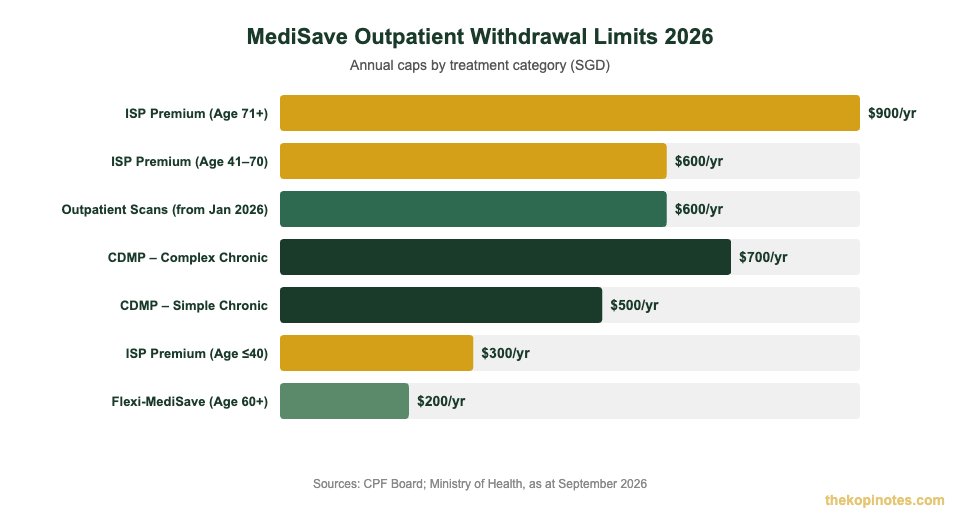
Outpatient MediSave claims work differently from hospitalization. Instead of daily limits, there are annual caps that apply across a calendar year. The main scheme is called MediSave500/700 — covering chronic disease management, vaccinations, and health screenings at polyclinics and approved GP clinics.
| Outpatient Use | Annual MediSave Limit (2026) | Coverage Includes |
|---|---|---|
| CDMP — Simple Chronic | $500/year | Hypertension, diabetes, high cholesterol at approved clinic/polyclinic |
| CDMP — Complex Chronic | $700/year | Multiple or complicated chronic conditions |
| Approved Vaccinations | Included in $500/$700 cap | National Adult & Childhood Immunisation Schedule vaccines |
| Outpatient Scans | $600/year (doubled from $300 Jan 2026) | Pre-approved outpatient radiology scans |
| Flexi-MediSave (Age 60+) | $200/year | Non-CDMP outpatient visits at any licensed doctor |
Sources: CPF Board; Ministry of Health COS 2026 announcement; as at September 2026
A key 2026 update: from 1 January 2026, the outpatient scans withdrawal limit doubled from $300 to $600 per year. This was announced in Budget 2026 and covers pre-approved radiology scans ordered by your doctor.
If you’re 60 or older, you get an additional Flexi-MediSave benefit of $200 per year. This lets you use MediSave for outpatient visits at any licensed doctor — even for conditions not covered under CDMP. It’s a useful top-up if you see specialists regularly.
The vaccinations covered by MediSave include all vaccines on the National Adult Immunisation Schedule (NAIS) — things like flu shots, pneumococcal vaccines, and the Tdap booster. These are claimed within your overall $500/$700 CDMP annual cap, not separately.
ISP Premium Withdrawal Limit (AWL)
Paying your Integrated Shield Plan (ISP) premium via MediSave is one of the most common uses of the account. But there’s a cap on how much MediSave you can use each year — called the Additional Withdrawal Limit (AWL).
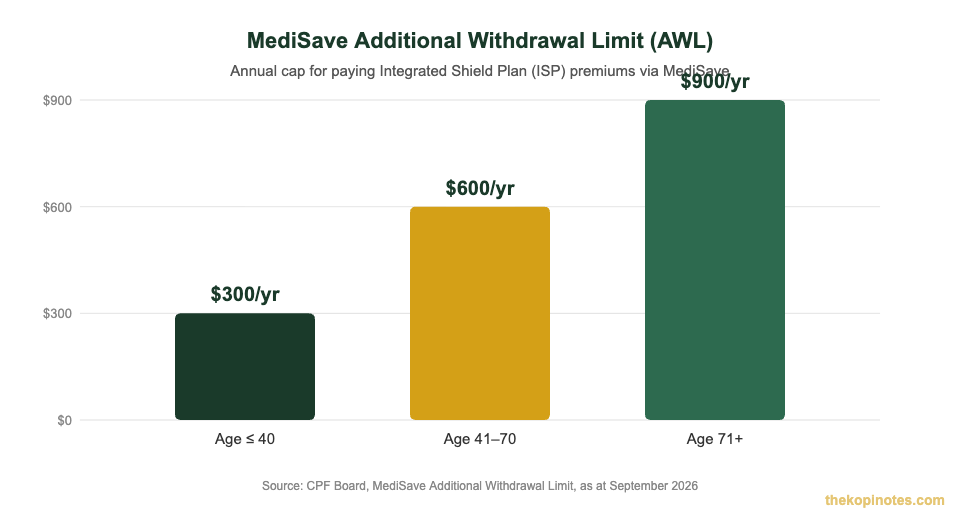
| Age Group | AWL (Annual MediSave for ISP Premium) | Why It’s Higher with Age |
|---|---|---|
| Age 40 and below | $300/year | ISP premiums are lowest when you’re young |
| Age 41 to 70 | $600/year | Premiums rise significantly in middle age |
| Age 71 and above | $900/year | Highest premiums require larger MediSave drawdown |
Source: CPF Board, Additional Withdrawal Limit for ISP premiums, as at September 2026
The AWL covers only the base ISP plan premium — not riders. If your ISP rider costs extra (which it usually does), you pay that portion in cash. MediShield Life premiums are fully covered by MediSave with no AWL cap — the AWL only applies to the private insurer’s portion.
For example, if your total ISP premium is $800 per year and you’re aged 42, MediSave covers up to $600 — and you pay the remaining $200 in cash. Your MediShield Life component is covered on top of this, also by MediSave. Our detailed article on using MediSave to pay your ISP premium walks through the exact calculation with real examples.
What Changes in 2027
Two significant changes are coming from 1 January 2027 that you should plan for now.
1. CDMP limits increase. The simple chronic condition annual limit rises from $500 to $700, and the complex chronic condition limit rises from $700 to $1,000. The scheme will also be renamed from MediSave500/700 to the “MediSave Chronic and Preventive Care” scheme.
2. Scope broadens. From 2027, the scheme will cover a wider range of preventive and chronic care services. If you have a chronic condition managed at a polyclinic or GP clinic, you’ll be able to claim more from MediSave per year without touching cash.
In 2026, the $500/$700 limits still apply. If you’re approaching the annual cap on your CDMP claims, knowing that higher limits are coming in 2027 can help you plan ahead.
How to Maximize Your MediSave in 2026
Most Singaporeans leave MediSave “passive” — contributions go in automatically, and claims happen automatically. But there are a few moves that help you get more value out of your balance.
1. Claim outpatient scans now. The new $600 annual limit for outpatient scans (doubled from Jan 2026) is underutilized. If your doctor orders a scan, ask whether it qualifies for MediSave — many do under the pre-approved list.
2. Use all $500/$700 of your CDMP allowance. If you have a chronic condition like hypertension or diabetes, make sure you’re attending approved clinics and claiming MediSave. Each visit reduces your cash outflow.
3. Cover ISP premiums up to your AWL. Review your ISP invoice to confirm the insurer is drawing exactly your AWL from MediSave each year. Some plans allow partial MediSave payment — don’t pay cash unnecessarily. For a full comparison of ISP plans by premium and coverage, see our guide to the MediShield Life benefits in Singapore 2026.
4. Plan around the BHS. If your MediSave balance is near $79,000, excess contributions go to your OA or SA — which earn different interest rates. Understanding this flows into your overall MediSave limit 2026 strategy.
For context on long-term retirement planning with CPF, our Singapore retirement calculator can help you model how your MediSave, OA, and SA balances compound over time.
Frequently Asked Questions
What is the MediSave cap in 2026?
How much MediSave can I use for outpatient treatment per year?
How much MediSave can I use for hospitalization per day?
What is the MediSave withdrawal limit for ISP premiums in 2026?
What MediSave changes are coming in 2027?
Does the MediSave BHS cap affect how much I can withdraw?
Get Free Insurance Advice
Speak with a licensed insurance advisor. No obligation, no cost.
By submitting this form, you agree to our Privacy Policy.
This article was researched with the help of AI. While we strive to keep all information accurate and up to date, there may be errors. If you notice any discrepancies, please contact us.