Best Brokerage in Singapore for Passive Investors: SRS, RSP & Long-Term Wealth (2026)
Updated October 2026 • 10 min read
For passive investors in Singapore, the best brokerage depends on one critical question: are you investing with SRS or CPF money? If yes, Endowus and FSMOne are the clear leaders — they are the only major platforms with full SRS compatibility, automated investing, and low-cost passive fund access. If you are investing cash in LSE-listed UCITS ETFs like CSPX or VWRA, Interactive Brokers (IBKR) offers the lowest per-trade cost for portfolios above SGD 30,000.
Not financial advice. All figures are for educational reference only. Data as at October 2026 unless noted. Consult a financial adviser before making investment decisions.
Why Brokerage Choice Matters More Than You Think
Most Google searches for “best brokerage in Singapore” return listicles that rank platforms by per-trade commission. This metric makes perfect sense for active traders placing dozens of orders a month. It makes almost no sense for passive investors who buy-and-hold index funds or ETFs over a 10–30 year horizon.
For passive investors, the factors that actually matter are:
1. SRS and CPF compatibility. If you contribute to your Supplementary Retirement Scheme (SRS) account, you can only invest through platforms connected to the SRS system. IBKR and Saxo — despite being the cheapest for LSE ETF trading — do not accept SRS funds. Choosing one of them means leaving significant tax savings on the table.
2. Total annual cost, not just commission. A robo-adviser charging 0.50% per year on a SGD 30,000 portfolio costs you SGD 150 annually. Twelve LSE ETF trades through IBKR at minimum commission (GBP 1.70 each) cost roughly SGD 35. But IBKR has no SRS access — so the comparison is meaningless unless both platforms are eligible for your money.
3. Automation and regular savings plans. Behavioural finance research consistently shows that automated, scheduled investing produces better long-term outcomes than manual investing. Not all platforms offer regular savings plans (RSPs) — and those that do vary widely in the minimum amount (from SGD 50 to SGD 1,000) and the investable universe.
4. Fund access and universe. SRS-compatible platforms in Singapore primarily offer unit trusts and SG-listed ETFs. Platforms like IBKR give access to LSE-listed UCITS ETFs (CSPX, VWRA), which are the most tax-efficient vehicles for Singapore investors holding global equities. If you want the latter, you may need to split across two platforms.
The bottom line: there is no single “best” brokerage in Singapore for passive investors. The right platform depends on your portfolio size, your tax situation, and how actively involved you want to be.
How Brokerage Cost Models Work in Singapore
Singapore investment platforms fall into two broad cost models, and understanding them helps you compare apples to apples.
Trading Platforms: Low Per-Trade Cost, No Ongoing Fee
Platforms like Interactive Brokers (IBKR) and Saxo charge a commission on each trade you execute. For LSE-listed ETFs in British pounds, IBKR charges approximately 0.05% per trade with a minimum of GBP 1.70, plus exchange and clearing fees. Saxo’s Classic tier charges 0.08% with a minimum of GBP 3 per trade.
Because there is no ongoing annual management fee, these platforms get proportionally cheaper as your portfolio grows and your trading frequency stays constant. An investor placing 12 trades per year through IBKR pays roughly the same SGD 60–70 whether their portfolio is SGD 20,000 or SGD 500,000. At large portfolio sizes, this is dramatically cheaper than a 0.5% annual platform fee.
The catch: neither IBKR nor Saxo supports SRS investing. They are also not designed for automated regular savings — you place each trade manually.
Wealth Platforms: Annual Fee, Automation, SRS Access
Platforms like Endowus, FSMOne, and Syfe charge an ongoing annual fee (either as a percentage of assets, or per transaction) but offer two things trading platforms cannot: SRS and CPF compatibility, and automated regular investing.
Endowus charges an annual access fee of 0.25% to 0.60% depending on your total assets under management. It negotiates trailer fee rebates from fund managers and passes some back to investors, which partially offsets the platform fee. Critically, Endowus is one of the few platforms in Singapore that allows you to invest your SRS money into a globally diversified portfolio of low-cost index funds.
FSMOne operates differently: it charges 0.08% per transaction with a minimum of SGD 10, but has no annual platform fee. Its Regular Savings Plan (RSP) lets you invest as little as SGD 100 per month automatically into a broad range of unit trusts and ETFs — and it supports SRS funding.
Syfe is a robo-adviser that charges 0.35%–0.65% per year depending on portfolio size. It manages your asset allocation automatically and rebalances for you — making it ideal for investors who want a truly hands-off approach. Syfe supports SRS investing through its Wealth platform.
For a detailed look at how ETF-focused investors compare IBKR and Saxo specifically, see our guide on the best brokerage for ETF investing in Singapore.
The SRS and CPF Advantage: Why Tax-Sheltered Investing Changes the Calculus
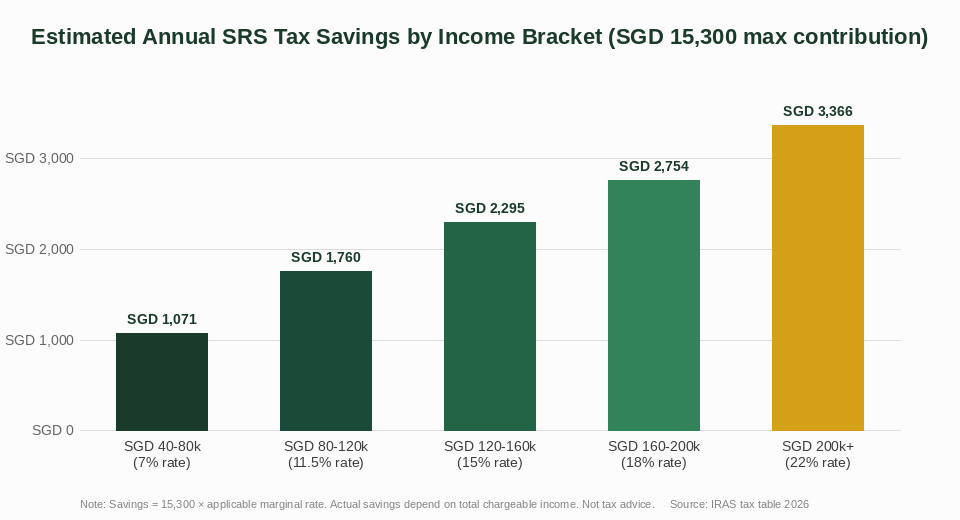
Singapore’s Supplementary Retirement Scheme (SRS) is one of the most underutilised tax-saving tools available to working Singaporeans. In 2026, Singapore Citizens and Permanent Residents can contribute up to SGD 15,300 to their SRS account per year. Foreign nationals working in Singapore can contribute up to SGD 35,700.
Every dollar contributed to SRS reduces your assessable income — meaning you pay less income tax in the year of contribution. At Singapore’s current marginal tax rates, a top-bracket taxpayer (22% marginal rate) who contributes the full SGD 15,300 saves SGD 3,366 in tax that year alone. Even a mid-bracket taxpayer at 15% saves SGD 2,295 annually.
But here is the critical constraint: SRS money can only be invested through SRS-linked platforms. You cannot transfer SRS funds to IBKR. You cannot use SRS money to buy CSPX on the LSE through Saxo. Your SRS investment options are limited to what each SRS operator offers.
The three SRS operators in Singapore are DBS, OCBC, and UOB. Each bank links to specific investment platforms. Endowus, FSMOne, and Syfe each operate as approved SRS investment managers — meaning you can transfer SRS funds directly into their platforms without liquidating or moving through the bank’s own investment portal.
If you have significant SRS balances — say, more than SGD 50,000 accumulated over years of maximum contributions — the compounding effect of investing that money at low cost, in diversified global equities, dwarfs the question of whether you are on IBKR or FSMOne for your cash portfolio.
Our CPF investment strategy guide covers the parallel question of investing CPF-OA money — a related but distinct decision with different approved platforms and risk considerations. You can also estimate how much your SRS savings could compound using our Singapore retirement calculator.
SRS Withdrawal Rules: The Other Side of the Equation
SRS is not a locked-away scheme — you can withdraw at any time, but early withdrawals (before the statutory retirement age of 63 in 2026) incur a 5% penalty and the full withdrawn amount is taxed as income. At retirement, 50% of each SRS withdrawal is tax-exempt — making it highly tax-efficient for building retirement wealth.
This means SRS investing is best suited for a long-term horizon of at least 10 years. If you might need the money sooner, cash investments through a trading platform may be more flexible.
Platform Comparison: Fees, SRS, RSP, and Fund Access
Here is how Singapore’s five main passive-investor-friendly platforms stack up across the dimensions that matter most. Note that this table focuses on passive investing features — if you are primarily buying LSE-listed ETFs with cash, our best ETF brokerage comparison goes deeper into IBKR vs Saxo vs Moomoo for that specific use case.
| Platform | SRS | Per-Trade Cost | Annual Fee | RSP | Best For |
|---|---|---|---|---|---|
| Endowus | ✓ | Nil | 0.25–0.60% | ✓ | SRS / CPF passive |
| FSMOne | ✓ | 0.08% (min SGD 10) | Nil | ✓ | DIY passive, low cost |
| Syfe | ✓ | Nil | 0.35–0.65% | ✓ | Robo-advisory, hands-off |
| IBKR | ✗ | ~0.05%, min GBP 1.70 | Nil | ✗ | Large portfolio, LSE ETFs |
| Saxo (Classic) | ✗ | 0.08%, min GBP 3 | Nil | ✗ | LSE ETFs, broader markets |
Source: Platform fee schedules as at October 2026. Annual fee applies to AUM. Per-trade applies per transaction.
Platform Snapshots
Endowus is the standout choice for SRS and CPF investing. It offers globally diversified portfolios built on institutional share classes of index funds from Dimensional, Vanguard, and BlackRock — often at lower expense ratios than retail investors can access directly. The access fee of 0.25%–0.60% per year is partially offset by trailer fee rebates. Endowus does not charge per-trade commissions, making it cost-efficient for investors who make regular contributions. Use our Endowus referral code (2V343) for a fee waiver on your first SGD 10,000 for six months.
FSMOne suits investors who want more control over their portfolio construction at a low cost. Its RSP minimum is SGD 100/month per fund, making it accessible for smaller investors building a position over time. The 0.08% commission with a SGD 10 minimum is very competitive, though it is worth noting that for monthly RSP contributions below SGD 12,500, the minimum fee makes the effective rate higher than 0.08%. FSMOne supports SRS investing across a wide range of unit trusts tracking global indices. Get SGD 10 cash credit via our FSMOne referral code (P0544985).
Syfe is best for investors who want automation without managing individual fund selections. Choose your risk level, connect your SRS account, and Syfe handles rebalancing and allocation automatically. The management fee of 0.35%–0.65% is higher than FSMOne’s transaction approach at large balances, but for many investors the hands-off convenience and behavioural benefit (no impulse selling or tinkering) is worth the premium. Sign up via our Syfe referral code and sign-up bonus (SRPRFFFCD) for three months fee-free on your first SGD 30,000.
IBKR is the go-to for large-portfolio investors who want to buy LSE-listed UCITS ETFs like CSPX or VWRA with their cash savings. At ~0.05% per trade (min GBP 1.70), it is the lowest-cost option for buying GBP-denominated ETFs. However, IBKR does not support SRS investing — so it is strictly a cash portfolio tool. Use referral code jianxiong368 when signing up for IBKR Singapore.
Saxo Classic charges 0.08% per LSE trade with a minimum of GBP 3 (verified from Saxo’s official fee schedule, October 2026). Slightly more expensive than IBKR per trade, but Saxo offers a broader product range including bonds and options, and some investors find its interface more user-friendly. Like IBKR, Saxo does not support SRS.
Total Annual Cost by Portfolio Size
To make this comparison concrete, here is what each platform costs at different portfolio sizes — assuming a passive investor who makes one contribution per month (12 transactions per year for trading platforms) and holds without trading.
| Platform | SGD 10,000 | SGD 50,000 | SGD 100,000 | Crossover Point |
|---|---|---|---|---|
| Endowus (0.55%) | SGD 55/yr | SGD 275/yr | SGD 500/yr | — |
| FSMOne RSP (monthly) | SGD 120/yr | SGD 120/yr | SGD 120/yr | Flat rate |
| Syfe Core (0.65%) | SGD 65/yr | SGD 325/yr | SGD 580/yr | — |
| IBKR (12 trades/yr) | SGD ~69/yr | SGD ~69/yr | SGD ~69/yr | No SRS |
| Saxo Classic (12 trades/yr) | SGD ~60/yr | SGD ~60/yr | SGD ~60/yr | No SRS |
Note: IBKR / Saxo annual cost = 12 trades × minimum commission per LSE trade, converted at GBP/SGD 1.70. Endowus / Syfe fee is tiered — mid-tier rate shown. Excludes fund TER and FX spread. Source: Platform fee schedules, October 2026.
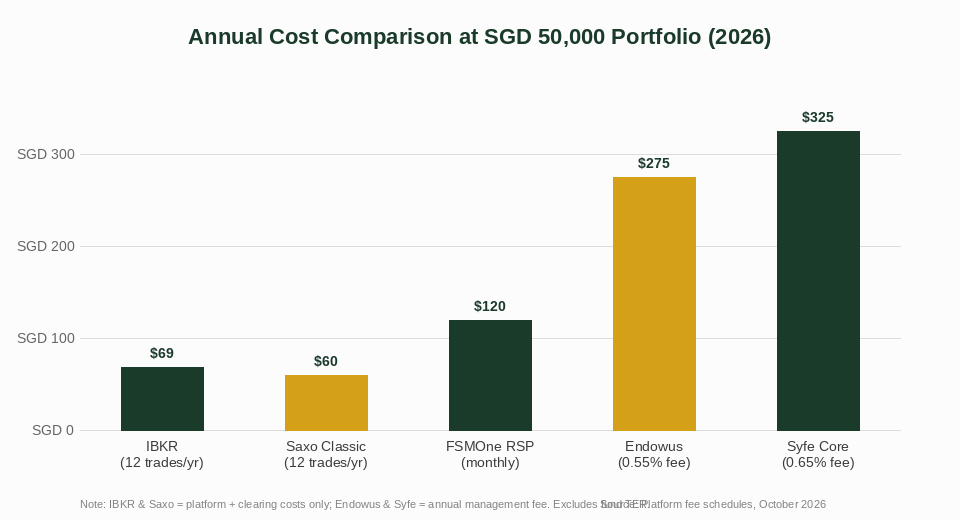
The chart above illustrates the annual cost difference at a SGD 50,000 portfolio. The key insight: for cash portfolios, IBKR and Saxo are dramatically cheaper at every portfolio size — but they do not support SRS. For SRS portfolios, Endowus and FSMOne dominate the comparison.
There is also a crossover dynamic worth noting for FSMOne: at a RSP of SGD 100/month, the effective commission rate is 10% (SGD 10 minimum on a SGD 100 purchase). At SGD 500/month, it drops to 1.6%. At SGD 1,000/month, it is 1%. This means FSMOne RSP makes the most sense if you are investing at least SGD 500–1,000 per month, or if you are making lump-sum contributions rather than monthly ones.
Original calculation: A Singapore investor contributing SGD 1,000/month to SRS via FSMOne (0.08% = SGD 10 minimum per trade) pays SGD 120/year in commissions — a 1.0% effective annual transaction rate on a SGD 12,000 annual investment. The same investor using Endowus at 0.55% on their accumulated balance of SGD 30,000 would pay SGD 165/year. FSMOne wins for early accumulation; Endowus may win at larger balances if the trailer rebates apply.
How to Choose: A Decision Framework by Investor Profile
There is no single best brokerage in Singapore for passive investors. Use this framework to identify which platform matches your situation:
If You Are Investing SRS Funds
Start with Endowus or FSMOne. Endowus is better if you want a managed, globally diversified portfolio with minimal decisions — just pick your risk level and contribute. FSMOne is better if you want to hand-pick specific index funds or ETFs yourself and prefer a per-transaction model over an annual fee. Syfe is a solid alternative if you prioritise automation and rebalancing.
If You Are a Beginner with a Small Cash Portfolio (< SGD 20,000)
Syfe or Endowus offers the lowest friction for getting started. The annual fee feels steep in percentage terms on small amounts, but it buys you automated investing, diversification, and no need to manually place orders. FSMOne RSP at SGD 100/month is also worth considering once you understand basic fund selection.
If You Are Building a Large Cash Portfolio (> SGD 50,000) in LSE ETFs
IBKR becomes the clear winner for cash investments in LSE-listed UCITS ETFs like CSPX or VWRA. At a portfolio of SGD 100,000 with 12 trades per year, IBKR costs roughly SGD 69 — versus SGD 500–600 per year on a 0.5% platform fee. The savings compound meaningfully over a 20-year horizon. You should still use a separate SRS-compatible platform for your tax-sheltered contributions.
The Dual-Platform Approach (Most Common for Serious Passive Investors)
Most Singaporean passive investors who are optimising seriously end up with two accounts: a wealth platform (Endowus or FSMOne) for SRS and CPF investing, and IBKR for their cash portfolio in LSE ETFs. This combines the tax efficiency of SRS with the cost efficiency of IBKR for cash. The complexity is manageable — you are essentially running two strategies in parallel, each optimised for its funding source.
If running two platforms feels like too much overhead, Endowus is the best single-platform solution: it supports SRS, CPF, and cash investing, and its globally diversified portfolios are competitive with buying individual ETFs through IBKR once you factor in the trailer rebates and automatic rebalancing.
Frequently Asked Questions
What is the best brokerage in Singapore for beginners?
For most beginners in Singapore, Syfe or Endowus offers the easiest entry point. Both platforms handle asset allocation automatically, require no knowledge of individual ETF selection, and support SRS investing. If you want to start with a very small amount (SGD 100–200/month), FSMOne’s Regular Savings Plan is also beginner-friendly. IBKR and Saxo are better suited to investors who already understand how to select and buy ETFs manually.
Can I use IBKR for SRS investing in Singapore?
No. IBKR (Interactive Brokers Singapore) does not support SRS investing. SRS funds must be held and invested through SRS-linked platforms. In Singapore, the only operators authorised to hold SRS accounts are DBS, OCBC, and UOB, and you can transfer SRS investments to approved managers including Endowus, FSMOne, and Syfe. If you want to use your SRS for global equity index investing, Endowus is typically the most popular option.
Is Endowus worth the fees for passive investing?
Whether Endowus is worth it depends on what you compare it to. Versus DIY investing through IBKR in LSE ETFs for a cash portfolio, Endowus’s 0.55% annual fee is significantly higher than IBKR’s ~SGD 70/year in commissions. But Endowus offers things IBKR cannot: SRS and CPF investing, automatic rebalancing, institutional-class fund access with trailer rebates, and a hands-off experience. For SRS money specifically, Endowus is frequently the best available option, making the fee debate somewhat moot — you have no lower-cost SRS alternative that offers similar diversification.
What is the minimum investment to start with FSMOne RSP?
FSMOne’s Regular Savings Plan (RSP) allows you to start investing from SGD 100 per month per fund. You can select multiple funds in a single RSP, and FSMOne supports SRS contributions into the RSP. The commission is 0.08% with a minimum of SGD 10 per transaction — meaning on a SGD 100 monthly purchase, the effective rate is 10%, which is quite high. FSMOne RSP makes more financial sense at SGD 500/month or above, where the 0.08% commission rate applies more realistically.
Which Singapore brokerage has the lowest fees for LSE ETF investing?
For Singapore investors buying LSE-listed UCITS ETFs like CSPX or VWRA with cash savings, IBKR offers the lowest fees. Its commission for LSE stocks is approximately 0.05% with a minimum of GBP 1.70 per trade. Saxo Classic charges 0.08% with a minimum of GBP 3. Both are competitive, but IBKR is generally cheaper for smaller trades (below SGD 3,000 per transaction). For a detailed comparison including Moomoo, see our best brokerage for ETF investing in Singapore guide.
Can I invest CPF money through these platforms?
CPF investing (through the CPF Investment Scheme, or CPFIS) is separate from SRS. Endowus is one of the most prominent platforms for CPFIS investing — it allows you to invest your CPF-OA balance in a curated range of unit trusts. FSMOne also supports CPFIS. Not all passive investment funds are eligible for CPFIS, and there are restrictions on how much of your CPF-OA you can invest. For a full breakdown, see our CPF investment strategy guide.
Ready to Start Passive Investing?
Use these referral codes to get started with a bonus:
- Syfe: Code SRPRFFFCD — 3 months free on first SGD 30,000
- Endowus: Code 2V343 — 6 months free on first SGD 10,000
- FSMOne: Code P0544985 — SGD 10 cash credit
- IBKR: Code jianxiong368
Use our retirement calculator to see how your SRS contributions compound over time.
The Kopi Notes may earn a referral fee when you sign up through our links. This does not affect our editorial assessment. Not financial advice.
This article was researched with the help of AI. While we strive to keep all information accurate and up to date, there may be errors. If you notice any discrepancies, please contact us.