SpaceX IPO: What Singapore Investors Need to Know (2026)
IPO price, valuation, SPCX ticker details, and how to buy SpaceX shares from Singapore — updated June 2026.
SpaceX is going public on 12 June 2026, listing on the Nasdaq under ticker SPCX at an IPO price of USD 135 per share. The IPO targets a USD 1.75 trillion valuation — making it the largest IPO in stock market history. Singapore investors can buy SPCX shares on listing day through brokers like Interactive Brokers, Saxo, Moomoo, or Tiger Brokers.
Not financial advice. All figures are for educational reference only. Data as at June 2026 unless noted.
- SpaceX lists on Nasdaq on 12 June 2026 (ticker: SPCX) at USD 135/share — a USD 1.75T valuation
- Singapore investors can buy on day 1 via IBKR, Saxo, Tiger, or Moomoo. IPO subscription is mostly for accredited investors
- Key risks: Elon Musk controls 82.4% of voting power, the company posted a USD 2.6B operating loss in 2025, and Starlink ARPU is declining
Table of Contents
Contents — Click to expand
- SpaceX IPO Status — When Is It Happening?
- SpaceX Valuation and Key Financials
- What Does SpaceX Do?
- Why Singapore Investors Are Interested
- How to Buy SpaceX (SPCX) from Singapore
- Pre-IPO Exposure — Is It Still Possible?
- ETFs and Funds With SpaceX Exposure
- Risks Singapore Investors Should Know
- What the SpaceX IPO Means for the Space Industry
- Frequently Asked Questions
SpaceX IPO Status — When Is It Happening?
SpaceX filed its S-1 registration confidentially with the US Securities and Exchange Commission on 1 April 2026. The SEC review was completed faster than expected, and SpaceX launched its investor roadshow on 4 June 2026.
Here’s the confirmed timeline:
| Date | Event |
|---|---|
| 1 April 2026 | Confidential S-1 filed with SEC |
| 20 May 2026 | S-1 publicly available; financials disclosed for first time |
| 4 June 2026 | Roadshow launched (accelerated timeline) |
| 11 June 2026 | Share pricing after market close |
| 12 June 2026 | First trading day on Nasdaq (ticker: SPCX) |
Source: SEC filings, CNBC — as at June 2026
The IPO is offering 556.6 million shares at USD 135 each, targeting a raise of approximately USD 75 billion. That would make it the largest IPO in US stock market history — surpassing Saudi Aramco’s USD 25.6 billion listing in 2019.
Elon Musk has committed to allocating 30% of IPO shares to retail investors. That’s at least three times the typical 5–10% retail allocation in most IPOs. Fidelity has already announced it will make the SpaceX IPO available to any customer with a retail brokerage account holding USD 2,000 or more.
SpaceX Valuation and Key Financials
The SpaceX IPO targets a USD 1.75 trillion valuation at the offer price. However, Bloomberg reported that demand has pushed the valuation target above USD 2 trillion, with the IPO oversubscribed — multiple institutional investors placed orders of USD 10 billion or more.
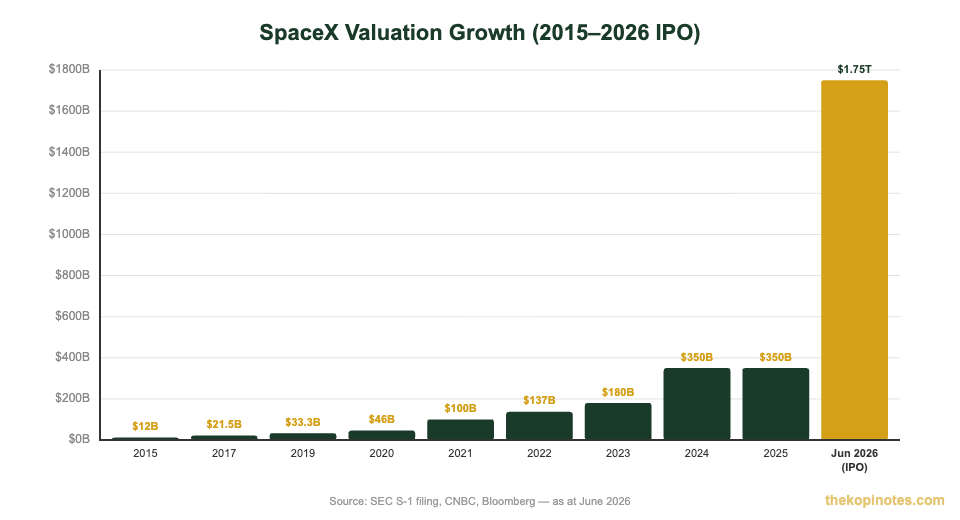
Here’s how the valuation has grown over the past decade:
| Year | Valuation | Key Milestone |
|---|---|---|
| 2015 | USD 12B | Falcon 9 commercial launches begin scaling |
| 2019 | USD 33.3B | Starlink prototype satellites launched |
| 2021 | USD 100B | Starlink subscriber base crosses 100K |
| 2023 | USD 180B | Starlink turns profitable, Starship testing |
| 2024 | USD 350B | Secondary market share sales at record price |
| June 2026 (IPO) | USD 1.75T | Largest IPO in history |
Source: SEC S-1 filing, CNBC, Bloomberg — as at June 2026
The S-1 filing gave the public its first-ever look at SpaceX’s finances. Here are the headline numbers:
Full-year 2025: USD 18.7 billion in revenue. Starlink (the “Connectivity” segment) contributed USD 11.4 billion — or 61% of total revenue. However, SpaceX posted an operating loss of USD 2.6 billion due to heavy Starship development spending. Adjusted EBITDA was USD 6.6 billion.
Q1 2026: USD 4.7 billion in revenue. Starlink grew to 10.3 million subscribers. But average revenue per user (ARPU) fell from USD 99/month in 2023 to USD 66/month in Q1 2026 — a trend worth watching.
What Does SpaceX Do?
SpaceX operates three main business lines. Understanding them helps you assess what you’re actually investing in.
Starlink — Satellite Internet (61% of Revenue)
Starlink is a constellation of over 9,600 low-Earth orbit (LEO) satellites providing broadband internet globally. As at March 2026, it serves 10.3 million subscribers across 100+ countries. Starlink is SpaceX’s cash cow — it generated USD 11.4 billion in revenue in 2025 and is the only profitable segment.
For Singapore investors, think of Starlink as the “boring but profitable” part of SpaceX. It’s essentially a telecommunications business with global reach and no ground infrastructure costs.
Falcon 9 — Rocket Launch Services
Falcon 9 is the world’s most-launched orbital rocket. SpaceX uses it to launch satellites (including its own Starlink fleet), cargo, and astronauts to the International Space Station. The reusable first stage has landed over 350 times, dramatically lowering launch costs.
This segment also includes the larger Falcon Heavy rocket and Dragon spacecraft for crewed missions.
Starship — The Mars Ambition
Starship is SpaceX’s next-generation, fully reusable super heavy-lift launch system. It’s the largest and most powerful rocket ever built. While still in the testing phase, Starship has been selected by NASA as the lunar lander for the Artemis programme.
In February 2026, Musk delayed SpaceX’s Mars mission plans by five to seven years to focus on lunar missions first. The first uncrewed Starship Mars flight is now likely in the early 2030s. However, Starship’s potential to deliver cargo to orbit at USD 100 per kilogram — versus USD 2,700 on Falcon 9 — could reshape the economics of space access entirely.
Why Singapore Investors Are Interested
SpaceX has been one of the most-watched private companies globally for over a decade. Here’s why Singapore investors are paying attention now.
Scale of the opportunity. At USD 1.75 trillion, SpaceX would immediately become one of the 10 most valuable companies in the world — ahead of Berkshire Hathaway and close to Amazon. For investors in Singapore who’ve watched companies like Tesla, NVIDIA, and Apple grow, SpaceX represents a similar “generational company” narrative.
Starlink’s recurring revenue. Unlike pure-play space companies that burn cash on R&D, SpaceX has a high-margin subscription business in Starlink. For income-oriented Singapore investors who also hold passive income investments in Singapore, adding a high-growth tech name like SpaceX diversifies the portfolio.
Previously inaccessible. Until now, only accredited investors and venture capital funds could invest in SpaceX. The IPO opens the door to everyday retail investors for the first time — and Singapore investors with a US brokerage account can participate from day one.
Easy access via existing brokers. If you already have an account with Interactive Brokers, Saxo, Tiger Brokers, or Moomoo, you can buy SPCX shares on the Nasdaq. No new account needed. If you’re comparing brokers, check our guide to the moomoo Singapore review for US stock trading.
How to Buy SpaceX (SPCX) from Singapore
There are two ways Singapore investors can access SPCX shares: subscribing to the IPO (limited access), or buying on the secondary market from the first trading day.
Option 1: IPO Subscription (Accredited Investors Only)
To subscribe at the IPO price of USD 135/share before listing day, you typically need to be a Monetary Authority of Singapore (MAS) Accredited Investor — that means net financial assets exceeding SGD 1 million or annual income above SGD 300,000. Some brokers like Moomoo SG require a minimum investment of SGD 200,000 for non-accredited investors.
Saxo Markets has confirmed IPO subscription access through a dedicated deal page. Moomoo’s IPO Centre also shows SpaceX for eligible investors.
Option 2: Buy on Nasdaq from Day 1 (Everyone)
Most Singapore retail investors will buy SPCX on the open market once it starts trading on 12 June 2026. This is available through any broker that offers US stock trading.
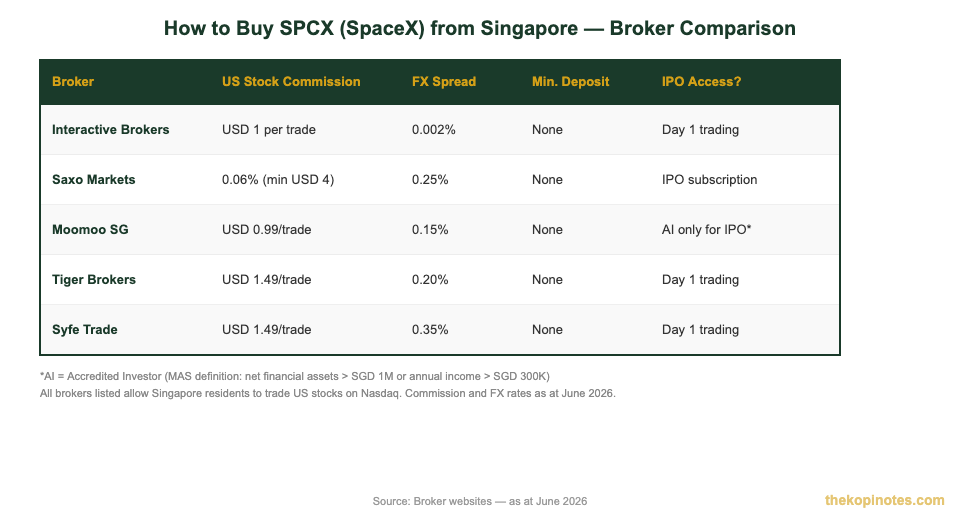
Here’s a comparison of the main brokers Singapore investors use:
| Broker | US Stock Commission | FX Spread | Min. Deposit | IPO Access? |
|---|---|---|---|---|
| Interactive Brokers | USD 1/trade | 0.002% | None | Day 1 trading |
| Saxo Markets | 0.06% (min USD 4) | 0.25% | None | IPO subscription available |
| Moomoo SG | USD 0.99/trade | 0.15% | None | AI only for IPO subscription* |
| Tiger Brokers | USD 1.49/trade | 0.20% | None | Day 1 trading |
| Syfe Trade | USD 1.49/trade | 0.35% | None | Day 1 trading |
*AI = Accredited Investor per MAS definition (net financial assets > SGD 1M or annual income > SGD 300K). Source: Broker websites — as at June 2026
For most Singapore investors, Interactive Brokers (IBKR) is the most cost-effective option for buying US stocks. The USD 1 flat commission and near-zero FX spread make it ideal for larger trades. If you don’t have an IBKR account yet, you can use our IBKR referral code to get started.
If you prefer a simpler platform, Syfe referral code and sign-up bonus offers a clean interface for beginners, though the FX spread is higher.
Step-by-Step: Buying SPCX on Interactive Brokers
1. Log in to your IBKR account (or open one — it takes 1–2 business days).
2. Fund your account in USD. You can transfer SGD and convert via IBKR’s FX tool at 0.002% spread.
3. Search for “SPCX” in the order entry. Select the Nasdaq listing.
4. Place a limit order at your target price. On listing day, the opening price may differ from the IPO price of USD 135.
5. Monitor your order. IPO stocks are volatile on day one — be prepared for swings.
Pre-IPO Exposure — Is It Still Possible?
Before the IPO, the only way to invest in SpaceX was through private secondary markets or venture funds. With the IPO just hours away, most pre-IPO routes have effectively closed. However, for context:
Secondary markets like Hiive, Forge Global, and EquityZen facilitated trades in SpaceX shares between existing shareholders and accredited investors. As at early June 2026, Hiive listed SpaceX shares at approximately USD 146.30 — an 8.4% premium over the IPO price.
The ARK Venture Fund (ARKVX) held SpaceX as its largest position at approximately 17% weighting. With a minimum investment of USD 500 and no accredited investor requirement, this was the most accessible pre-IPO route. However, ARKVX is an interval fund with limited liquidity — you can only redeem shares quarterly.
Going forward, these pre-IPO routes become less relevant. Once SPCX is trading publicly, you can simply buy shares on the open market.
ETFs and Funds With SpaceX Exposure
Once SpaceX is publicly listed, expect several ETFs to add SPCX to their holdings. Here are the funds likely to gain significant SpaceX exposure:
ARK Space & Defense Innovation ETF (ARKX) — This Cathie Wood-managed ETF focuses on companies in space exploration and innovation. As at June 2026, ARKX does not yet hold SpaceX directly (since it was private), but the fund’s mandate makes SPCX an obvious addition. Analysts have flagged a potential “concentration crisis” if ARKX allocates heavily to a single stock.
Procure Space ETF (UFO) — Another space-themed ETF that tracks the S-Network Space Index. SPCX will likely be added at its next rebalance.
Major index ETFs — While SPCX won’t immediately join the S&P 500 (which requires four consecutive quarters of profitability), it could eventually qualify. If added, every VOO, CSPX, and VUAA investor would automatically hold SpaceX exposure. For Singapore investors who already hold CSPX, this is worth watching.
Broad Nasdaq ETFs — ETFs tracking the Nasdaq-100 (like QQQ or its UCITS equivalents) typically rebalance annually. If SPCX’s market cap qualifies, it could be included as early as the December 2026 reconstitution.
Risks Singapore Investors Should Know
SpaceX is an exciting company, but the IPO carries real risks. Here’s what you should consider before buying.
1. Elon Musk Controls 82.4% of Voting Power
SpaceX uses a dual-class share structure. Musk holds 5.22 billion Class B shares (10 votes each), giving him 82.4% of voting power after the IPO — despite owning approximately 42% of the equity. That means public shareholders have very limited say in company decisions.
If you’re investing in SPCX, you’re trusting Musk’s vision entirely. There’s no realistic scenario where shareholders can override him.
2. The Company Is Not Profitable (Yet)
SpaceX posted an operating loss of USD 2.6 billion in 2025 and USD 1.9 billion in Q1 2026 alone. While Starlink is profitable, massive Starship development spending pushes the consolidated business into the red.
For context, a USD 1.75 trillion valuation on USD 18.7 billion in revenue gives a price-to-sales ratio of about 94x. That’s higher than Tesla (about 15x) and even NVIDIA at its peak (about 40x). You’re paying a premium for long-term growth potential.
3. Starlink ARPU Is Declining
Starlink’s average revenue per user dropped from USD 99/month in 2023 to USD 66/month in Q1 2026. While subscriber numbers are growing, the per-user revenue decline suggests pricing pressure as Starlink expands into lower-income markets.
4. IPO Day Volatility
IPO stocks are notoriously volatile on day one. The opening price may significantly differ from the USD 135 IPO price. Some investors will see a “pop” and sell immediately. Others may face a dip if early demand fades. If you’re a long-term investor, consider dollar-cost averaging rather than going all-in on day one.
5. Regulatory and Geopolitical Risk
SpaceX holds classified US government contracts and operates critical national security infrastructure. Any changes in US government relationships, export controls, or international regulations could affect operations. Musk’s involvement with the US government (through DOGE and other advisory roles) adds another layer of political risk.
6. US Estate Tax for Singapore Investors
As a US-listed stock, SPCX holdings above USD 60,000 are subject to US estate tax for non-US persons. This is the same consideration that drives many Singapore investors to buy Ireland-domiciled UCITS ETFs on the London Stock Exchange. For your broader US stock portfolio, use our Singapore retirement calculator to assess your total exposure.
What the SpaceX IPO Means for the Space Industry
The SpaceX IPO is bigger than one company. It could reshape the entire space investment landscape.
Validation of the space economy. SpaceX listing at USD 1.75 trillion signals that the market believes space is a real, investable sector — not science fiction. This will likely accelerate capital flows into other space companies, including Rocket Lab (RKLB), Virgin Galactic, and private companies like Relativity Space.
ETF rebalancing wave. Once SPCX starts trading, space-themed ETFs will rebalance to include it. This creates a secondary demand wave as passive money flows in. For investors who hold ARKX or similar funds, watch for concentration risk — a single stock could dominate the portfolio.
Starship changes the economics. If Starship achieves its target of USD 100/kg to orbit — versus USD 2,700 on Falcon 9 — it fundamentally changes what’s possible in space. Satellite constellations, space stations, lunar bases, and eventually Mars missions all become economically viable at that cost. Companies that previously couldn’t afford space access will be able to build businesses in orbit.
Competition heats up. SpaceX’s IPO war chest (USD 75 billion in proceeds) gives it enormous capital to accelerate Starship development and expand Starlink. Competitors like Blue Origin, ULA, and Arianespace will need to respond. For investors, this means both opportunity and disruption in the broader aerospace sector.
If you’re building a long-term investment portfolio in Singapore, the SpaceX IPO is a milestone worth understanding — even if you decide not to buy shares on day one. For a broader portfolio framework, consider reviewing our Endowus referral code for a diversified robo-advisory approach, or our guide to CPF investment strategy Singapore for your retirement funds.
Not financial advice. All figures are for educational reference only. Data as at June 2026 unless noted. The Kopi Notes may earn referral fees from broker links mentioned in this article.
Frequently Asked Questions
When is the SpaceX IPO date?
SpaceX is expected to begin trading on the Nasdaq on 12 June 2026 under the ticker SPCX. Share pricing is set for after market close on 11 June 2026. The IPO price is USD 135 per share.
Can Singapore investors buy SpaceX IPO shares?
Yes. Singapore investors can buy SPCX shares from the first trading day (12 June 2026) through any broker that offers US stock trading — including Interactive Brokers, Saxo, Moomoo, and Tiger Brokers. For IPO subscription at the offer price, most brokers require you to be an MAS Accredited Investor or meet a minimum investment of SGD 200,000.
What is SpaceX's valuation at IPO?
SpaceX is targeting a valuation of USD 1.75 trillion at the IPO price of USD 135 per share. Bloomberg has reported the valuation could exceed USD 2 trillion due to strong oversubscription. This would make it the most valuable company to ever go public.
Is SpaceX profitable?
SpaceX is not yet profitable on a consolidated basis. It posted an operating loss of USD 2.6 billion in 2025. However, its Starlink segment is profitable, generating USD 4.4 billion in operating income in 2025 on USD 11.4 billion in revenue. The losses come from heavy Starship development spending.
What broker is best for buying SpaceX from Singapore?
Interactive Brokers (IBKR) is generally the most cost-effective option for Singapore investors buying US stocks. It charges a flat USD 1 commission and offers the tightest FX spread at 0.002%. For beginners, Moomoo and Syfe offer simpler interfaces but charge slightly higher fees.
Will SpaceX pay dividends?
SpaceX has not announced any plans to pay dividends. Given the company is still making operating losses and investing heavily in Starship development, dividends are unlikely in the near term. If you’re looking for dividend income, consider Singapore REITs or dividend ETFs instead — see our guide to passive income in Singapore.
Does US estate tax apply to SpaceX shares held by Singapore investors?
Yes. SPCX is a US-listed stock, so holdings above USD 60,000 are subject to US estate tax (up to 40%) for non-US persons. This is the same estate tax risk that applies to any US-domiciled stock or ETF. To avoid this risk on your broader portfolio, many Singapore investors buy Ireland-domiciled UCITS ETFs on the London Stock Exchange instead.
Ready to Buy SpaceX (SPCX)?
Open a brokerage account and buy SPCX on the Nasdaq from day one. Use our referral links for exclusive sign-up bonuses.
This article was researched with the help of AI. While we strive to keep all information accurate and up to date, there may be errors. If you notice any discrepancies, please contact us.