How to Buy CSPX in Singapore (2026 Complete Guide)
Step-by-step guide for Singapore investors — broker instructions, tax advantages, and live 2026 data.
CSPX is an Ireland-domiciled, accumulating ETF listed on the London Stock Exchange (LSE) that tracks the S&P 500 Index, giving investors exposure to 500 of the largest US companies. Singapore investors prefer CSPX over US-listed equivalents like VOO or IVV because of two decisive tax advantages: a reduced 15% US dividend withholding tax (versus 30% on US-domiciled ETFs) and zero exposure to the US estate tax that applies to non-US persons holding more than USD 60,000 in US-situs assets.
Not financial advice. All figures are for educational reference only. Data as at May 2026 unless noted.
What Is CSPX?
CSPX — formally the iShares Core S&P 500 UCITS ETF (Acc) — is a passively managed exchange-traded fund issued by BlackRock’s iShares range. It is listed on the London Stock Exchange under the ticker CSPX and trades in US dollars (USD). The fund was launched in May 2010 and, as at May 2026, manages over USD 80 billion in assets, making it one of the largest S&P 500 ETFs available to non-US investors globally.
The fund tracks the S&P 500 Index — a market-capitalisation-weighted index of 500 large-cap US companies. Its top holdings include Apple, Microsoft, NVIDIA, Amazon, and Alphabet, which together account for roughly 25% of the fund. CSPX holds all 500 constituents physically (full replication), meaning it directly owns the underlying shares rather than using derivatives or sampling.
CSPX is an accumulating fund: dividends paid by the underlying US companies are automatically reinvested back into the fund rather than distributed to unitholders. This is particularly advantageous for Singapore investors because there is no dividend tax in Singapore — and by reinvesting dividends at fund level, CSPX benefits from a slightly lower effective withholding tax rate compared to distributing equivalents.
The fund is domiciled in Ireland and structured as a UCITS (Undertakings for Collective Investment in Transferable Securities) vehicle — the EU regulatory framework for retail investment funds. UCITS structure gives CSPX critical tax treaty access to US dividends that funds domiciled in the US or other jurisdictions do not have.
Key Facts at a Glance
| Metric | Detail |
|---|---|
| Full Name | iShares Core S&P 500 UCITS ETF (Acc) |
| Ticker (LSE) | CSPX |
| Index Tracked | S&P 500 Index |
| Domicile | Ireland (UCITS) |
| Structure | Accumulating (dividends reinvested) |
| TER (Expense Ratio) | 0.07% p.a. |
| AUM | USD 80B+ (as at May 2026) |
| Number of Holdings | 503 |
| Exchange | London Stock Exchange (LSE) |
| Trading Currency | USD |
| Launch Date | May 2010 |
Source: iShares CSPX factsheet, May 2026
Why Singapore Investors Buy ETFs on the London Stock Exchange
The single most important reason Singapore investors favour LSE-listed, Ireland-domiciled ETFs like CSPX over their US-listed equivalents (VOO, IVV, SPY) comes down to two tax issues: withholding tax and US estate tax.
Withholding Tax (WHT): When a US company pays a dividend, the IRS withholds a percentage before the payment reaches the fund. For funds domiciled in Ireland, the Ireland–US tax treaty reduces this rate to 15%. For funds domiciled in the US (like VOO), non-US investors face the full 30% withholding. On a USD 100,000 portfolio yielding 1.3% annually, the 15% WHT advantage saves approximately USD 195 per year compared to a US-domiciled fund.
US Estate Tax: Non-US persons who hold US-situs assets (including US-listed ETFs) worth more than USD 60,000 at the time of death are subject to US estate tax — at rates up to 40% on the amount above the threshold. Ireland-domiciled ETFs like CSPX are not US-situs assets, so they carry no US estate tax exposure regardless of portfolio size. This is a critical consideration for Singaporean investors with growing portfolios.
No Singapore Capital Gains Tax: Singapore does not levy capital gains tax, so the entire price appreciation of CSPX is yours to keep. Combined with the WHT and estate tax advantages, CSPX is structurally one of the most tax-efficient S&P 500 exposure vehicles available to Singapore-based investors.
| ETF Type | Domicile | US Dividend WHT | US Estate Tax Risk | Listed On |
|---|---|---|---|---|
| CSPX | Ireland | 15% | None | LSE |
| SPYL | Ireland | 15% | None | LSE |
| VOO | USA | 30% | Yes (above USD 60k) | NYSE |
| IVV | USA | 30% | Yes (above USD 60k) | NYSE |
Source: IRS Publication 515, Ireland–US Tax Treaty, iShares/Vanguard/SPDR fund documentation, May 2026
Expense Ratio and Total Costs
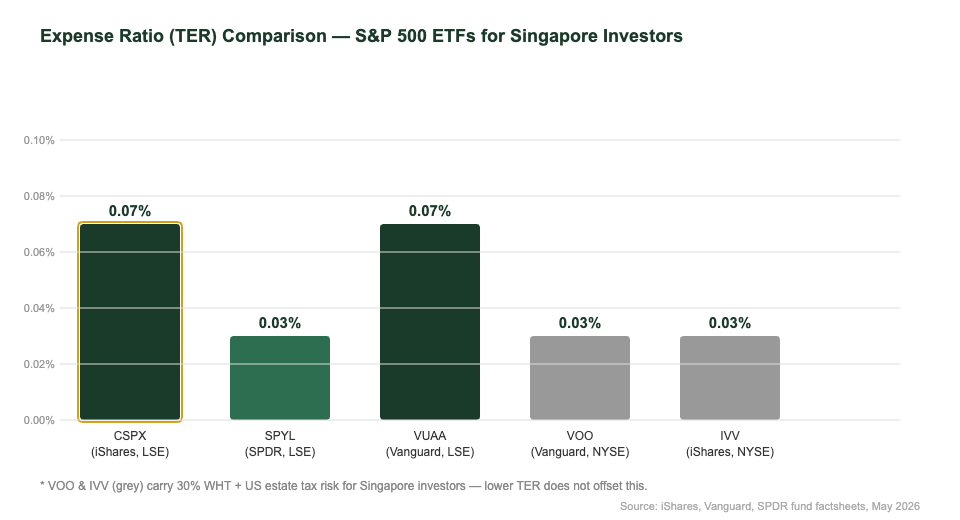
CSPX carries a Total Expense Ratio (TER) of 0.07% per annum — meaning for every SGD 10,000 invested, the annual management cost is approximately SGD 7. This is competitive for an Ireland-domiciled UCITS ETF, though slightly higher than the ultra-low-cost US-listed alternatives like VOO (0.03%) and IVV (0.03%).
However, TER alone does not tell the full cost story for Singapore investors. The more meaningful metric is the total cost of ownership, which includes TER, the impact of withholding tax on dividends, brokerage commissions, and FX conversion costs. When these are factored in, CSPX’s advantage over VOO becomes clear:
| Cost Component | CSPX (LSE) | VOO (NYSE) |
|---|---|---|
| TER | 0.07% | 0.03% |
| US Dividend WHT (on ~1.3% yield) | 15% × 1.3% ≈ 0.195% | 30% × 1.3% ≈ 0.39% |
| Total annual drag | ~0.265% | ~0.42% |
| Saving in favour of CSPX | ~0.155% p.a. — equivalent to SGD 155/yr on a SGD 100,000 portfolio | |
Calculation based on S&P 500 indicative dividend yield ~1.3% p.a. as at May 2026. Actual results vary.
For Singapore investors focused on building passive income in Singapore, the lower total cost drag of CSPX compounds significantly over a 20–30 year investment horizon.
How to Buy CSPX in Singapore (Step-by-Step)
CSPX is not listed on the SGX, so you need a brokerage account with international market access. The four most commonly used platforms by Singapore investors are Interactive Brokers (IBKR), Saxo Markets, moomoo Singapore, and Syfe Brokerage. CSPX is also not eligible for CPF Investment Scheme (CPFIS), but it can be purchased using SRS (Supplementary Retirement Scheme) funds through eligible brokers — ask your broker to confirm SRS eligibility before transacting.
Option 1: Interactive Brokers (IBKR) — Best for Larger Portfolios
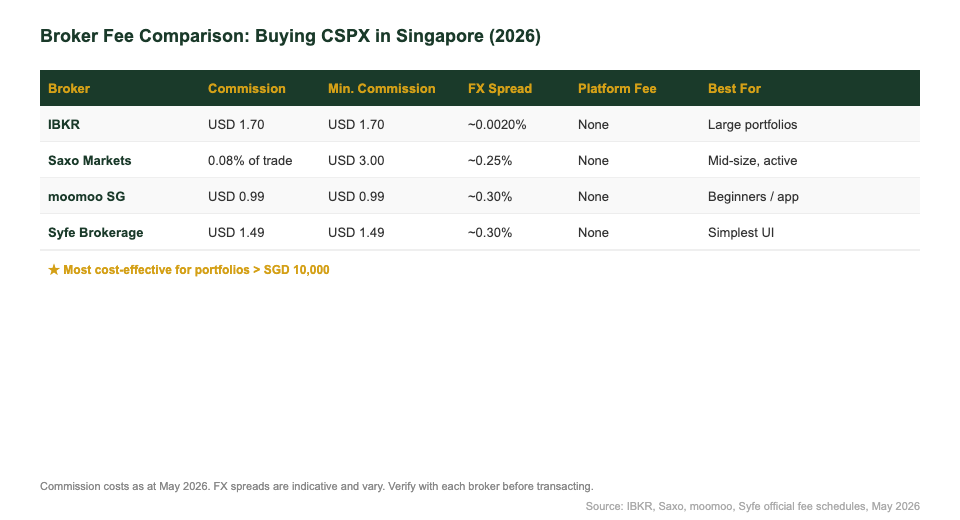
IBKR offers the lowest commissions for LSE-listed ETFs: USD 1.70 per trade (fixed, tiered pricing). For investors deploying SGD 10,000 or more per trade, this is the most cost-effective option. Steps: (1) Open and fund an IBKR account (minimum USD 0, but USD 1,000+ recommended); (2) In the trading platform, search ticker CSPX; (3) Select exchange LSE to ensure you’re buying the London-listed version; (4) Place a limit order in USD. Note: IBKR charges an inactivity fee of USD 0 if monthly commissions fall below USD 10 for accounts under USD 100,000 — verify current fee schedule at IBKR’s website.
Option 2: Saxo Markets — Best for Mid-Size Active Investors
Saxo charges 0.08% per trade with a minimum of USD 3.00. For a SGD 5,000 trade (~USD 3,750), that’s USD 3.00. Steps: (1) Open a Saxo Classic account; (2) Search CSPX on the LSE; (3) Fund via FAST/PayNow. Saxo’s platform is more full-featured than most retail apps and suited to investors who actively monitor positions. FX spread is approximately 0.25%.
Option 3: moomoo Singapore — Best for Beginners
moomoo Singapore offers flat commissions of USD 0.99 per trade (minimum USD 0.99) for US and international markets. The app interface is beginner-friendly and supports real-time quotes, analyst ratings, and community features. To buy CSPX: (1) Download moomoo and open a Universal Account; (2) Search CSPX; (3) Select the LSE-listed version carefully — moomoo may show multiple listings. See the moomoo Singapore review for a full fee breakdown.
Option 4: Syfe Brokerage — Best for Simplicity
Syfe Brokerage charges USD 1.49 per trade (min USD 1.49). It is the simplest of the four options, with a clean app interface and fractional share support. Syfe is part of a broader investment platform that also includes robo-advisor portfolios (Core, REIT+, Income+). If you’re already using Syfe for other investments, consolidating your CSPX holdings there simplifies account management. You can get a sign-up bonus via the Syfe referral code.
CSPX vs Alternatives
CSPX is the dominant Ireland-domiciled S&P 500 ETF for Singapore investors, but it’s worth comparing it against its closest peers. The key variables are TER, AUM (liquidity proxy), structure (acc vs dist), and whether the ETF is also available on other exchanges.
| ETF | Ticker | TER | Structure | AUM | Exchange | Best For |
|---|---|---|---|---|---|---|
| iShares Core S&P 500 | CSPX | 0.07% | Acc | USD 80B+ | LSE | Most liquid, largest AUM |
| SPDR S&P 500 UCITS | SPYL | 0.03% | Acc | USD 5B+ | LSE | Lowest TER, newer fund |
| Vanguard S&P 500 UCITS | VUAA | 0.07% | Acc | USD 10B+ | LSE | Vanguard brand preference |
| iShares Core S&P 500 (Dist) | CSPX.L (dist) | 0.07% | Dist | USD 5B+ | LSE | Investors wanting cash dividends |
| Vanguard S&P 500 ETF | VOO | 0.03% | Dist | USD 600B+ | NYSE | ⚠️ 30% WHT, estate tax risk |
Source: iShares, Vanguard, SPDR fund factsheets, May 2026
CSPX vs SPYL: SPYL’s 0.03% TER is half of CSPX’s 0.07% — a saving of SGD 40/yr on a SGD 100,000 portfolio. Both are Ireland-domiciled with identical WHT treatment. CSPX wins on liquidity and track record (since 2010 vs SPYL’s 2022 launch). For a long-term buy-and-hold investor, SPYL’s lower TER makes it increasingly compelling; for anyone prioritising liquidity and the tightest bid-ask spreads, CSPX remains the default choice.
Who Should Buy CSPX?
CSPX is ideal if you: want straightforward S&P 500 exposure without distributing dividends (accumulating structure simplifies reinvestment), have a portfolio large enough that the USD estate tax exposure of US-listed ETFs is a concern, value high liquidity and a 15-year track record, and prefer iShares / BlackRock as your fund manager.
Consider alternatives if you: want the absolute lowest TER (consider SPYL at 0.03%), want global diversification beyond the S&P 500 (consider VWRA), want income via regular cash dividends, or are investing via CPF (CSPX is not CPFIS-eligible; explore SGX-listed ETFs instead via the CPF investment strategy Singapore guide).
For investors building a retirement portfolio, CSPX works best as the growth engine in a diversified allocation that also includes income assets. Use the Singapore retirement calculator to project how much you’ll need and how a CSPX-centred portfolio fits your retirement timeline. For those also considering S-REITs alongside ETFs, see the best S-REITs in Singapore 2026 for a yield-focused complement to a CSPX core holding.
SRS investors: CSPX is SRS-compatible through brokers like IBKR and Saxo. Contributing to SRS gives an immediate income tax deduction (up to SGD 15,300/year for Singapore citizens), and the invested amount grows tax-free — making CSPX via SRS one of the most tax-efficient wealth-building strategies available to Singapore residents. For further options on fee-efficient platforms, the Endowus referral code and FSMOne referral code pages list current sign-up bonuses for platforms that support SRS investing.
Frequently Asked Questions
What is CSPX and why do Singapore investors buy it?
CSPX is the iShares Core S&P 500 UCITS ETF (Acc), listed on the London Stock Exchange. Singapore investors buy it instead of US-listed equivalents like VOO or IVV primarily because of two tax advantages: a 15% withholding tax on US dividends (versus 30% for US-domiciled ETFs) under the Ireland–US tax treaty, and zero exposure to US estate tax — which applies to non-US persons holding more than USD 60,000 in US-situs assets. Singapore has no capital gains tax, making CSPX a highly tax-efficient vehicle for long-term S&P 500 exposure.
Is CSPX the same as VOO or S&P 500?
CSPX and VOO both track the S&P 500 Index and hold the same 500 underlying US companies, so investment returns (before costs and taxes) are nearly identical. The key differences are domicile and structure: CSPX is Ireland-domiciled and accumulating; VOO is US-domiciled and distributing. For a Singapore investor, CSPX is typically the better choice due to the 15% vs 30% withholding tax difference and the US estate tax risk that comes with VOO. CSPX also has a higher TER (0.07% vs 0.03%), but the WHT saving more than offsets this for most investors.
Can I buy CSPX using my CPF or SRS funds?
CSPX is not eligible for the CPF Investment Scheme (CPFIS) — you cannot use CPF OA or SA savings to buy it. However, CSPX can be purchased using Supplementary Retirement Scheme (SRS) funds through eligible brokers such as Interactive Brokers and Saxo Markets. SRS investing in CSPX is a tax-efficient strategy: SRS contributions attract an income tax deduction of up to SGD 15,300 per year, and the investment grows tax-free until withdrawal. Confirm SRS eligibility with your specific broker before transacting.
Which broker is cheapest for buying CSPX in Singapore?
For most Singapore investors, Interactive Brokers (IBKR) is the most cost-effective broker for buying CSPX, charging a flat USD 1.70 commission per trade with no platform fees. For smaller trades or investors prioritising ease-of-use, moomoo Singapore (USD 0.99 per trade) and Syfe Brokerage (USD 1.49 per trade) are competitive alternatives. Saxo Markets charges 0.08% per trade (minimum USD 3.00), which is more expensive than flat-fee brokers for smaller orders but competitive for larger trades. Factor in FX conversion costs (typically 0.20–0.35% on top of commissions) when comparing total cost.
What is CSPX's expense ratio and how does it compare to SPYL?
CSPX has a Total Expense Ratio (TER) of 0.07% p.a. SPYL (SPDR S&P 500 UCITS ETF) has a TER of 0.03% p.a. — the lowest available for an Ireland-domiciled S&P 500 UCITS ETF as at May 2026. On a SGD 100,000 portfolio, SPYL saves approximately SGD 40 per year in management fees versus CSPX. Both ETFs have identical withholding tax treatment (15% under the Ireland–US treaty). The main argument for CSPX over SPYL remains its larger AUM (USD 80B+ vs USD 5B+), tighter bid-ask spreads, and longer track record since 2010.
Is CSPX safe? What are the main risks?
CSPX is managed by BlackRock, the world’s largest asset manager, and holds physical shares in all 500 S&P 500 companies — there is no counterparty or synthetic replication risk. The main risks are market risk (the S&P 500 can fall significantly; it dropped ~34% in March 2020 and ~19% in 2022), currency risk (CSPX trades in USD; a stronger SGD reduces returns in SGD terms), and concentration risk (the top 10 holdings represent roughly 35% of the index, so it is not as diversified as a global fund like VWRA). CSPX is a core long-term holding suited to investors with a 10+ year horizon who can tolerate short-term volatility.
Ready to Start Buying CSPX?
Open a brokerage account today and use our referral links for sign-up bonuses.
This article was researched with the help of AI. While we strive to keep all information accurate and up to date, there may be errors. If you notice any discrepancies, please contact us.