Best Dividend ETF Singapore 2026: Top Picks for Passive Income Investors
A data-driven comparison of the top dividend-paying ETFs available to Singapore investors — yield, TER, tax efficiency, and where to buy them.
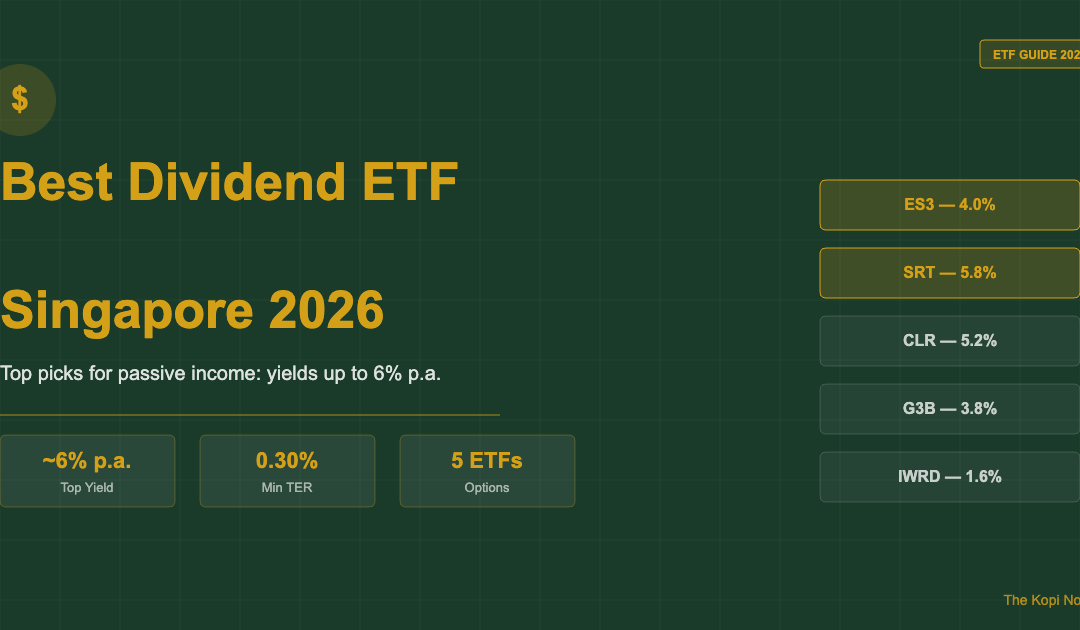
The best dividend ETF for Singapore investors in 2026 depends on whether you want income from Singapore REITs, global equities, or bonds — but the top picks include the Nikko AM STI ETF (ES3) for local exposure, iShares MSCI World SRI ETF (SUSW) for global dividends, and CSOP iEdge S-REIT Leaders ETF (SRT) for REIT-focused income. All three are accessible through local brokers and offer yields ranging from 3% to 6% p.a.
Not financial advice. All figures are for educational reference only. Data as at May 2026 unless noted.
Table of Contents
What Is a Dividend ETF?
A dividend ETF is an exchange-traded fund that holds a basket of dividend-paying stocks or REITs and distributes income to investors on a regular basis — typically quarterly or semi-annually. Unlike accumulating ETFs (such as VWRA or CSPX), which reinvest dividends automatically, distributing ETFs pay cash directly to your brokerage account.
For Singapore investors, dividend ETFs are popular for two reasons. First, Singapore imposes no personal income tax on dividends received, making regular income payouts genuinely tax-free in your hands. Second, with CPF-OA rates at 2.5% and bank savings accounts offering variable yields, a well-chosen dividend ETF delivering 4–6% p.a. can meaningfully enhance a retirement or passive income portfolio.
There are three main categories of dividend ETF available to Singapore investors in 2026: SGX-listed ETFs (denominated in SGD, easy to buy through local brokers), LSE-listed UCITS ETFs (Ireland-domiciled, more tax-efficient for global equity dividends), and thematic income ETFs targeting specific sectors such as S-REITs or Asian high-yield bonds.
Top Dividend ETFs for Singapore Investors 2026
1. Nikko AM STI ETF (SGX: ES3) — Best for Singapore Market Exposure
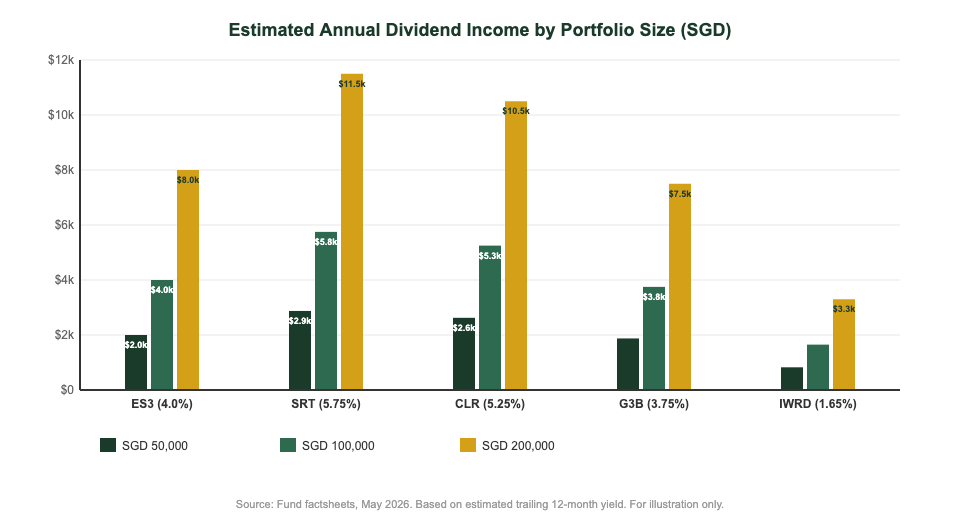
The Nikko AM Singapore STI ETF tracks the Straits Times Index (STI), holding Singapore’s top 30 blue-chip companies including DBS, OCBC, UOB, Singtel, and Keppel. It is a distributing ETF that pays dividends semi-annually, with a trailing 12-month dividend yield of approximately 3.8–4.2% p.a. as at Q1 2026. The TER is 0.30% p.a., which is competitive for a locally-listed ETF. As an SGX-listed fund, it is accessible through virtually every local broker, including Standard Chartered, DBS Vickers, and Syfe Brokerage. Notably, ES3 is eligible for CPF Investment Scheme (CPFIS) and Supplementary Retirement Scheme (SRS) investment — a significant advantage for investors looking to grow their retirement savings. For a Singapore investor holding SGD 50,000 in ES3, the annual management cost works out to approximately SGD 150, making it one of the most cost-effective locally-listed income options.
2. CSOP iEdge S-REIT Leaders ETF (SGX: SRT) — Best for REIT Income
The CSOP iEdge S-REIT Leaders ETF offers direct exposure to Singapore’s largest S-REITs, including CapitaLand Integrated Commercial Trust (CICT), Mapletree Logistics Trust, and Frasers Centrepoint Trust. With a distribution yield of approximately 5.5–6.0% p.a. as at Q1 2026, SRT is the highest-yielding ETF option on SGX for income-focused investors. The TER is 0.60% p.a. — higher than ES3 but still reasonable given the specialised REIT exposure. SRT distributes quarterly, which suits investors who prefer more frequent income. One important note: S-REITs are required to distribute at least 90% of taxable income to maintain tax transparency, which underpins the relatively high and predictable yield of this ETF. SRT is available through local brokers and is SRS-eligible, though not CPFIS-eligible. If you want to learn more about individual S-REIT selection, our guide to the best S-REITs in Singapore 2026 covers the top picks in detail.
3. Lion-Phillip S-REIT ETF (SGX: CLR) — Best for Broad REIT Diversification
The Lion-Phillip S-REIT ETF provides exposure to a broader basket of Singapore REITs compared to SRT, tracking the Morningstar Singapore REIT Yield Focus Index. It holds approximately 27 S-REITs with equal-weight tilts, reducing concentration risk in any single trust. The distribution yield is approximately 5.0–5.5% p.a. as at Q1 2026, with quarterly distributions and a TER of 0.60% p.a. CLR is a strong choice for investors who want REIT income but are nervous about concentration in the top three or four names. The Lion-Phillip S-REIT ETF is SGX-listed, SRS-eligible, and can be bought through most local brokers. Our dedicated Singapore REIT ETF guide provides a deeper dive into both CLR and SRT.
4. SPDR Straits Times Index ETF (SGX: G3B) — Blue-Chip Income Alternative
The SPDR STI ETF is the other major Singapore market ETF alongside ES3, also tracking the Straits Times Index. Its trailing dividend yield is approximately 3.5–4.0% p.a. and the TER is 0.30% p.a. — identical to ES3. The main practical difference for most investors is liquidity and lot sizing: G3B and ES3 have similar average daily volumes, and both can be bought in board lots (100 shares). G3B is CPFIS-eligible and SRS-eligible. For most investors choosing between ES3 and G3B, either is a solid pick — the choice often comes down to which broker you use and which has a slightly lower spread on any given day.
5. iShares MSCI World UCITS ETF Dist (LSE: IWRD) — Best for Global Dividend Exposure
For Singapore investors seeking global equity income rather than Singapore-only exposure, the iShares MSCI World UCITS ETF Distributing (IWRD) listed on the London Stock Exchange is a strong option. IWRD tracks the MSCI World Index across 23 developed markets, holding approximately 1,460 stocks, and pays semi-annual distributions. The TER is 0.50% p.a. and the distribution yield is approximately 1.5–1.8% p.a. — modest compared to REIT ETFs but coming from a much broader, more globally diversified portfolio. Critically, as an Ireland-domiciled UCITS ETF, IWRD benefits from the Ireland–US tax treaty: US dividend withholding tax is capped at 15% (vs 30% for US-domiciled equivalents), and Singapore investors face no US estate tax exposure on their IWRD holdings. IWRD requires a broker with LSE access, such as Interactive Brokers (IBKR) or Saxo Markets. You can use our Syfe referral code to open a Syfe Brokerage account if you prefer a simpler platform. For long-term retirement planning, consider pairing IWRD with our Singapore retirement calculator to model your income needs.
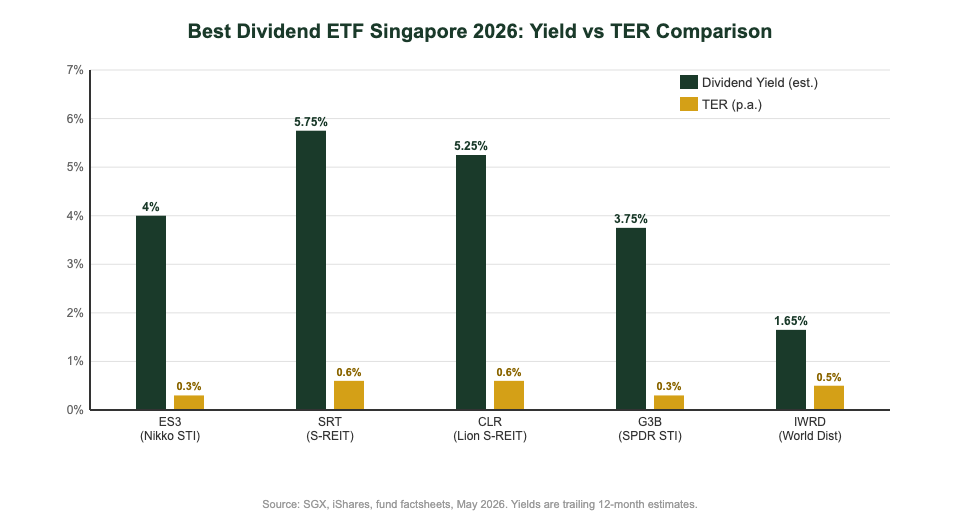
Full Comparison Table
The table below compares all five top dividend ETF picks on the metrics that matter most to Singapore income investors — yield, cost, exchange, and CPF/SRS eligibility.
| ETF | Ticker | Exchange | Yield (est.) | TER | CPF/SRS | Frequency |
|---|---|---|---|---|---|---|
| Nikko AM STI ETF | ES3 | SGX | 3.8–4.2% | 0.30% | CPF + SRS | Semi-annual |
| CSOP iEdge S-REIT ETF | SRT | SGX | 5.5–6.0% | 0.60% | SRS only | Quarterly |
| Lion-Phillip S-REIT ETF | CLR | SGX | 5.0–5.5% | 0.60% | SRS only | Quarterly |
| SPDR STI ETF | G3B | SGX | 3.5–4.0% | 0.30% | CPF + SRS | Semi-annual |
| iShares MSCI World Dist (IWRD) | IWRD | LSE | 1.5–1.8% | 0.50% | SRS only | Semi-annual |
Source: SGX, iShares, fund factsheets, May 2026. Yields are trailing 12-month estimates and will vary with market conditions.
Tax Considerations for Singapore Investors
One of the most significant advantages of dividend investing from Singapore is the tax treatment. Singapore does not impose a dividend withholding tax on Singapore-sourced dividends — meaning distributions from SGX-listed ETFs (ES3, G3B, SRT, CLR) flow to investors without any deduction at source. This makes SGX-listed dividend ETFs particularly attractive for income investors compared to those in markets where dividend taxes of 15–30% apply.
For LSE-listed UCITS ETFs like IWRD, the situation is more nuanced. The fund itself pays 15% withholding tax on US dividends received (down from 30% for a US-domiciled fund, thanks to the Ireland–US tax treaty), and Singapore investors do not pay any additional personal income tax on the distributions they receive from IWRD. The result is that a Singapore investor in IWRD keeps approximately 85% of US-source dividends at the fund level — a meaningful improvement over holding a US-domiciled equivalent like VYM (Vanguard High Dividend Yield ETF), which would retain only 70%.
| ETF Type | Domicile | US Div WHT | SG Personal Tax | US Estate Tax Risk |
|---|---|---|---|---|
| SGX-listed (ES3, SRT, CLR) | Singapore | N/A | 0% | None |
| LSE-listed UCITS (IWRD) | Ireland | 15% | 0% | None |
| US-listed (VYM, SCHD) | USA | 30% | 0% | Yes (>USD 60k) |
Source: MAS, IRS, iShares factsheets, May 2026. Singapore investors should consult a tax adviser for their specific situation.
SGX-Listed vs LSE-Listed Dividend ETFs
The choice between SGX-listed and LSE-listed dividend ETFs largely comes down to what income source you want and how much you care about currency exposure.
SGX-listed ETFs (ES3, G3B, SRT, CLR) offer SGD-denominated income, zero currency conversion costs, CPF/SRS compatibility, and simple access through every local brokerage platform. Their distributions reflect Singapore’s blue-chip and REIT ecosystem — heavily weighted toward financials (DBS, OCBC, UOB) and property (S-REITs). This concentration is both a strength (high yield from REIT mandated distributions) and a risk (Singapore-specific economic exposure). If you are interested in building a passive income Singapore portfolio with reliable quarterly payouts, SGX-listed REIT ETFs are a natural starting point.
LSE-listed UCITS ETFs (IWRD) provide USD-denominated global equity income with Ireland-domicile tax efficiency. The yield is lower (1.5–1.8%) but the geographical diversification across 1,460 stocks in 23 countries significantly reduces concentration risk. For investors who already have substantial Singapore exposure through CPF, their property, and local stocks, adding IWRD provides genuine diversification. Brokers with LSE access include Interactive Brokers, Saxo Markets, and MooMoo Singapore — see our moomoo Singapore review for a detailed breakdown of their ETF trading fees.
How to Buy Dividend ETFs in Singapore
For SGX-listed ETFs (ES3, G3B, SRT, CLR): Open an account with any SGX-connected broker. Popular options include DBS Vickers, OCBC Securities, Standard Chartered Online Trading, and Syfe Brokerage. Minimum lot sizes on SGX are 100 shares — at ES3’s approximate price of SGD 3.50, a single lot costs around SGD 350, making it accessible for new investors. If you want to invest using CPF-OA funds, ensure your broker is CPFIS-approved and that the specific ETF (ES3 or G3B) is on the CPFIS list. Use our CPF investment strategy Singapore guide to understand how CPF investing works. For SRS investing, you can use Syfe — check out our Syfe referral code for a sign-up bonus when opening an account.
For LSE-listed ETFs (IWRD): You need a broker with international exchange access. Interactive Brokers is the most cost-effective for larger portfolios (USD 1 commission per trade), while Saxo Markets and MooMoo are good alternatives with simpler interfaces. Fund your account in SGD and convert to GBP or USD at the broker level. IWRD trades on the LSE in USD (ticker: IWRD) and GBP (ticker: IWDG) — either works, though USD pricing is more common for Singapore investors. LSE-listed ETFs are SRS-eligible if bought through an eligible broker. For SRS-linked ETF investing, the Endowus referral code gets you started with a fund platform that also offers curated ETF portfolios for SRS accounts. To model how these dividend streams contribute to your financial goals, use the Singapore retirement calculator.
Who Should Buy Dividend ETFs?
Dividend ETFs are ideal if you:
- Want regular cash income rather than capital growth (e.g. semi-retirement or retirement phase)
- Prefer a simple, low-maintenance income strategy over stock-picking individual REITs or dividend stocks
- Have CPF-OA funds sitting at 2.5% that you want to put to work in a CPFIS-eligible ETF (ES3 or G3B)
- Are building a passive income portfolio and want Singapore-specific income with no dividend tax
- Prefer quarterly or semi-annual cash distributions over end-of-year rebalancing
Consider alternatives if you:
- Are in the wealth accumulation phase and can tolerate not receiving cash income — an accumulating ETF like VWRA or CSPX (which automatically reinvests dividends) is more tax-efficient globally and avoids the drag of reinvesting distributions manually
- Want to optimise for maximum total return over 20+ years — accumulating ETFs historically outperform distributing equivalents due to tax-free compounding within the fund
- Need high income and are comfortable with individual stock/REIT selection — buying S-REITs directly can yield 5–7% with higher control but requires more research. Our guide to the best S-REITs in Singapore 2026 is a good starting point if you go this route
- Are investing for a child’s education or other long-dated goal — accumulating ETFs are more capital-efficient for multi-decade horizons
This article is for educational purposes only and does not constitute financial advice. Always consult a licensed financial adviser before making investment decisions. Dividend yields and fund data are subject to change.
Frequently Asked Questions
What is the best dividend ETF in Singapore for 2026?
For most Singapore investors seeking income, the Nikko AM STI ETF (ES3) is the best all-round dividend ETF — it offers a yield of approximately 3.8–4.2% p.a., a low TER of 0.30%, CPFIS and SRS eligibility, and SGD-denominated distributions with no dividend tax. If you want higher income and are comfortable with REIT concentration, the CSOP iEdge S-REIT Leaders ETF (SRT) offers 5.5–6.0% p.a. but is not CPFIS-eligible.
Do I pay tax on dividends from ETFs in Singapore?
Singapore residents pay no personal income tax on dividends received from SGX-listed ETFs or from UCITS ETFs listed on the London Stock Exchange. For LSE-listed funds like IWRD, the fund itself pays 15% withholding tax on US dividends at the fund level (reduced from 30% via the Ireland–US tax treaty), but you personally pay nothing further. US-domiciled ETFs like VYM or SCHD are generally not recommended for Singapore investors due to the 30% US dividend withholding tax and US estate tax exposure above USD 60,000.
Can I buy dividend ETFs using CPF?
Yes, but only specific ETFs are CPF Investment Scheme (CPFIS)-eligible. As at May 2026, the Nikko AM STI ETF (ES3) and the SPDR STI ETF (G3B) are both CPFIS-approved and can be purchased using CPF-OA funds. REIT ETFs (SRT, CLR) and LSE-listed ETFs (IWRD) are not CPFIS-eligible, though they can generally be purchased using SRS funds through an eligible broker. Always verify the current CPFIS list on the CPF Board website before investing.
What is a good dividend yield for an ETF in Singapore?
A yield of 3.5–4.5% p.a. is considered solid for a broad-market dividend ETF in Singapore (e.g. ES3 or G3B), while REIT-focused ETFs (SRT, CLR) typically offer 5.0–6.5% p.a. Yields above 7% should be approached cautiously — they may reflect unsustainably high payout ratios, declining NAV, or sector-specific distress. Always evaluate total return (yield + capital growth) rather than yield alone, and check the ETF’s payout ratio and distribution history before investing.
Is it better to buy a dividend ETF or individual REITs in Singapore?
It depends on your time and expertise. Dividend ETFs like SRT and CLR give instant diversification across 20–30 S-REITs with low management effort — ideal for investors who prefer a hands-off approach. Individual S-REITs can offer higher yields (some paying 6–8%) and more control over your portfolio composition, but require more research and active monitoring. Many Singapore investors hold both: ETFs for the core, with a few selected REITs for higher income. For research on individual picks, our guide to the best S-REITs in Singapore 2026 is a useful starting point.
How often do dividend ETFs in Singapore pay out?
Distribution frequency varies by ETF. The Nikko AM STI ETF (ES3) and SPDR STI ETF (G3B) pay semi-annually (typically in May/June and November/December). The CSOP iEdge S-REIT ETF (SRT) and Lion-Phillip S-REIT ETF (CLR) pay quarterly, which suits investors who prefer more regular income. The iShares MSCI World Distributing ETF (IWRD) pays semi-annually. Always check the fund’s distribution history on the SGX or iShares website to verify the payment schedule before investing.
Start Building Your Dividend ETF Portfolio
Open a brokerage account today and start earning passive income from Singapore’s top dividend ETFs.
This article was researched with the help of AI. While we strive to keep all information accurate and up to date, there may be errors. If you notice any discrepancies, please contact us.