If you’re building a passive income portfolio in Singapore and want exposure to the AI infrastructure boom, Keppel DC REIT (SGX: AJBU) belongs on your watchlist. Singapore’s first and largest data centre REIT sits at the intersection of two powerful forces: surging AI and cloud demand, and Singapore’s status as Asia-Pacific’s premier data hub. In this review, we break down the latest dividend figures, DPU history, peer comparison, and whether AJBU deserves a spot in your 2026 portfolio.
Data as of March 2026. This is not financial advice. Please consult a licensed financial adviser before investing.
Table of Contents
- What Is Keppel DC REIT (SGX: AJBU)?
- Portfolio Overview: Singapore, Europe & Asia-Pacific
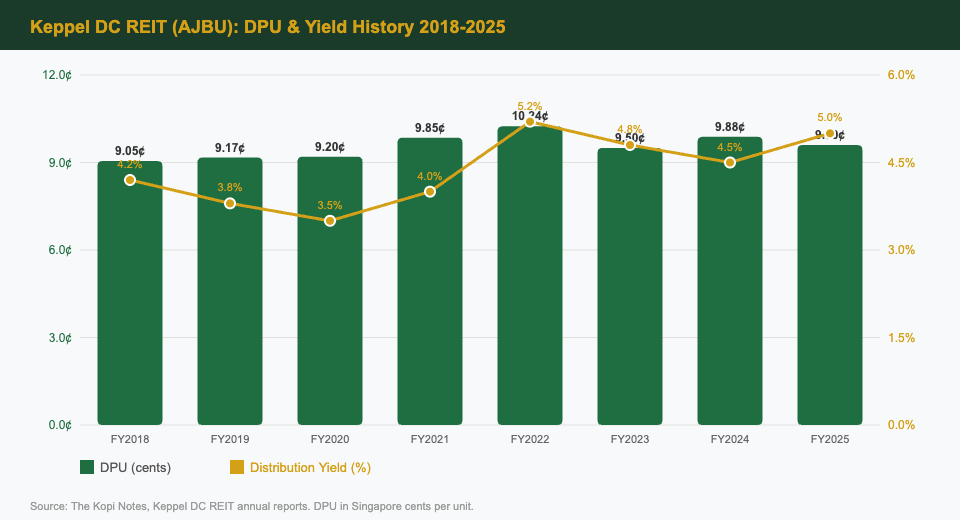
- Keppel DC REIT Dividend & DPU History 2021–2026
- Yield Comparison: Keppel DC REIT vs S-REIT Peers
- Financial Health: Gearing, NAV & ICR
- Why the AI Boom is a Structural Tailwind
- Risks & Challenges for 2026
- FAQ
- Our Verdict
- References & Sources
What Is Keppel DC REIT (SGX: AJBU)?
Keppel DC REIT was listed on the Singapore Exchange in December 2014 as Singapore’s first pure-play data centre REIT. It is managed by Keppel DC REIT Management Pte. Ltd., a subsidiary of Keppel Capital (part of the Keppel Corporation and Temasek Holdings ecosystem). With approximately 23 data centre assets across 12 countries, it is the largest data centre REIT listed in Singapore by portfolio size and market capitalisation.
Data centres are the physical backbone of the digital economy — housing servers, networking equipment, and cooling infrastructure that powers cloud computing, AI model training, streaming services, and financial transactions. As AI adoption accelerates and hyperscalers (AWS, Microsoft Azure, Google Cloud) expand aggressively, demand for colocation data centre space has reached record levels globally.
Quick Facts (as at March 2026)
| Detail | Data |
|---|---|
| SGX Ticker | AJBU |
| REIT Type | Specialised (Data Centres) |
| Sponsor | Keppel Corporation (Temasek-linked) |
| Listing Date | December 2014 |
| Distribution Frequency | Semi-annual |
| Portfolio Size | ~23 assets, 12 countries |
| Estimated Trailing Yield | ~4.8% |
| Gearing Ratio | ~36% |
| Price-to-Book | ~0.93x |
Portfolio Overview: Singapore, Europe & Asia-Pacific
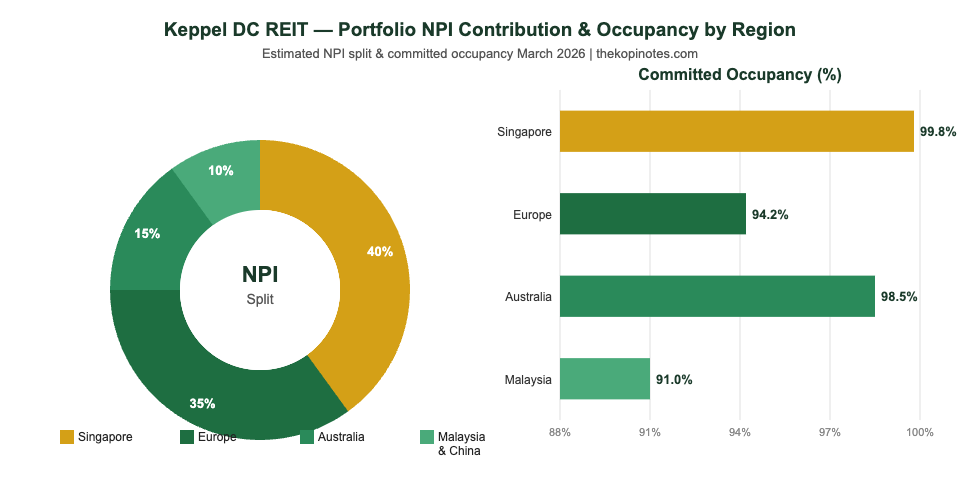
Keppel DC REIT’s ~23 data centre assets are spread across three key regions:
Singapore (~40% of NPI)
Singapore is the portfolio’s anchor region. Multiple hyperscale-grade colocation facilities house major cloud providers and tech enterprises. Singapore data centres benefit from political stability, Tier 1 subsea cable connectivity, government-backed digital infrastructure investment, and tight supply controls (Singapore’s data centre moratorium and careful power quota allocation limit new entrants). These structural factors underpin above-average rental growth in Singapore assets.
Europe (~35% of NPI)
European assets span Germany, Netherlands, UK, Ireland, and Italy — serving major cloud platforms and enterprise clients. EUR-denominated income introduces FX variability into SGD-reported distributions, which was a headwind in 2023 when EUR weakened against SGD. However, European data centre demand remains robust as GDPR compliance requirements and energy-efficient data sovereignty regulations drive demand for local, Tier III+ compliant facilities.
Asia-Pacific ex-Singapore (~25% of NPI)
Assets in Australia (Sydney, Melbourne), Malaysia, and China round out the portfolio. The Australia portfolio benefits from strong demand from local government, financial services, and healthcare tenants. Malaysia is emerging as a key data centre hub due to lower land and power costs, while the China assets serve domestic enterprise clients.
Keppel DC REIT consistently maintains overall committed occupancy above 93%, with Singapore and Australian assets typically at or near 100%. This occupancy resilience through economic cycles demonstrates the non-discretionary nature of data centre infrastructure demand.
Keppel DC REIT Dividend & DPU History 2021–2026
Keppel DC REIT pays distributions semi-annually (two times per year, typically in March and September). Here is the distribution per unit (DPU) history from FY2021:
| Financial Year | Total DPU (cents) | YoY Change |
|---|---|---|
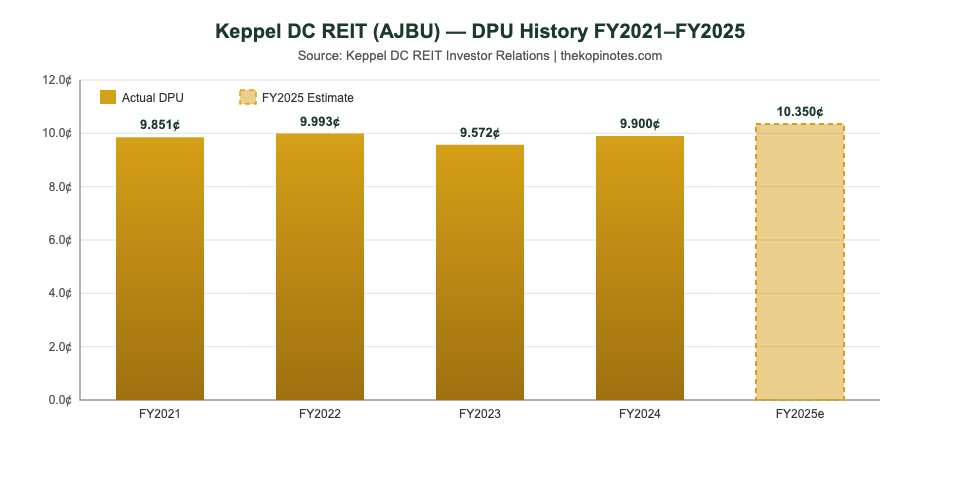
| FY2021 | 9.851¢ | +7.0% |
| FY2022 | 9.993¢ | +1.4% |
| FY2023 | 9.572¢ | -4.2% |
| FY2024 | ~9.9¢ | ~+3.4% |
| FY2025 (est) | ~10.2–10.5¢ | ~+3–6% |
Source: Keppel DC REIT investor relations. FY2025 figures are estimates based on 1H FY2025 results extrapolation.
The FY2023 dip reflected higher interest expense as SORA/SIBOR rates rose sharply from 2022–2023. The recovery trajectory since FY2024 is supported by strong positive rental reversions on lease renewals, new hyperscaler tenant leases, and a more stable global interest rate environment heading into 2025–2026.
Annualised Yield Calculation (Illustrative)
At a unit price of S$2.10 and trailing DPU of ~9.9 cents:
Dividend Yield = DPU / Unit Price = S$0.099 / S$2.10 = 4.71%
At S$2.00 per unit (buying on a slight dip), yield climbs to approximately 4.95%. Note that Keppel DC REIT distributions are not subject to withholding tax for individual Singapore tax residents holding units through a brokerage — a meaningful advantage.
Keppel DC REIT is approved under the CPF Investment Scheme (CPFIS-OA), so you can invest using CPF Ordinary Account savings through a CPFIS-approved broker. For more on deploying CPF into REITs strategically, read our guide on optimising your CPF for S-REIT investing.
Yield Comparison: Keppel DC REIT vs S-REIT Peers
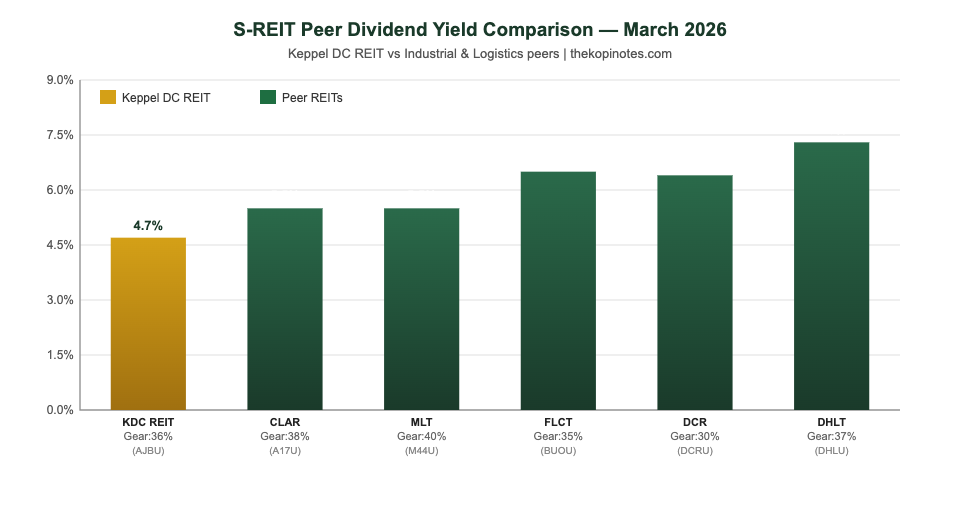
How does Keppel DC REIT compare against Singapore-listed peers across sectors? Based on March 2026 market data:
| REIT | SGX | Type | DPU (S¢) | Price (S$) | Yield | Gearing |
|---|---|---|---|---|---|---|
| Keppel DC REIT | AJBU | Data Centre | ~9.9¢ | ~$2.10 | ~4.7% | ~36% |
| CapitaLand Ascendas REIT | A17U | Industrial | ~15.1¢ | ~$2.75 | ~5.5% | ~38% |
| Mapletree Logistics Trust | M44U | Logistics | ~8.0¢ | ~$1.45 | ~5.5% | ~40% |
| Frasers Logistics & Commercial | BUOU | Logistics/Office | ~7.0¢ | ~$1.08 | ~6.5% | ~35% |
| Digital Core REIT | DCRU | Data Centre (US) | ~3.5¢ | ~$0.55 | ~6.4% | ~30% |
| Daiwa House Logistics Trust | DHLU | Logistics | ~5.5¢ | ~$0.75 | ~7.3% | ~37% |
Data sourced from SGX and company investor relations pages, March 2026. Yields are indicative and subject to market price changes.
Keppel DC REIT’s ~4.7% yield is lower than most peers — but this premium pricing reflects a sector scarcity premium (only two SGX-listed data centre REITs), strong AI-driven demand growth, and Keppel Corporation’s sponsor backing. If pure yield is your goal, CapitaLand Ascendas REIT or Frasers Logistics offer better income. But if you want sector exposure to the AI/cloud infrastructure megatrend within a Singapore-listed REIT wrapper, Keppel DC REIT stands apart.
For investors wanting managed S-REIT exposure without picking individual counters, platforms like Syfe Income+ or Endowus Fund Smart provide diversified REIT portfolio options. Alternatively, for low-cost DIY investing with CDP linkage, explore our FSMOne referral page.
Financial Health: Gearing, NAV & ICR
Financial health metrics are critical for REIT investors. Under MAS’s Property Fund Appendix, Singapore REITs are regulated on leverage and interest coverage.
| Metric | Keppel DC REIT | MAS Limit |
|---|---|---|
| Aggregate Leverage (Gearing) | ~36% | 50% (45% if ICR < 2.5x) |
| Interest Coverage Ratio (ICR) | ~4.5x | Must exceed 1.5x |
| NAV per Unit | ~S$2.25 | — |
| Price-to-NAV | ~0.93x | — |
| % Fixed-Rate Debt | ~75% | — |
Keppel DC REIT’s balance sheet is in solid shape. Gearing of ~36% sits comfortably below MAS’s 50% regulatory ceiling — 14 percentage points of headroom, sufficient to absorb moderate asset value declines without a rights issue. With ~75% of debt on fixed rates, the REIT has substantially hedged its interest cost exposure through the current rate cycle. Each 25 basis points increase in floating borrowing costs affects approximately 25% of the debt book, limiting DPU dilution from rate movements.
The NAV discount of ~7% is modest and reflects a normalisation from the premium valuations of 2021–2022. At roughly par value, investors are not significantly overpaying for the underlying assets, which compares favourably with the deep NAV discounts still seen at some retail and office REITs.
Debt maturity profile: The manager has staggered debt maturities well across multiple years, with no single year accounting for a disproportionate refinancing burden. This disciplined liability management is a positive signal for DPU stability through 2026 and beyond.
Why the AI Boom is a Structural Tailwind for Keppel DC REIT
Unlike cyclical demand drivers in retail or office REITs, the demand underpinning data centre REITs is structural and multi-decade. Here is why the AI megatrend matters specifically for Keppel DC REIT unitholders:
1. Hyperscaler Capex at Record Levels
Microsoft, Google, and Amazon have collectively committed over USD 300 billion in data centre capex across 2025–2026. Asia-Pacific — particularly Singapore — is a priority destination. Singapore’s fibre connectivity, political neutrality, and proximity to 700 million Southeast Asian internet users make it an irreplaceable hyperscaler node.
2. Singapore Supply Remains Constrained
The Singapore government’s careful management of data centre power quotas (introduced in 2019 and extended beyond the 2022 moratorium lift) continues to limit new supply. Existing licensed operators, including Keppel DC REIT’s Singapore assets, benefit from scarcity rent dynamics. New entrants face multi-year regulatory hurdles — a structural moat for incumbents.
3. AI Lease Structures Are More Favourable
AI training cluster deployments typically demand longer leases (10–15 years vs 3–5 years for standard enterprise colo) at materially higher rents. Hyperscaler renewals and new AI leases signed across 2024–2025 have reportedly been 20–30% above prior rents in Singapore. This translates directly into positive DPU growth through 2026 and beyond.
4. Positive Rental Reversions
Keppel DC REIT has consistently delivered positive rental reversions on lease renewals in its Singapore portfolio, with renewal rents tracking well above expiring lease rates. This organic growth engine — entirely driven by supply-demand dynamics, not financial engineering — makes data centre REITs unusually well-positioned for inflation-adjusted income growth.
If you want to understand how broader macro trends (Fed rate decisions, AI capex cycles) affect S-REIT investors, see our Singapore REIT ETF investing guide.
Risks & Challenges for Keppel DC REIT in 2026
No investment is risk-free. Here are the key risks for Keppel DC REIT unitholders to monitor:
1. Single-Sector Concentration
Unlike diversified commercial REITs (retail + office), Keppel DC REIT has no sector backstop. If data centre valuations re-rate downward — for instance, if AI investment cools sharply or power constraints suppress hyperscaler expansions — the entire portfolio is exposed.
2. FX Headwinds
Approximately 60% of revenues are non-SGD denominated (EUR, AUD, MYR, CNY). Currency movements can materially impact SGD-reported DPU independent of operating performance. The FY2023 DPU dip was partly explained by EUR/SGD weakness. While hedging programmes mitigate short-term exposure, multi-year FX trends remain a structural risk.
3. Rising Power Costs
Data centres are energy-intensive. Electricity price spikes — particularly in Europe following energy market disruptions — can erode net property income margins if power cost escalation clauses do not fully pass through increases to tenants. Singapore’s transition to lower-carbon energy sources also adds medium-term cost uncertainty.
4. Tenant Concentration Risk
Keppel DC REIT’s top 10 tenants represent a significant portion of total revenue. Non-renewal by a major hyperscaler or enterprise tenant — particularly in Singapore — could create short-term income volatility, though the structural demand environment makes this scenario less likely.
5. Interest Rate Sensitivity
While ~75% of debt is on fixed rates, the remaining 25% is floating. Additionally, fixed-rate debt will reset at refinancing. If global interest rates remain elevated beyond 2026, successive refinancings will gradually increase borrowing costs, putting mild pressure on distributable income.
Frequently Asked Questions — Keppel DC REIT
When does Keppel DC REIT pay its dividend?
What is Keppel DC REIT's current dividend yield?
Is Keppel DC REIT a good investment for 2026?
Can I use CPF to invest in Keppel DC REIT?
What is Keppel DC REIT's gearing ratio?
How does Keppel DC REIT compare to Digital Core REIT?
Where can I invest in Keppel DC REIT in Singapore?
Our Verdict: Keppel DC REIT in 2026
Keppel DC REIT is one of the most strategically positioned S-REITs for 2026 and beyond. The data centre sector tailwind from AI and cloud adoption is structural — not cyclical — and Singapore’s constrained supply environment means rental growth should persist for years.
At a ~4.7–5% trailing yield, it won’t satisfy income-focused investors chasing 6–8% distributions. But for investors comfortable accepting a moderate yield in exchange for capital growth potential, sector momentum, and a structurally improving DPU trajectory, Keppel DC REIT is a compelling hold or accumulate on dips.
Our verdict: BUY / ACCUMULATE on dips toward S$2.00.
This is not financial advice. Always conduct your own due diligence or consult a licensed financial adviser before making any investment decisions.
Ready to start investing in S-REITs? Compare your options via FSMOne (low commissions, CDP-linked) or explore managed S-REIT portfolios on Syfe. Also see our Best S-REITs for 2026 comparison for a broader Singapore REIT landscape overview.
This article was researched with the help of AI. While we strive to keep all information accurate and up to date, there may be errors. If you notice any discrepancies, please contact us.