moomoo Singapore Review 2026: Fees, ETF Access & Is It Worth It?
A Singapore investor’s complete review — commissions, market access, ETF trading limitations, and how moomoo compares to IBKR, Tiger Brokers, and Saxo in 2026.
moomoo Singapore is a MAS-licensed brokerage operated by Futu Singapore Pte. Ltd., offering commission-free US stock and ETF trading alongside SGX, Hong Kong, and Japan market access. It is particularly popular for US market investing and its advanced charting tools. Key limitation for Singapore ETF investors: moomoo does not support London Stock Exchange (LSE) trading, meaning UCITS ETFs like VWRA and CSPX cannot be bought on this platform.
Not financial advice. All figures are for educational reference only. Data as at May 2026 unless noted.
Table of Contents
Contents — Click to expand
What Is moomoo Singapore?
moomoo Singapore is the local brand of Futu Singapore Pte. Ltd., a wholly owned subsidiary of Futu Holdings — a Hong Kong-listed financial technology company founded by a former Tencent engineer. The platform launched in Singapore in 2021 and has since become the top-ranked investment app by download volume in Singapore as of February 2026, according to app store data.
Futu Singapore Pte. Ltd. holds a Capital Markets Services (CMS) Licence from the Monetary Authority of Singapore (MAS), as well as Exempt Financial Adviser status. This means client assets are subject to Singapore’s regulatory framework for custody and asset segregation — a key consideration when selecting a broker. Singapore investors’ funds are held in segregated accounts, separate from company funds.
The platform is built around an advanced mobile and desktop trading interface with features like real-time Level 2 data, earnings calendars, analyst ratings, institutional tracking, and an active investor community (similar to a social trading feed). For investors who want professional-grade data at no additional cost, moomoo is one of the best-valued platforms available in Singapore as at May 2026.
However, moomoo’s core strength is US equity and ETF trading. For Singapore investors specifically interested in Irish-domiciled UCITS ETFs on the London Stock Exchange, moomoo is not a suitable platform — it does not support LSE trading at all.
Key Facts at a Glance
| Feature | Detail |
|---|---|
| Full Entity Name | Futu Singapore Pte. Ltd. (trading as moomoo) |
| MAS Licence | Capital Markets Services Licence (CMS100917) |
| US Stock Commission | $0 (lifetime, + US$0.99 platform fee per order) |
| SGX Commission | 0.03% of trade value (or S$0.99, whichever higher) |
| HK Stock Commission | 0.03% or HKD 3 minimum |
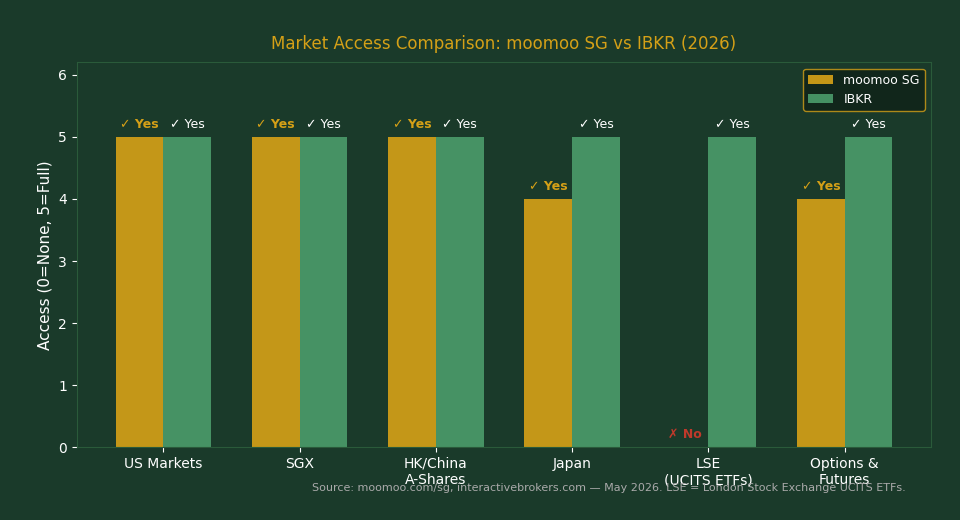
| Markets Available | US, SGX, HKEX, China A-Shares, Japan, Australia, Malaysia, Canada |
| LSE (UCITS ETFs) | Not available |
| Minimum Deposit | None (but deposit required to trade or qualify for promos) |
| Fractional Shares | Yes (US stocks and ETFs) |
| Regular Savings Plan | Yes (US stocks and ETFs — daily, weekly, bi-weekly, monthly) |
| GST on Fees | 9% GST applicable on platform and commission fees from 1 Jan 2024 |
Source: moomoo.com/sg, MAS CMS licence register — May 2026
moomoo Singapore Fees & Commissions
moomoo’s pricing model is built around a “$0 commission + platform fee” structure for US markets. Understanding what this means in practice is important before comparing it to competitors.
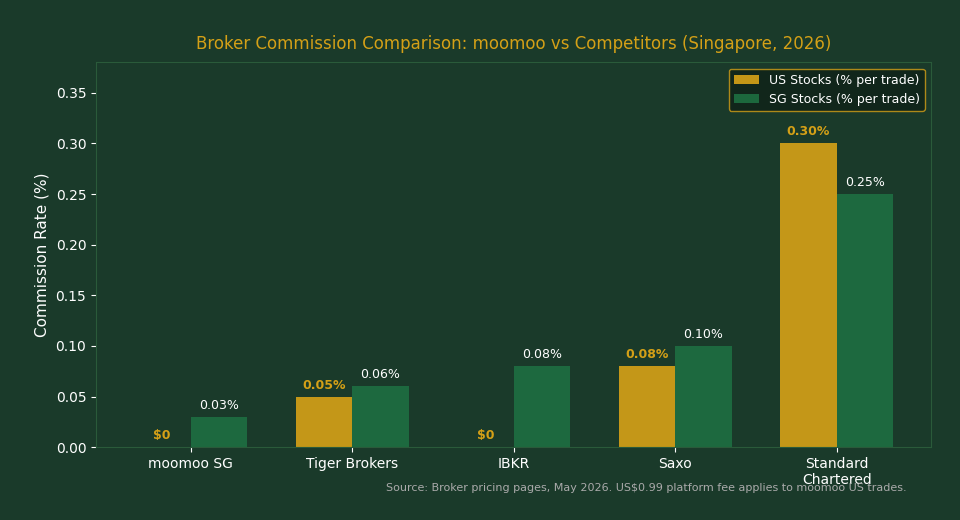
For US stocks and ETFs: there is a lifetime $0 brokerage commission for new account holders, but a US$0.99 platform fee per order still applies. Additionally, regulatory charges apply: a Trading Activity Fee (TAF) of US$0.000195 per share (minimum US$0.01, maximum US$9.79), and the SEC Fee resumed on 4 April 2026 at a rate of US$0.0000278 per USD of sales. For a typical SGD 1,000 US ETF trade, total fees (platform fee + TAF + SEC Fee) remain well below S$2 — significantly cheaper than traditional brokerages.
For SGX-listed stocks and ETFs: commission is 0.03% of trade value, with a S$0.99 minimum. This is competitive for smaller trades but slightly less so for larger orders versus IBKR (which charges a flat SGD 2.50 minimum for SGX). For a SGD 10,000 SGX trade, moomoo charges S$3 vs IBKR’s S$2.50.
For currency conversion: moomoo applies a standard FX spread when converting SGD to USD or HKD. The spread is approximately 0.1%, which is competitive among retail brokers but higher than IBKR’s interbank-near FX rates (as low as 0.002%). For frequent currency conversions on large portfolios, IBKR has a meaningful advantage.
A 9% GST applies to all fees for Singapore tax residents effective 1 January 2024, as mandated by IRAS.
| Fee Type | moomoo SG | Tiger Brokers | IBKR | Saxo |
|---|---|---|---|---|
| US Stock Commission | $0 + US$0.99/order | 0.05% min US$0.99 | $0 (Tiered: from US$0.005/share) | 0.08% min US$1 |
| SGX Commission | 0.03% min S$0.99 | 0.06% min S$1.50 | 0.08% min SGD 2.50 | 0.10% min S$4 |
| LSE / UCITS ETFs | Not available | Not available | Available | Available |
| FX Spread (USD/SGD) | ~0.10% | ~0.10% | ~0.002% (interbank) | ~0.15% |
| Custody / Platform Fee | US$0.99 per US order | 0.03% platform fee | None | None |
Source: Broker pricing pages, moomoo.com/sg, interactivebrokers.com, saxo.com — May 2026
ETF Access: What Can You Actually Buy on moomoo?
This is the most critical section for Singapore ETF investors. moomoo provides access to a wide range of ETFs across multiple markets — but with one significant gap.
US-listed ETFs (available on moomoo): You can buy major US ETFs including VOO (S&P 500), QQQ (Nasdaq 100), VTI (total US market), SPY, and hundreds more. These are dollar-denominated, traded on NYSE Arca. However, US-domiciled ETFs carry a 30% withholding tax on dividends for non-US residents, and exposure to US estate tax above the USD 60,000 threshold for non-US domiciled holdings. For a Singapore investor, this is a meaningful cost drag versus Irish-domiciled UCITS equivalents.
SGX-listed ETFs (available on moomoo): STI ETF (ES3, G3B), Nikko AM STI ETF (O9P), Lion-Phillip S-REIT ETF (CLR), and others are accessible. These are SGD-denominated, CPF-investable (where CPFIS-approved), and have no withholding tax issues for Singapore residents.
LSE UCITS ETFs (NOT available on moomoo): This is the key limitation. Popular ETFs like VWRA (Vanguard FTSE All-World Acc), CSPX (iShares Core S&P 500), and IWDA (iShares Core MSCI World) trade on the London Stock Exchange and benefit from Ireland’s 15% US dividend withholding tax rate — saving Singapore investors 15 percentage points on US dividend taxes compared to buying US-domiciled equivalents. moomoo does not offer LSE trading. For these ETFs, investors need IBKR or Saxo. You can explore the CSPX buying guide or the VWRA Singapore guide for step-by-step IBKR instructions.
Regular Savings Plan (RSP): moomoo supports RSP for US stocks and ETFs — daily, weekly, bi-weekly, or monthly. This is a genuine advantage for dollar-cost averaging into the US market.
How to Open a moomoo Singapore Account (Step-by-Step)
Opening a moomoo SG account is straightforward and fully digital. Here is what to expect:
Step 1 — Download the app. Download the moomoo app from the App Store or Google Play. Create a moomoo ID using your email address.
Step 2 — Complete identity verification. Upload your NRIC (for Singapore citizens/PRs) or passport (for foreigners). moomoo uses an automated KYC process — approval typically takes minutes to a few hours.
Step 3 — Complete the Customer Account Review (CAR). As a MAS-licensed broker, moomoo is required to assess your investment knowledge and risk appetite before allowing trading in certain products (particularly options and leveraged products). Complete the questionnaire honestly.
Step 4 — Fund your account. Use a DDA (Direct Debit Authorisation) instant transfer from a Singapore bank account (DBS, OCBC, UOB, etc.) for immediate SGD funding. For USD deposits, you can use a bank wire or a service like Wise to convert SGD to USD before depositing — this can reduce FX costs versus moomoo’s own conversion spread.
Step 5 — Start trading. Search for a US ETF ticker (e.g. VOO, QQQ, SPY), select the exchange, and place your order. For an RSP, go to the RSP section, select the ETF, set your investment amount and frequency.
New users as at May 2026 may be eligible for welcome rewards — check the moomoo Singapore welcome page for current promotions. Promotions change frequently and are not guaranteed. TKN may earn a referral fee if you open an account via our moomoo referral link.
If you are also considering other platforms for passive income and dividend investing, the Syfe referral code and FSMOne referral code pages cover sign-up bonuses for those brokers respectively.
moomoo Singapore: Pros and Cons
Here is an honest assessment of moomoo Singapore for retail investors as at May 2026:
| Pros | Cons |
|---|---|
| ✅ $0 lifetime commission on US stocks and ETFs | ❌ No LSE access — cannot buy VWRA, CSPX, IWDA |
| ✅ MAS-licensed (Futu Singapore Pte. Ltd.) | ❌ Higher FX spread vs IBKR for USD/SGD conversion |
| ✅ Free advanced charting, Level 2 data, earnings calendar | ❌ US$0.99 platform fee per US order (not truly free) |
| ✅ RSP (Regular Savings Plan) for US ETFs | ❌ US-domiciled ETFs carry 30% WHT — tax-inefficient for SG investors |
| ✅ Fractional shares (US market) | ❌ No negative balance protection |
| ✅ Wide market access: US, SGX, HK, China A-Shares, Japan | ❌ SGX fee (0.03%) higher than IBKR’s flat SGD 2.50 for large orders |
| ✅ Paper trading simulator for beginners | ❌ LSE ETFs like VWRA require separate IBKR or Saxo account |
Source: moomoo.com/sg, brokerchooser.com, growbeansprout.com review — May 2026
moomoo Singapore vs IBKR vs Tiger Brokers vs Saxo
Choosing between Singapore’s main online brokers depends on what you plan to invest in. Here is a summary of how the four major platforms compare for typical Singapore retail investors in 2026:
For US ETF DCA investors (VOO, QQQ, SPY): moomoo offers the most user-friendly RSP with $0 commission — ideal for beginners building a US equity portfolio. Tiger Brokers is a close alternative.
For UCITS ETF investors (VWRA, CSPX, IWDA on LSE): IBKR is the gold standard — cheapest FX spreads, full LSE access, competitive commissions. Saxo is a valid alternative but charges higher commissions. moomoo and Tiger Brokers cannot be used for LSE trading. For detailed steps on using IBKR for tax-efficient UCITS ETF investing, see the CSPX step-by-step guide.
For SGX stock and REIT investors: moomoo is competitive at 0.03% minimum. For S-REIT investors trading frequently, the low SGX fee and fractional access on moomoo make it a practical choice. IBKR is better for larger single trades due to its flat SGD 2.50 minimum.
For retirement planning with SRS: If you plan to use your Supplementary Retirement Scheme funds, check which brokers accept SRS account linkage before opening. Using our Singapore retirement calculator can help you model whether ETF investing via an RSP helps close your retirement gap.
Who Should Use moomoo Singapore?
moomoo SG is a strong choice if you:
- Want to invest in US stocks and ETFs (VOO, QQQ, SPY) with minimal fees
- Are building a Regular Savings Plan into US markets
- Want access to Hong Kong, China A-Share, or Japan markets alongside your US portfolio
- Value advanced charting tools, Level 2 data, and earnings analysis at no extra cost
- Are a beginner who wants a paper trading account to practise before committing real money
- Are interested in the SGX market alongside US equities
Consider alternatives if you:
- Primarily want to buy Irish-domiciled UCITS ETFs (VWRA, CSPX, IWDA) on the London Stock Exchange — use IBKR or Saxo instead
- Convert large amounts of SGD to USD regularly — IBKR’s interbank FX rates save significantly on large conversions
- Invest very large amounts on SGX regularly (above SGD 8,000+ per trade, where IBKR’s flat SGD 2.50 is cheaper)
- Need CPF-investable ETF access — SGX-listed ETFs (ES3, G3B) are available on moomoo but always verify CPFIS approval status with CPF Board directly
Many Singapore investors maintain two brokerage accounts: moomoo for US equity/ETF exposure and an IBKR account for UCITS ETF investing on the LSE. This hybrid approach captures the best fee structure for each asset class. To understand whether you need both, read our CPF investment strategy guide for Singapore-specific tax and account considerations. For broader passive income planning in Singapore, combining ETFs with S-REITs remains a popular approach for local investors.
Disclaimer: This review is for informational purposes only and does not constitute financial advice. Always verify fees and product availability directly with the broker before investing. Commission structures and promotions change frequently. Data as at May 2026.
Frequently Asked Questions
Is moomoo Singapore safe and regulated?
Yes. moomoo Singapore is operated by Futu Singapore Pte. Ltd., which holds a Capital Markets Services (CMS) Licence from the Monetary Authority of Singapore (MAS) with CMS licence number CMS100917. Client funds are held in segregated accounts, separate from company assets, as required under Singapore’s Securities and Futures Act. As a MAS-regulated entity, Futu Singapore is subject to ongoing regulatory supervision and capital adequacy requirements.
Can I buy VWRA or CSPX on moomoo Singapore?
No. moomoo Singapore does not support trading on the London Stock Exchange (LSE). VWRA and CSPX are Irish-domiciled UCITS ETFs listed on the LSE, and cannot be purchased through moomoo. To buy these ETFs, Singapore investors need to use Interactive Brokers (IBKR) or Saxo Markets, both of which support LSE trading. See the CSPX guide and VWRA guide on The Kopi Notes for step-by-step instructions.
What is the moomoo Singapore commission for ETFs?
For US-listed ETFs (e.g. VOO, QQQ, SPY), moomoo charges $0 commission with a US$0.99 platform fee per order. Additional regulatory charges apply: a Trading Activity Fee of US$0.000195 per share (max US$9.79) and the SEC Fee (from April 2026). For SGX-listed ETFs (e.g. STI ETF ES3), the commission is 0.03% of trade value with a S$0.99 minimum. A 9% GST applies to all fees for Singapore tax residents from 1 January 2024.
Can I use CPF or SRS funds to invest on moomoo?
moomoo Singapore does not natively link to CPF Investment Scheme (CPFIS) accounts — you cannot directly invest CPF-OA funds through moomoo. For CPF-investable ETFs, you would need to use a CPF-approved agent bank. However, some SGX-listed ETFs that are CPFIS-approved (such as the Nikko AM STI ETF) are tradable on moomoo using cash. Always verify CPFIS approval directly with the CPF Board before investing CPF funds in any ETF.
Is moomoo better than Tiger Brokers for Singapore investors?
Both moomoo and Tiger Brokers are competitive options for US and SGX trading. moomoo has a slight edge in platform features (Level 2 data, charting tools) and its RSP (Regular Savings Plan) for automatic investing. Tiger Brokers has a comparable fee structure. Neither platform supports LSE trading. The choice often comes down to user interface preference — moomoo is generally considered to have the more polished mobile experience as at May 2026. For UCITS ETFs on the LSE, neither is suitable; use IBKR instead.
Does moomoo offer a referral bonus in Singapore in 2026?
Yes, moomoo Singapore typically offers welcome rewards for new users who fund their accounts, including free shares, cash vouchers, and commission-free trading periods. As of May 2026, new users may be eligible for up to S$1,100+ in welcome rewards depending on the deposit amount and current promotion. Promotion terms change frequently — verify the latest offer at moomoo.com/sg/events/welcome before signing up. Note that welcome rewards usually require a minimum deposit and holding period to unlock.
What is the withholding tax on US ETFs bought through moomoo?
When you buy a US-domiciled ETF (like VOO or SPY) through moomoo, dividends are subject to a 30% US withholding tax for non-US investors. This is automatically deducted before dividends are paid to your account. In contrast, Irish-domiciled UCITS ETFs (like CSPX or VWRA on the LSE) only face 15% WHT on US dividends, saving 15 percentage points. For a SGD 100,000 portfolio with a 1.5% dividend yield, this WHT difference amounts to approximately SGD 225 per year in additional tax drag for US-domiciled ETFs. This is why many Singapore investors prefer UCITS ETFs through IBKR despite the lower TER of US ETFs.
Ready to Start Investing in Singapore?
Open a brokerage account and start building your portfolio. Use our referral links for exclusive sign-up bonuses.
This article was researched with the help of AI. While we strive to keep all information accurate and up to date, there may be errors. If you notice any discrepancies, please contact us.