UI Boustead REIT (SGX: UIBU) 2026: Complete Investor Guide to Singapore’s Biggest S-REIT IPO of the Year
Occupancy surged from 89.4% at IPO to 98.1% within four months — here’s the full breakdown of the S$1.9 billion Singapore-Japan industrial portfolio, its 7.4-7.8% distribution yield, and what three brokers now think it’s worth.
Not financial advice — this article is for informational and educational purposes only. Always do your own due diligence before investing.
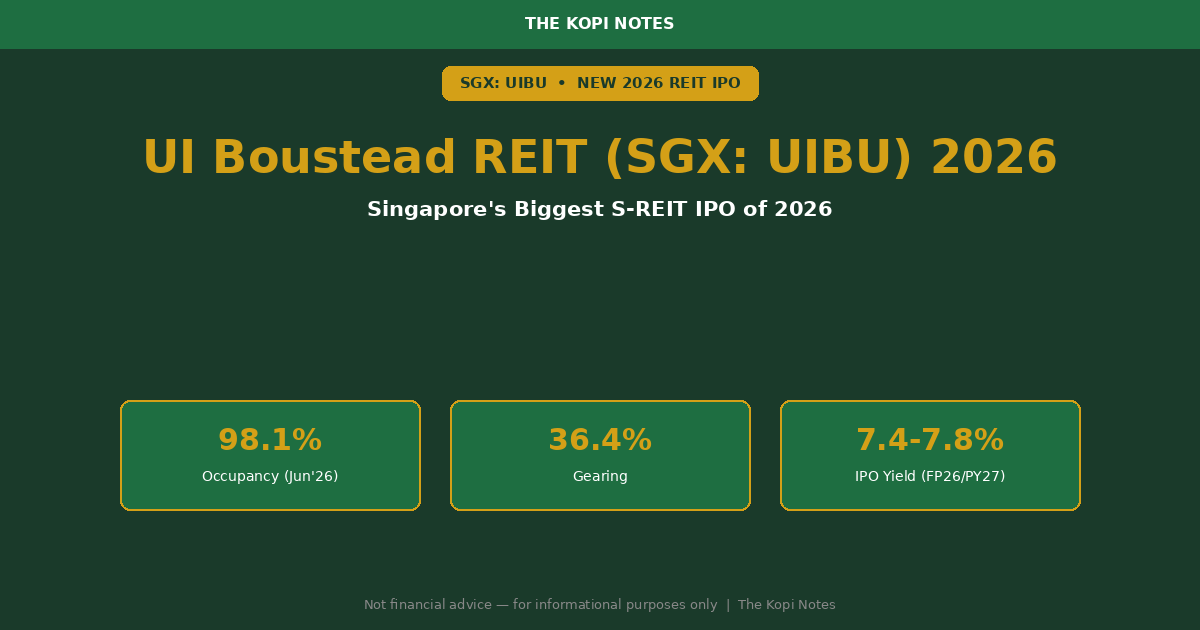
UI Boustead REIT (SGX: UIBU) listed on the Mainboard of the Singapore Exchange on 12 March 2026 at S$0.88 per unit, raising approximately S$973.6 million — the largest Singapore REIT listing of 2026 so far. Formed through a partnership between Unified Industrial (an industrial and logistics real estate platform focused on Japan and China) and Boustead Projects Limited (the real estate arm of SGX-listed Boustead Singapore Limited), the REIT invests in logistics, industrial, high-specifications industrial, and business space assets across Singapore and Japan.
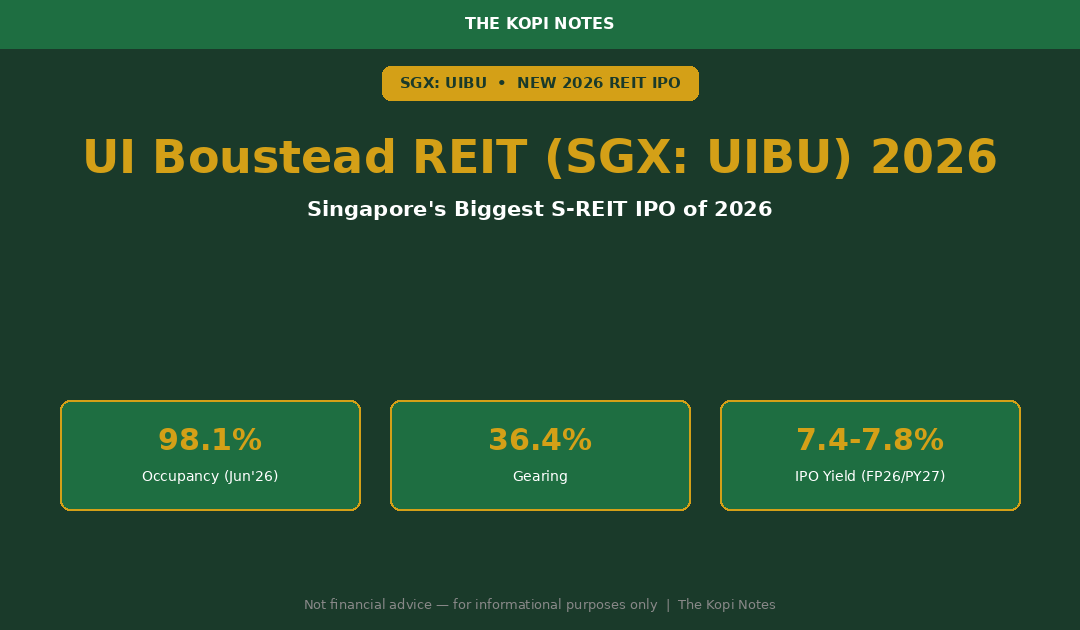
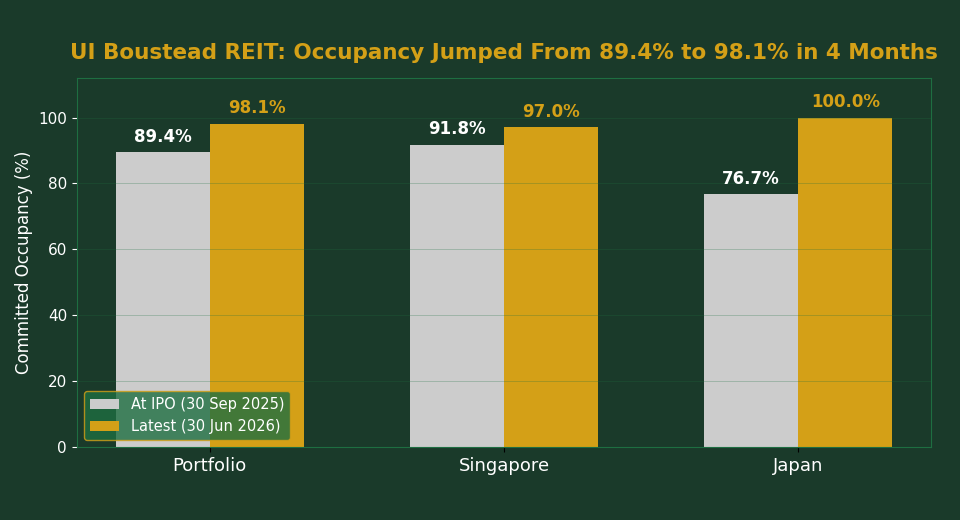
Four and a half months after listing, the numbers have moved fast: committed portfolio occupancy jumped from 89.4% at IPO (30 September 2025) to 98.1% as at 30 June 2026, and Japan’s portfolio occupancy went from 76.7% to a full 100%. Two brokers initiated or maintained Buy calls in the past week alone. This guide covers the sponsor, the portfolio, the numbers that matter, the growth pipeline, the risks, and how to actually buy units if you decide UIBU deserves a place in your portfolio.
Table of Contents
Contents — Click to expand
- What Is UI Boustead REIT?
- Portfolio at a Glance: 23 Properties, S$1.9B
- Occupancy & Leasing Momentum
- Financial Performance: DPU, Yield & NPI
- Gearing & Capital Management
- Growth Pipeline: ROFR, Co-Investments & AEIs
- Key Risks to Understand
- Analyst Views: Is UIBU a Buy?
- How to Buy UI Boustead REIT Units
- Frequently Asked Questions
What Is UI Boustead REIT?
UI Boustead REIT is a real estate investment trust mandated to invest in logistics, industrial, high-specifications (“Hi-Specs”) industrial, and business space assets across the Asia Pacific region, with an initial focus on Singapore and Japan. It is the first REIT to bring together a dedicated Japan-and-China industrial platform (Unified Industrial) with a well-known Singapore industrial developer (Boustead Projects) under one sponsor structure, UIB Holdings — 80% owned by Unified Industrial and 20% owned by Boustead Projects Limited.
Boustead Projects Limited is the real estate solutions arm of Boustead Singapore Limited (SGX: F9D), an infrastructure-related engineering and technology group with a market capitalisation of roughly S$943.8 million — giving UIBU’s Singapore leg a recognisable, long-track-record parent. Unified Industrial brings the Japan sourcing capability, which matters because 84% of the sponsor’s US$5.9 billion acquisition pipeline (by value) sits in Japan.
Following listing, the Sponsor and Boustead Projects Limited together hold a combined 19% stake in UI Boustead REIT. That sponsor stake is on the lower side versus some peers, which is one of the points independent research houses have flagged as worth watching (more in the Key Risks section below). Portfolio and sponsor details in this section are drawn from the REIT’s IPO prospectus (dated 5 March 2026) as summarised in independent broker research.
Portfolio at a Glance: 23 Properties, S$1.9 Billion
The IPO portfolio comprised 23 properties — 21 in Singapore and 2 in Japan — with an agreed property value of approximately S$1.9 billion as at 30 September 2025. Singapore accounts for 71.2% of portfolio value and Japan the remaining 28.8%. Total gross floor area (GFA) is about 5.9 million sq ft, with net lettable area (NLA) of approximately 5.3 million sq ft.
| Metric | Figure (as at 30 Sep 2025 IPO base, unless noted) |
|---|---|
| Listing date | 12 March 2026, SGX Mainboard |
| IPO price | S$0.88 per unit |
| IPO size | ~S$973.6 million raised — largest SGX listing of 2026 to date |
| Number of properties | 23 (21 Singapore, 2 Japan) |
| Agreed property value | ~S$1.9 billion |
| Portfolio split by value | Singapore 71.2% / Japan 28.8% |
| GFA / NLA | ~5.9 million sq ft / ~5.3 million sq ft |
| Portfolio WALE (30 Jun 2026) | 5.4 years (Singapore 4.9 years, Japan 7.5 years) |
| High-tech / value-add tenant mix | ~65.9% of gross rental income (Jun 2026) |
Singapore assets sit near strategic hubs — Changi Airport, one-north, Seletar Aerospace Park, and the Tuas industrial corridor. The two Japan assets are UIB Konan Phase 2, an institutional-grade logistics facility in Shiga Prefecture (Kansai region), and the Toyo MK Fuso Building, a business space property in Tokyo’s Koto Ward. Roughly 65.9% of gross rental income now comes from tenants in high-technology, value-add, and innovative sectors — electronics and IT, automotive, aerospace, life sciences, and precision engineering — the kind of tenants that need purpose-built space and tend to stay put once they move in.
Key anchor tenants at IPO included a leading aircraft manufacturer’s APAC HQ (8.6% of NPI), a global technology company (8.4%), GlaxoSmithKline’s Asia Commercial Hub (7.8%), the AUMOVIO R&D Centre (6.2%), and Rolls-Royce Solutions Asia’s regional HQ (4.9%). By June 2026, the top 10 tenants — all Fortune 500 or listed multinationals, with an average relationship of over a decade with the Sponsor — contributed 47% of net property income (NPI), with an average WALE of 7.8 years among that group specifically.
Occupancy & Leasing Momentum
The single most important development since listing is occupancy. Stabilised committed portfolio occupancy reached 98.1% as at 30 June 2026, up from 89.4% at the IPO reference date (30 September 2025) — a 8.7 percentage point improvement in under ten months, and most of that gain came within the four months after listing.
Japan drove the sharpest improvement: occupancy there went from 76.7% to a full 100.0%, powered by the successful lease-up of UIB Konan Phase 2 (helped by new leases with reputable e-commerce, distribution, and logistics tenants, including expansion from Nippon Express) and the Toyo MK Fuso Building, whose committed occupancy recovered to 100.0% by 20 February 2026 after its major tenant vacated following a corporate restructuring. The Singapore portfolio rose to 97.0%, supported partly by a new lease with a globally renowned fast-food chain establishing its Singapore HQ at 26 Tai Seng Street.
Leasing momentum has also produced positive rental reversion — leases renewing in Singapore reverted 2.6% higher during the period to June 2026. Looking ahead, only 11.2% of gross rental income is due for renewal for the rest of FY2027, and 78% of that is already in advanced negotiations. Portfolio WALE stood at 5.4 years as at 30 June 2026 (Singapore 4.9 years, Japan a much longer 7.5 years), with the top 10 tenants averaging a longer 7.8-year WALE — the REIT’s largest, stickiest relationships are also its longest-dated.
Financial Performance: DPU, Yield & NPI
At IPO, UI Boustead REIT forecast an annualised distribution yield of 7.4% for the Forecast Period 2026 (FP2026, the two months from 1 February to 31 March 2026) and 7.8% for Projection Year 2027 (PY2027), at the S$0.88 IPO price. Organic DPU growth of 4.8% from annualised FP2026 to PY2027 is expected to come from built-in rental escalations (2.8 percentage points), occupancy uplift (1.7 points), and positive rental reversions (0.3 points) — notably, none of this factors in acquisitions, which means any accretive deal from the sponsor pipeline would be additive to these numbers.
From listing (12 March 2026) to 30 June 2026, net property income (NPI) came in at S$29.2 million, about 4.3% below the IPO forecast — mainly due to a weaker Japanese yen and a lease-commencement delay at UIB Konan Phase 2 that has since been resolved. Offsetting this, the REIT’s share of results from joint ventures was S$3.3 million, some 30.3% above forecast, boosted by better-than-expected performance at the Razer SEA HQ and 6 Tampines Industrial Avenue 5 joint ventures.
At the current unit price of roughly S$0.81 (late July 2026), Maybank Research estimates a forward DPU yield of 8.4% for FY2027E and 8.8% for FY2028E — meaningfully higher than the IPO-price yield simply because the unit price has fallen from the S$0.88 IPO level while the distribution outlook has held up. Figures above are drawn from the REIT’s business update to 30 June 2026 and Maybank Research’s 29 July 2026 report.
Gearing & Capital Management
UI Boustead REIT started life at 37.9% aggregate leverage at IPO and has since delevered slightly to 36.4% as at 30 June 2026 — comfortably within MAS’s 50% regulatory gearing cap for S-REITs, leaving roughly S$230 million of debt headroom at IPO. Gearing is projected to rise to about 38.6% once the REIT’s two committed development co-investments are funded, which would still sit well inside the regulatory limit.
The REIT’s debt book is conservatively managed: all-in cost of debt is 2.4-2.5% per annum, interest coverage ratio (ICR) stands at a healthy 5.0x (versus a projected 4.7x for FY2027 at IPO), and 67-80% of borrowings are on fixed rates, limiting near-term sensitivity to interest rate moves. No debt refinancing is required until FY2029, giving management a long runway before the next maturity wall.
Growth Pipeline: ROFR, Co-Investments & AEIs
UI Boustead REIT benefits from a right of first refusal (ROFR) over the Sponsor’s stabilised, income-producing logistics, industrial, Hi-Specs industrial, and business space assets across the Asia Pacific — a pipeline worth over US$5.9 billion, of which 84% (about US$4.99 billion) sits in Japan. A near-term acquisition candidate already flagged is 36 Tuas Road, a five-storey ramp-up logistics facility completed in February 2025 and valued at roughly S$220.0 million, leased to a global apparel brand and a multinational logistics solutions provider.
Beyond ROFR acquisitions, the REIT has committed to two co-development projects: UIB Konan Phase 3 in Japan (a 24.26% stake, S$20.8 million total investment, S$7.3 million capital commitment, roughly 70% pre-leased, targeted for mid-2027 completion), and a built-to-suit aerospace facility at Seletar Aerospace Park in Singapore (51% stake, S$53.9 million total investment, S$17.9 million capital commitment, targeted for mid-2028). Combined, these total S$74.7 million — just 3.9% of deposited property, well inside the 10% development limit for Singapore REITs.
On the asset enhancement front, the REIT has kicked off a S$2.6 million AEI at 84 Boon Keng Road, converting it from single-tenanted to multi-tenanted use, with 40% of the space already pre-committed ahead of a targeted end-2026 completion. Separately, AUMOVIO issued a termination notice for its lease at AUMOVIO Building Phase 3 (vacating 29 May 2026); the REIT has a S$3.0 million AEI planned there too, converting the building to multi-tenant use over a roughly 12-month downtime.
For context on scale, UI Boustead REIT sits mid-pack among Singapore’s industrial and logistics REITs — roughly twice the size of Sabana REIT (also known as Alpha Integrated REIT), and about a fifth the size of Mapletree Industrial Trust. Its 5.8-year WALE at IPO was the longest among its six SGX-listed industrial/logistics peers (2.7 to 4.6 years), a group that also includes Mapletree Logistics Trust.
Key Risks to Understand
Concentrated two-market exposure. The portfolio is exclusively industrial, logistics, and business space assets in just two markets — Singapore and Japan. Both are developed economies with strong fundamentals, but the REIT carries none of the geographic diversification that a pan-Asian or global industrial REIT would have.
Short Singapore land leases. Thirteen of the 21 Singapore properties have remaining lease tenure of less than 30 years — typical for JTC industrial land, but these 13 properties generated 61.4% of the portfolio’s FY2025 operating profit. Lease decay affects both income duration and eventual valuation.
Foreign exchange risk. With 28.8% of portfolio value in Japan, distributions are exposed to SGD/JPY movements. Maybank estimates every 10% depreciation in the yen against the Singapore dollar reduces FY2027 distributions by about 2.6%. Weak JPY was already cited as a factor behind the 4.3% NPI shortfall versus IPO forecast in the first stub period.
Tenant concentration and lease expiry. Around 38.5% of tenants by gross rental income have balance leases of less than three years, and the REIT has already seen one major tenant (AUMOVIO) issue a termination notice at one property. Any failure to renew major leases on favourable terms, or unexpected vacancies, would directly hit distributable income.
Relatively low sponsor stake. At 19% combined, the Sponsor and Boustead Projects Limited hold a lower stake than unitholders might prefer for full alignment of interests — independent research has flagged this as a point to monitor, even though the ROFR pipeline still provides a credible growth runway regardless of sponsor ownership level.
Analyst Views: Is UIBU a Buy?
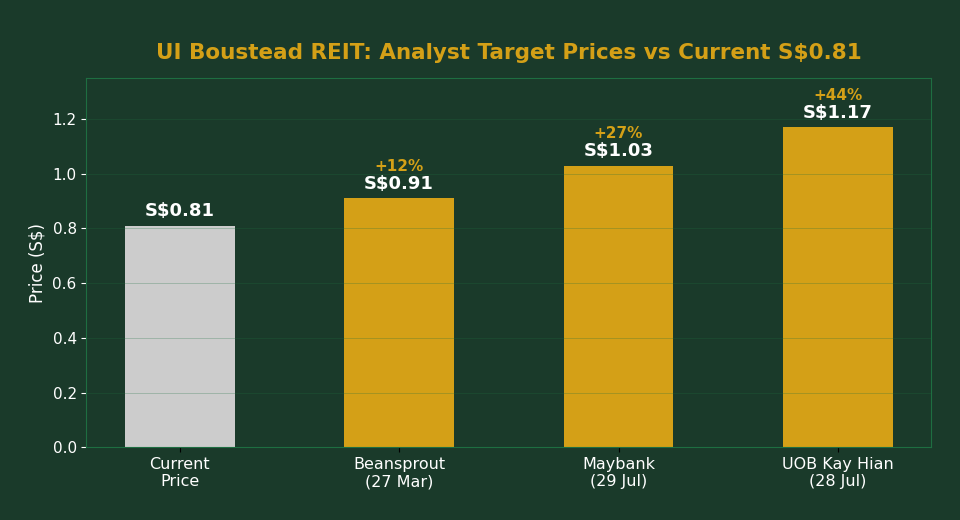
Coverage has grown quickly since listing. Beansprout initiated at Neutral with a S$0.91 target price back on 27 March 2026, using a dividend discount model and flagging the REIT’s smaller scale, shorter lease tenures, and lower sponsor stake as reasons for caution despite an above-average yield. As occupancy and operating momentum built through mid-2026, sentiment turned more constructive: UOB Kay Hian holds a Buy rating with a S$1.17 target price (as at 28 July 2026), and Maybank Research initiated a Buy call on 29 July 2026 with a S$1.03 target price, implying roughly 27% upside from the then-prevailing S$0.81 unit price.
The bull case rests on the occupancy turnaround being real and sustained, a long WALE that locks in income visibility, and a sizeable ROFR pipeline for future accretive acquisitions. The bear case rests on FX drag from the yen, shorter Singapore land leases, and a still-unproven track record given the REIT is barely five months old as a listed entity. UI Boustead REIT is one of several genuinely new S-REIT listings from the 2025-2026 IPO wave — alongside Centurion Accommodation REIT, which debuted in September 2025 as Singapore’s first Living Sector REIT. We covered UIBU’s IPO ahead of listing in our March 2026 S$1B Singapore REIT IPO preview, and the occupancy and analyst-coverage progress since then has been one of the more notable REIT stories of the year.
How to Buy UI Boustead REIT Units
UI Boustead REIT trades on the SGX Mainboard under ticker UIBU, so it can be bought through any broker offering SGX access — FSMOne, moomoo, Interactive Brokers, Tiger Brokers, or the local bank brokerages (DBS Vickers, OCBC Securities, UOB Kay Hian). Since it’s a REIT rather than a unit trust or ETF, Endowus and Syfe won’t give you direct access to UIBU itself, but both are worth having in your toolkit for the cash management and diversified fund side of a REIT-heavy portfolio, and either is a reasonable place to start if you’re building out your broader Singapore investing stack alongside a direct SGX brokerage.
Before buying any REIT — including UIBU — it’s worth checking how its leverage compares to peers and to MAS’s 50% regulatory ceiling. Our free S-REIT Gearing Ratio & ICR Calculator lets you plug in any REIT’s debt and property value figures to see exactly where it sits.
Frequently Asked Questions
What does UI Boustead REIT (UIBU) own?
UI Boustead REIT owns 23 logistics, industrial, Hi-Specs industrial, and business space properties across Singapore (21 assets, 71.2% of value) and Japan (2 assets, 28.8% of value), with an agreed property value of approximately S$1.9 billion as at 30 September 2025.
When did UI Boustead REIT list on SGX?
UI Boustead REIT listed on the Mainboard of the Singapore Exchange on 12 March 2026 at S$0.88 per unit, raising approximately S$973.6 million — the largest Singapore REIT IPO of 2026 to date.
Who is the sponsor of UI Boustead REIT?
The Sponsor, UIB Holdings, is 80% owned by Unified Industrial (a Japan/China-focused industrial and logistics real estate platform) and 20% owned by Boustead Projects Limited, the real estate arm of SGX-listed Boustead Singapore Limited (SGX: F9D).
What is UI Boustead REIT's dividend yield?
At IPO, the REIT forecast an annualised distribution yield of 7.4% for FP2026 and 7.8% for PY2027 at the S$0.88 IPO price. At the lower current unit price of around S$0.81 (late July 2026), Maybank Research estimates a forward yield of 8.4% for FY2027E and 8.8% for FY2028E.
How has UI Boustead REIT's occupancy changed since listing?
Committed portfolio occupancy rose from 89.4% as at 30 September 2025 (the IPO reference date) to 98.1% as at 30 June 2026. Japan occupancy specifically went from 76.7% to a full 100.0% over the same period.
What is UI Boustead REIT's gearing ratio?
Aggregate leverage was 37.9% at IPO and has since eased to 36.4% as at 30 June 2026, well within MAS’s 50% regulatory gearing cap for Singapore REITs. Gearing is projected to rise to about 38.6% once current development co-investments are funded.
What are the main risks of investing in UI Boustead REIT?
Key risks include concentrated exposure to just two markets (Singapore and Japan), foreign exchange risk from the Japanese yen, relatively short remaining lease tenure on 13 of 21 Singapore properties, tenant concentration (38.5% of gross rental income has under 3 years remaining on leases), and a relatively low 19% combined sponsor stake.
What do analysts think of UI Boustead REIT?
Coverage has grown more positive as operating metrics improved: Beansprout initiated at Neutral with a S$0.91 target (27 March 2026), UOB Kay Hian holds a Buy rating with a S$1.17 target (28 July 2026), and Maybank Research initiated a Buy call with a S$1.03 target (29 July 2026) — implying roughly 27% upside from the S$0.81 price at the time.
How can I buy UI Boustead REIT units?
UIBU trades on the SGX Mainboard and can be bought through any broker with SGX market access, including FSMOne, moomoo, Interactive Brokers, Tiger Brokers, or the local bank brokerages. It is a REIT rather than a fund, so robo-advisors like Endowus and Syfe do not offer direct access to it, though they remain useful for the broader fund and cash management side of a portfolio.
Data and figures in this article are sourced from UI Boustead REIT’s IPO prospectus (dated 5 March 2026), company business updates, and third-party broker research (Beansprout, Maybank Research, UOB Kay Hian) as cited throughout. Prices and analyst targets are as at late July 2026 and will move over time. This article is not financial advice — always verify current figures via SGX/company announcements before investing.
This article was researched with the help of AI. While we strive to keep all information accurate and up to date, there may be errors. If you notice any discrepancies, please contact us.