Centurion Accommodation REIT 2026: Singapore’s First Living Sector REIT (SGX: 8C8U) — Complete Investor Guide
Inside the S$2 billion sponsor-backed REIT combining workers’ accommodation in Singapore with student housing in the UK and Australia.
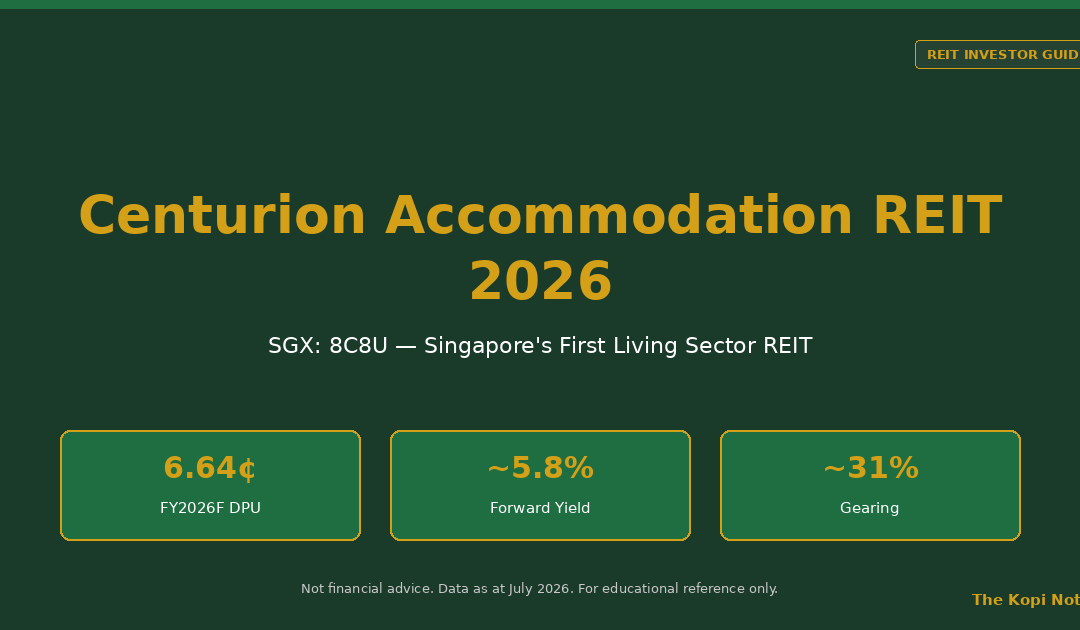
Centurion Accommodation REIT (SGX: 8C8U) is Singapore’s first pure-play Living Sector REIT, combining purpose-built workers’ accommodation (PBWA) in Singapore with purpose-built student accommodation (PBSA) in the UK and Australia. Listed in September 2025 at S$0.88 a unit, it now trades near S$1.14 and carries a forecast FY2026 distribution per unit (DPU) of 6.64 cents, backed by a 100% payout of distributable income.
Not financial advice. All figures are for educational reference only. Data as at July 2026 unless noted.
- CAREIT is SGX’s first and only Living Sector REIT — it owns worker dormitories in Singapore (PBWA) and student housing in the UK and Australia (PBSA), a sector no other S-REIT covers.
- FY2026F DPU of 6.64 cents works out to roughly a 5.8% yield at today’s ~S$1.14 price. Analysts expect DPU to jump 27.4% this year as a full year of distributions kicks in.
- Gearing sits at about 31% after the January 2026 Sydney acquisition — well under MAS’s 50% cap, but you should still watch dormitory regulation, land-lease renewal and GBP/AUD currency risk.
Table of Contents
Contents — Click to expand
- What Is Centurion Accommodation REIT?
- IPO Story and Sponsor Backing
- Portfolio Breakdown: 15 Properties, 3 Countries
- 1Q2026 Results: Beating the Prospectus Forecast
- DPU Forecast and Distribution Yield
- Gearing, ICR and Balance Sheet Health
- Share Price Performance Since IPO
- Analyst Ratings and Price Targets
- Key Risks to Watch
- CAREIT vs Other Accommodation-Adjacent S-REITs
- Is Centurion Accommodation REIT a Buy in 2026?
- Frequently Asked Questions
What Is Centurion Accommodation REIT?
Centurion Accommodation REIT (CAREIT, SGX: 8C8U) is Singapore’s first — and so far only — pure-play Global Living Sector REIT. That is a technical term for a REIT that invests in “living” real estate: places where people actually reside for extended periods, rather than offices, malls or warehouses.
CAREIT does this through two segments you have probably never seen combined before:
- Purpose-Built Workers’ Accommodation (PBWA) — dormitories in Singapore that house the migrant workforce behind construction, marine and manufacturing sites.
- Purpose-Built Student Accommodation (PBSA) — modern student housing in the UK and Australia, serving university towns with chronic bed shortages.
Both segments share the same investment logic: structural undersupply, long operating leases, and tenants who need a bed regardless of what the stock market is doing. That is the pitch. It is also why CAREIT’s IPO in September 2025 was one of the most anticipated S-REIT listings of the year — and why, nearly a year on, it is still the only game in town for this asset class on SGX.
IPO Story and Sponsor Backing
CAREIT listed on the SGX Mainboard on 25 September 2025 at an offer price of S$0.88 per unit, raising approximately S$771.1 million and implying a portfolio valuation of roughly S$1.5 billion at listing. The IPO drew heavy demand — the public offer tranche was reported to be around 30.9 times subscribed.
The sponsor is Centurion Corporation Limited (see CAREIT Investor Relations for full disclosures), a listed operator that has run workers’ and student accommodation assets for over a decade before spinning part of its portfolio into CAREIT. Centurion retains a significant post-IPO stake of roughly 42.8%–45.8%, which keeps its interests aligned with unitholders — if the REIT does well, so does its largest shareholder.
That sponsor track record matters for a young REIT. Under Centurion’s stewardship, the pre-IPO portfolio posted rental reversions of 26.3% CAGR for PBWA assets and 11.3% CAGR for PBSA assets between FY2022 and FY2024 — a period when Asia-Pacific labour shortages and post-pandemic student intake both drove demand for beds higher.
Portfolio Breakdown: 15 Properties, 3 Countries
As at July 2026, CAREIT owns 15 properties worth roughly S$2.12–2.18 billion, spread across three countries. The portfolio grew from its 14-asset IPO base after CAREIT completed a forward purchase of EPIISOD Macquarie Park, a purpose-built student accommodation asset in Sydney, in January 2026.
| Segment | Country | Assets | Occupancy (1Q2026) |
|---|---|---|---|
| PBWA (Workers’ Accommodation) | Singapore | 5 | 94.0% |
| PBSA (Student Accommodation) | United Kingdom | 8 | 99.0% |
| PBSA (Student Accommodation) | Australia | 2 (incl. EPIISOD Macquarie Park, Jan 2026) | 97.5% |
Source: CAREIT 1Q2026 Business Update, IPO Prospectus (Sept 2025)
The Singapore PBWA assets are the REIT’s original engine — dormitories that shelter the migrant workforce building Singapore’s construction, marine and process sectors. Demand here is structural: Singapore does not have enough purpose-built dormitory beds for its foreign workforce, and new supply is slow because land for this use is scarce and tightly zoned.
The UK and Australian PBSA assets diversify CAREIT away from a single-country, single-currency risk. UK university towns have chronic student housing shortages of their own, and the Sydney acquisition gives CAREIT a foothold in Australia’s growing international-student market. That said, this also means a chunk of CAREIT’s income arrives in British pounds and Australian dollars, which we cover in the risks section below.
1Q2026 Results: Beating the Prospectus Forecast
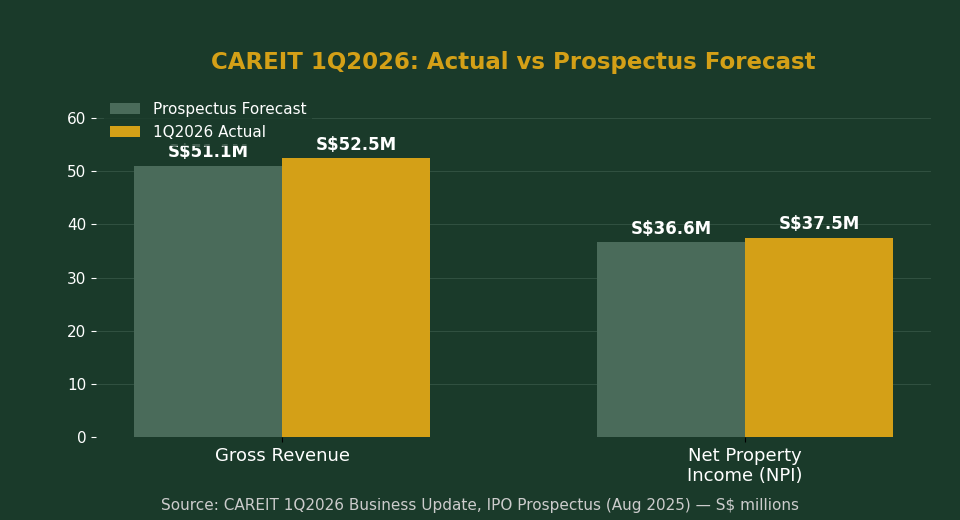
CAREIT reported its first full quarter under public ownership in May 2026, covering the three months to 31 March 2026. The headline: it beat its own IPO prospectus forecast on every major line.
| Metric | 1Q2026 Actual | Prospectus Forecast | Beat |
|---|---|---|---|
| Gross Revenue | S$52.5 million | S$51.1 million | +2.7% |
| Net Property Income (NPI) | S$37.5 million | S$36.6 million | +2.4% |
| PBWA Occupancy (Singapore) | 94.0% | 93.1% | +0.9pp |
| PBSA Occupancy (UK) | 99.0% | 97.4% | +1.6pp |
| PBSA Occupancy (Australia) | 97.5% | 96.7% | +0.8pp |
Source: CAREIT 1Q2026 Business Update (May 2026)
Beating a prospectus forecast in your very first reported quarter is a meaningful signal for a newly listed REIT — it means management under-promised rather than over-promised at IPO, which is exactly what you want to see before trusting a REIT’s forward guidance. Singapore PBWA retention came in at 79.4%, a healthy figure for a segment where worker headcount tracks construction and shipyard activity.
DPU Forecast and Distribution Yield
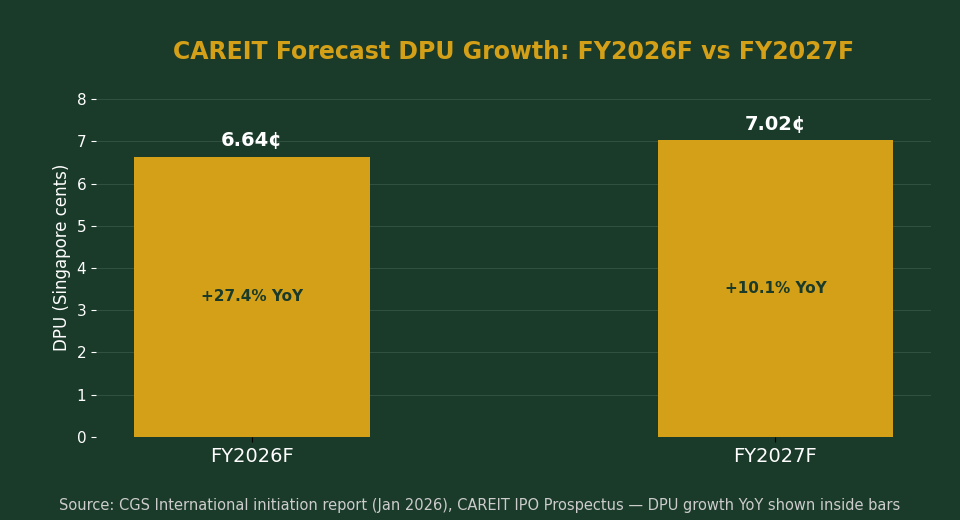
CAREIT has committed to paying out 100% of distributable income for FY2026 and FY2027 — a common move for young REITs trying to build a track record with income investors. According to the IPO prospectus and a January 2026 initiation report from CGS International, forecast DPU works out to:
| Financial Year | Forecast DPU | YoY Growth | Yield at IPO Price (S$0.88) | Yield at ~S$1.14 (Jul 2026) |
|---|---|---|---|---|
| FY2026F | 6.64 cents | +27.4% | 7.54% | ~5.83% |
| FY2027F | 7.02 cents | +10.1% | 7.98% | ~6.16% |
Source: CAREIT IPO Prospectus (Aug 2025), CGS International initiation report (21 Jan 2026)
Two numbers matter here, and they tell different stories. If you had bought at the IPO price of S$0.88, you would be looking at a forecast yield north of 7.5% for FY2026 — genuinely high for an SGX-listed REIT. But CAREIT’s unit price has risen about 30% since listing, so if you are buying today at roughly S$1.14, your forward yield compresses to around 5.8%. That is still respectable, but it is no longer the standout figure that drove the IPO’s 30x subscription.
The FY26F DPU jump of 27.4% mostly reflects a full 12 months of income versus the partial stub period CAREIT earned between its September 2025 listing and its first financial year-end. FY27F growth of 10.1% is the more “normal” run-rate figure, driven by contracted rental step-ups and the newly acquired Sydney asset contributing a full year.
Gearing, ICR and Balance Sheet Health
CAREIT listed with conservative gearing of just 20.9% — low even by S-REIT standards. That headroom was deliberate: it let CAREIT fund the January 2026 EPIISOD Macquarie Park acquisition partly with debt without straining its balance sheet.
For context, the Monetary Authority of Singapore (MAS) caps all S-REITs at a single aggregate leverage limit of 50%, with a minimum interest coverage ratio (ICR) of 1.5x now required of every REIT regardless of gearing level (see MAS’s 2024 REIT leverage rationalisation). At roughly 31% gearing, CAREIT sits comfortably below that threshold, giving it room to fund further bolt-on acquisitions — a growth lever many more mature, more heavily geared S-REITs no longer have.
The parent, Centurion Corporation, separately reports a net gearing ratio of about 22% and an interest coverage ratio of 5.3x at the group level, with S$340.8 million in cash reserves — a reasonably strong sponsor balance sheet standing behind CAREIT if it ever needs support.
Share Price Performance Since IPO
CAREIT units have performed strongly since the September 2025 listing. As at 27 July 2026, the unit traded at S$1.14, within a 52-week range of S$0.95 to S$1.20 — up roughly 30% from the S$0.88 IPO price.
| Metric | Value |
|---|---|
| IPO Price (25 Sep 2025) | S$0.88 |
| Price as at 27 Jul 2026 | S$1.14 |
| 52-Week Range | S$0.95 – S$1.20 |
| Market Capitalisation | ~S$2.02 billion |
| Units Outstanding | ~1.72 billion |
Source: StockAnalysis.com, delayed SGX pricing data, 27 July 2026
That price appreciation is a double-edged sword for anyone considering CAREIT today. It confirms the market has warmed to the Living Sector story — but it also means the entry yield is meaningfully lower than what early IPO investors locked in. If you are buying now, you are paying up for a REIT the market has already re-rated once.
Analyst Ratings and Price Targets
CAREIT has quickly attracted broker coverage since its listing. As at July 2026 (per StockAnalysis.com delayed pricing data), the analyst consensus stood at Strong Buy from 5 analysts, with an average 12-month price target of S$1.35 — about 18.4% above the then-prevailing price.
CGS International initiated coverage in January 2026 with an “Add” rating and a S$1.38 target, citing strong dividend growth prospects, asset enhancement opportunities and CAREIT’s status as the only pure-play living-sector REIT on SGX. The house flagged the same risks worth watching that we cover below: dormitory regulation, land-lease renewal, foreign worker and student policy shifts, and currency exposure.
As always, treat analyst price targets as informed estimates, not guarantees — CAREIT has only a few quarters of public trading history, so forecasts still carry more uncertainty than they would for a REIT with a decade-long track record.
Key Risks to Watch
CAREIT’s story is compelling, but no REIT is risk-free. Here is what could go wrong:
- Dormitory regulation. Singapore’s PBWA sector is subject to government rules on worker density, quarantine facilities and living standards. Tighter regulation — as seen during COVID-19 — could raise operating costs or cap bed capacity.
- Land lease renewal. Some PBWA sites in Singapore sit on state land with finite leases. Non-renewal or unfavourable renewal terms on any site would shrink CAREIT’s Singapore income base.
- Foreign worker and student policy shifts. Singapore’s foreign workforce quotas and the UK/Australia’s international student visa policies both directly drive occupancy. A policy tightening in any of the three countries would hit demand.
- Currency exposure. UK and Australian income arrives in GBP and AUD before being converted to SGD for distribution. A weaker pound or Aussie dollar would shrink the SGD value of those distributions, even if local rental income is unchanged.
- Short track record. CAREIT has been public for less than a year. Its resilience through a full economic cycle — a downturn in construction activity, or a slump in international student enrolment — remains untested.
None of these are dealbreakers on their own, but together they explain why CAREIT still trades at a meaningfully higher forecast yield than blue-chip, decade-old S-REITs like CapitaLand Ascendas REIT or Mapletree Industrial Trust — the market is pricing in some execution and regulatory uncertainty that comes with being new.
CAREIT vs Other Accommodation-Adjacent S-REITs
No other SGX REIT does exactly what CAREIT does, but a few S-REITs sit in adjacent “people need somewhere to stay” categories. Here is how they stack up:
| REIT | Sector | Gearing | Approx. Forward Yield |
|---|---|---|---|
| Centurion Accommodation REIT | Worker + student accommodation (SG/UK/AU) | ~31% | ~5.8% (FY26F) |
| CDL Hospitality Trusts | Hotels (8-country portfolio) | ~40% | ~6.2% |
| Far East Hospitality Trust | Hotels + serviced residences (Singapore) | ~31% | ~6.8% |
| United Hampshire US REIT | US self-storage + grocery-anchored retail | ~40% | ~8.8% |
Source: The Kopi Notes internal estimates and cited articles, July 2026. Figures rounded, subject to change.
The comparison is useful mainly to show why CAREIT is genuinely different, not to suggest they are interchangeable. Hotels and serviced residences (CDL Hospitality, Far East Hospitality) earn revenue per available room that swings with tourism cycles. CAREIT’s PBWA and PBSA beds are contracted on longer leases with structurally undersupplied demand — closer in spirit to Digital Core REIT’s data-centre niche than to a traditional hotel REIT, in the sense that both occupy a thematic pocket the rest of the S-REIT universe does not cover.
Is Centurion Accommodation REIT a Buy in 2026?
CAREIT earns a cautious thumbs-up for the right kind of investor. You get exposure to a genuinely uncovered niche — worker and student accommodation — with structural demand tailwinds, a sponsor with real operating history, low starting gearing, and a track record so far of beating its own IPO forecasts. Analyst sentiment is strongly positive, with a Strong Buy consensus and price targets implying further upside from current levels.
The trade-off: at ~S$1.14, you are no longer buying at the ~7.5% yield that made the IPO attractive — you are buying closer to 5.8%, competitive with, but not dramatically better than, several more established S-REITs. You are also taking on currency risk (GBP/AUD), regulatory risk specific to dormitories, and the general uncertainty that comes with any REIT under a year old.
If you want a growth-oriented REIT with a differentiated, defensively positioned income stream and are comfortable holding through CAREIT’s first full economic cycle, it is worth a starter position. If you specifically need the highest possible entry yield today, several more seasoned S-REITs — the kind our Best S-REITs in Singapore 2026 guide ranks by yield — may suit you better.
Before buying any REIT, it helps to check whether it is trading above or below its net asset value. Our S-REIT P/NAV Calculator lets you do that in seconds using CAREIT’s own reported NAV per unit.
Frequently Asked Questions
What does Centurion Accommodation REIT (SGX: 8C8U) own?
CAREIT owns 15 properties across three countries: five purpose-built workers’ accommodation (PBWA) assets in Singapore, and ten purpose-built student accommodation (PBSA) assets across the UK and Australia, worth roughly S$2.12–2.18 billion in total.
When did Centurion Accommodation REIT list on SGX?
CAREIT listed on the SGX Mainboard on 25 September 2025 at an offer price of S$0.88 per unit, raising approximately S$771.1 million.
What is CAREIT's forecast dividend yield?
The prospectus and broker estimates put FY2026F DPU at 6.64 cents (about 7.5% yield at the S$0.88 IPO price). At the current price of roughly S$1.14 (July 2026), that works out to a forward yield of about 5.8%.
Is Centurion Accommodation REIT the same as Centurion Corporation?
No. Centurion Corporation Limited is the sponsor and largest unitholder (holding roughly 42.8%–45.8% of CAREIT), but CAREIT is a separately listed REIT with its own SGX ticker (8C8U) and its own unitholders.
What is the difference between PBWA and PBSA?
PBWA stands for Purpose-Built Workers’ Accommodation — dormitories for migrant workers, which CAREIT owns in Singapore. PBSA stands for Purpose-Built Student Accommodation — modern student housing, which CAREIT owns in the UK and Australia.
How geared is Centurion Accommodation REIT?
CAREIT’s gearing was 20.9% at IPO and rose to approximately 31.0% after the January 2026 acquisition of EPIISOD Macquarie Park in Sydney — well within MAS’s 50% aggregate leverage limit for S-REITs.
Did CAREIT beat its 1Q2026 forecast?
Yes. CAREIT reported 1Q2026 gross revenue of S$52.5 million (2.7% above its prospectus forecast) and net property income of S$37.5 million (2.4% above forecast), with occupancy across all three segments also beating forecast.
What are the main risks of investing in Centurion Accommodation REIT?
Key risks include tighter dormitory regulation in Singapore, non-renewal of land leases, changes to foreign worker or international student policy in Singapore, the UK or Australia, GBP/AUD currency exposure, and CAREIT’s short public track record of under a year.
When does Centurion Accommodation REIT release its 1H2026 results?
CAREIT’s unaudited results for the six months ended 30 June 2026 are scheduled for release on 5 August 2026, after this article’s July 2026 publish date.
This article was researched with the help of AI. While we strive to keep all information accurate and up to date, there may be errors. If you notice any discrepancies, please contact us.