USD Corporate Bond ETFs for Singapore Investors: LQD vs LQDA vs VUCP (2026 Guide)
A Singapore investor’s guide to buying US-dollar investment-grade corporate bond ETFs — costs, withholding tax and the US estate tax angle most guides skip.
LQD (US-listed, TER 0.14%) is the cheapest way to buy USD investment-grade corporate bonds, but it exposes you to US estate tax above USD 60,000. LQDA and VUCP are Ireland-domiciled UCITS ETFs tracking similar corporate bond indices, listed on the London Stock Exchange, with no US estate tax exposure. For most Singapore investors, that estate tax risk outweighs LQD’s lower fee once your bond allocation grows past a modest size.
Not financial advice. All figures are for educational reference only. Data verified as at 16-18 September 2026 unless otherwise noted.
- LQD has the lowest TER (0.14%) but is a US-situs asset — non-resident aliens face US estate tax above a USD 60,000 exemption.
- LQDA (iShares, TER 0.20%) and VUCP (Vanguard, TER 0.07%) are Ireland-domiciled UCITS alternatives with the same estate tax exposure as CSPX or VWRA: none.
- Corporate bond interest is usually exempt from the 30% US dividend withholding tax that hits US equity ETFs — but the estate tax rule still applies to all three funds’ US listing status differently.
Quick Answer: Which Should You Buy?
If you’re building a small bond sleeve — say under USD 100,000 — LQD’s rock-bottom liquidity and 0.14% TER make it a reasonable pick. Once your corporate bond holding grows past that, the US estate tax exposure on LQD becomes a real number, not a theoretical one.
VUCP (Vanguard) is the cheapest UCITS option at 0.07% TER — even cheaper than LQD — while LQDA (iShares) tracks the same iBoxx USD Liquid Investment Grade Index that LQD uses, just wrapped in an Ireland-domiciled fund. For most Singapore investors who already hold CSPX or VWRA on the London Stock Exchange for the estate tax benefit, adding LQDA or VUCP keeps that same protection extended to the fixed income sleeve of the portfolio.
Key Differences at a Glance
All three funds hold US-dollar-denominated investment-grade corporate bonds, but they differ in domicile, listing, and total expense ratio (TER) — the annual fee that covers fund management, custody and administration. Here’s how the three compare as at mid-September 2026.
| Feature | LQD | LQDA | VUCP |
|---|---|---|---|
| Full Name | iShares iBoxx $ Investment Grade Corporate Bond ETF | iShares $ Corp Bond UCITS ETF | Vanguard USD Corporate Bond UCITS ETF |
| Exchange | NYSE Arca (US) | London Stock Exchange | London Stock Exchange |
| Domicile | USA | Ireland | Ireland |
| Index Tracked | Markit iBoxx USD Liquid Investment Grade Index | Markit iBoxx USD Liquid Investment Grade Index | Bloomberg Global Aggregate Corporate USD Index |
| TER | 0.14% p.a. | 0.20% p.a. | 0.07% p.a. |
| AUM | ~USD 32.0 billion (Sep 2026) | ~USD 9.5 billion (Jun 2026) | ~USD 4.7 billion (Aug 2026) |
| Structure | Distributing (monthly) | Accumulating or Distributing share class | Distributing (monthly) |
| Effective Duration | ~7.9 years | ~7.9 years (same index) | Similar, broader global mandate |
| Launch Date | 2002 | 2003 (LQDA share class) | 2016 |
Source: iShares.com, BlackRock LQDA fund fact sheet, Vanguard VUCP fund page, justETF — verified 16-18 September 2026.
Tax Comparison: Withholding Tax vs Estate Tax
Here’s where most comparisons of US vs UCITS bond ETFs get confused. Bond funds are taxed differently from equity funds — and the two tax risks you need to separate are withholding tax on income and estate tax on your entire holding.
Withholding tax on interest. Unlike stock dividends, a US-domiciled bond fund can usually pass through its interest income to non-US holders as an “interest-related dividend” under the regulated investment company (RIC) rules. That income is largely exempt from the standard 30% US withholding tax that applies to equity dividends. In practice, this means LQD does not carry the same 30% dividend-tax penalty that VOO does for a Singapore investor.
Estate tax is the real risk with LQD. Because LQD is listed in the US and classified as a US-situs asset, it counts toward the USD 60,000 exemption threshold that applies to non-resident aliens under IRS estate tax rules. Anything above that amount, across all your US-situs holdings combined, is taxed on a graduated schedule running from 18% up to 40%. LQDA and VUCP, both domiciled in Ireland and listed on the LSE, are not US-situs assets — they carry no US estate tax exposure at all, the same protection you already get from holding CSPX instead of VOO.
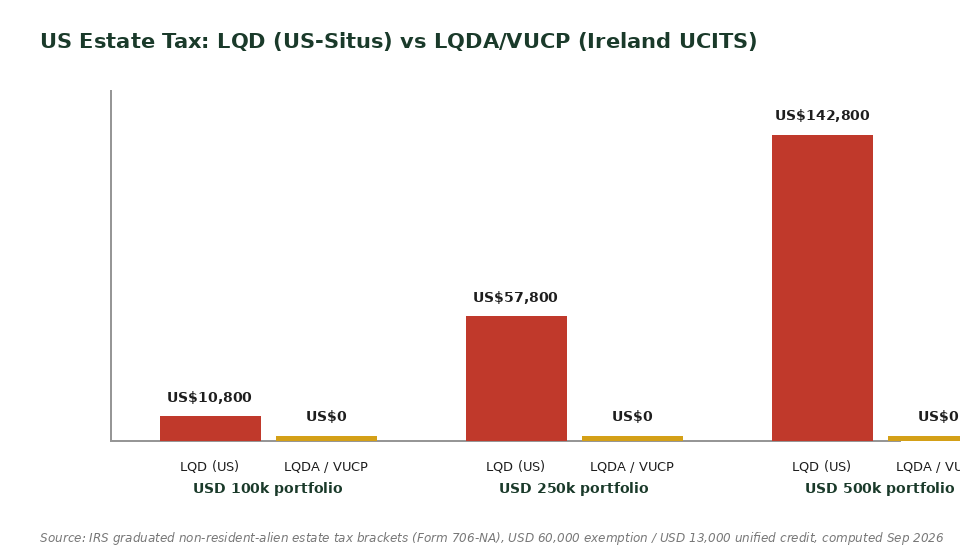
Here’s the real dollar impact. A Singapore investor holding USD 250,000 in LQD alone would face roughly USD 57,800 in US estate tax if they passed away while still holding it — computed using the IRS’s graduated non-resident-alien brackets (18% to 40% above the USD 60,000 exemption, less the USD 13,000 unified credit). Hold that same USD 250,000 in LQDA or VUCP instead, and the US estate tax bill is zero, because neither fund is a US-situs asset.
| Portfolio Size (USD) | Estate Tax if Held in LQD | Estate Tax if Held in LQDA or VUCP |
|---|---|---|
| 100,000 | ~USD 10,800 | USD 0 |
| 250,000 | ~USD 57,800 | USD 0 |
| 500,000 | ~USD 142,800 | USD 0 |
Source: IRS Form 706-NA graduated estate tax brackets applied to the USD 60,000 non-resident-alien exemption, computed September 2026. Assumes no other US-situs assets and no treaty relief — Singapore has no US estate tax treaty.
That last point matters: Singapore has no estate tax treaty with the US, so there’s no reduced rate or extra exemption to fall back on. This is the same mechanic covered in our US estate tax guide for Singapore investors — it just applies to your bond allocation the way it already applies to your equity ETFs.
Yield and Duration in a Post-FOMC World
The Fed hiked its policy rate to 3.75%-4.00% on 16 September 2026 — the first hike since 2023. That matters for corporate bond ETFs because bond prices move opposite to yields: when the Fed raises rates, existing bond prices fall and new yields rise. With an effective duration of roughly 7.9 years, LQD and LQDA would each lose about 7.9% of their value for every 1 percentage point rise in interest rates, all else equal.
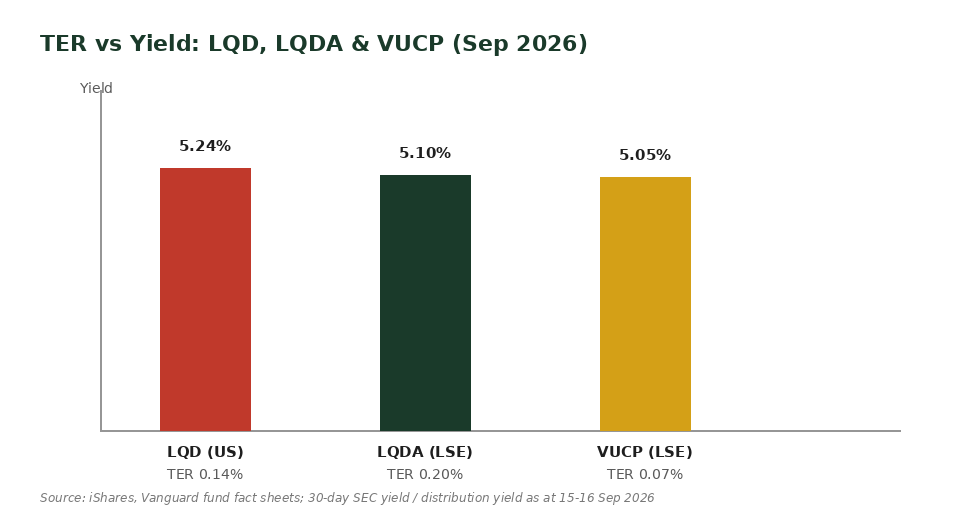
As at 15-16 September 2026, LQD’s 30-day SEC yield sat around 5.2%-5.7% depending on the measurement window, with an average yield to maturity near 5.9% and a weighted average maturity of about 12.75 years. LQDA and VUCP, tracking similar or related investment-grade corporate bond universes, run close behind. None of the three funds is a short-duration, low-volatility cash substitute — if you want that, a T-bill or a shorter-duration bond fund is the better fit, not this comparison.
Total Cost of Ownership
TER isn’t the only cost. You also pay a brokerage commission and, if trading a currency your broker doesn’t hold natively, an FX spread. Here’s the worked example for a Singapore investor putting USD 50,000 into each fund and holding for one year.
| Fund | TER Cost (1 Yr, USD 50k) | Est. Round-Trip Commission (IBKR) | Currency |
|---|---|---|---|
| LQD | USD 70 | ~USD 2 (US stock commission) | USD |
| LQDA | USD 100 | ~USD 6-8 (LSE commission) | USD |
| VUCP | USD 35 | ~USD 6-8 (LSE commission) | USD |
Source: TER figures per fund fact sheets above; commission estimates per Interactive Brokers published fee schedule, verified September 2026. Actual fees vary by broker and order size.
On pure fees, VUCP is the cheapest of the three despite its Ireland domicile — Vanguard’s 0.07% TER undercuts even LQD’s US-listed 0.14%. The commission difference between US and LSE listings is small in absolute terms once you’re trading in blocks of a few thousand dollars, so it shouldn’t be the deciding factor here. The estate tax question should be.
Who Should Pick Which?
LQD may suit you if: your total US-situs holdings (including any US-listed equity ETFs, US shares, and US real estate) sit comfortably under USD 60,000, you want the deepest liquidity and tightest bid-ask spread, and you’re comfortable revisiting the estate tax question as your portfolio grows.
LQDA or VUCP may suit you if: you already hold CSPX or VWRA on the LSE for the estate tax benefit and want the same protection extended to your bond sleeve, your total portfolio is likely to exceed USD 60,000 in US-situs assets over time, or you simply want one consistent tax treatment across your entire portfolio rather than mixing US-listed and UCITS funds.
If you’re not sure how a bond allocation fits your broader retirement plan, run the numbers through our Singapore retirement calculator first — corporate bonds are one option alongside Singapore T-bills and the TIPS ETF we’ve covered separately for the inflation-protected side of a fixed income sleeve. For a broader look at SGD-denominated bond options including the CPFIS-approved ABF Singapore Bond Index Fund, see our bond ETF Singapore guide. And if currency exposure is a concern across your whole portfolio, our currency-hedged vs unhedged ETF guide covers that trade-off in more depth.
Whichever fund you choose, you’ll need a broker that can access both US and LSE listings. Read our note on opening an account via the Syfe referral code or the FSMOne referral code if you don’t already have a brokerage set up — both support LSE-listed UCITS ETFs, though you’ll want IBKR or Saxo specifically if you plan to also hold the US-listed LQD.
Not financial advice. This article is for educational purposes only and does not account for your personal tax residency, treaty position, or estate planning needs. Speak to a qualified tax advisor before making decisions based on estate tax exposure.
Frequently Asked Questions
What is the main difference between LQD and LQDA?
LQD and LQDA track the same Markit iBoxx USD Liquid Investment Grade Index and hold a similar portfolio of US-dollar investment-grade corporate bonds. The difference is domicile and listing: LQD is a US-domiciled ETF listed on NYSE Arca with a 0.14% TER, while LQDA is an Ireland-domiciled UCITS ETF listed on the London Stock Exchange with a 0.20% TER. LQDA is not a US-situs asset for estate tax purposes; LQD is.
Do I pay 30% withholding tax on corporate bond ETF interest like I would on US stock dividends?
Generally no. US interest income paid through a regulated investment company can qualify as an “interest-related dividend,” which is typically exempt from the 30% US withholding tax that applies to equity dividends for non-US holders. This is a genuine structural difference between bond ETFs and equity ETFs like VOO or CSPX — it doesn’t remove the separate estate tax risk on a US-listed fund, though.
Is VUCP a good substitute for LQD for Singapore investors?
VUCP is a reasonable substitute, though not an identical one. It tracks the Bloomberg Global Aggregate Corporate USD Index rather than LQD’s iBoxx index, so the holdings and duration profile will differ slightly. Its 0.07% TER is the cheapest of the three funds covered here, and as an Ireland-domiciled UCITS ETF, it carries no US estate tax exposure — the main reason Singapore investors consider it over LQD.
Is LQDA the same as buying US Treasuries?
No. LQDA and LQD both hold corporate bonds issued by companies like banks, utilities and industrial firms — not government debt. Corporate bonds carry credit risk that US Treasuries do not: if a company gets downgraded or defaults, bond prices can fall sharply. If you want government bond exposure instead, look at a Treasury or aggregate bond ETF, not a corporate bond fund like this one.
Can I buy LQD, LQDA or VUCP using my CPF or SRS funds?
None of these three funds are CPFIS-approved, so you cannot buy them with your CPF Ordinary Account or Special Account funds. SRS funds can be used if your SRS-linked broker supports trading LSE-listed or US-listed ETFs — check with your bank (DBS, OCBC or UOB) or your SRS-compatible brokerage before assuming this is available.
Which broker should I use to buy LQDA or VUCP from Singapore?
Interactive Brokers and Saxo Markets both give Singapore investors direct access to the London Stock Exchange, where LQDA and VUCP are listed. moomoo Singapore does not currently support LSE trading, so it’s not an option for these two funds — though it can be used for LQD, which trades on NYSE Arca in the US.
How much US estate tax would I owe if I died holding USD 250,000 in LQD?
Based on the IRS’s graduated non-resident-alien estate tax brackets, a USD 250,000 holding in LQD alone would generate approximately USD 57,800 in US estate tax, after the USD 13,000 unified credit that offsets tax on the first USD 60,000. Holding the same amount in LQDA or VUCP instead would generate zero US estate tax, since neither is a US-situs asset. This calculation assumes no other US-situs assets and no available treaty relief, since Singapore has no estate tax treaty with the US.
Ready to Add Corporate Bonds to Your Portfolio?
Open a brokerage account that supports both US and LSE listings, and use our referral links for exclusive sign-up bonuses.
This article was researched with the help of AI. While we strive to keep all information accurate and up to date, there may be errors. If you notice any discrepancies, please contact us.