VWRA vs IWDA: Which Global ETF Should Singapore Investors Buy in 2026?
A data-driven comparison of two of the most popular LSE-listed ETFs — fees, tax efficiency, holdings, and which suits your portfolio.
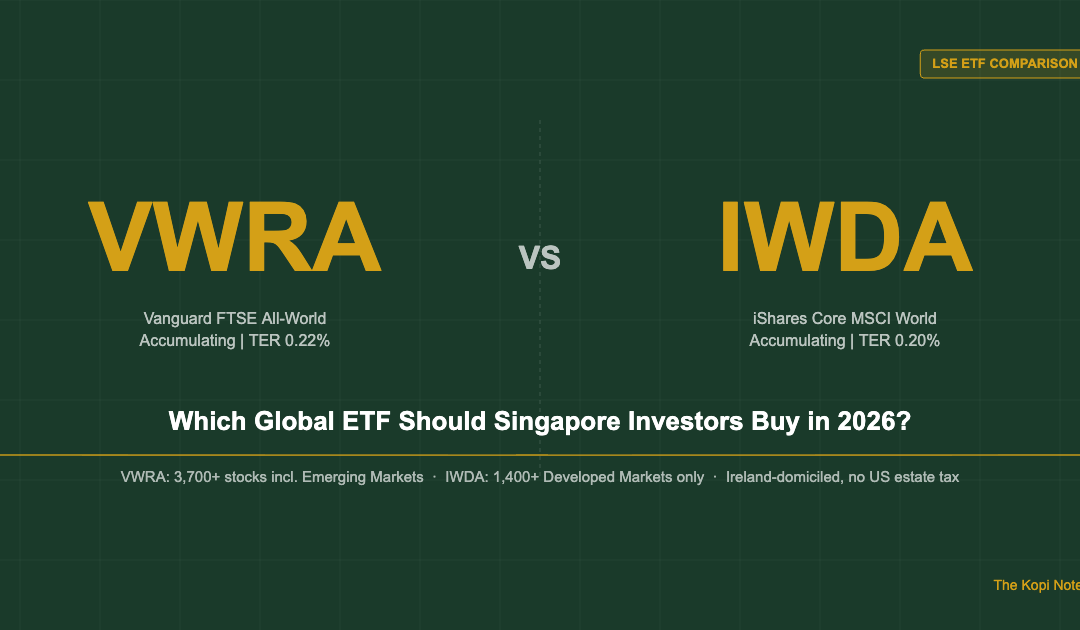
VWRA (Vanguard FTSE All-World UCITS ETF) covers 3,700+ stocks across both developed and emerging markets, while IWDA (iShares Core MSCI World UCITS ETF) holds ~1,400 developed-market stocks only. Both are Ireland-domiciled accumulating ETFs listed on the London Stock Exchange with similar low TERs (0.22% vs 0.20%). For most Singapore investors building a long-term passive portfolio, VWRA offers broader diversification including China, India and other growth markets — but IWDA’s slightly lower cost may suit those who prefer developed-market-only exposure.
Not financial advice. All figures are for educational reference only. Data as at April 2026 unless noted.
Table of Contents
Quick Answer: VWRA or IWDA?
If you want a single ETF that covers the entire world — including fast-growing emerging economies like China, India, Taiwan, Brazil, and South Korea — VWRA is the stronger choice. It gives you roughly 90% developed markets and 10% emerging markets in one fund, all at a TER of just 0.22% per year.
If you believe developed markets (US, Europe, Japan, Australia) will continue to drive global returns and you want to minimise costs by the smallest margin, IWDA at 0.20% TER delivers that with ~1,400 of the world’s largest developed-market companies.
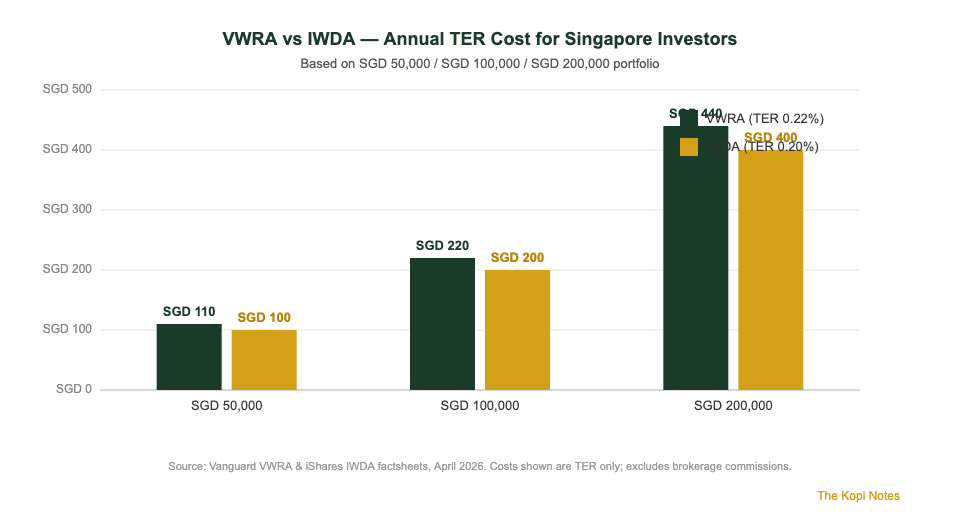
The difference in TER is just 0.02% — on a SGD 100,000 portfolio, that’s about SGD 20 per year. For most investors, the coverage question (emerging markets in or out?) matters far more than that cost gap.
Both ETFs are Ireland-domiciled, accumulating, listed on the London Stock Exchange, and fully suitable for Singapore investors — with no US estate tax risk and a 15% withholding tax rate on US dividends (versus 30% on US-domiciled equivalents). Neither is eligible for CPF investment, but both are accessible via Syfe referral code and sign-up bonus and other major brokers.
Key Differences at a Glance
Here is a side-by-side breakdown of the two ETFs across the metrics that matter most to Singapore investors.
| Feature | VWRA | IWDA |
|---|---|---|
| Full Name | Vanguard FTSE All-World UCITS ETF (Accumulating) | iShares Core MSCI World UCITS ETF (Accumulating) |
| Ticker (LSE) | VWRA | IWDA |
| Index Tracked | FTSE All-World Index | MSCI World Index |
| Market Coverage | Developed + Emerging Markets | Developed Markets Only |
| Number of Holdings | ~3,700 | ~1,400 |
| TER (Expense Ratio) | 0.22% p.a. | 0.20% p.a. |
| Structure | Accumulating | Accumulating |
| Domicile | Ireland | Ireland |
| Exchange Listed | London Stock Exchange (LSE) | London Stock Exchange (LSE) |
| Currency | USD | USD |
| AUM | ~USD 23 billion (as at April 2026) | ~USD 77 billion (as at April 2026) |
| US Dividend WHT | 15% | 15% |
| US Estate Tax Risk | None | None |
Source: Vanguard VWRA factsheet and iShares IWDA factsheet, April 2026
What Each ETF Holds
This is where VWRA and IWDA diverge most meaningfully. The difference isn’t just about numbers — it’s about which part of the global economy you are exposed to.
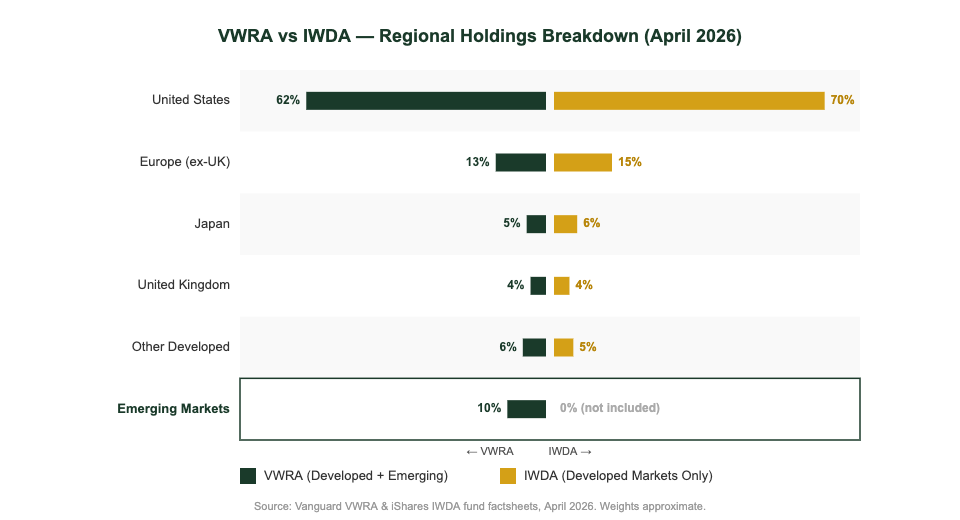
VWRA tracks the FTSE All-World Index, which covers both large and mid-cap stocks across 49 countries. It includes all the major developed market companies (US, UK, Europe, Japan, Australia) plus emerging markets like China (~3–4%), India (~2%), Taiwan (~2%), South Korea (~1.5%), Brazil, Saudi Arabia, and others. In total, around 10–11% of VWRA’s weight sits in emerging markets as at April 2026.
IWDA tracks the MSCI World Index, which is developed markets only — 23 countries, no emerging markets whatsoever. The US accounts for roughly 70% of IWDA, followed by Japan (~6%), the UK (~4%), France (~3%), and Canada (~3%). If you hold IWDA, you have zero direct exposure to China, India, or any frontier/emerging market.
The top 10 holdings are nearly identical between both ETFs — Apple, Microsoft, NVIDIA, Amazon, Meta, Alphabet, and other US mega-caps dominate both. The difference shows up in the tail of the portfolio, where VWRA adds Asian and emerging market mid-caps that IWDA skips entirely.
| Region | VWRA Weight | IWDA Weight |
|---|---|---|
| United States | ~62% | ~70% |
| Europe (ex-UK) | ~13% | ~15% |
| Japan | ~5% | ~6% |
| United Kingdom | ~4% | ~4% |
| Emerging Markets (China, India, Taiwan, etc.) | ~10–11% | 0% |
| Total Countries | ~49 | ~23 |
Source: Vanguard VWRA and iShares IWDA fund factsheets, April 2026. Weights are approximate and change monthly.
Tax & Cost Comparison for Singapore Investors
Here is the good news: on tax efficiency, VWRA and IWDA are identical for Singapore investors. Both are Ireland-domiciled UCITS ETFs, which means:
- 15% US dividend withholding tax — Ireland’s tax treaty with the US reduces the fund-level WHT from 30% to 15%. This compares to 30% if you held a US-domiciled equivalent like VT (the US version of VWRA) directly.
- No US estate tax risk — Because neither ETF is domiciled in the US, Singapore investors are not exposed to the IRS estate tax that applies to US-domiciled ETF holdings above USD 60,000.
- No capital gains tax in Singapore — Singapore has no capital gains tax, so all price appreciation in both ETFs is entirely tax-free for Singapore residents.
- No dividend income tax in Singapore — As accumulating ETFs, dividends are automatically reinvested within the fund. Singapore does not tax this reinvested income.
The only tax consideration specific to VWRA is the withholding tax on emerging market dividends. Countries like China, India, and Taiwan impose their own dividend withholding taxes on the fund level, typically between 10–20%, depending on the country. This is already accounted for in VWRA’s fund performance figures and net asset value — it is not an additional cost you pay directly. IWDA does not have this because it holds no emerging market stocks.
For a practical illustration: a Singapore investor holding SGD 100,000 in VWRA pays approximately SGD 220 per year in TER, while the same amount in IWDA costs SGD 200 — a difference of SGD 20 annually. That’s genuinely negligible over a long-term horizon.
Historical Performance
Both ETFs have delivered strong long-term returns, driven primarily by US equities which dominate both. Over the past decade, developed markets — particularly US tech — have significantly outperformed emerging markets, which has meant IWDA’s narrower focus has historically been an advantage rather than a drawback.
However, returns are cyclical. When emerging market economies accelerate — as seen during 2003–2007 and parts of 2017–2021 — a fund like VWRA would have meaningfully outperformed IWDA. The trade-off is that VWRA also provides some exposure to higher volatility during emerging market downturns.
Approximate annualised returns (in USD, as at April 2026, before SGD/USD FX impact):
| Period | VWRA (approx.) | IWDA (approx.) |
|---|---|---|
| 1 Year | ~+5% to +8%* | ~+6% to +9%* |
| 3 Year (annualised) | ~+6% to +10%* | ~+7% to +11%* |
| 5 Year (annualised) | ~+10% to +14%* | ~+11% to +15%* |
*Ranges reflect market volatility in early 2026 following US tariff announcements. Verify current figures at Morningstar or the respective fund factsheets. Past performance is not indicative of future results.
The 1–2% performance gap in recent years reflects the underperformance of emerging markets versus US-heavy developed market indices — not a structural flaw in VWRA. Investors with a 20–30 year horizon should not over-index on short-term return differences between these two ETFs.
Total Cost of Ownership
Beyond the TER, Singapore investors incur additional costs when buying either ETF. These include brokerage commissions, currency conversion (SGD to USD), and the LSE bid-ask spread. Here is how the full picture looks for a Singapore investor using Interactive Brokers (IBKR), one of the most cost-effective platforms for LSE-listed ETFs:
| Cost Component | VWRA | IWDA |
|---|---|---|
| TER (annual) | 0.22% | 0.20% |
| IBKR Commission (per trade) | USD 1.70 min (LSE) | USD 1.70 min (LSE) |
| FX Spread (SGD→USD via IBKR) | ~0.1–0.2% per conversion | ~0.1–0.2% per conversion |
| Bid-Ask Spread (LSE, typical) | ~0.05–0.10% | ~0.03–0.08% |
| Total Annual Cost (est., SGD 50k portfolio) | ~SGD 110–160/yr | ~SGD 100–150/yr |
Source: IBKR commission schedule and fund factsheets, April 2026. Estimates assume 4 trades per year (quarterly DCA). Actual costs vary with trade frequency and portfolio size.
The bottom line: on a SGD 50,000 portfolio, you’re looking at a difference of around SGD 10–15 per year between VWRA and IWDA on total costs. This should not be the deciding factor. The more important question is whether you want emerging market exposure or not.
For investors who prefer a simple, globally diversified retirement portfolio, our Singapore retirement calculator can help you model how either ETF fits into your long-term plan with compound growth projections.
Who Should Pick Which?
Choose VWRA if:
- You want a true one-fund global portfolio with zero gaps — developed and emerging markets in one ticker
- You believe in the long-term growth story of Asia (China, India, ASEAN), and want automatic exposure as these economies grow
- You prefer a market-cap weighted approach where your allocation to emerging markets adjusts automatically as their share of global GDP shifts
- You are investing for 15+ years and want the simplest possible buy-and-hold strategy
- You already have significant Singapore property or S-REIT exposure and want your ETF to give you a globally diversified counterweight
Choose IWDA if:
- You are deliberately cautious on emerging markets or want to avoid geopolitical risks associated with China’s market
- You intend to add emerging market exposure separately via a dedicated ETF like EMIM (iShares MSCI EM UCITS ETF), giving you explicit control over your EM allocation
- You want the marginally lower TER and slightly tighter bid-ask spread
- You are already building a broader portfolio that includes S-REITs and Singapore dividend stocks, which already provide some Asia exposure
Both ETFs pair naturally with Singapore’s passive income ecosystem. Investors combining either VWRA or IWDA with local dividend-paying S-REITs get a well-rounded portfolio — global growth from the ETF, local income from REITs. See our guide to passive income Singapore strategies for how to combine these effectively.
How to Buy VWRA or IWDA in Singapore
Both ETFs are bought through brokers with access to the London Stock Exchange. Here are the main options for Singapore investors:
1. Interactive Brokers (IBKR) — Best for cost-conscious investors with SGD 10,000 or more to invest. Commission is USD 1.70 minimum per LSE trade. You will need to convert SGD to USD first (IBKR’s FX conversion is excellent at ~0.1% spread). Search for VWRA or IWDA on the LSE exchange. The platform is more complex to navigate but offers the lowest ongoing costs in Singapore.
2. Syfe Brokerage — Best for beginners and those who want a cleaner interface. You can sign up using our Syfe referral code and sign-up bonus for a cash bonus when you open your account. Syfe also offers managed portfolios that include VWRA for those who prefer a hands-off approach.
3. FSMOne — Good for regular savings plan (RSP) investors. FSMOne allows you to set up an automated monthly investment into VWRA or IWDA, making it ideal for disciplined dollar-cost averaging. Use our FSMOne referral code when opening an account.
4. Saxo Markets — Competitive for larger portfolios. Saxo’s commission structure becomes more attractive at higher investment amounts, and the platform is well-regarded for its LSE execution quality.
Regardless of broker, the steps are the same: fund your account in SGD → convert to USD → search for VWRA or IWDA on the LSE → place a market or limit order. Both ETFs are highly liquid on the LSE with significant daily trading volume.
Note: neither VWRA nor IWDA is eligible for CPF Investment Scheme (CPFIS) investment. If you are planning your CPF strategy, see our CPF investment strategy guide for what options are available within the scheme. Both ETFs are accessible via SRS accounts through eligible brokers, making them suitable for tax-efficient retirement saving. For long-term planning, our best S-REITs in Singapore 2026 guide covers how REITs can complement your ETF holdings for local income.
Disclaimer: The Kopi Notes may earn referral fees when you use our referral links. This does not affect the fees you pay or the editorial independence of our content. All figures cited in this article are for educational reference only and should not be construed as financial advice. Please consult a licensed financial adviser before making investment decisions.
Frequently Asked Questions
What is the main difference between VWRA and IWDA?
VWRA tracks the FTSE All-World Index and includes approximately 3,700 stocks across both developed and emerging markets (such as China, India, and Taiwan). IWDA tracks the MSCI World Index and holds around 1,400 stocks from developed markets only — no emerging markets exposure at all. Both are accumulating, Ireland-domiciled ETFs listed on the London Stock Exchange, with very similar TERs (VWRA at 0.22%, IWDA at 0.20%).
Is VWRA or IWDA better for Singapore investors?
For most Singapore investors seeking a simple, long-term passive portfolio, VWRA is the more popular choice because it provides true global diversification in a single fund — including emerging market growth economies. However, IWDA is not a worse choice; it is a deliberate preference for developed-markets-only exposure. The cost difference (0.02% TER) is negligible at SGD 20 per year on a SGD 100,000 portfolio. The key question is whether you want emerging market exposure — if yes, VWRA; if no, IWDA.
Which has lower fees — VWRA or IWDA?
IWDA has a slightly lower TER at 0.20% per year versus VWRA’s 0.22%. On a SGD 100,000 portfolio, this translates to a difference of approximately SGD 20 per year — truly minimal over a long investment horizon. Both ETFs have identical tax treatment for Singapore investors (15% US dividend WHT, no US estate tax, no Singapore capital gains tax), so tax efficiency is the same between the two.
Can I buy VWRA or IWDA with my CPF or SRS?
Neither VWRA nor IWDA is eligible for the CPF Investment Scheme (CPFIS). CPF funds can only be invested in approved products including certain SGX-listed ETFs, unit trusts, and Singapore government bonds. However, both VWRA and IWDA can be purchased using Supplementary Retirement Scheme (SRS) funds through eligible brokers such as IBKR or Saxo, making them suitable for SRS investors looking to grow their retirement savings tax-efficiently.
Which broker is best for buying VWRA or IWDA in Singapore?
Interactive Brokers (IBKR) is widely regarded as the most cost-effective broker for buying LSE-listed ETFs like VWRA and IWDA in Singapore, particularly for portfolios above SGD 10,000. It charges a minimum of USD 1.70 per LSE trade and offers excellent SGD-to-USD conversion rates. For beginners or those who prefer a simpler interface, Syfe Brokerage and FSMOne are good alternatives — FSMOne also allows regular savings plans (RSP) for automated monthly investing into both ETFs.
Does VWRA pay dividends?
No — VWRA is an accumulating ETF, meaning all dividends received from underlying stocks are automatically reinvested back into the fund. You will not receive cash dividend payments. This is intentional and tax-efficient for Singapore investors, as there is no dividend income to declare or pay tax on. If you prefer to receive dividend income, the distributing equivalent of VWRA is VWRD (same fund, different share class). Most Singapore long-term investors prefer the accumulating VWRA for its compounding advantage.
Should I switch from IWDA to VWRA?
If you already hold IWDA and are considering switching to VWRA, be aware that selling IWDA to buy VWRA incurs brokerage commissions and bid-ask spread costs twice (sell + buy). Since there is no capital gains tax in Singapore, there is no tax cost to switching — but you should weigh the transaction costs against the coverage difference. For larger holdings, consider adding VWRA for new contributions instead, gradually shifting your allocation over time without incurring a large lump-sum switch cost.
Ready to Buy VWRA or IWDA?
Open a brokerage account today and start building your global ETF portfolio. Use our referral links for exclusive sign-up bonuses.
This article was researched with the help of AI. While we strive to keep all information accurate and up to date, there may be errors. If you notice any discrepancies, please contact us.