Mapletree Logistics Trust (M44U) Share Price After Fed Rate Hike: Q4 2026 DPU Outlook
SGX: M44U | Sep 2026 | Logistics REIT Deep Dive
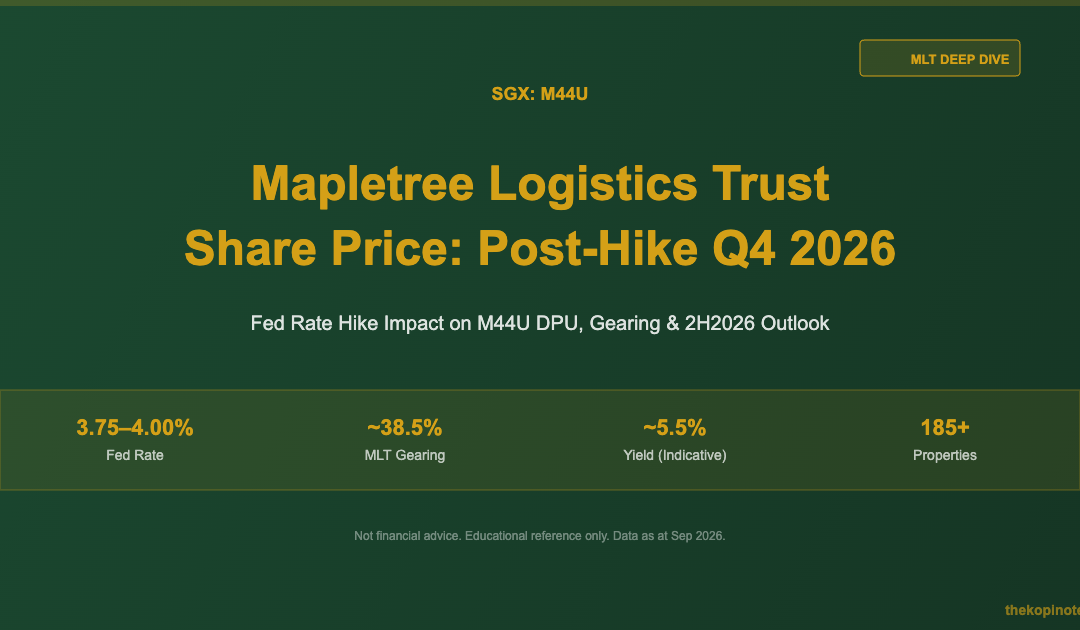
Mapletree Logistics Trust (MLT, SGX: M44U) is one of Singapore’s largest logistics REITs, owning 185+ properties across 9 Asia-Pacific markets. The US Federal Reserve raised rates by 25 basis points to 3.75-4.00% on 16 September 2026 — a move that increases MLT’s borrowing costs and pressures its Distribution Per Unit (DPU). This guide explains what the hike means for M44U’s share price, gearing, and Q4 2026 DPU outlook.
Not financial advice. All figures are for educational reference only. Data as at September 2026 unless noted.
- The Sep 2026 Fed hike (to 3.75-4.00%) is a headwind for MLT — but ~60% of its debt is fixed-rate, so the immediate DPU impact is limited.
- MLT’s gearing of ~38.5% sits comfortably below MAS’s 50% limit, giving it a meaningful buffer even if rates stay elevated through 2027.
- The share price may face short-term pressure, but the 185-property pan-Asia portfolio and 5.5% indicative yield keep longer-term appeal intact for patient investors.
Table of Contents
What the Fed Rate Hike Means for S-REITs
On 16 September 2026, the US Federal Reserve raised its target rate by 25 basis points — bringing the federal funds rate to a range of 3.75% to 4.00%. This is bad news for any company that carries significant debt, and REITs are at the top of that list.
Here is why it matters. REITs borrow money to buy properties. When rates go up, new borrowings cost more. If a REIT has floating-rate debt, its interest bill rises immediately. That money comes straight out of the income that would otherwise flow to you as a unitholder — in the form of DPU.
For MLT specifically, the situation is nuanced. The trust carries roughly S$6 billion in total debt. Around 60% of that is hedged to fixed rates through swaps and fixed-rate bonds. The remaining 40% is exposed to floating rates — meaning a 25bp hike adds roughly S$6 million annually to MLT’s interest cost on the floating portion alone.
That S$6 million translates to roughly 0.1-0.2 Singapore cents per unit in DPU erosion on an annualised basis. Not catastrophic — but meaningful over multiple rate increases.
If you want to understand the broader fixed-income backdrop, our Singapore T-bills 2026 guide explains how risk-free rates are currently competing with REIT yields for investor dollars.
MLT’s Gearing and Fixed-Rate Debt Buffer
Gearing — the ratio of debt to total assets — is the key safety metric for any REIT. MAS caps Singapore REITs at 50%. MLT’s current gearing sits at approximately 38.5%, which leaves a comfortable buffer.
| Metric | MLT (M44U) | MAS Limit |
|---|---|---|
| Gearing Ratio | ~38.5% | 50% |
| Fixed-Rate Debt Proportion | ~60% | — |
| Interest Coverage Ratio | ~2.8x | Min 1.5x |
| Weighted Average Debt Maturity | ~3.2 years | — |
Source: MLT FY2026 results presentation, Sep 2026. Figures are estimates based on published data.
The interest coverage ratio of ~2.8x means MLT earns 2.8 dollars of net property income for every 1 dollar of interest it pays. That is above the minimum but below the 3-4x range that income-focused investors often prefer. A further rate hike could push this ratio lower.
The weighted average debt maturity of ~3.2 years is the more reassuring number. Most of MLT’s fixed-rate debt does not roll over until 2028-2029, so even if rates stay elevated, the immediate refinancing risk is manageable.
DPU Sensitivity: 4 Rate Scenarios
Let us put some numbers on this. The chart below models MLT’s estimated annual DPU under four Fed rate scenarios. Remember, these are illustrative estimates — not a forecast or financial advice.
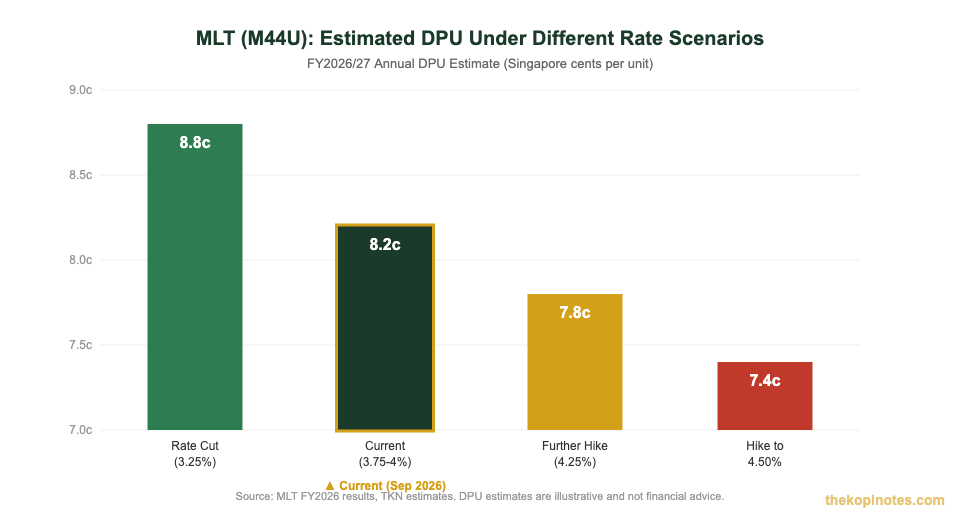
The key insight: moving from the pre-hike environment to the current 3.75-4.00% range reduces estimated DPU by roughly 0.6 cents per year. That is a meaningful step down from the ~8.8c scenario in a rate-cut environment.
If rates rise further to 4.25% or above, DPU could fall below the 8.0 cent mark. At a unit price of around S$1.50, that still implies a yield above 5% — keeping MLT competitive versus Singapore Savings Bonds and T-bills, though the gap is narrower than it was two years ago.
| Rate Scenario | Est. Annual DPU | Yield at S$1.50 | vs T-Bill (3.8%) |
|---|---|---|---|
| Rate cut to 3.25% | ~8.8c | ~5.9% | +2.1% |
| Current (3.75-4.00%) ★ | ~8.2c | ~5.5% | +1.7% |
| Hike to 4.25% | ~7.8c | ~5.2% | +1.4% |
| Hike to 4.50% | ~7.4c | ~4.9% | +1.1% |
★ Current scenario as at Sep 2026. Estimates are illustrative and assume constant unit price of S$1.50. Not financial advice.
MLT vs Logistics REIT Peers
How does MLT stack up against Singapore’s other major logistics and industrial REITs? The chart below compares gearing and indicative yield across five peers.
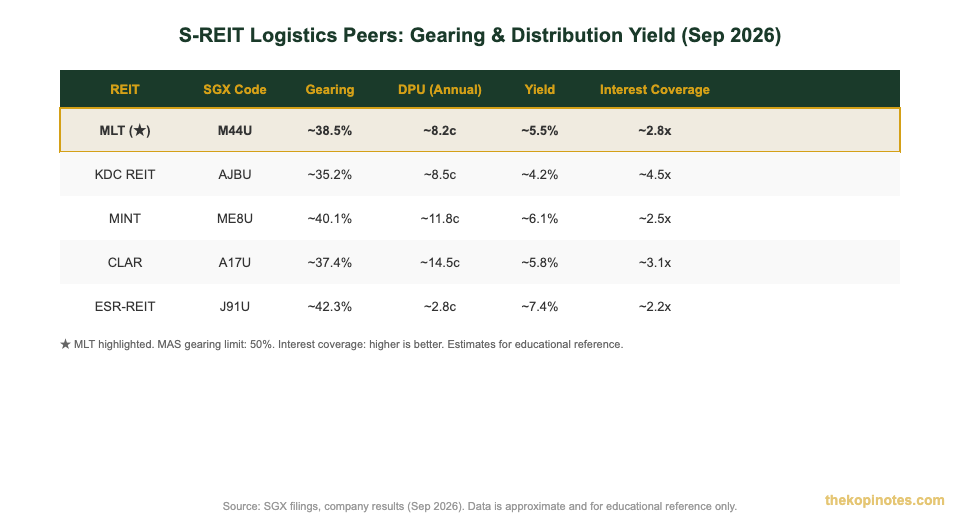
MLT’s 38.5% gearing is in the middle of the pack. Keppel DC REIT carries lower gearing (~35%) because its data centre properties command premium valuations, which keeps the ratio down. ESR-REIT carries higher gearing (~42%) but compensates with a higher yield above 7%.
For income investors comparing MLT against KDC REIT, the trade-off is clear: KDC offers lower yield but more rate sensitivity protection via lower gearing. MLT offers broader geographic diversification across 9 markets — a different kind of protection against any single-country slowdown.
If you are building a diversified REIT portfolio, our guide to the best S-REITs in Singapore 2026 covers the full landscape, including which REITs combine the lowest gearing with the best yield-to-risk profile right now.
MLT Portfolio Strengths That Cushion the Hike
Not all the news is negative. MLT has several structural advantages that help absorb higher rates.
Pan-Asia diversification. MLT owns 185+ properties across Singapore, Japan, China, Hong Kong, Australia, South Korea, Vietnam, India, and Malaysia. No single market accounts for more than 40% of net property income. If China’s economy softens under global trade headwinds, Japanese and Australian properties can offset the drag.
Long weighted average lease expiry (WALE). MLT’s WALE sits at approximately 4.0 years. That means most rental income is locked in for the next 4 years — rate hikes do not hurt your rental income, only your borrowing cost.
Built-in rent escalations. Many of MLT’s leases in developed markets include annual rent escalation clauses tied to CPI or fixed step-ups. In an inflationary environment, these escalations partially offset higher financing costs.
E-commerce structural tailwind. The long-term demand story for logistics real estate remains intact. Online retail penetration across Asia-Pacific continues to rise. That supports occupancy rates at MLT’s warehouses and gives the manager pricing power at lease renewals.
For context on how passive income from REITs compares to other investment approaches, see our overview of passive income strategies for Singapore investors.
Share Price Outlook for Q4 2026
MLT’s share price has historically moved inversely with interest rate expectations. When rates rise, REIT unit prices typically fall — higher rates make REIT yields less competitive versus fixed-income alternatives, so investors re-price units lower to push the yield up.
In practical terms, if the market expects another 25bp hike in November 2026, you may see M44U trade sideways or drift downward through Q4. Conversely, if US economic data weakens and the Fed signals a pause, MLT’s share price could recover quickly — as it did in late 2023 and mid-2024 when rate cuts were first priced in.
The near-term share price direction will hinge on two things: whether the Fed pauses after September, and whether MLT’s Q2 FY2026/27 results (due October 2026) show any DPU deterioration beyond what the market has already priced in.
If you are trying to decide whether to wait or invest now, our retirement planning calculator can help you model how different REIT yield scenarios affect your long-term retirement income projections.
Should You Buy MLT Now?
This is the question most readers want answered. The honest answer is: it depends on what you already own and what you are trying to achieve.
If you own no REITs yet, MLT at a 5.5% indicative yield represents a reasonable entry point for a logistics REIT with strong diversification. The risk is that rates rise further and the share price dips another 5-10% before stabilising.
If you already hold MLT and are wondering whether to add more, dollar-cost averaging — buying the same dollar amount monthly regardless of price — is one way to reduce the risk of timing the bottom incorrectly. If you put S$500 into MLT each month, a price dip would simply buy you more units at lower cost.
If you want to invest in MLT through a platform with fractional or low-minimum options, Syfe’s REIT+ portfolio and Endowus’s fund platform both offer exposure to Singapore REITs with low minimums. You can find our full sign-up details on the Syfe referral code page (referral code: SRPRFFFCD) and the Endowus referral code page (referral code: 2V343).
If you prefer to hold REITs within your CPF-OA, MLT is on the CPF Investment Scheme (CPFIS) approved list. That allows you to use funds from your Ordinary Account to buy M44U via SGX. For more on optimising this, see our CPF investment strategy guide.
The related article MLT’s rate-cut impact analysis (published before the Fed pivoted back to hikes) is worth reading alongside this one — it shows how quickly MLT’s story can flip when rate expectations change.
Frequently Asked Questions — MLT Share Price & Rate Hike
”What
”What
”Can
”How
Disclaimer: This article is for educational and informational purposes only and does not constitute financial, investment, or legal advice. Past performance is not indicative of future results. All figures are estimates based on publicly available data as at September 2026 and may not be accurate. Always consult a licensed financial adviser before making investment decisions. The Kopi Notes may earn referral fees from links on this page.
This article was researched with the help of AI. While we strive to keep all information accurate and up to date, there may be errors. If you notice any discrepancies, please contact us.