Mapletree Logistics Trust Share Price 2026: FOMC Rate Cut Impact, DPU Sustainability, and 2H2026 Outlook
Published: September 2026 | Category: S-REITs | Ticker: M44U (SGX)
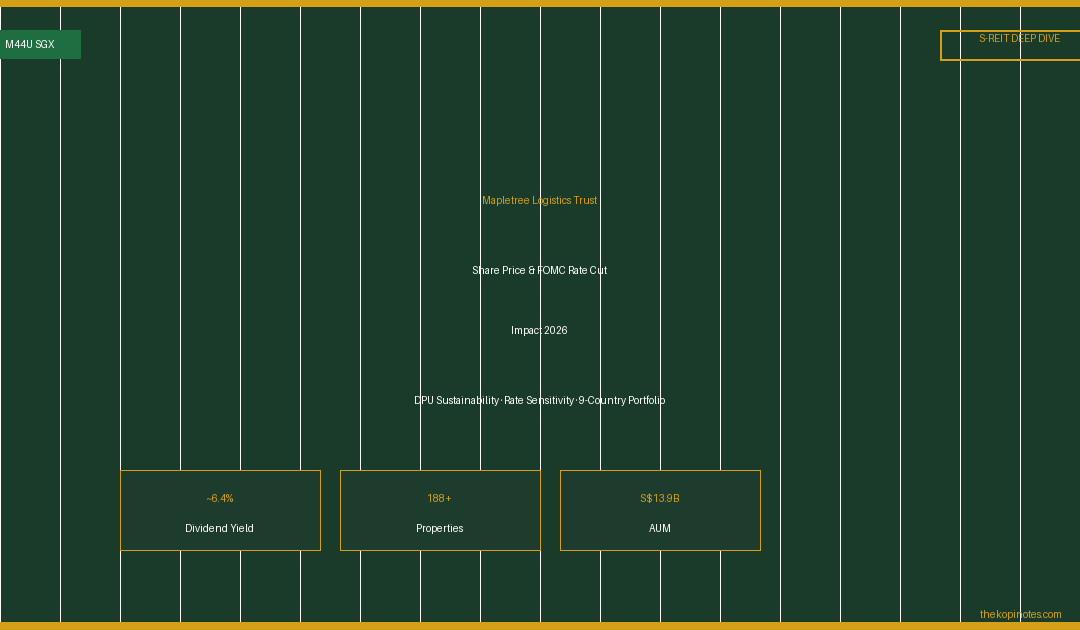
Mapletree Logistics Trust (SGX: M44U) is Singapore’s largest listed pure-play logistics REIT, owning 188 properties across 9 countries in the Asia-Pacific region. At a distribution yield of approximately 6.4% as at September 2026, it offers one of the more attractive income streams among blue-chip S-REITs. With the US Federal Reserve’s FOMC meeting on 17–18 September 2026, rate-sensitive REITs like MLT are in focus — here’s what a rate cut could mean for its DPU, share price, and your investment thesis.
Not financial advice. All figures are for educational reference only. Data as at September 2026 unless noted.
- MLT trades at ~S$1.28, yielding ~6.4% — attractive but watch gearing at ~39%.
- A 50bps Fed rate cut could add approximately 0.15 cents to annual DPU via lower floating-rate debt costs.
- China headwinds (vacancy, rental pressure) remain the key risk; 9-country diversification provides a buffer.
Table of Contents
Contents — Click to Expand
- What Is Mapletree Logistics Trust?
- MLT Share Price History & Current Level
- DPU History and Dividend Yield
- FOMC Rate Cut Impact on MLT
- Portfolio Breakdown: 9 Countries, 188+ Properties
- Gearing, ICR, and Financial Health
- Key Risks for MLT Investors
- How to Buy MLT in Singapore
- Frequently Asked Questions
What Is Mapletree Logistics Trust?
Mapletree Logistics Trust (M44U) is a real estate investment trust listed on the Singapore Exchange (SGX) since 2005. It is managed by Mapletree Logistics Trust Management Ltd, a wholly-owned subsidiary of Mapletree Investments — which is in turn owned by Temasek Holdings. That Temasek backing gives MLT strong credit access and institutional credibility.
MLT focuses exclusively on logistics and warehouse real estate. Its tenants are manufacturers, retailers, logistics operators, and e-commerce players who need to store and move goods across Asia-Pacific. Think warehouses, distribution centres, cold-chain facilities, and ramp-up logistics parks.
As at September 2026, MLT’s portfolio spans 188+ properties with an aggregate lettable area of over 10 million square metres across Singapore, Hong Kong, China, Japan, South Korea, Australia, Malaysia, Vietnam, and India.
MLT Share Price History & Current Level
MLT’s share price has faced pressure since 2022 when interest rates began rising sharply. After trading above S$2.00 in 2021, the unit price has corrected to the S$1.20–S$1.35 range — reflecting higher borrowing costs, concerns about the China portfolio, and a risk-off environment for yield assets.
| Period | Share Price Range | Key Driver |
|---|---|---|
| 2021 Peak | S$2.00–S$2.10 | Post-COVID logistics demand surge |
| 2022–2023 | S$1.50–S$1.80 | Rate hike cycle begins |
| 2024 | S$1.30–S$1.55 | Elevated rates + China headwinds |
| 2025–Sep 2026 | S$1.20–S$1.35 | Persistent gearing concerns, DPU compression |
Source: SGX, Bloomberg. As at September 2026. Past performance is not indicative of future results.
At around S$1.28 as at September 2026, MLT trades at a discount to its net asset value (NAV) of approximately S$1.40 per unit. That 8–9% NAV discount partly explains why the distribution yield looks attractive — but it also reflects the market’s uncertainty about China’s logistics market and the pace of rate cuts.
DPU History and Dividend Yield
DPU stands for Distribution Per Unit — the cash payout you receive per MLT unit you hold, typically paid semi-annually. It is the most important metric for income investors.
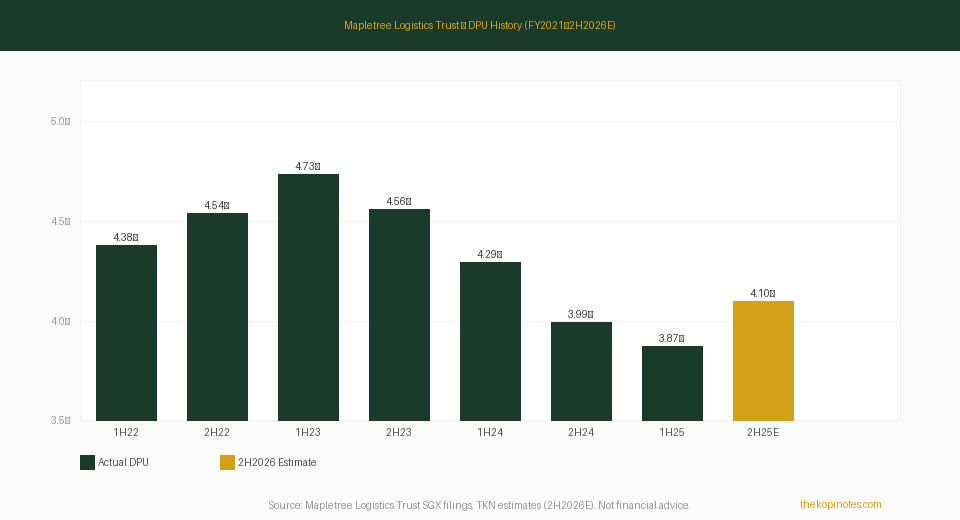
MLT’s DPU peaked in the first half of FY2023 at around 4.73 cents per unit per half-year, then trended lower as higher financing costs weighed on distributable income. By 2H FY2025, DPU had eased to approximately 3.99–4.10 cents per half-year.
The good news: MLT has maintained distribution payouts throughout the rate cycle, unlike some smaller REITs that suspended distributions. This resilience reflects the diversified portfolio and the manager’s track record of active capital recycling.
| Financial Year | Full-Year DPU (cents) | Approx Yield at Year-End Price |
|---|---|---|
| FY2021/22 | 8.92¢ | ~4.5% (high price era) |
| FY2022/23 | 9.27¢ | ~5.8% |
| FY2023/24 | 8.85¢ | ~6.2% |
| FY2024/25 | ~8.09¢ | ~6.3% |
| FY2025/26E (est.) | ~8.00–8.20¢ | ~6.3–6.4% |
Source: SGX announcements, TKN estimates. FY2025/26E is an estimate — not a forecast. Not financial advice.
At a share price of S$1.28, MLT’s forward yield of approximately 6.3–6.4% compares well to the Singapore T-bill rate and Singapore Savings Bonds, especially if you factor in the potential DPU uplift from a rate cut cycle.
FOMC Rate Cut Impact on MLT
The US Federal Reserve’s FOMC is meeting on 17–18 September 2026. As at mid-September 2026, market pricing is uncertain — futures are not uniformly pricing a rate cut. However, the direction of travel globally is toward easing, and any cut will have direct implications for S-REITs like MLT.
Here’s how it works: MLT borrows money to fund its property portfolio. Part of that borrowing is on fixed-rate terms (locked in for 2–5 years), and part is on floating rates (e.g. linked to SOFR or SORA). When rates fall, the floating-rate portion gets cheaper — which directly reduces finance costs and lifts distributable income, all else equal.
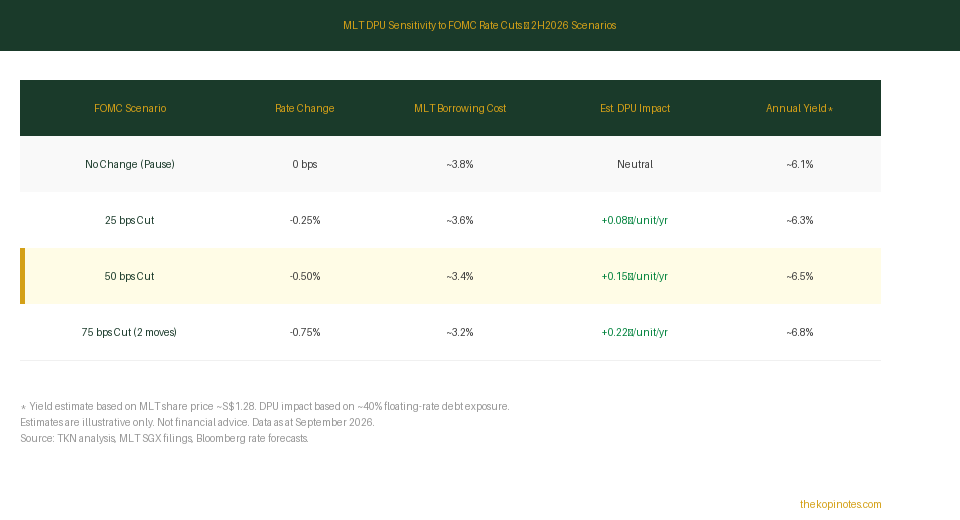
MLT’s debt profile as at 1H FY2025/26 shows approximately 60–65% of borrowings on fixed rates and 35–40% on floating rates. The weighted average cost of debt is approximately 3.7–3.9%. A 50bps rate cut would reduce the cost of the floating-rate portion — improving DPU by an estimated 0.12–0.15 cents per unit per year.
That may seem small, but on a S$1.28 unit price, 0.15 cents annualised is about a 0.12% yield improvement — moving the yield from ~6.3% to ~6.4–6.5%. More importantly, it signals to the market that the refinancing environment is improving, which often supports unit price re-rating.
For context: MLT has S$2.4 billion+ in debt. Every 25bps reduction in average cost of debt saves approximately S$6 million in annual finance costs — and about 60–70% of those savings flow through to distributable income.
Portfolio Breakdown: 9 Countries, 188+ Properties
MLT’s 9-country spread is one of its strongest differentiators versus Singapore-focused logistics landlords. Here’s the approximate geography of assets by value:
| Country | Approx % of Portfolio Value | Key Assets / Notes |
|---|---|---|
| Singapore | ~18% | Mapletree Logistics Hub, Toh Guan |
| China | ~20% | Key risk area; vacancy headwinds |
| Japan | ~21% | JPY volatility; low vacancy; key growth |
| South Korea | ~12% | Strong e-commerce demand |
| Australia | ~11% | AUD exposure; stable occupancy |
| Hong Kong | ~8% | Cold chain and high-spec facilities |
| Malaysia / Vietnam / India | ~10% | Emerging market growth corridor |
Source: TKN estimates based on MLT SGX announcements and annual reports. Percentages are approximate. Data as at mid-2026.
The Japan portfolio (~21% of AUM) has been a strong performer — low vacancy rates and solid rental uplifts from a recovering logistics market. However, JPY weakness against SGD means currency translation can dampen DPU when converting yen rents back to Singapore dollars.
The China portfolio (~20% of AUM) remains the most watched. Logistics vacancy rates in tier-1 and tier-2 Chinese cities have risen due to oversupply, putting pressure on rental reversions. MLT has been actively recycling weaker assets here. This drag on overall DPU is partly why yield remains elevated — the market is pricing in ongoing China risk.
For investors interested in the broader passive income thesis, the passive income Singapore guide covers how logistics REITs like MLT fit into an income portfolio.
Gearing, ICR, and Financial Health
Gearing (debt-to-assets) is the most important balance sheet metric for REITs. The MAS regulatory limit for Singapore REITs is 50%. MLT’s gearing as at the latest results is approximately 38–40% — within safe limits but not the lowest in the S-REIT universe.
The Interest Coverage Ratio (ICR) measures how many times MLT’s earnings cover its interest expenses. MLT’s ICR sits at approximately 3.4–3.6x — above the 2.5x MAS minimum for REITs seeking to borrow above 45% gearing. This gives MLT headroom.
The weighted average debt maturity is approximately 3.5–4 years, with a staggered refinancing profile. This means MLT is not at risk of a sudden debt cliff. However, refinancing at today’s rates (versus the lower rates of the 2018–2021 era) is still a headwind — one that eases as rate cuts materialise.
For a broader view of how financial health metrics apply to S-REIT investing, see the best S-REITs in Singapore 2026 comparison.
Key Risks for MLT Investors
No investment is without risk. Here are the five specific risks you need to understand before buying MLT:
1. China logistics oversupply. Chinese logistics parks are facing elevated vacancies as domestic consumption growth slows and new supply has been added aggressively. MLT’s China portfolio (~20% of assets) may see continued rental headwinds, limiting DPU recovery even if rates fall.
2. Currency volatility. MLT collects rents in JPY, AUD, CNY, KRW, and HKD — but reports in SGD. A strong SGD (or weak JPY/AUD) reduces the SGD value of overseas distributions. In FY2025, JPY weakness was a notable drag.
3. Higher-for-longer interest rates. If the Fed pauses or cuts less than expected, the refinancing benefit won’t materialise. A significant portion of debt will be refinanced over the next 2–3 years, and if rates stay elevated, DPU remains under pressure.
4. Gearing approaching mid-range. At ~39% gearing, MLT doesn’t have enormous debt headroom for acquisitive growth. Asset recycling (selling weaker properties, buying better ones) is the more likely growth avenue — which takes time and market conditions to execute well.
5. Logistics sector structural shift. The post-COVID e-commerce boom that drove logistics demand is moderating. Some markets are seeing over-supply. MLT needs to maintain high-spec, last-mile assets to retain premium tenants — which requires capital expenditure.
Understanding these risks is part of any informed investment decision. If you want to compare MLT against other income-generating instruments, the Singapore retirement calculator helps model how different yields compound over time.
How to Buy MLT in Singapore
MLT (ticker: M44U) trades on the Singapore Exchange (SGX). You can buy it through any brokerage account that supports SGX equities — including IBKR, Syfe Brokerage, and FSMOne.
For most retail investors, the two most cost-effective routes are:
IBKR (Interactive Brokers): Low commissions (~S$1.50–S$3 per trade), no custody fees on SGX equities. Best for investors comfortable with a more professional interface. Use the Syfe referral code SRPRFFFCD or the FSMOne platform if you prefer a Singapore-headquartered broker.
Syfe Brokerage: Offers commission-free trades on SGX stocks (up to a monthly limit). Simple app, good for beginners. If you also want a managed S-REIT portfolio, Syfe’s Income+ portfolio is worth exploring — use the Syfe referral code SRPRFFFCD to get started with a bonus.
FSMOne: Popular among Singapore DIY investors. Supports regular savings plans (RSP) which let you invest a fixed amount monthly. The FSMOne referral code P0544985 gives you a small cash reward on sign-up.
Endowus (for CPF/SRS): If you want to use CPF-OA or SRS funds, Endowus connects to SGX-listed REITs via fund wrappers. It won’t let you buy M44U directly, but you can access MLT exposure through some fund options. Use the Endowus referral code 2V343 for a S$20 bonus.
Frequently Asked Questions
What is Mapletree Logistics Trust's current share price?
What is MLT's dividend yield in 2026?
How does a Fed rate cut affect MLT's DPU?
What is MLT's gearing ratio and is it safe?
How many countries does MLT invest in?
Can I buy MLT using CPF?
What is the difference between MLT and MINT?
Disclaimer: This article is for educational purposes only and does not constitute financial advice. Investment in REITs involves risks including loss of principal. DPU estimates are illustrative and not guaranteed. Always conduct your own due diligence or consult a licensed financial advisor. The Kopi Notes may earn referral commissions from links above.
This article was researched with the help of AI. While we strive to keep all information accurate and up to date, there may be errors. If you notice any discrepancies, please contact us.