Singapore T-Bills 2026: Current Yield, How to Buy & Compare With SSBs & Fixed Deposits
Updated April 2026 | MAS-Issued Government Securities | 6-Month & 1-Year T-Bills
Singapore T-bills remain one of the most popular low-risk investments for local retail investors — and for good reason. Issued by the Monetary Authority of Singapore (MAS), T-bills carry zero default risk and offer competitive short-term yields compared to bank fixed deposits.
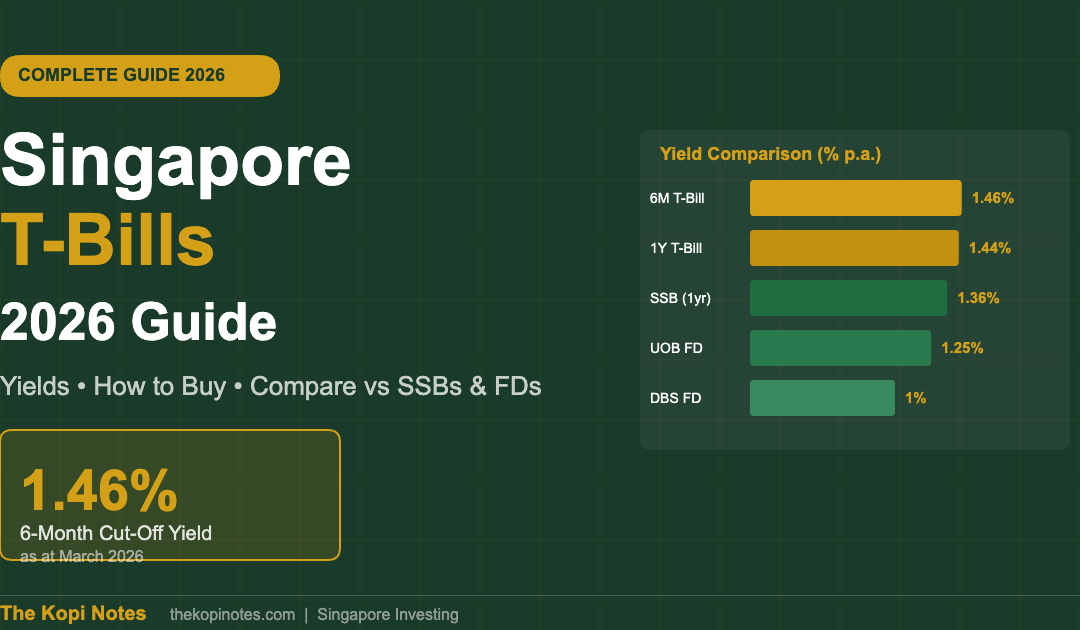
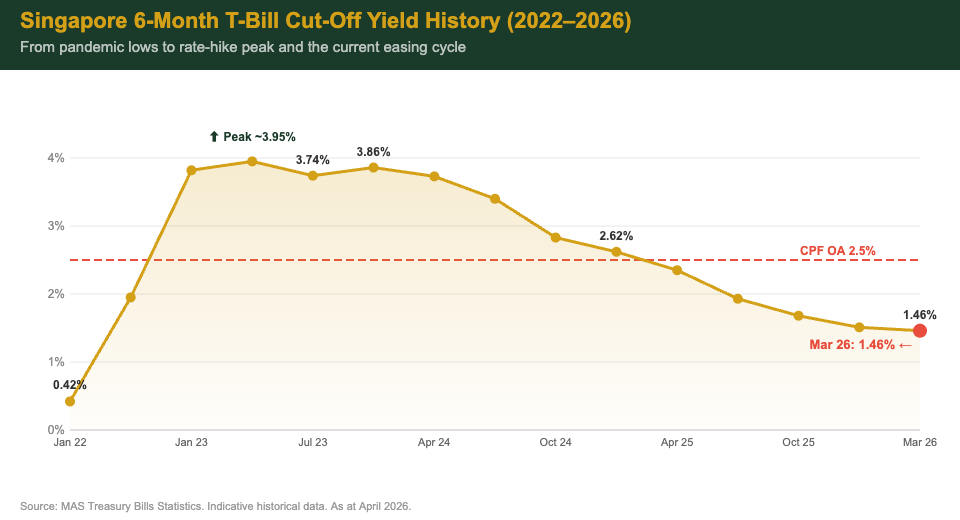
The latest 6-month T-bill (March 31, 2026 auction) cleared at a cut-off yield of 1.46% p.a., while the most recent 1-year T-bill yielded 1.44% p.a. These rates have declined significantly from the 3.8–4.2% highs seen in 2023–2024 as Singapore interest rates follow global rate-cut cycles — but T-bills still edge out most bank fixed deposits in Singapore today.
This guide covers everything you need to know: what T-bills are, current yields, how to buy them (cash, CPF OA, SRS), and a full comparison with Singapore Savings Bonds (SSBs) and fixed deposits. This is not financial advice — please do your own research before investing.
Table of Contents
Contents — Click to expand
1. What Are Singapore T-Bills?
Singapore Treasury Bills — commonly called T-bills — are short-term debt securities issued by the Singapore government through MAS. They carry zero default risk and are backed by the full faith and credit of the Singapore government, which holds a AAA credit rating.
Unlike bonds that pay periodic coupon interest, T-bills are zero-coupon instruments. You buy them at a discount to their face value, and at maturity, MAS pays you the full face value. For example: a S$10,000 6-month T-bill clearing at 1.46% costs approximately S$9,927 upfront — you earn S$73 over 6 months.
Key T-bill facts:
- Tenors available: 6-month and 1-year
- Minimum investment: S$1,000 (multiples of S$1,000)
- Issuance frequency: Every 2 weeks (6-month); quarterly (1-year)
- Eligible investors: Singapore citizens, PRs, and foreigners (with CDP account)
- Payment methods: Cash, CPF OA (via CPFIS), SRS
- Agent banks: DBS/POSB, OCBC, UOB
- Issuer: MAS on behalf of the Singapore government
T-bills are tradeable on the secondary market but most retail investors hold to maturity. You will need a CDP (Central Depository) account linked to your bank account to apply.
2. Current T-Bill Yields (April 2026)
Singapore T-bill yields have declined sharply from the 2023–2024 highs as global central banks entered an easing cycle. SORA dropped from a 3.03% peak to approximately 1.07% by early 2026, pulling T-bill yields lower in tandem.
Latest T-bill cut-off yields (as at April 2026):
| Tenor | Cut-Off Yield | Auction Date | Issue Amount | Bid-to-Cover |
|---|---|---|---|---|
| 6-Month T-Bill | 1.46% p.a. | 31 Mar 2026 | S$8.2 billion | 2.00x |
| 1-Year T-Bill | 1.44% p.a. | 22 Jan 2026 | ~S$3.5 billion | ~3.5x |
Source: MAS Treasury Bills Statistics. Figures as at April 2026.
The latest 6-month auction drew S$16.4 billion in total applications against S$8.2 billion issued — a bid-to-cover of 2.00x. This is down from the 3x+ ratios seen during the 2023 peak, reflecting reduced urgency as yields have normalised. With the US Fed holding at 3.50–3.75% and only 1 cut projected for 2026, T-bill yields are likely to remain in the 1.3–1.6% range through mid-2026.
3. T-Bills vs SSBs vs Fixed Deposits — Full Comparison
Singapore retail investors have several low-risk options for parking short-to-medium-term cash. Here’s how T-bills stack up against Singapore Savings Bonds (SSBs) and bank fixed deposits as at April 2026:
| Instrument | Current Yield | Tenor | Min. Investment | Liquidity | CPF-Compatible | Max Holding |
|---|---|---|---|---|---|---|
| 6-Month T-Bill | 1.46% p.a. | 6 months | S$1,000 | Low (held to maturity) | ✅ CPF OA, SRS | Unlimited |
| 1-Year T-Bill | 1.44% p.a. | 1 year | S$1,000 | Low (held to maturity) | ✅ CPF OA, SRS | Unlimited |
| SSB Apr 2026 (Year 1) | 1.36% p.a. | Up to 10 years | S$500 | High (monthly redemption) | ✅ CPF OA, SRS | S$200,000 |
| SSB Apr 2026 (10-yr avg) | 1.99% p.a. | Up to 10 years | S$500 | High | ✅ | S$200,000 |
| DBS Fixed Deposit | 1.00% p.a. | 6–12 months | S$1,000 | Medium (penalty applies) | ❌ | None |
| UOB Fixed Deposit | 1.25% p.a. | 6–12 months | S$10,000 (fresh funds) | Medium | ❌ | None |
| OCBC Fixed Deposit | 1.20% p.a. | 9–12 months | S$20,000 (fresh funds) | Medium | ❌ | None |
| CPF OA | 2.50% p.a. | Ongoing | — | Low | N/A | N/A |
Rates as at April 2026. Fixed deposit rates subject to promotional terms and fresh fund requirements. Verify directly with banks.
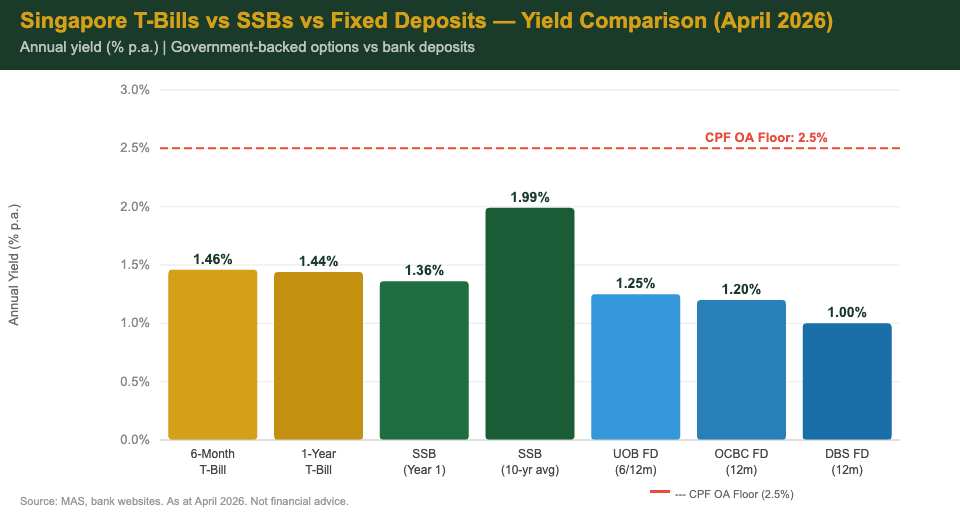
Key takeaways: T-bills currently offer the best short-term yield among FDs and SSBs Year 1 at 1.46%. SSBs win for the long run (1.99% 10-year average, monthly liquidity). CPF OA’s guaranteed 2.5% floor beats all of these — a critical point covered in Section 5. For S-REIT investors seeking higher income yields (5–7%), see our Best S-REITs Singapore 2026 guide and Best Passive Income Ideas in Singapore.
4. How to Buy Singapore T-Bills (Step-by-Step)
You can buy Singapore T-bills using cash, CPF Ordinary Account (OA) funds, or SRS savings through DBS/POSB, OCBC, or UOB — via internet banking, mobile app, or ATM.
Option A: Buying T-Bills With Cash
- Log in to your bank’s internet banking portal (e.g. DBS iBanking)
- Navigate to Invest → Singapore Government Securities (SGS)
- Select T-bill and choose the current issuance (e.g. BS26106T)
- Select payment method: Cash
- Choose bid type: Non-competitive bid (recommended — you accept the cut-off yield) or Competitive bid (you specify a minimum yield; risk of missing out if auction clears below your bid)
- Enter your investment amount (minimum S$1,000, multiples of S$1,000)
- Submit before the deadline: 9pm the day before the auction
Option B: Buying T-Bills With CPF OA Funds
T-bills are eligible under the CPF Investment Scheme (CPFIS). You need a CPFIS-OA investment account at one of the three agent banks. Applications via CPF OA through DBS iBanking must be made on the website (not mobile app).
- Ensure you have a CPFIS-OA investment account set up at DBS/POSB, OCBC, or UOB
- Log in to DBS iBanking (website only)
- Navigate to Invest → Singapore Government Securities (SGS) → T-bill
- Select payment method: CPF-OA
- Choose non-competitive or competitive bid, enter amount
- Submit before: 12pm (noon) on the 2nd business day before the auction
- Note: a transaction fee of S$2.70 (incl. GST) applies per application
Option C: Buying T-Bills With SRS
Select SRS as payment method in iBanking. SRS contributions receive income tax relief (up to S$15,300/year for Singapore citizens), making this tax-efficient. Use our Retirement Planning Calculator to model T-bills and SSBs in your retirement strategy.
| Payment Method | Application Deadline |
|---|---|
| Cash / SRS (iBanking or ATM) | 9pm the day before the auction |
| CPF OA (DBS iBanking — website only) | 12pm noon, 2 business days before auction |
5. Should You Use CPF OA Funds for T-Bills in 2026?
This is the most important question in 2026 — and the answer has changed dramatically from two years ago.
In 2023–2024: T-bills yielded 3.8–4.2% — well above CPF OA’s 2.5% floor. Using CPF OA for T-bills made clear financial sense, and bid-to-cover ratios exceeded 3x as investors piled in.
In 2026: T-bill yields are 1.46% — more than 1 percentage point below CPF OA’s 2.5% floor. Using CPF OA for T-bills now locks you into a lower return than simply leaving money in CPF OA. The net cost: approximately S$52 per S$10,000 over 6 months.
When does CPF OA for T-bills make sense? Only when T-bill yields significantly exceed 2.5% again. Based on current Fed rate expectations and SORA at ~1.07%, this is unlikely before late 2026 at the earliest. For CPF strategy, read our CPF Investment Strategy guide.
For cash and SRS investors, T-bills at 1.46% remain attractive — they beat all major bank FDs, carry no lock-up penalty, and are fully government-backed. For those willing to lock in a longer horizon, the SSB April 2026 issue at 1.99% (10-year average) is worth considering. For higher yields with managed risk, Syfe and Endowus income portfolios target 4–6%+ distribution yields.
6. 2026 T-Bill Auction Calendar
MAS auctions 6-month T-bills approximately every two weeks, and 1-year T-bills quarterly. Always verify on the MAS Auctions and Issuance Calendar before applying.
| Type | Auction Date (approx.) | Cash Deadline | CPF OA Deadline |
|---|---|---|---|
| 6-Month T-Bill | Mid-April 2026 | 9pm, 1 day before | 12pm, 2 business days before |
| 6-Month T-Bill | Late April 2026 | 9pm, 1 day before | 12pm, 2 business days before |
| 1-Year T-Bill | Apr/May 2026 (quarterly) | 9pm, 1 day before | 12pm, 2 business days before |
Pro tip: Set a calendar reminder 3 days before each auction. Missing the CPF OA 12pm deadline (2 business days early) is the most common avoidable mistake.
7. Common Mistakes When Buying T-Bills
- Submitting a competitive bid that’s too high. If you bid 1.60% on a T-bill clearing at 1.46%, your application is rejected entirely. Most retail investors should use non-competitive bids.
- Using CPF OA when T-bill yield < 2.5%. In 2026, this costs you money vs leaving funds in CPF OA. Always compare T-bill yield vs CPF OA floor before deciding.
- Missing the CPF OA deadline. The 12pm, 2-business-days-before cut-off catches many investors off-guard. Cash has more leeway (9pm the day before).
- Not having a CDP account. You need a CDP account linked to your bank to buy T-bills. Apply via SGX if you haven’t already — it takes a few days to process.
- Ignoring SSBs for longer-term idle cash. With SSB Apr 2026 averaging 1.99% over 10 years and monthly redemption flexibility, SSBs beat rolling T-bill reinvestment for patient investors.
- Overlooking REIT ETFs for higher-yield needs. For capital-growth-tolerant investors, Singapore REIT ETFs deliver 4–5.5% distribution yields. See our Singapore REIT ETF guide.
8. Frequently Asked Questions
Are Singapore T-bill returns taxable?
Can I sell a T-bill before maturity?
What is a non-competitive vs competitive T-bill bid?
Is there a limit on how many T-bills I can buy?
Should I choose a 6-month or 1-year T-bill?
Can I use CPF Special Account (SA) funds for T-bills?
How long does it take to receive T-bill proceeds at maturity?
Where can I track T-bill auction results?
Conclusion: Are T-Bills Worth It in 2026?
Singapore T-bills remain a solid option for cash investors who want government-backed safety and better returns than bank fixed deposits. At 1.46% p.a., they beat DBS (1.00%), OCBC (1.20%) and UOB (1.25%), with no minimum holding penalty and full Singapore government guarantee.
However, the calculus has shifted. CPF OA investors should not move funds into T-bills at 1.46% when CPF OA guarantees 2.5%. For longer-term idle cash, the SSB Apr 2026 at 1.99% (10-year average) is attractive given its monthly redemption flexibility. For significantly higher yields with managed risk, consider S-REITs, dividend stocks, or robo advisor income portfolios via Endowus or Syfe.
Not financial advice. All figures as at April 2026. Please verify current rates before investing.
This article was researched with the help of AI. While we strive to keep all information accurate and up to date, there may be errors. If you notice any discrepancies, please contact us.