Best Retirement Plan Singapore 2026
CPF, SRS, S-REITs & ETFs — The Complete Investor Roadmap to Retirement Income
Planning for retirement in Singapore has never been more important — or more timely. With the retirement age rising to 64 on 1 July 2026, CPF LIFE enhancements, and S-REITs offering 5–7% yields at near-trough SORA rates, 2026 is a pivotal year for Singapore investors to lock in their retirement income strategy.
This guide covers every major tool available to Singapore investors — CPF LIFE, SRS, T-bills, SSBs, S-REITs, dividend stocks, ETFs, and robo advisors — with real payout numbers and step-by-step strategies. This is not financial advice. Always consult a licensed adviser for personalised guidance.
Table of Contents
Contents — Click to expand
- Singapore’s Retirement Landscape in 2026
- CPF LIFE: Your Guaranteed Income Foundation
- SRS: Tax Relief + Investment Growth
- S-REITs: 5–7% Yield for Monthly Cash Flow
- T-Bills & SSBs: Low-Risk Fixed Income
- ETFs & Robo Advisors: Long-Term Growth
- Dividend Stocks: Blue-Chip Singapore Income
- Yield Comparison: All Strategies
- CPF LIFE Retirement Sum Milestones
- The Best Retirement Plan by Age & Profile
- Calculator & Tools
- FAQ
1. Singapore’s Retirement Landscape in 2026
Singapore’s retirement framework is undergoing significant change in 2026. Here are the key shifts every investor must know:
- Retirement Age rises to 64 (from 63) effective 1 July 2026 — on track for 65 by 2030.
- Re-Employment Age rises to 69 (from 68) — workers can continue earning and building CPF savings longer.
- CPF Contribution Rates for Senior Workers increase in 2027: Workers aged 55–60 see a 1.5 percentage point increase; aged 60–65 see a 1 percentage point increase.
- SRS Statutory Retirement Age: The penalty-free SRS withdrawal age is locked in at the statutory retirement age when you make your first SRS contribution. If you start before 1 Jul 2026, you lock in 63 for life. After 1 Jul 2026, the new withdrawal age is 64.
- CPF LIFE Payout Age: Unchanged at 65. CPF withdrawals still allowed from 55. The retirement age change does NOT affect CPF payout timing.
- Senior Employment Credit (SEC): Extended to December 2027 — employers get up to 7% wage support for workers aged 60+ earning below S$4,000/month.
The bottom line: Singaporeans are working longer, contributing more to CPF at higher ages, and have more years to build retirement wealth. For investors, this creates a longer accumulation runway — and stronger demand for income assets like S-REITs and dividend stocks.
2. CPF LIFE: Your Guaranteed Income Foundation
CPF LIFE (Lifelong Income For the Elderly) is the bedrock of every Singapore retirement plan. It provides a monthly income for life starting at age 65 — regardless of how long you live.
CPF LIFE Key Facts (2026)
| Parameter | Details |
|---|---|
| Payout Start Age | 65 (defer up to 70 for +6–7%/yr boost) |
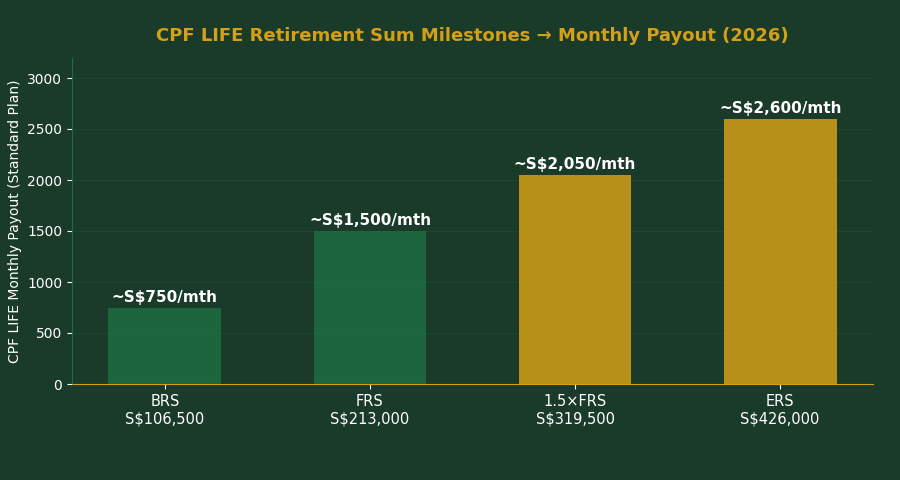
| Basic Retirement Sum (BRS 2026) | S$106,500 → ~S$750/mth |
| Full Retirement Sum (FRS 2026) | S$213,000 → ~S$1,500/mth |
| Enhanced Retirement Sum (ERS 2026) | S$426,000 → ~S$2,600/mth |
| SA/RA Interest Rate | 4.08% p.a. (5.08% on first S$40k/S$30k) |
| Plans Available | Standard (higher payout, lower bequest), Basic (lower payout, full bequest), Escalating (+2%/yr payout growth) |
CPF LIFE Power Moves
- Top up to ERS: The gap between FRS (S$213,000) and ERS (S$426,000) is S$213,000. Topping up here via the Retirement Sum Topping-Up (RSTU) scheme gives you the highest guaranteed monthly income.
- Defer payouts to 70: Each year of deferral adds approximately 6–7% to your monthly payout. Deferring from 65 to 70 can increase your payout by ~35%.
- Cash top-ups get tax relief: S$8,000 for yourself + S$8,000 for family members = up to S$16,000 in chargeable income reduction per year. At the 24% tax bracket, that’s S$3,840 in tax savings.
Use the CPF LIFE Payout Calculator to model your exact monthly income at different RA balances.
3. SRS: Tax Relief + Investment Growth
The Supplementary Retirement Scheme (SRS) is one of Singapore’s most powerful — and underused — tax tools. Contributions reduce your taxable income dollar-for-dollar, while your money grows invested in stocks, ETFs, or managed funds.
SRS Key Facts (2026)
- Annual contribution limit: S$15,300 (Singapore citizens/PRs); S$35,700 (foreigners)
- Tax relief: Full contribution reduces chargeable income — at 24% bracket, S$15,300 saves you S$3,672/year
- Penalty-free withdrawal age: Locked at the statutory retirement age when you first contribute. Contribute before 1 Jul 2026 → lock in 63. After 1 Jul 2026 → 64.
- Withdrawal taxation: Only 50% of SRS withdrawals are taxable. Over a 10-year drawdown window, you can often withdraw largely tax-free.
- Penalty for early withdrawal: 5% penalty + full income tax on withdrawal amount
- Investment options: SGX-listed stocks (including S-REITs), ETFs, unit trusts, Singapore Government Securities, fixed deposits
Best SRS Investment Platforms (2026)
| Platform | SRS Fee | Best For |
|---|---|---|
| Endowus | 0.25–0.60% p.a. | Fund-of-funds, CPF OA access, full trailer rebate |
| Syfe | 0.25–0.65% p.a. | REIT+, Income+ portfolios, Singapore income focus |
| FSMOne | 0.08–0.18% p.a. (brokerage) | DIY investors, CPFIS-approved, wide fund selection |
The SRS strategy works best when you invest your contributions into growth or income assets rather than leaving cash at 0.05% p.a. in the SRS account. For a detailed guide, see our SRS Account Singapore Guide 2026.
4. S-REITs: 5–7% Yield for Monthly Cash Flow
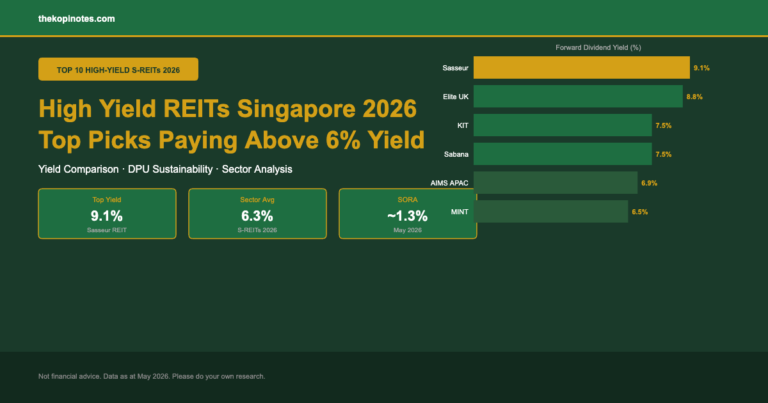
Singapore REITs (S-REITs) are the income engine of most Singapore retirement portfolios. With forward yields of 5–7% and the S-REIT index trading at ~0.9× book value as at April 2026, the sector offers compelling value for income investors.
Why S-REITs Work for Retirement
- High yields: FY2026 forward sector average ~6.3% — far above CPF OA (2.5%), T-bills (~1.5%), and SSBs (~2%)
- 90% distribution rule: By law, S-REITs must distribute at least 90% of taxable income — your income is highly predictable
- Quarterly/semi-annual payouts: Most S-REITs pay every quarter or every 6 months, creating regular cash flow
- Singapore tax-exempt: No withholding tax for individual Singapore investors — dividends are paid gross
- SORA at ~0.8% trough: Lower financing costs directly boost distributable income (DPU) for leveraged REITs
- SRS-compatible: All SGX-listed S-REITs can be purchased inside SRS accounts via any broker
Top S-REIT Sectors by Yield (April 2026)
| Sector | Fwd Yield Range | Representative REITs |
|---|---|---|
| Industrial | 5.5–9.5% | ESR-LOGOS (9.4%), AIMS APAC (7.3%), MIT (6.9%) |
| Retail | 5.5–7% | Lendlease REIT (6.7%), FCT, Starhill (~7%) |
| Office/Commercial | 5–6% | CICT (5.5%), Keppel REIT (6%), Suntec (~5%) |
| Hospitality | 4.5–6.5% | Far East Hospitality Trust (6.1%) |
| Data Centre | 4–5% | Keppel DC REIT (4.7%), AI-driven demand |
| Healthcare | 3.5–4% | Parkway Life REIT (3.8%), 18-yr DPU growth track |
For a curated list, see our Best S-REITs Singapore 2026 guide. Use the REITs Dividend Yield Calculator to model your income at different portfolio sizes.
5. T-Bills & SSBs: Low-Risk Fixed Income
For the defensive layer of your retirement portfolio, Singapore government securities offer capital safety and predictable returns — backed by the Singapore government’s AAA credit rating.
6-Month T-Bills (as at April 2026)
- Current cut-off yield: ~1.46% p.a. (down from peak of ~3.8% in 2023)
- Minimum investment: S$1,000
- How to buy: Via DBS/OCBC/UOB iBanking, ATM, or CPF OA / SRS
- CPF OA compatible: Yes — earn more than the 2.5% OA floor? Only possible if T-bill yields exceed 2.5%, which they currently do not. T-bills currently below OA rate.
- Best use in 2026: Parking emergency funds or short-term savings while waiting for better opportunities
Singapore Savings Bonds (SSB — May 2026)
- 10-year average yield: ~2.14% p.a. (May 2026 issue)
- Maximum per person: S$200,000
- No early withdrawal penalty: Redeem anytime, get accrued interest
- SRS-compatible: Yes (but not CPF OA)
- Best use: Medium-term parking for investors who want flexibility over fixed deposits
Explore our T-Bill, SSB & Fixed Deposit Comparison Calculator to model returns across all three. For the full guide, see Singapore Savings Bonds 2026 Guide and Singapore T-Bills 2026 Guide.
6. ETFs & Robo Advisors: Long-Term Growth
For the growth component of a retirement portfolio, globally diversified ETFs and robo advisors offer low-cost exposure to hundreds of companies with minimal active management needed.
Top ETFs for Singapore Retirement Investors
| ETF | Exchange | TER | Why Choose |
|---|---|---|---|
| CSPX (iShares S&P 500) | LSE (USD) | 0.07% | US large-cap, 15% WHT (Ireland UCITS), no US estate tax |
| VWRA (Vanguard All-World Acc) | LSE (USD) | 0.22% | Global diversification, accumulating (auto-reinvest) |
| Nikko AM STI ETF | SGX (SGD) | 0.30% | Singapore blue-chips (DBS/OCBC/UOB), CPFIS-approved, ~3% yield |
Robo Advisors for SRS & Cash Investing
- Endowus — 0.25–0.60% fee, CPF OA compatible, 100% trailer rebate. Cash Smart Ultra ~3.3–3.6%. Best for CPF/SRS investors who want fund-of-funds approach.
- Syfe — 0.25–0.65% fee, REIT+ and Income+ portfolios for Singapore income focus. Cash+ Flexi ~3.1–3.4%. Best for S-REIT exposure within a managed wrapper.
See our CSPX ETF Singapore Guide and VWRA ETF Singapore Guide for detailed analysis of the top ETF picks.
7. Dividend Stocks: Blue-Chip Singapore Income
Beyond S-REITs, Singapore’s SGX offers a range of high-quality dividend-paying stocks that can anchor a retirement income portfolio. The top picks for 2026 are Singapore’s three major banks and a handful of large-cap infrastructure companies.
| Stock | SGX Code | Div Yield (2026E) | Key Feature |
|---|---|---|---|
| DBS Group | D05 | ~5.5% | Quarterly dividends, scrip dividend option |
| OCBC Bank | O39 | ~6.0% | Strong capital ratios, ASEAN growth exposure |
| UOB | U11 | ~5.8% | Regional bank, Citibank retail acquisition synergies |
| NetLink NBN Trust | CJLU | ~6.8% | Utility-like fibre income, high payout stability |
| Sembcorp Industries | U96 | ~5.6% | Renewable energy transition play |
For the full guide, see Best Dividend Stocks Singapore 2026.
8. Yield Comparison: All Strategies (2026)
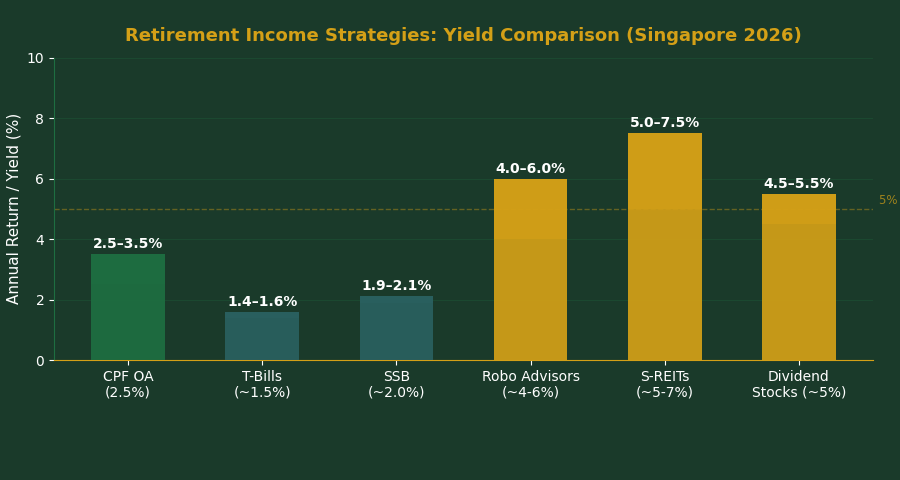
| Strategy | Annual Return / Yield | Risk | CPF/SRS |
|---|---|---|---|
| CPF OA | 2.5% (3.5% on first S$20k) | Zero | ✅ Both |
| CPF SA/RA | 4.08% (5.08% on first S$40k) | Zero | ✅ Both |
| T-Bills (6M) | ~1.46% p.a. | Very Low | ✅ Both |
| SSB (May 2026) | ~2.14% p.a. (10-yr avg) | Very Low | SRS only |
| Robo Advisors | ~4–6% (long-term) | Low–Medium | ✅ Both |
| S-REITs | 5–7% yield (fwd) | Medium | SRS only (LSE ETFs: neither) |
| Dividend Stocks | 4.5–6.8% yield | Medium | SRS only |
| Global ETFs (CSPX/VWRA) | ~7–10% p.a. long-term (historical) | Medium–High | Neither (LSE) |
9. The Best Retirement Plan by Age & Profile
The optimal Singapore retirement plan depends on your age, risk tolerance, and whether your priority is income now or growth for later.
Age 30–45: Growth & Accumulation Phase
- Priority: Maximise CPF SA growth (4.08%+), start SRS contributions (lock in 63 withdrawal age before Jul 2026)
- Invest SRS in: Global ETFs (CSPX/VWRA) via IBKR or Endowus
- Also consider: Dollar-cost averaging into S-REITs or dividend stocks for compounding distributions
- CPF top-up: Top up SA to FRS target — earns 4.08% risk-free
Age 45–55: Transition Phase
- Priority: CPF SA top-up (RSTU) to close gap to FRS/ERS, increase SRS contributions to max S$15,300/yr
- Invest in: Higher-yielding S-REITs + dividend stocks + robo advisor for stable income
- Start building: T-bill/SSB ladder for near-term liquidity (3–5 years of expenses in low-risk assets)
Age 55–65: Pre-Retirement Phase
- Priority: Consider topping up RA to ERS (S$426,000) to maximise CPF LIFE payout
- SRS drawdown planning: Model 10-year withdrawal to keep each year’s 50% taxable portion within the S$20,000 zero-tax band
- Portfolio shift: Reduce growth ETFs, increase S-REIT/dividend stock income allocation
- Consider deferring CPF LIFE: Each year of deferral from 65 to 70 adds ~6–7% to your monthly payout
Age 65+: Retirement Income Phase
- CPF LIFE: Start drawing — or defer to 70 for maximum monthly payout
- SRS drawdown: Spread over 10 years from retirement age to minimise tax impact
- S-REIT income: Maintain a 30–50% allocation for 5–7% yield income stream
- Rebalance annually: As you age, gradually shift from equity to income assets
Model your specific retirement number using our Retirement Planning Calculator Singapore.
10. Calculators & Tools
Use these free Singapore retirement planning calculators to model your exact numbers:
- Retirement Planning Calculator — Target retirement income vs savings gap
- CPF LIFE Payout Calculator — Monthly income at BRS / FRS / ERS
- CPF Retirement Sum Calculator — Project your RA balance at 55
- SRS Tax Savings Calculator — Annual savings by income bracket
- T-Bill, SSB & FD Comparison Calculator — Compare low-risk income
- S-REIT Dividend Yield Calculator — Model REIT income by portfolio size
- Dividend Portfolio Yield Calculator — Build your income portfolio
FAQ
What is the best retirement plan in Singapore for 2026?
Does the retirement age increase affect my CPF payouts?
What's the retirement age in Singapore in 2026?
This article was researched with the help of AI. While we strive to keep all information accurate and up to date, there may be errors. If you notice any discrepancies, please contact us.