Mapletree Logistics Trust (MLT) Investor Guide 2026: DPU History, Yield Analysis & Asia-Pacific Portfolio
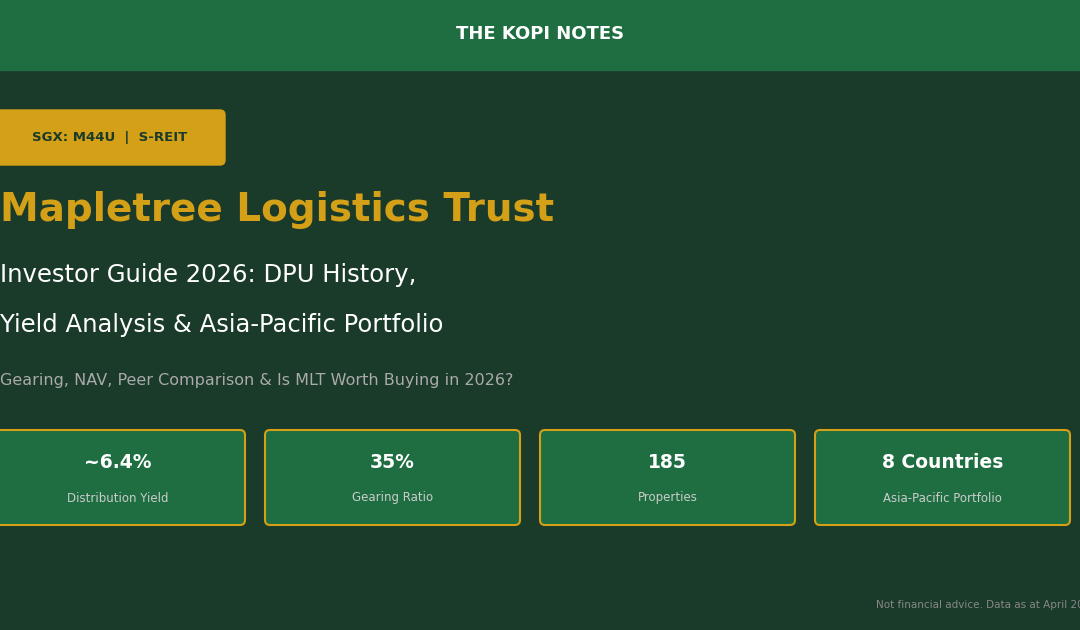
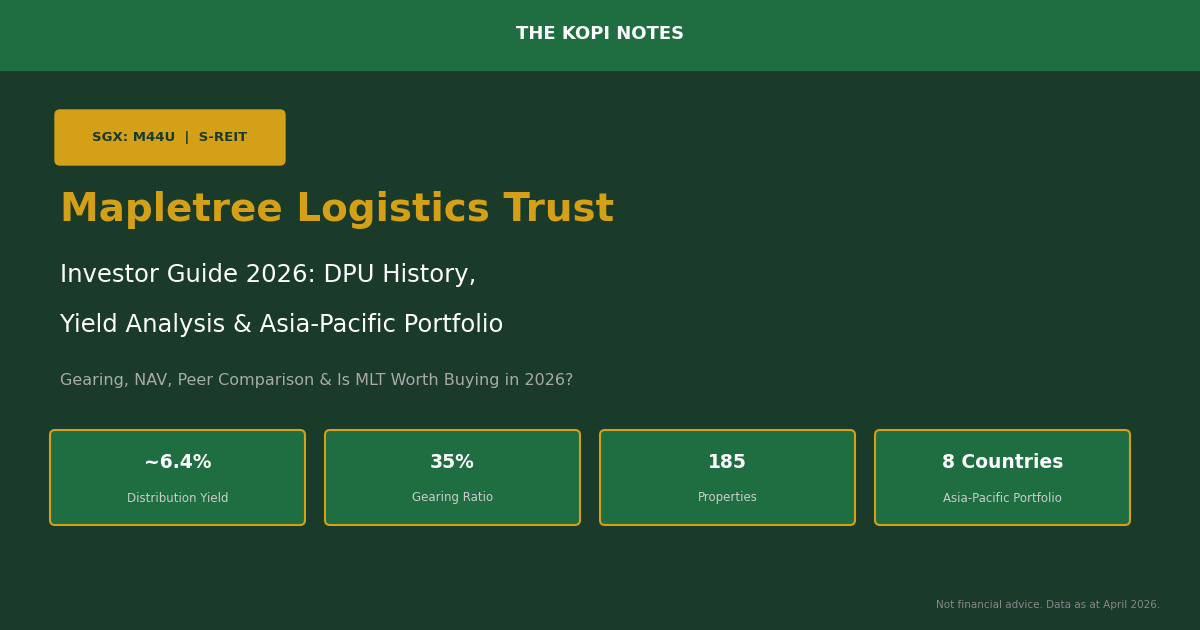
Mapletree Logistics Trust (SGX: M44U) is one of Singapore’s largest and most geographically diversified logistics REITs, with over 185 modern warehouses and logistics facilities across 8 countries in Asia-Pacific. In this comprehensive guide, we cover MLT’s DPU history, distribution yield, gearing ratio, portfolio breakdown, and how it compares to S-REIT peers in 2026.
Disclaimer: This article is for informational purposes only and does not constitute financial advice. Always do your own research before investing.
Table of Contents
Contents — Click to expand
- Mapletree Logistics Trust — Quick Overview
- Portfolio Breakdown: Countries & Asset Types
- DPU History FY2018–FY2025
- Yield Analysis & Peer Comparison
- Gearing Ratio, NAV & Financial Health
- MLT Key Financial Metrics Table
- Strengths & Risks for Investors
- Is MLT Worth Buying in 2026?
- Useful Tools for S-REIT Investors
- Frequently Asked Questions
Mapletree Logistics Trust — Quick Overview
Mapletree Logistics Trust (MLT) was listed on the Singapore Exchange (SGX) in 2005 and is managed by Mapletree Logistics Trust Management Ltd, a wholly-owned subsidiary of Mapletree Investments Pte Ltd — itself a subsidiary of Temasek Holdings. This blue-chip sponsor backing gives MLT access to a strong acquisition pipeline and preferential funding terms.
As at April 2026, MLT owns a portfolio valued at approximately S$13.5 billion, with properties spanning Singapore, China, Japan, Australia, South Korea, Malaysia, Vietnam, India, and Hong Kong. The REIT focuses on modern logistics facilities, cold chain warehouses, and business parks that serve e-commerce, 3PL (third-party logistics), retail, and manufacturing tenants.
MLT is widely regarded as a core logistics S-REIT holding due to its geographic diversification, long weighted average lease expiry (WALE), and track record of growing DPU over more than a decade.
Portfolio Breakdown: Countries & Asset Types
MLT’s portfolio is one of the most geographically diversified among Singapore-listed logistics REITs. As at FY2024/25, the portfolio comprised approximately 185 properties with a total net lettable area (NLA) of around 11.5 million sqm.
By asset value, the key markets are:
| Country / Market | Portfolio Weight (Approx.) | No. of Properties | Key Tenants / Sectors |
|---|---|---|---|
| China | ~26% | 52 | E-commerce, 3PL, cold chain |
| Japan | ~21% | 38 | FMCG, 3PL, pharma |
| Singapore | ~18% | 21 | Regional HQs, pharma, tech |
| Australia | ~12% | 20 | Retail logistics, e-comm |
| South Korea | ~9% | 14 | Cold chain, e-commerce |
| Malaysia & Vietnam | ~8% | 22 | Manufacturing, FMCG, 3PL |
| Others (India, HK) | ~6% | 18 | Pharma, 3PL, retail |
Note: Portfolio weights are approximate as at FY2024/25 annual report. Always verify with the latest MLT investor presentation at the MLT investor relations page.
One key concern for investors in 2026 is MLT’s exposure to China (~26% of portfolio value), where logistics rental reversions have been under pressure due to oversupply in some tier-2 and tier-3 cities. Management has been proactive in repositioning assets and focusing on gateway cities. Offsetting this is strong leasing momentum in Japan, Australia, and Vietnam, which are benefiting from nearshoring and supply chain diversification trends.
DPU History FY2018–FY2025
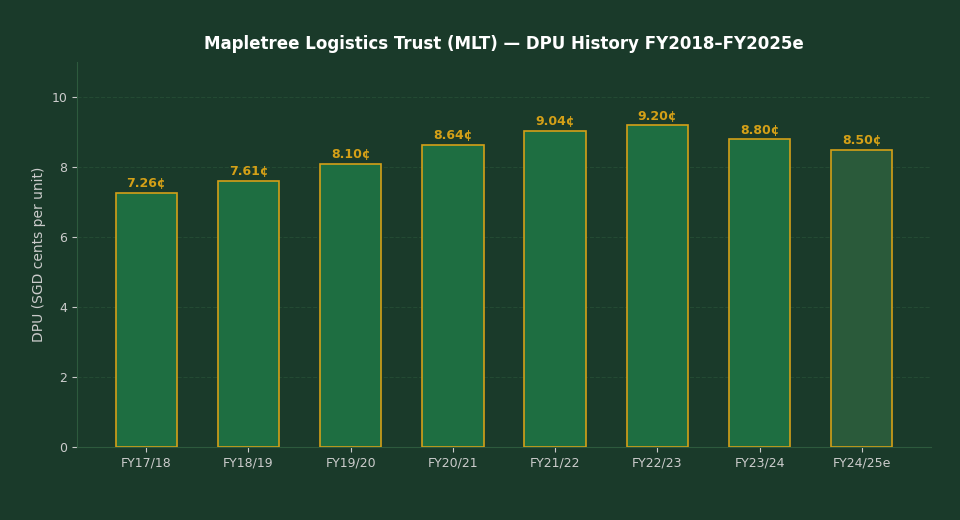
Mapletree Logistics Trust grew its distribution per unit (DPU) consistently for more than a decade following its 2005 listing. However, DPU has faced mild pressure since FY2022/23 due to higher borrowing costs, China rental reversions, and asset recycling activity. Here is the recent DPU trend:
| Financial Year | DPU (SGD cents) | YoY Change |
|---|---|---|
| FY2017/18 | 7.26¢ | — |
| FY2018/19 | 7.61¢ | +4.8% |
| FY2019/20 | 8.10¢ | +6.4% |
| FY2020/21 | 8.64¢ | +6.7% |
| FY2021/22 | 9.04¢ | +4.6% |
| FY2022/23 | 9.20¢ | +1.8% |
| FY2023/24 | 8.80¢ | -4.3% |
| FY2024/25 (est.) | ~8.50¢ | ~-3.4% |
The DPU decline from FY2022/23 onwards reflects the impact of higher interest rates on MLT’s financing costs, as well as weaker rental reversions in China. That said, the pace of decline has moderated, and management has flagged improving conditions in key markets. With Singapore’s best S-REITs in 2026 delivering 5–8% yields, MLT’s ~6.4% yield remains competitive for its risk-return profile.
It is worth noting that MLT distributes quarterly (March, June, September, December), making it convenient for investors seeking regular income. Always verify the latest DPU figures at the MLT distributions page or SGX announcements.
Yield Analysis & Peer Comparison
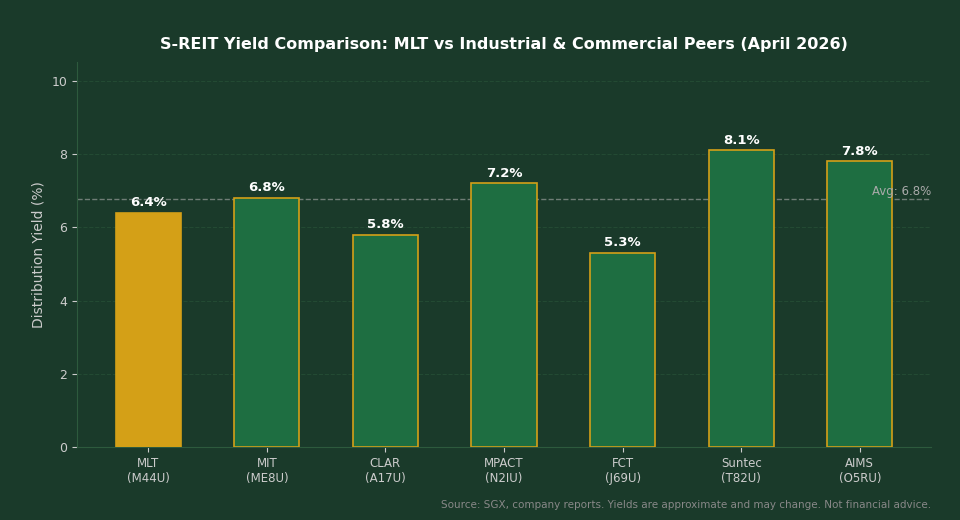
As at April 2026, MLT’s annualised distribution yield is approximately 6.4% based on the trailing 12-month DPU and current unit price. This positions MLT in the mid-range among S-REIT peers:
| S-REIT | SGX Code | Approx. Yield (Apr 2026) | Subsector |
|---|---|---|---|
| Mapletree Logistics Trust | M44U | ~6.4% | Logistics |
| Mapletree Industrial Trust | ME8U | ~6.8% | Industrial / Data Centres |
| CapitaLand Ascendas REIT | A17U | ~5.8% | Industrial / Business Park |
| MPACT (Mapletree Pan Asia Commercial) | N2IU | ~7.2% | Commercial / Retail |
| Frasers Centrepoint Trust | J69U | ~5.3% | Retail / Suburban Malls |
| Suntec REIT | T82U | ~8.1% | Office / Commercial |
| AIMS APAC REIT | O5RU | ~7.8% | Industrial / Logistics |
Yields are indicative as at April 2026 and based on trailing DPU. Unit prices change daily — always check SGX for current prices. Not financial advice.
MLT’s yield is not the highest in the S-REIT universe, but it benefits from a much larger portfolio (S$13.5B AUM vs AIMS APAC’s ~S$2B), a stronger sponsor (Mapletree/Temasek), and significantly greater geographic diversification. For conservative income investors who want logistics exposure with blue-chip quality, MLT is often preferred over smaller high-yield alternatives.
You can use the S-REIT dividend yield calculator to input the current MLT unit price and DPU to compute your personal yield on cost.
Gearing Ratio, NAV & Financial Health
As at the latest available results (Q3 FY2024/25), MLT’s key financial metrics reflect a REIT in a period of balance sheet consolidation:
Aggregate Leverage (Gearing): Approximately 35–36%, below the MAS regulatory cap of 50% (or 55% if interest coverage is ≥2.5x). MLT has operated at 35–40% gearing historically, giving it moderate debt headroom for acquisitions or asset enhancement initiatives (AEIs).
Interest Coverage Ratio (ICR): Approximately 3.5–4.0x, comfortably above the MAS minimum. This means MLT’s earnings cover its interest obligations roughly 3.5 times, indicating healthy debt serviceability even if interest rates remain elevated.
Net Asset Value (NAV): MLT’s NAV per unit is approximately S$1.40–S$1.45. If the unit price trades at a significant discount to NAV (e.g., 10–15% below), this is often viewed as a value signal by REIT investors. You can compute the price-to-NAV ratio using the S-REIT yield vs SGS bond spread calculator to assess whether the risk premium is attractive.
Weighted Average Debt Maturity: Approximately 3.5 years, with a mix of SGD, JPY, AUD, and USD borrowings. MLT actively hedges its foreign currency income, though FX movements still affect reported DPU in SGD terms (particularly JPY and AUD weakness in FY2024).
Fixed Rate Debt: Approximately 75–80% of MLT’s debt is fixed or hedged into fixed rates, providing reasonable interest cost certainty in the near term.
You can check MLT’s latest gearing and ICR data using our S-REIT gearing ratio & ICR calculator.
MLT Key Financial Metrics Table
The table below summarises Mapletree Logistics Trust’s key investment metrics as at April 2026. Always verify with the latest SGX announcement or MLT quarterly business update.
| Metric | Value (Approx., Apr 2026) |
|---|---|
| SGX Code | M44U |
| Asset Under Management (AUM) | ~S$13.5 billion |
| No. of Properties | ~185 |
| Countries | 8 (SG, CN, JP, AU, KR, MY, VN, IN) |
| Trailing DPU (FY2023/24) | 8.80 SGD cents |
| Distribution Yield | ~6.4% |
| NAV per Unit | ~S$1.40–S$1.45 |
| Aggregate Leverage (Gearing) | ~35–36% |
| Interest Coverage Ratio (ICR) | ~3.5–4.0x |
| WALE (by NLA) | ~2.8–3.2 years |
| Portfolio Occupancy | ~96–97% |
| Distribution Frequency | Quarterly |
| Sponsor | Mapletree Investments (Temasek subsidiary) |
| Fixed-Rate Debt Proportion | ~75–80% |
Data as at April 2026. Figures are approximate. Verify with the SGX MLT page and MLT’s latest quarterly business update.
Strengths & Risks for Investors
Key Strengths:
1. Blue-chip Temasek-backed sponsor: Mapletree Investments is backed by Temasek Holdings, Singapore’s state investment company. This provides MLT with a robust acquisition pipeline, preferential debt financing, and institutional credibility — rarely available to smaller REITs.
2. True geographic diversification: With 8 countries and ~185 properties, MLT is far less exposed to any single market than single-country logistics REITs. Japan and Australia have been delivering positive rental reversions in 2024/25, helping offset China headwinds.
3. Structural tailwinds: Asia-Pacific logistics demand is underpinned by e-commerce growth, 3PL outsourcing, cold chain expansion, and supply chain nearshoring. MLT is well-positioned to benefit from these multi-year trends.
4. Quarterly distributions: MLT pays quarterly — convenient for income investors managing cash flow. Contrast this with some S-REITs that pay semi-annually.
5. CPF and SRS investable: MLT (M44U) is approved for CPF Ordinary Account (OA) investment under the CPF Investment Scheme (CPFIS), and can also be purchased via SRS (Supplementary Retirement Scheme). This makes it tax-efficient for Singapore investors.
Key Risks:
1. China exposure (~26%): Logistics rental pressure in China due to supply glut in some cities remains a material headwind. This is the single largest risk for MLT in 2026. Management is repositioning but execution takes time.
2. FX risk: MLT collects rents in JPY, AUD, KRW, CNY, MYR, VND, and INR, then reports in SGD. Currency movements — particularly JPY and AUD weakness — have reduced reported DPU in recent years.
3. Rising interest rates: MLT’s all-in financing cost has risen from ~2% (pre-2022) to approximately 3.2–3.5% as at FY2024/25. While 75–80% of debt is on fixed rates, refinancing of maturing debt at higher rates remains a headwind to DPU.
4. Unit price sensitivity: MLT’s unit price is sensitive to interest rate expectations. Rate cut expectations tend to support S-REIT unit prices; delayed cuts (as seen in 2024) keep prices suppressed. Read our analysis of the best S-REITs in Singapore 2026 for the macro interest rate context.
Is MLT Worth Buying in 2026?
This is the question most retail investors are asking after MLT’s unit price corrected significantly from its post-COVID highs of over S$2.00 to around S$1.35–S$1.40 in early 2026.
The bear case is clear: DPU has declined for two consecutive years, China headwinds persist, and the JPY/AUD translation effect has hurt income. If you’re looking for DPU growth, MLT may disappoint in the near term.
The bull case, however, is also compelling: at current prices, MLT trades at or slightly below NAV — a rare occurrence for a Temasek-backed logistics REIT. The ~6.4% yield is competitive, the portfolio occupancy remains high at ~96%, and structural demand for Asia-Pacific logistics is secular. If the US Federal Reserve delivers rate cuts in H2 2026 (which the S-REIT outlook for 2026 discusses in detail), re-rating potential is meaningful.
For a long-term income investor building a retirement portfolio, MLT at current valuations offers a reasonable entry point — particularly if accumulated over time using a dollar-cost averaging (DCA) approach. Use our DCA Investment Calculator to model how a regular monthly investment in MLT would grow over 10–20 years.
For investors comparing brokers to buy MLT, check our recommended platforms with referral bonuses: Syfe, Endowus, or FSMOne.
This is not financial advice. Please consult a licensed financial adviser and conduct your own due diligence before investing in any S-REIT.
Useful Tools for S-REIT Investors
If you’re researching MLT or building a broader S-REIT portfolio, these free calculators on The Kopi Notes can help you run the numbers:
- S-REIT Dividend Yield Calculator — compute your yield on cost from current price and DPU
- S-REIT Yield vs SGS Bond Spread Calculator — assess whether REIT valuations are attractive relative to risk-free rates
- Gearing Ratio & ICR Calculator — check if a REIT’s leverage is at safe levels
- DCA Investment Calculator — model regular monthly investments in MLT over time
- Retirement Planning Calculator — see how S-REIT income fits your retirement plan
Frequently Asked Questions
What is Mapletree Logistics Trust (MLT)?
What is MLT's current dividend yield?
How often does MLT pay dividends?
Is MLT a good buy in 2026?
Can CPF OA be used to buy MLT?
What is MLT's gearing ratio?
How does MLT compare to CapitaLand Ascendas REIT (CLAR)?
Start Investing in S-REITs Today
Whether you’re buying MLT for the first time or adding to an existing position, these platforms offer competitive fees and sign-up bonuses for Singapore investors:
This article was researched with the help of AI. While we strive to keep all information accurate and up to date, there may be errors. If you notice any discrepancies, please contact us.