DPS Insurance Singapore vs Term Life Insurance: Is $70,000 Enough to Protect Your Family? (2026)
Data verified as at 4 October 2026 · Source: CPF Board (last updated Jul 2026)
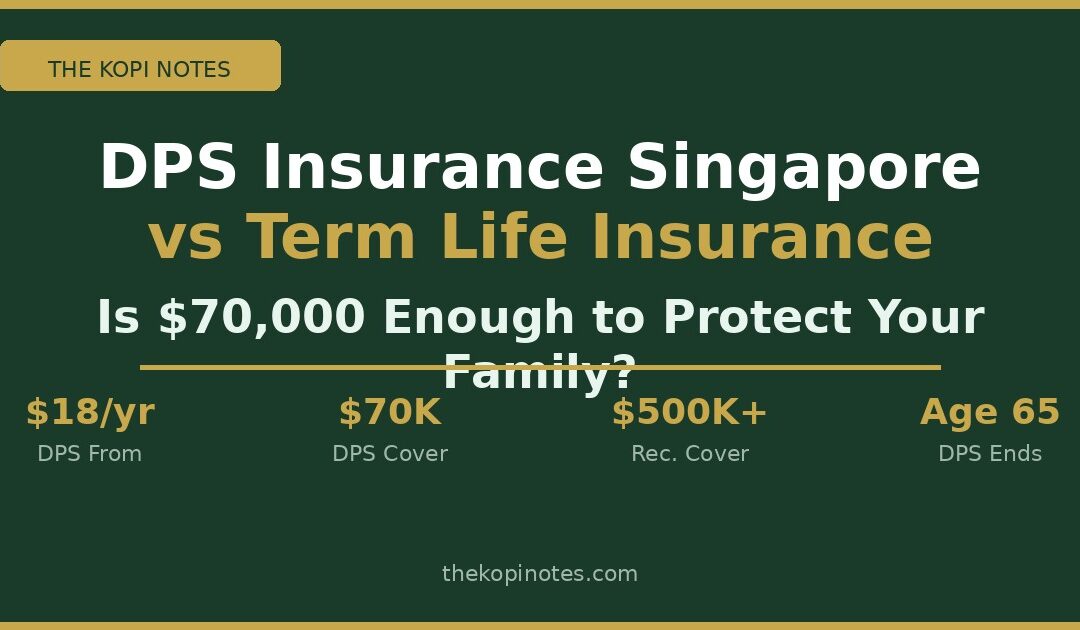
Every working Singaporean and PR is automatically enrolled in the Dependants’ Protection Scheme (DPS) — a CPF-linked term life insurance that pays up to $70,000 if you die or become totally and permanently disabled. Premiums start at just $18 a year, deducted straight from your CPF Ordinary Account.
Sounds great. But here’s the uncomfortable truth: $70,000 is rarely enough for a family with a mortgage, children, and decades of living expenses ahead. This guide breaks down exactly how DPS works, where it falls short, and when you need to supplement it with private term life insurance.
Table of Contents
- What Is DPS (Dependants’ Protection Scheme)?
- DPS Coverage, Premiums & Eligibility
- What Is Private Term Life Insurance?
- DPS vs Term Life Insurance: Full Comparison
- How Much Coverage Does Your Family Actually Need?
- When Should You Top Up Beyond DPS?
- How to Get Additional Term Life Coverage
- Frequently Asked Questions
- Conclusion
1. What Is DPS (Dependants’ Protection Scheme)?
The Dependants’ Protection Scheme (DPS) is Singapore’s national term life insurance programme, administered by the CPF Board and underwritten by Great Eastern Life. It was introduced to ensure every working Singaporean and PR has at least a basic level of life insurance protection.
You are automatically enrolled in DPS when you make your first valid CPF contribution as an employee, and your premiums are deducted automatically from your CPF Ordinary Account (OA) each year — or from your Special Account (SA) if your OA has insufficient funds.
What Does DPS Cover?
DPS pays out a lump sum if you:
- Pass away while covered under the scheme
- Are certified to have a terminal illness with less than 12 months to live
- Suffer Total Permanent Disability (TPD) — meaning you are permanently unable to work in any occupation
Coverage is in force from age 21 until age 65, when the policy automatically lapses. You may also opt out of DPS if you have sufficient alternative coverage elsewhere.
2. DPS Coverage, Premiums & Eligibility
Coverage Amounts
DPS pays out a lump sum sum assured based on your age at the time of claim:
| Age Group | Sum Assured (Payout) |
|---|---|
| Age 21 – 59 | $70,000 |
| Age 60 – 64 | $55,000 |
| Age 65 and above | No coverage (policy ends) |
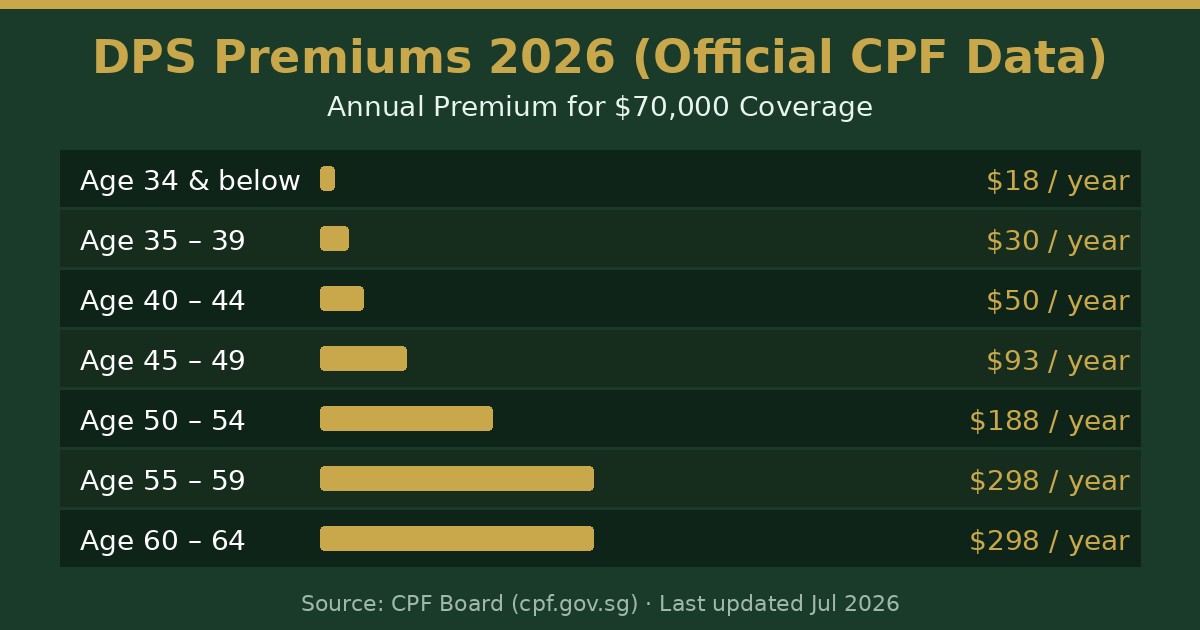
Official DPS Premiums (CPF Board, 2026)
Premiums are paid annually from your CPF OA and are age-banded as follows:
| Age at Payment Date | Annual Premium | Monthly Equivalent |
|---|---|---|
| 34 years and below | $18 | ~$1.50 |
| 35 – 39 years | $30 | ~$2.50 |
| 40 – 44 years | $50 | ~$4.17 |
| 45 – 49 years | $93 | ~$7.75 |
| 50 – 54 years | $188 | ~$15.67 |
| 55 – 59 years | $298 | ~$24.83 |
| 60 – 64 years | $298 (for $55,000 cover) | ~$24.83 |
Source: CPF Board, cpf.gov.sg — last updated 23 July 2026
Eligibility & How to Stay Covered
- Who qualifies: Singapore Citizens and PRs aged 21–64 who make CPF contributions
- Auto-enrollment: You are enrolled automatically on first CPF contribution — no application required
- Health declaration: You must make a health declaration to Great Eastern upon first enrollment
- Payment method: Deducted from CPF OA annually (SA used if OA balance insufficient)
- Opt-out: You can opt out if you have adequate alternative coverage
3. What Is Private Term Life Insurance?
Private term life insurance is a policy you purchase independently from an insurer (AIA, Prudential, Great Eastern, FWD, Income, Singlife, etc.) that pays a pre-agreed lump sum — called the sum assured — if you die or are diagnosed with a terminal illness during the policy term.
Key Characteristics
- Coverage range: Typically $100,000 to $2,000,000+ (you choose the amount)
- Policy term: 10, 20, 30 years, or up to age 65/70/85/99
- Premiums: Fixed for the policy duration; paid in cash (not CPF)
- Riders available: Critical illness, disability income, waiver of premium, and more
- No cash value: Pure protection — premiums do not accumulate any savings element
- Medical underwriting: Requires full health disclosure; pre-existing conditions may be excluded
For a healthy 30-year-old non-smoker, a $500,000 term life policy covering to age 65 typically costs $30–$60 per month depending on the insurer and riders selected.
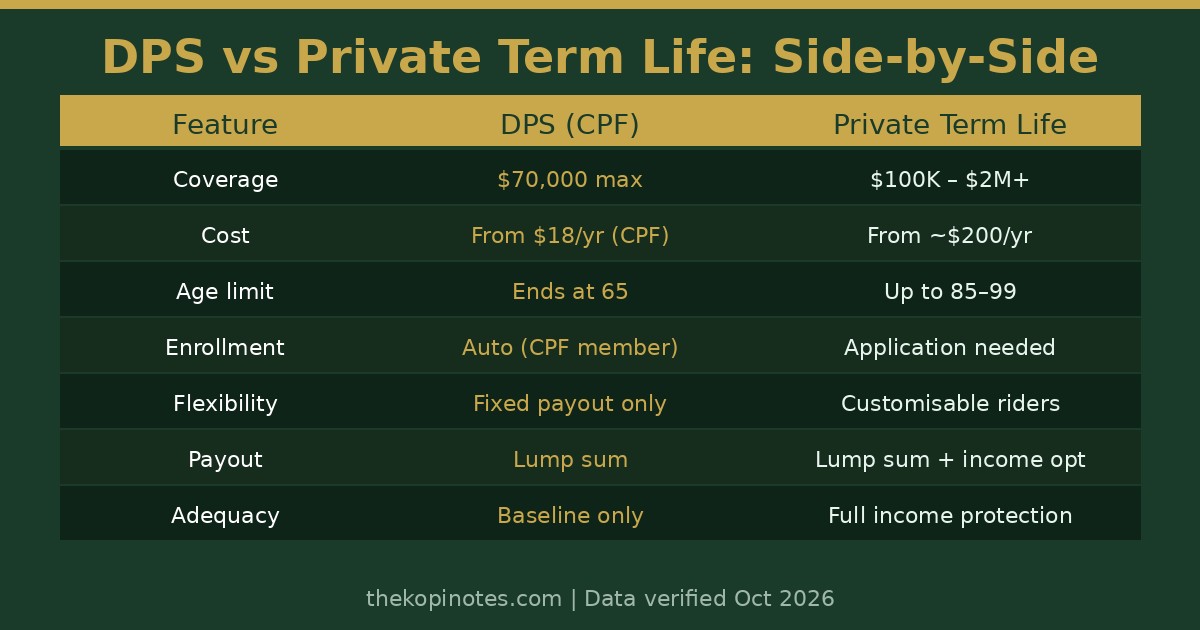
4. DPS vs Term Life Insurance: Full Comparison
| Feature | DPS (CPF Scheme) | Private Term Life |
|---|---|---|
| Maximum Coverage | $70,000 | $100K – $2M+ |
| Coverage Age | Ends at 65 | Up to age 85–99 |
| Cost | $18–$298/yr (CPF) | $200–$1,500+/yr (cash) |
| Enrollment | Automatic | Application required |
| Triggers | Death, terminal illness, TPD | Death, terminal illness (± riders) |
| Flexibility | Fixed — no customisation | Fully customisable |
| Critical Illness | Not covered | Available as rider |
| Payment Method | CPF OA / SA | Cash / GIRO |
| Best For | Baseline protection only | Full income replacement |
5. How Much Coverage Does Your Family Actually Need?
Financial planners in Singapore typically use the income replacement method: your life insurance coverage should equal 5 to 10 times your annual income, plus outstanding debts and dependant-related expenses.
Simple Coverage Estimate
| Annual Income | 5× Rule (Minimum) | 10× Rule (Recommended) | DPS Gap |
|---|---|---|---|
| $36,000 (~$3K/mth) | $180,000 | $360,000 | -$110K to -$290K |
| $60,000 (~$5K/mth) | $300,000 | $600,000 | -$230K to -$530K |
| $96,000 (~$8K/mth) | $480,000 | $960,000 | -$410K to -$890K |
This table makes the shortfall stark: DPS alone leaves most Singapore families significantly underinsured. A $3,000/month breadwinner with a $400,000 HDB mortgage and two children needs at least $400,000–$600,000 in total coverage. DPS covers just $70,000 — barely covering 5 months of household expenses.
6. When Should You Top Up Beyond DPS?
You should seriously consider adding private term life insurance if any of the following apply:
- ✅ You have a spouse, children, or elderly parents who depend on your income
- ✅ You carry an outstanding home loan (HDB or private property)
- ✅ Your total family expenses exceed $2,000 per month
- ✅ You are the sole or primary breadwinner of your household
- ✅ You want coverage that extends beyond age 65
- ✅ You want riders for critical illness or disability income
Conversely, DPS alone may be sufficient if you are single, debt-free, with no dependants and substantial liquid assets.
7. How to Get Additional Term Life Coverage
Getting a private term life policy in Singapore typically involves three steps:
- Calculate your coverage gap using the income replacement formula above
- Compare quotes from multiple insurers — premiums vary significantly between AIA, Prudential, Great Eastern, FWD, Singlife, and Income
- Apply with a licensed financial adviser (IFA) or directly via the insurer’s portal
To make the most of your investment portfolio alongside your insurance planning, consider using a robo-advisor for passive investing — so your emergency fund and long-term wealth grow while your insurance protects against worst-case scenarios.
🌿 Start Building Your Financial Safety Net
While you’re reviewing your insurance needs, make sure your savings and investments are working hard too. These platforms are trusted by Singaporeans for low-cost, diversified investing:
Frequently Asked Questions About DPS Singapore
What is DPS in Singapore?
How much does DPS cost per year?
Is DPS enough life insurance for a family?
When does DPS end?
Can I opt out of DPS?
Does DPS cover critical illness?
Who is the insurer for DPS?
Conclusion
The Dependants’ Protection Scheme is one of the best things CPF has built into the Singapore financial system: automatic, cheap, zero-hassle baseline life insurance. At $18 a year for those under 35, there’s simply no reason not to keep it.
But DPS was never designed to be your only protection. The $70,000 cap, the age-65 cutoff, and the absence of critical illness coverage all mean that for most working Singaporeans with families and mortgages, DPS needs to be supplemented with a properly sized private term life policy.
As a rule of thumb: keep your DPS as the foundation, then layer a private term life policy of $300,000–$1,000,000 on top (depending on your income, debts, and dependant obligations). Compare premiums regularly — the life insurance market in Singapore is competitive and costs have fallen significantly in recent years.
For further reading, check out our guides on DPS Singapore complete guide 2026 and term life insurance Singapore comparison 2026.
Disclaimer: This article is for informational purposes only and does not constitute financial advice. Insurance needs vary by individual circumstances. Please consult a licensed financial adviser before making coverage decisions.
Get Free Insurance Advice
Speak with a licensed insurance advisor. No obligation, no cost.
By submitting this form, you agree to our Privacy Policy.
This article was researched with the help of AI. While we strive to keep all information accurate and up to date, there may be errors. If you notice any discrepancies, please contact us.