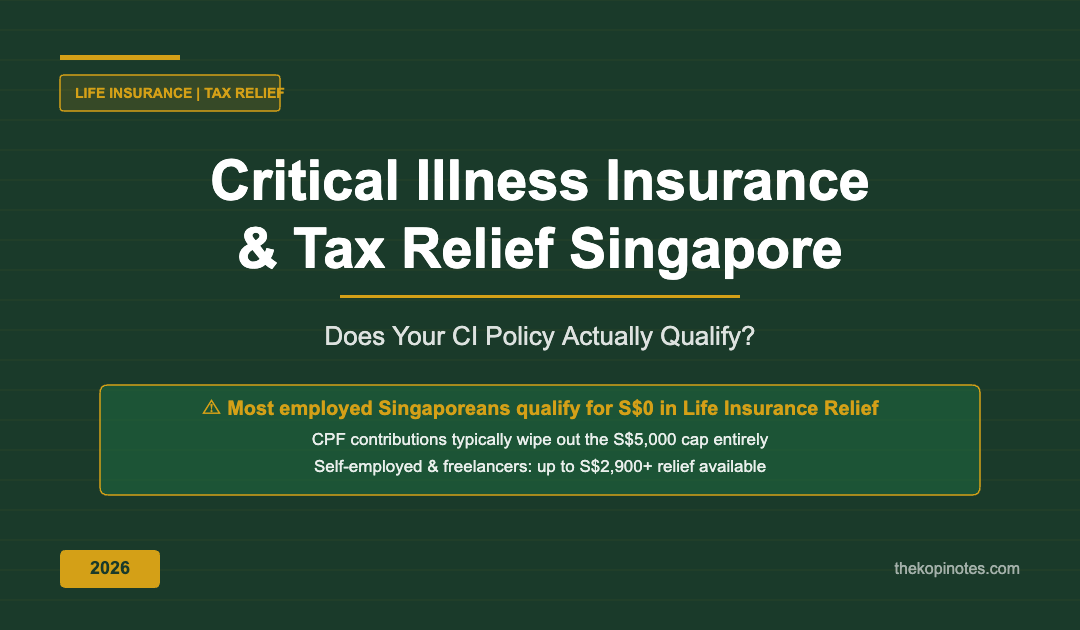
Critical Illness Insurance Singapore 2026: Does Your Policy Qualify for Tax Relief?
If you pay S$1,200 a year in CI insurance premiums and expect a tax deduction at year-end, you may be in for a surprise. Most employed Singaporeans receive zero Life Insurance Relief on their CI premiums — not because the government does not want to help, but because CPF contributions you already make fully absorb the S$5,000 cap. This guide explains who actually qualifies, what types of CI policy count, and how to reduce your costs through other means.
Data verified as at 1 September 2026. Sources: IRAS, CPF Board, LIA Singapore.
What Is Life Insurance Relief in Singapore?
Life Insurance Relief is a personal income tax deduction administered by IRAS. For YA 2026, the maximum claimable amount is S$5,000 per year — but this is reduced dollar-for-dollar by your compulsory CPF employee contributions made in the preceding year.
The formula is straightforward:
Life Insurance Relief = S$5,000 − Annual CPF employee contributions
If your CPF contributions equal or exceed S$5,000, your relief is S$0. The result is never negative — it simply disappears. There is no carryover to future years.
New for YA 2026: Wives may now claim Life Insurance Relief on premiums paid for their husband’s qualifying life insurance policy. The same S$5,000 cap minus the wife’s own CPF contributions applies.
The CPF Reality: Why Most Employed Singaporeans Get S$0
The employee CPF contribution rate is 20% for those under 55. The CPF Ordinary Wage ceiling is S$7,400/month (from January 2025). Any employee earning more than roughly S$2,083/month will have annual CPF contributions exceeding S$5,000 — eliminating the Life Insurance Relief entirely.
| Monthly Salary | Annual CPF (Employee 20%) | Life Insurance Relief Available |
|---|---|---|
| S$2,000 | S$4,800 | S$200 |
| S$3,000 | S$7,200 | S$0 |
| S$5,000 | S$12,000 | S$0 |
| S$8,000+ | S$17,760 (OW cap) | S$0 |
| Self-employed (Medisave ~S$2,100) | S$2,100 | Up to S$2,900 |
CPF OW ceiling S$7,400/month (Jan 2025). Employee rate 20% for age below 55. Self-employed: mandatory Medisave contribution only. Source: CPF Board, IRAS.
The conclusion is blunt: if you earn more than about S$2,083/month as a full-time employee, you will receive S$0 in Life Insurance Relief, regardless of how much you spend on CI insurance premiums. The relief primarily benefits the self-employed and part-time workers with lower mandatory CPF contributions.
Which CI Insurance Policies Actually Qualify?
Even for self-employed Singaporeans who do have Life Insurance Relief headroom, not all CI-related premiums qualify. IRAS classifies each policy type differently:
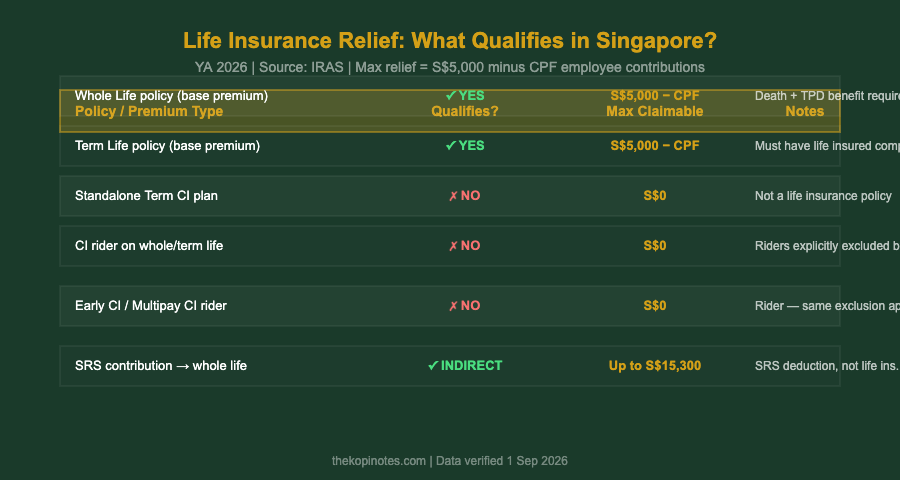
Standalone term CI plans (e.g. AIA Beyond Critical Care, FWD Recover First): These are pure living-benefit plans with no death or TPD benefit. IRAS does not classify them as “life insurance” for relief purposes. Their premiums do not qualify.
CI riders on a base policy (whole life or term life): IRAS explicitly excludes rider premiums — including critical illness riders, early CI riders, and premium waiver riders. You pay the CI rider premium alongside your base policy, but only the base policy premium (covering death or TPD) can qualify — and only if you have CPF headroom.
Whole life or term life base policy (with or without CI rider): The base premium for a life insurance policy that covers death or TPD may qualify for Life Insurance Relief, subject to the S$5,000 minus CPF headroom rule. The CI rider portion is excluded from the qualifying amount.
The SRS Workaround: Indirect Tax Savings on Life Insurance
If you cannot use Life Insurance Relief directly — which applies to most working Singaporeans — the Supplementary Retirement Scheme (SRS) offers an indirect route to reduce your tax bill.
How it works:
- Contribute to your SRS account by 31 December each year. Singapore Citizens and PRs can contribute up to S$15,300/year; foreigners up to S$35,700.
- Use your SRS balance to purchase a whole life insurance policy with a CI component. Several major insurers in Singapore accept SRS funds for qualifying policies.
- Claim the SRS contribution as a tax deduction in your IRAS tax filing for the year — reducing your chargeable income by the amount contributed.
The effective tax savings depend on your marginal tax rate. At 11.5%, contributing the full S$15,300 saves approximately S$1,760 in income tax. At 15%, the saving rises to about S$2,295. While this is not a direct deduction for CI premiums, the combined effect — a whole life policy with CI coverage paid partly from SRS funds — produces a similar outcome.
Platforms like Endowus (referral code: 2V343) let you invest SRS funds in low-cost diversified funds, separate from any insurance purchase. Syfe (code: SRPRFFFCD) is another SRS-eligible platform worth comparing.
Frequently Asked Questions
Can I claim tax relief on my critical illness insurance premiums in Singapore?
For most employed Singaporeans, no. CI insurance premiums — whether from a standalone CI plan or a CI rider on a life policy — generally do not qualify for Life Insurance Relief. CI riders are explicitly excluded by IRAS. Standalone CI plans without a death or TPD benefit are also outside the scope of qualifying life insurance. The main indirect tax benefit is using SRS contributions to fund a whole life policy with a CI component, which reduces chargeable income via the SRS deduction.
What is the maximum Life Insurance Relief I can claim for YA 2026?
The cap is S$5,000 per year, minus your compulsory employee CPF contributions for that year. If your CPF contributions exceed S$5,000 — which happens for anyone earning above roughly S$2,083/month — the available relief is S$0. Self-employed individuals whose mandatory Medisave contributions are below S$5,000 can potentially claim the difference, up to a maximum of S$5,000.
Does a whole life policy with a CI rider qualify for Life Insurance Relief?
The base whole life policy premium (covering death and TPD) may qualify for Life Insurance Relief, subject to your CPF headroom. The CI rider premium, however, is explicitly excluded by IRAS. You cannot include the CI rider cost in your qualifying premium amount when computing the relief.
Is the CI insurance payout (lump sum) taxable in Singapore?
No. Critical illness insurance payouts in Singapore are entirely tax-free. The lump sum is not considered income by IRAS and does not need to be declared in your annual tax return. This applies to all standard CI plans from MAS-licensed insurers.
Can my wife claim Life Insurance Relief on my CI premiums?
From YA 2026, wives may claim Life Insurance Relief on premiums paid for their husband’s qualifying life insurance policy (covering death or TPD). This is subject to the same S$5,000 cap minus the wife’s own CPF contributions. CI rider premiums on the husband’s policy still do not qualify under this expanded rule.
How much CI insurance coverage do I actually need?
The standard recommendation is 3–5 years of annual income as your CI sum assured, to cover income replacement during treatment and recovery. For someone earning S$60,000/year, that means S$180,000–S$300,000 in coverage. Add outstanding mortgage balance and estimated out-of-pocket medical costs for a personalised figure. See our full CI insurance comparison guide 2026 for plan options and worked examples.
Maximise Your SRS Tax Savings Before 31 December
Contribute to SRS and invest through a low-cost platform to reduce your chargeable income by up to S$15,300 this year.
Get Free Insurance Advice
Speak with a licensed insurance advisor. No obligation, no cost.
By submitting this form, you agree to our Privacy Policy.
This article was researched with the help of AI. While we strive to keep all information accurate and up to date, there may be errors. If you notice any discrepancies, please contact us.