Disability Income Insurance Singapore 2026: Complete Guide to DI Plans, Benefits & Costs
Protect up to 75% of your salary if illness or injury stops you working — here’s everything you need to know about DI insurance in Singapore.
Disability income (DI) insurance is a policy that replaces a percentage of your monthly salary — typically 50–75% — if you are unable to work due to illness or injury. In Singapore, DI plans are sold by major insurers including NTUC Income, AIA, Prudential, Great Eastern, Manulife, and Singlife. Premiums start from around S$50–S$120 per month for a 30-year-old non-smoker. Most Singaporeans are underinsured here: CPF contributions stop when you stop working, and government schemes like the Dependants’ Protection Scheme (DPS) only pay out on death or total permanent disability — not partial or temporary disability.
Not financial advice. All figures are for educational reference only. Data as at June 2026 unless noted.
Table of Contents
Contents — Click to expand
- What Is Disability Income Insurance?
- How DI Insurance Works in Singapore
- DI Insurance vs TPD vs Critical Illness
- Best Disability Income Insurance Plans Singapore 2026
- Premiums by Age, Gender & Benefit Amount
- How Much Disability Cover Do You Need?
- Common Exclusions & Waiting Periods
- How to Buy Disability Income Insurance in Singapore
- Frequently Asked Questions
What Is Disability Income Insurance?
Disability income insurance — often called DI insurance or income protection insurance — pays you a monthly benefit if you are medically unable to work. Unlike critical illness (CI) insurance, which pays a one-time lump sum on diagnosis of a covered condition, DI insurance pays an ongoing monthly income for as long as you remain disabled (or until the benefit period ends).
In Singapore, DI policies are classified as long-term Accident & Health (A&H) policies regulated by MAS. The key parameters in any DI policy are:
- Monthly benefit amount — capped at 75% of your gross monthly salary across all DI policies (MAS rule, to prevent over-insurance)
- Waiting/deferred period — the period after disability onset before benefits start paying (typically 30, 60, 90, or 180 days); longer waiting periods mean lower premiums
- Benefit period — how long the benefit is paid (2 years, 5 years, to age 60, or to age 65)
- Definition of disability — own occupation (most favourable to policyholders) or any occupation (more restrictive)
The own occupation definition means you are considered disabled if you cannot perform the specific duties of your own job — a surgeon who loses fine motor control would qualify even if they could theoretically do desk work. Any occupation means you only qualify if you cannot do any job at all, which is a much higher bar.
How DI Insurance Works in Singapore
Here is a worked example of how a DI policy pays out:
Suppose you are a 35-year-old marketing manager earning S$6,000/month. You buy a DI policy with:
- Monthly benefit: S$4,000 (66.7% of income)
- Waiting period: 60 days
- Benefit period: to age 60
- Definition: own occupation for the first 2 years, any occupation thereafter
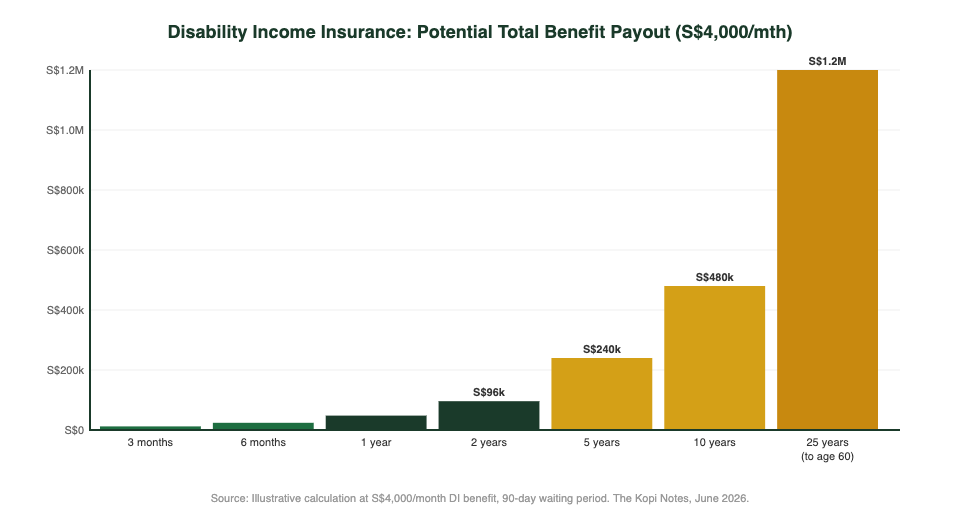
If you suffer a back injury in March 2026 and cannot return to work, your DI policy would start paying S$4,000/month from May 2026 (after the 60-day waiting period). If you recover by August 2026, you receive 3 months of benefits totalling S$12,000. If you never recover, the policy pays until you turn 60 — a potential total benefit of S$1,200,000 (25 years × 12 months × S$4,000).
| Scenario | Income Without DI | Income With DI (S$4,000/mth) |
|---|---|---|
| Short-term disability (3 mths) | S$0 | S$12,000 total benefit |
| Medium-term (2 years) | S$0 | S$96,000 total benefit |
| Long-term (to age 60, 25 yrs) | S$0 | S$1,200,000 total benefit |
| Partial disability (50% capacity) | S$3,000 earned | S$3,000 + partial DI benefit top-up |
Source: Illustrative example based on standard DI policy terms, June 2026.
DI Insurance vs TPD vs Critical Illness — What’s the Difference?
Many Singaporeans confuse disability income insurance with total and permanent disability (TPD) coverage bundled into life insurance policies, or with critical illness insurance. They serve different purposes and often complement each other.
| Feature | DI Insurance | TPD (Life Policy Rider) | Critical Illness |
|---|---|---|---|
| Pays out on | Inability to work (temp or perm) | Permanent total disability only | Diagnosis of listed conditions |
| Payout type | Monthly income stream | One-time lump sum | One-time lump sum |
| Covers partial disability? | Yes (most policies) | No | No |
| Covers temporary disability? | Yes | No | No |
| Example qualifying event | Back injury, depression, cancer recovery | Loss of 2+ limbs, total paralysis | Cancer diagnosis, heart attack |
| Typical SG premium (30M, S$3k/mth benefit) | S$600–S$900/yr | Bundled into life policy | S$500–S$800/yr |
Source: Insurer product guides and CompareFirst.sg data, June 2026. Premiums are indicative.
The key insight: most Singaporeans buy CI insurance and assume they are protected against disability. They are not. CI pays a lump sum only on diagnosis of specific listed diseases. DI insurance covers any cause of inability to work — including musculoskeletal conditions (the #1 cause of long-term absence in Singapore), mental health conditions, and accident injuries that are not life-threatening but prevent you from working.
According to LIA Singapore, the median duration of a long-term disability claim in Singapore is approximately 3.5 years — well beyond what most emergency funds can cover. For someone earning S$6,000/month, that represents S$252,000 of lost income.
Best Disability Income Insurance Plans Singapore 2026
Here is a comparison of the major DI insurance plans available in Singapore in 2026. Note that premiums vary significantly based on occupation class, health status, and specific policy terms — always get a personalised quote.
| Insurer / Plan | Max Benefit | Benefit Period | Waiting Period | Disability Definition |
|---|---|---|---|---|
| NTUC Income IncomeShield DI | 75% of income, max S$20,000/mth | To age 60 or 65 | 30, 60, 90 days | Own occupation (first 2 yrs), any occupation thereafter |
| AIA Disability Income | 75% of income, max S$30,000/mth | 2 yrs, 5 yrs, to age 60/65 | 30, 60, 90, 180 days | Own occupation (first 2 yrs), any occupation thereafter |
| Prudential PRUincome | 75% of income, max S$20,000/mth | To age 60 or 65 | 30, 60, 90 days | Own occupation (first 2 yrs), any occupation thereafter |
| Great Eastern GREAT Income Protector | 75% of income, max S$20,000/mth | To age 60 | 60, 90, 120, 180 days | Own occupation (first 2 yrs), any occupation thereafter |
| Manulife IncomeGuard | 75% of income, max S$20,000/mth | 2 yrs, 5 yrs, to age 60/65 | 30, 60, 90 days | Own occupation (first 2 yrs), any occupation thereafter |
| Singlife Disability Income | 75% of income, max S$20,000/mth | To age 60 or 65 | 30, 60, 90, 180 days | Own occupation (first 2 yrs), any occupation thereafter |
Source: Individual insurer product summaries and policy documents, June 2026. Exact terms and benefit caps vary by occupation class and health status. Always verify with the insurer directly.
Key differentiators to look for:
- Partial disability benefit — pays a pro-rated amount if you return to work part-time; not all plans include this
- Rehabilitation benefit — covers retraining costs if you need to switch careers due to disability
- Waiver of premium — premiums waived while you are claiming; standard in most plans
- Inflation protection — some plans offer benefit increases pegged to CPI
- Future insurability option — ability to increase coverage without fresh medical underwriting
Disability Income Insurance Premiums in Singapore 2026
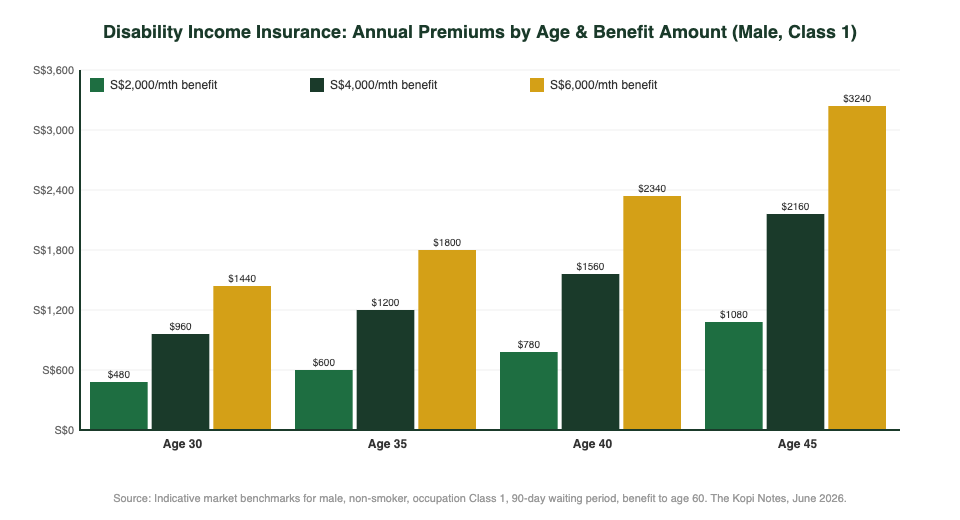
Premiums for DI insurance depend on your age, gender, occupation class, benefit amount, waiting period, and benefit period. The following table shows indicative annual premiums for a non-smoker in occupation Class 1 (office professional) with a 90-day waiting period and benefit period to age 60.
| Age at Entry | Gender | S$2,000/mth Benefit | S$4,000/mth Benefit | S$6,000/mth Benefit |
|---|---|---|---|---|
| 30 | Male | ~S$480/yr | ~S$960/yr | ~S$1,440/yr |
| 30 | Female | ~S$600/yr | ~S$1,200/yr | ~S$1,800/yr |
| 35 | Male | ~S$600/yr | ~S$1,200/yr | ~S$1,800/yr |
| 35 | Female | ~S$720/yr | ~S$1,440/yr | ~S$2,160/yr |
| 40 | Male | ~S$780/yr | ~S$1,560/yr | ~S$2,340/yr |
| 40 | Female | ~S$900/yr | ~S$1,800/yr | ~S$2,700/yr |
| 45 | Male | ~S$1,080/yr | ~S$2,160/yr | ~S$3,240/yr |
| 45 | Female | ~S$1,200/yr | ~S$2,400/yr | ~S$3,600/yr |
Source: Indicative premiums based on market benchmarks for occupation Class 1, non-smoker, 90-day waiting period, benefit period to age 60. Actual premiums will vary by insurer and individual underwriting. June 2026.
Premium levers — how to reduce your cost:
- Extend the waiting period — switching from 30 days to 90 days can reduce premiums by 20–35%. Most office workers can sustain 90 days using emergency savings.
- Shorten the benefit period — a 5-year benefit period costs significantly less than to age 60, while still protecting against medium-term disability
- Buy young — premiums lock in at your entry age. Buying at 30 vs 40 saves roughly 35–40% on annual premiums for the same coverage
- Smoke-free — non-smoker rates are typically 15–20% lower than smoker rates
How Much Disability Income Coverage Do You Need?
As a rule of thumb, your DI benefit should cover your essential monthly expenses — not your full income. The MAS cap of 75% already ensures you are not over-insured (keeping an incentive to return to work). Here is a practical framework for a Singapore resident:
- Total your fixed monthly obligations: mortgage/rent, utilities, grocery, insurance premiums, minimum loan payments
- Add dependent costs: school fees, helper salary, parental allowance
- Subtract existing disability income sources: your employer’s group insurance benefit, CPF savings you could draw down, any existing DI coverage
- The gap is your target DI benefit
Worked example for a Singapore family (dual income, HDB mortgage):
- Monthly HDB loan: S$1,800
- Groceries + utilities: S$800
- Children’s school/enrichment: S$600
- Parent allowance: S$400
- Other insurance premiums: S$300
- Total essential expenses: S$3,900/month
This family should target a DI benefit of at least S$3,900/month. If the primary earner’s salary is S$7,000, they can buy up to S$5,250/month (75% cap) — providing a comfortable buffer. Their insurance gap calculator would help quantify the shortfall across all protection types.
Common Exclusions & Waiting Periods to Watch For
Most DI policies in Singapore will not pay out under the following circumstances:
- Pre-existing conditions — any disability arising from a medical condition disclosed (or that should have been disclosed) before policy inception
- Mental health conditions (partial exclusion) — some older policies cap mental health claims at 12–24 months; newer policies increasingly include full cover
- Self-inflicted injuries — deliberate self-harm or attempted suicide
- Pregnancy and childbirth — unless complications arise; standard maternity leave is not covered
- Criminal acts — disability resulting from the insured committing a crime
- War or terrorism — standard exclusion across all policies
Waiting periods for pre-existing conditions: Even if a condition is covered (not excluded), many policies impose a 12–24 month waiting period before claims related to that condition are accepted. This is separate from the deferred period.
Partial disability definition: If you return to work part-time and earn less than your pre-disability income, most policies pay a proportional benefit. The exact formula varies — some insurers pay the difference between pre- and post-disability income, up to the policy benefit amount.
How to Buy Disability Income Insurance in Singapore
Here is a step-by-step guide to securing DI coverage in Singapore:
- Assess your gap — use the Insurance Gap Calculator to quantify how much income protection you need after accounting for existing coverage and emergency savings
- Choose your parameters — decide on your benefit amount (50–75% of salary), waiting period (90 days recommended for most), and benefit period (to age 60 or 65 for maximum protection)
- Compare plans via CompareFirst — the LIA CompareFirst portal lists standardised DI plan summaries side by side, including benefit tables and indicative premiums
- Check your occupation class — occupations are rated Class 1 (office), Class 2 (light manual), Class 3 (skilled trades), or Class 4 (hazardous). Higher classes attract higher premiums; some high-risk occupations may be declined
- Disclose all pre-existing conditions — failure to disclose may void your claim. Be thorough, even for conditions you think are minor or resolved
- Check your employer group cover — many Singapore employers provide group DI or group hospitalization benefits. Factor this into your calculation to avoid paying for duplicate coverage
For most Singaporeans building a comprehensive protection portfolio alongside investments, the recommended order is: term life first, CI insurance second, DI insurance third. If your employer already provides group DI cover, you may only need a top-up policy.
To build your investment portfolio alongside your insurance coverage, consider platforms like Endowus (referral code 2V343) for CPF and SRS investing, or Syfe (referral code SRPRFFFCD) for cash investing with professionally managed portfolios. Diversifying into best S-REITs in Singapore 2026 can generate passive income that supplements your DI benefit if you become disabled.
If you are already thinking about retirement and how disability fits into your long-term plan, check out the Singapore retirement calculator to see how a 3–5 year disability gap affects your retirement savings target.
[/et_pb_text][/et_pb_column][/et_pb_row][/et_pb_section]Frequently Asked Questions
What is the difference between disability income insurance and TPD insurance in Singapore?
Total and permanent disability (TPD) insurance pays a one-time lump sum only when you are permanently and totally disabled — for example, losing two limbs or total paralysis. Disability income (DI) insurance pays a monthly benefit for any period you cannot work, including temporary disabilities like a serious back injury or cancer recovery. DI is far broader in scope and is the primary income-replacement tool; TPD is a supplemental safety net for catastrophic scenarios.
Is disability income insurance covered under Medisave in Singapore?
No. Disability income insurance premiums cannot be paid using CPF Medisave funds in Singapore. Medisave can only be used for MediShield Life premiums, approved Integrated Shield Plans, and certain CareShield Life supplements. DI insurance must be paid from cash. However, disability income benefits received are not taxable under IRAS rules, as they are considered compensation for lost income rather than assessable income.
How much disability income insurance do I need in Singapore?
As a rule of thumb, target a monthly benefit equal to your fixed essential expenses — typically 50–75% of your gross salary. MAS caps total DI benefits at 75% of your pre-disability income across all policies. A practical approach: total your monthly fixed obligations (mortgage, utilities, dependents), subtract any employer group DI cover, and buy individual DI to cover the gap. Use the Insurance Gap Calculator on The Kopi Notes to get a personalised figure.
What is the waiting period in disability income insurance?
The waiting period (also called the deferred period or elimination period) is the time between when your disability begins and when your policy starts paying benefits. Common options in Singapore are 30, 60, 90, or 180 days. A longer waiting period means lower premiums. Most financial advisers in Singapore recommend a 90-day waiting period for office professionals who have 3 months of emergency savings, as this significantly reduces premiums without leaving a dangerous protection gap.
Does disability income insurance cover mental health conditions in Singapore?
Coverage for mental health conditions varies by policy and insurer. Older DI policies often capped mental health claims at 12–24 months. Newer policies from 2022 onwards increasingly provide full coverage for mental health conditions including depression, anxiety disorders, and PTSD — though some still impose time limits. Always check the policy wording specifically for psychiatric and mental health conditions before buying. With mental health claims rising as a cause of workplace absence in Singapore, this is an increasingly important policy feature.
Can self-employed Singaporeans buy disability income insurance?
Yes. Self-employed Singaporeans can and should buy DI insurance — they are arguably more exposed than salaried employees because they have no employer group insurance and no employer-paid sick leave. When applying, insurers will typically require income documentation (IRAS Notice of Assessment for the past 2–3 years) to establish your pre-disability income for benefit calculation purposes. The 75% income cap still applies based on your average declared income.
What happens if I recover and return to work while claiming DI benefits?
If you recover fully and return to your previous role at your pre-disability income, your DI benefits stop. If you return to work part-time or in a reduced capacity and earn less than your pre-disability income, most policies pay a partial residual benefit — typically proportional to your income loss. For example, if you return earning 60% of your previous salary, you may receive 40% of your full DI benefit. Check your specific policy’s residual or partial disability clause.
How does the own occupation vs any occupation disability definition affect my claim?
This is one of the most important policy terms in DI insurance. Under the own occupation definition, you qualify for benefits if you cannot perform the specific duties of your current job — a surgeon who loses fine motor control qualifies, even if they could theoretically do administrative work. Under the any occupation definition, you only qualify if you cannot perform any gainful employment at all. Most Singapore DI policies apply own occupation for the first 2 years, then switch to any occupation — this is the market standard. Some policies (especially higher-end ones) maintain own occupation throughout the entire benefit period, which is preferable.
Does the DPS (Dependants' Protection Scheme) in Singapore cover disability income?
The Dependants’ Protection Scheme (DPS) in Singapore provides a lump-sum payout only upon death or total permanent disability — not upon partial or temporary disability, and not as an income stream. DPS covers S$70,000 or S$46,000 (depending on your entry date) as a one-time lump sum, which would last a median Singapore household only 9–12 months. DI insurance is a separate, complementary product that fills the critical gap DPS leaves behind.
Build Your Protection & Investment Portfolio
Disability income insurance protects your earning power. Pair it with smart investing to build long-term financial resilience.
Get Free Insurance Advice
Speak with a licensed insurance advisor. No obligation, no cost.
By submitting this form, you agree to our Privacy Policy.
This article was researched with the help of AI. While we strive to keep all information accurate and up to date, there may be errors. If you notice any discrepancies, please contact us.