Early Critical Illness Insurance Singapore 2026: Is It Worth It?
How multi-pay CI works, what stages are covered, and whether the higher premium makes sense for you.
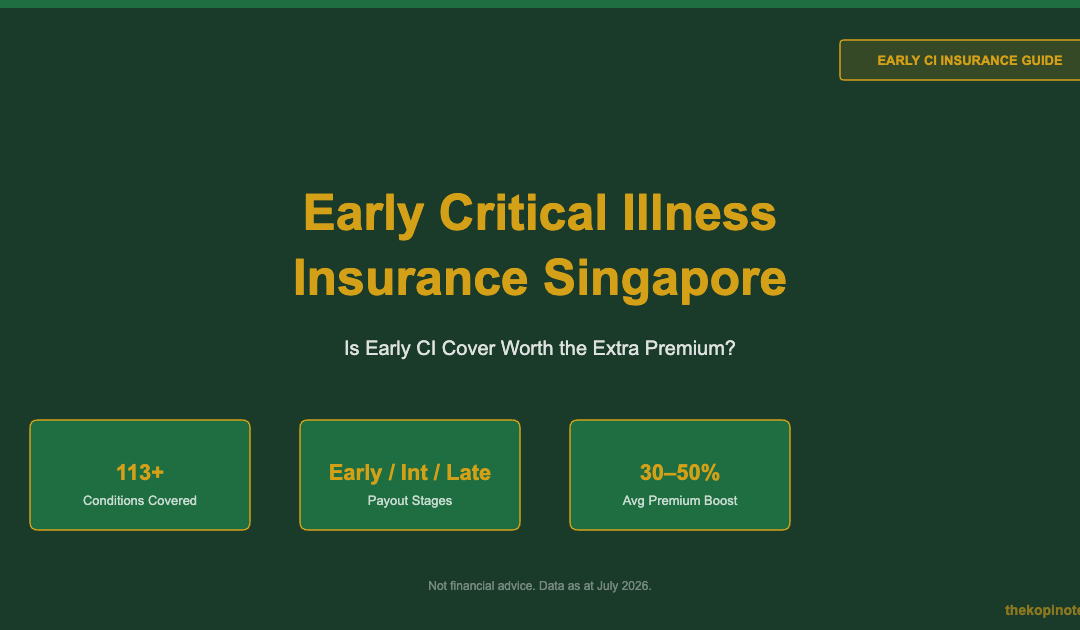
Early critical illness insurance in Singapore pays out a lump sum when you are diagnosed with a covered illness at the early or intermediate stage — not just late-stage. Standard CI plans only pay when the illness is advanced. An early CI (or multi-pay CI) plan typically covers 113 or more conditions across three payout stages, so you can access cash the moment a treatable diagnosis lands. The trade-off is a 30–50% higher monthly premium compared to standard CI.
Not financial advice. All figures are for educational reference only. Data as at July 2026 unless noted.
- Standard CI pays only at late-stage diagnosis. Early CI pays at early, intermediate, and late stages.
- Most Singaporeans are under-insured at the early stage — when treatment is most effective and most expensive.
- Early CI is worth it if you have a strong family history of cancer or heart disease, or want maximum income-replacement coverage.
Table of Contents
Contents — Click to expand
- What Is Early Critical Illness Insurance?
- Standard CI vs Early CI: Key Differences
- How the 3-Stage Payout System Works
- What Conditions Are Covered?
- Premium Comparison: Standard vs Early CI
- Who Needs Early CI Insurance?
- Top Early CI Plans in Singapore 2026
- How to Buy Early CI Insurance in Singapore
- Frequently Asked Questions
What Is Early Critical Illness Insurance?
Most people know what critical illness (CI) insurance does: it pays you a lump sum if you’re diagnosed with a severe condition like cancer, heart attack, or stroke. But here’s the catch. Standard CI insurance only triggers at the late stage of an illness.
By the time late-stage cancer is diagnosed, your options are limited. Treatment is aggressive, expensive, and often not covered in full by your Integrated Shield Plan. You may need to stop working for months. That’s when the CI payout really matters.
Early critical illness insurance extends the same protection to earlier diagnoses. This means you get a payout at the early or intermediate stage — while the illness is still treatable and before your income is badly disrupted.
These plans go by different names in Singapore:
- Multi-pay CI — you can claim more than once for different stages of the same illness, or for different illnesses
- Early CI rider — an add-on to a base whole life or term plan that adds early-stage coverage
- Comprehensive CI — marketing term for plans covering both early and late stages
The key benefit is simple: you get cash sooner, when you need it most. Whether it’s to cover the cost of targeted therapy, pay for a specialist, or replace lost income while on medical leave.
Standard CI vs Early CI: Key Differences
Here’s the most important table in this article. If you take nothing else away, understand this distinction.
| Feature | Standard CI | Early CI (Multi-Pay) |
|---|---|---|
| When does it pay? | Late stage only | Early, intermediate, late stages |
| Number of conditions | ~37 (LIA standard) | 113+ across all stages |
| Can you claim multiple times? | No — once only | Yes — up to 300–600% of SA |
| Premium (same SA) | Lower | 30–50% higher |
| Best for | Budget-conscious buyers | Those wanting maximum protection |
Source: LIA Singapore CI framework; insurer product sheets, July 2026.
The Life Insurance Association (LIA) Singapore sets a standard framework of 37 late-stage CI conditions all insurers must cover. Early CI plans go well beyond this — covering thyroid cancer at early stage, coronary artery bypass at less severe criteria, and dozens of other conditions that don’t yet meet the late-stage threshold.
How the 3-Stage Payout System Works
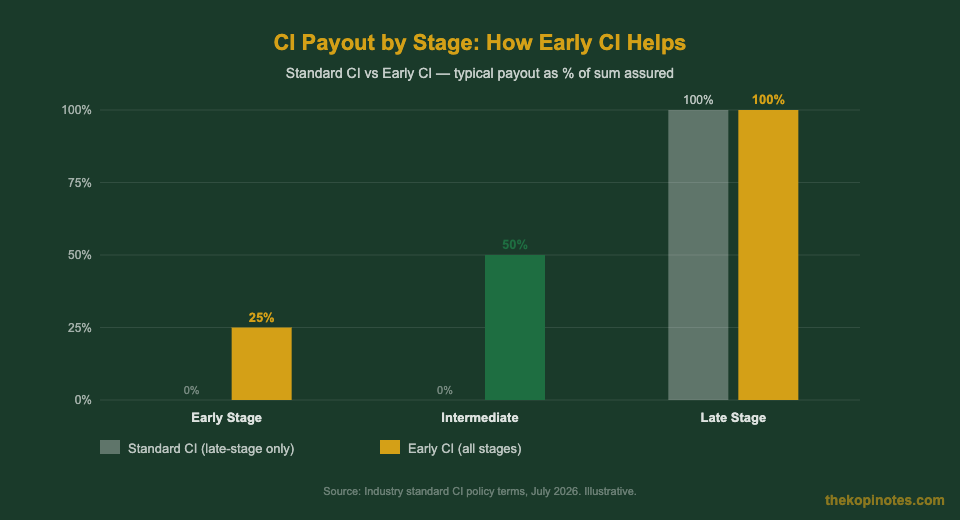
Early CI plans divide covered conditions into three stages. Each stage triggers a different payout amount. You keep your policy after each claim — the coverage continues for the remaining stages and other conditions.
Here’s how a typical multi-pay CI plan works with $300,000 sum assured:
| Stage | Example: Cancer Diagnosis | Typical Payout | Policy After Claim? |
|---|---|---|---|
| Early | Carcinoma-in-situ; thyroid cancer T1; Stage I breast cancer | 25% of SA = $75,000 | Continues |
| Intermediate | Stage II–III cancer meeting partial severity criteria | 50% of SA = $150,000 | Continues |
| Late | Stage IV cancer; spreading beyond original site | 100% of SA = $300,000 | Ends or reduces |
Source: Illustrative based on industry-standard multi-pay CI plan structures, July 2026. Exact payout percentages vary by insurer.
The waiting period between claims is typically 1 year. If you’ve already claimed for early-stage cancer and the same cancer progresses, you can file a late-stage claim after the waiting period, receiving an additional payout.
Some plans (like Singlife’s multipay CI) reset the coverage for different illness groups — meaning a heart attack claim after your cancer claim is possible, subject to the policy’s reset conditions. Always check the policy terms carefully.
What Conditions Are Covered?
Standard CI plans cover the LIA’s 37 severe-stage conditions. Early CI plans extend this significantly. Most comprehensive plans in Singapore cover 113 or more conditions across all severity levels.
The most commonly claimed conditions under early CI plans in Singapore:
- Cancer — includes carcinoma-in-situ (the most common early-stage claim), ductal carcinoma in situ (DCIS), and early-stage cancers by TNM classification
- Heart disease — less severe coronary artery disease criteria, early-stage angioplasty, pericarditis
- Stroke — transient ischemic attacks (TIAs) and mild neurological deficits
- Kidney disease — less severe chronic kidney disease stages
- Parkinson’s disease — early Parkinson’s before full disability
Cancer remains the most important category. In Singapore, 1 in 4 people will be diagnosed with cancer in their lifetime, according to the National Registry of Diseases Office. Many of these diagnoses will initially be at an early or intermediate stage — exactly when standard CI won’t pay.
For women in particular, breast cancer diagnosed at Stage I or as DCIS is extremely common. A standard CI plan wouldn’t pay at this stage. An early CI plan would — giving you $50,000–$75,000 immediately to cover treatment costs and time off work.
Premium Comparison: Standard CI vs Early CI
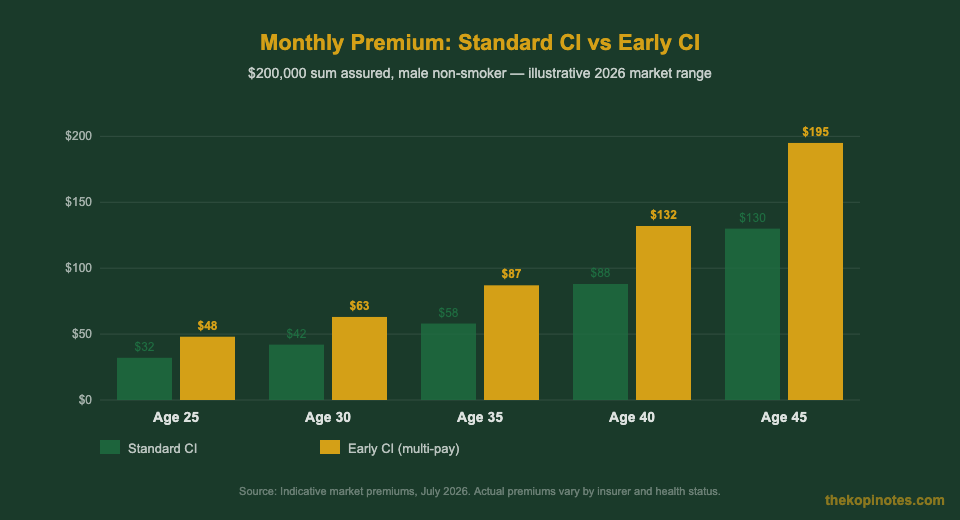
This is where many people hesitate. Early CI costs more — sometimes significantly more. Here’s a realistic comparison for a $200,000 sum assured plan in Singapore for 2026:
| Age / Gender | Standard CI (monthly) | Early CI (monthly) | Extra Cost / Month |
|---|---|---|---|
| Male, 25, non-smoker | ~$32 | ~$48 | +$16 |
| Male, 35, non-smoker | ~$58 | ~$87 | +$29 |
| Female, 35, non-smoker | ~$65 | ~$98 | +$33 |
| Male, 45, non-smoker | ~$130 | ~$195 | +$65 |
Source: Indicative market premiums from major Singapore insurers, July 2026. Actual premiums vary by insurer, health declaration, and plan terms. Obtain a formal quote.
At age 25, the extra cost is less than a kopi and kaya toast per day. That changes the maths considerably. The question becomes: is an extra $16/month worth getting paid for early-stage cancer? For most people, yes.
At age 45, the gap widens to $65/month. At this point, you’d want to run your full financial picture — your existing CI coverage, DPS coverage, savings cushion, and how much income disruption your household can absorb before deciding if the premium is justified.
Who Needs Early CI Insurance?
Not everyone needs to pay the early CI premium. Here’s a practical framework to decide.
| Situation | Why Early CI Matters |
|---|---|
| Family history of cancer, heart disease, or stroke | You have elevated risk; early detection is more likely — and you need the payout to be triggered at that point |
| Self-employed or freelancer | No employer sick pay. Any period of medical leave hits your income immediately. Early CI gives you a bridge |
| Sole breadwinner | Your family depends on your income. Even a 3-month cancer treatment leave is a financial shock |
| Less than 6 months of emergency savings | Without a cash buffer, an early-stage diagnosis could force you to liquidate investments or go into debt for treatment |
Source: TKN financial planning framework, July 2026.
If you already have a robust emergency fund (12+ months of expenses), a large standard CI policy, and no family history of serious illness, you might reasonably stick with standard CI and direct that premium saving to investing instead.
For most working Singaporeans — especially those in their 30s and 40s with dependants — the extra premium for early CI is well justified by the additional protection it provides exactly when early diagnoses occur.
Top Early CI Plans in Singapore 2026
Several insurers offer strong multi-pay or early CI plans in Singapore. Here are the most widely compared:
| Insurer / Plan | Conditions Covered | Max Payout | Notable Feature |
|---|---|---|---|
| Singlife MultiPay CI | 132 conditions | 500% of SA | Claims across different illness groups; 1-year waiting period between claims |
| AIA Power Critical Cover | 140+ conditions | 600% of SA | Early, intermediate, advanced stages; diabetic complications covered |
| Manulife Critical SelectCare | 128 conditions | 500% of SA | Premiums waived on first CI claim; term or whole life options |
| Prudential PRUActive Life III | 113 conditions | 500% of SA | Life stage multiplier — higher payout when you have kids or mortgage |
| Great Eastern GREAT CareShield | 115 conditions | 300% of SA | Integrates with CareShield Life supplemental coverage |
Source: Insurer product brochures, July 2026. Verify with insurer for current plan specifications.
The best plan for you depends on your health history, budget, and coverage goals. Compare using an insurance broker or the CompareFirst portal (MAS-regulated). Avoid comparing solely on conditions covered — read the definitions carefully, as “early-stage cancer” means different things across plans.
Also, check whether your existing life insurance comparison already includes an early CI rider before buying a standalone plan — adding a rider to an existing whole life policy is often more cost-efficient.
How to Buy Early CI Insurance in Singapore
There are two main routes to buying early CI cover in Singapore. Both are legitimate — choose based on your comfort level and complexity of needs.
Route 1: Direct Purchase via an IFA or tied agent
Speak to a financial adviser and request an early CI or multi-pay CI recommendation. Ask specifically for a needs analysis before any product recommendation. A good adviser will calculate your income replacement gap first, then suggest the right sum assured.
Route 2: Buy via a digital financial platform
Platforms like Endowus and Syfe offer access to a range of insurance products alongside your investment portfolio. This lets you manage your risk and investment exposure in one place — useful if you want a holistic view of your financial plan.
Before buying, run through this checklist:
- ✅ Calculate your CI coverage gap using our insurance gap calculator
- ✅ Check if your employer group insurance includes any CI rider — many do at early stage too
- ✅ Review the exact definitions of “early stage” for the 3 conditions you’re most concerned about
- ✅ Compare at least 3 insurers’ early CI options — premiums can differ by 20–30% for identical coverage
- ✅ Declare all pre-existing conditions accurately — non-disclosure voids your claim
- ✅ Choose a plan that is aligned with LIA’s critical illness framework
If you want a broader view of your life insurance needs, check our life insurance comparison guide or use our life insurance needs calculator to see how much coverage you need before shopping.
Frequently Asked Questions
What is the difference between early CI and standard CI insurance?
Is early critical illness insurance worth the higher premium?
Can I get early CI coverage as a rider on my existing plan?
What is the most commonly claimed condition under early CI plans?
How much early CI coverage do I need?
Does early CI insurance cover pre-existing conditions?
What is the waiting period between early CI claims on a multi-pay plan?
Can I buy early CI insurance through CPF?
What happens to my policy after I make an early CI claim?
Get Free Insurance Advice
Speak with a licensed insurance advisor. No obligation, no cost.
By submitting this form, you agree to our Privacy Policy.
This article was researched with the help of AI. While we strive to keep all information accurate and up to date, there may be errors. If you notice any discrepancies, please contact us.