ILP vs Endowment Plan Singapore 2026: Which Wins After the Rate Hike?
A plain-English comparison of returns, fees, and risk — updated after the Fed’s September 2026 +25bps hike
An investment-linked policy (ILP) and an endowment plan are both insurance-savings hybrids sold in Singapore — but they work very differently. An ILP invests your premiums in sub-funds you choose, with no guaranteed returns. An endowment plan locks in a fixed guaranteed return over a set term, typically 2 to 5 years. After the Fed’s September 2026 rate hike of 25bps, endowment plan yields have improved to 1.44-3.00% p.a. guaranteed, while ILPs still carry total charges of 2.5-3.5% p.a. that drag on long-term returns.
Not financial advice. All figures are for educational reference only. Data verified as at September 2026.
- Endowment plans now offer 1.44-3.00% p.a. guaranteed after the rate hike – better short-term certainty.
- ILPs have higher growth potential over 15-25 years but carry 2.5-3.5% p.a. in total charges.
- For most Singaporeans with a 2-5 year horizon, a new post-hike endowment tranche is the safer pick right now.
What Is an Investment-Linked Policy (ILP)?
An investment-linked policy is a life insurance product that combines insurance coverage with investment. You pay premiums, and a portion goes toward insurance costs (called mortality charges). The rest buys units in sub-funds you choose, similar to unit trusts.
Here is what makes ILPs different from other investments:
- No guaranteed returns. Your policy value rises and falls with your chosen sub-funds.
- Built-in insurance. You get a sum assured, typically 125% of premiums paid or the account value, whichever is higher.
- Multiple charges. Mortality charges, fund management charges (FMC), and policy fees are deducted monthly.
- Long commitment. Surrendering early can result in significant losses, especially in the first 5 years.
MAS regulates ILPs as Complex Investment Products (CIP) under the Financial Advisers Act. Your financial adviser must assess your risk profile and investment knowledge before recommending one. Under MAS’s 2026 complex product rules, all ILP Key Information Documents (KIDs) must show the Reduction in Yield (RIY). The RIY is the total annualised cost drag on your investment, and it is the most honest number to compare when evaluating an ILP.
Always ask your adviser for the RIY over your intended holding period before signing anything. A lower RIY means less of your investment return is eaten by charges.
What Is an Endowment Plan?
An endowment plan is an insurance-savings product with a fixed term and a guaranteed payout at maturity. You pay premiums over the policy term, or a single lump sum, and receive your capital back plus a guaranteed return when the plan matures.
Most endowment plans in Singapore today are short-to-medium term: 2-year, 3-year, or 5-year plans. Single premium endowment plans are particularly popular because they require just one upfront payment. There is no ongoing commitment or fund switching to manage.
Key features of endowment plans:
- Guaranteed returns. You know exactly what you will get at maturity, as long as you hold till the end.
- Capital protection. At minimum, you receive 100% of premiums back at maturity for capital-guaranteed plans.
- Fixed term. You cannot extend or shorten the policy term once it starts.
- Non-par or par plans. Non-par plans have a fixed guaranteed return. Par plans may pay non-guaranteed bonuses on top, but bonuses can vary year to year.
ILP vs Endowment Plan: Key Differences
Here is how the two products compare across the factors that matter most to Singapore investors:
| Feature | Investment-Linked Policy | Endowment Plan |
|---|---|---|
| Returns | No guarantee – depends on sub-fund performance | Guaranteed 1.44%-3.00% p.a. (Sep 2026 tranches) |
| Capital protection | None – value can fall below premiums paid | Yes – 100% capital returned at maturity |
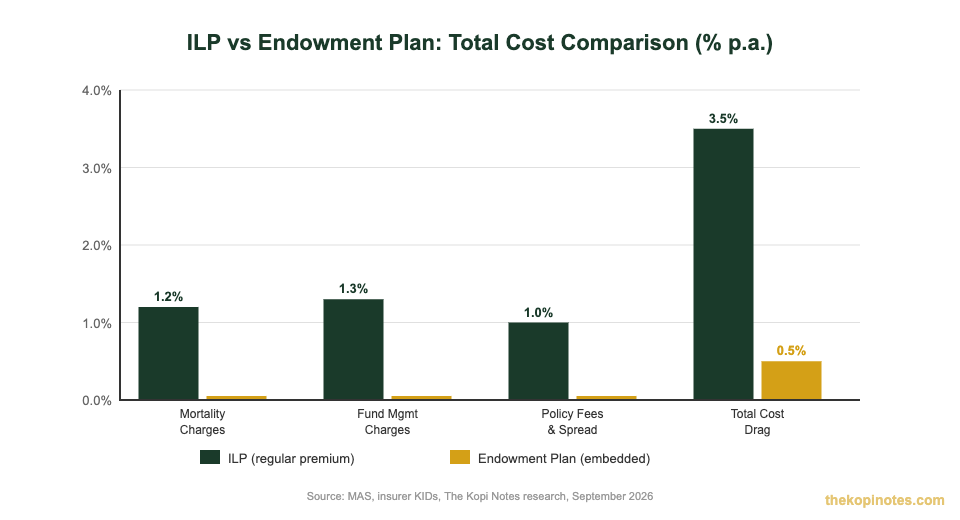
| Typical charges | 2.5%-3.5% p.a. total (mortality + FMC + policy fees) | Low – embedded in the guaranteed yield |
| Term | Long – 15 to 25 years ideal for cost recovery | Short to medium – 2 to 5 years common |
| Insurance coverage | Yes – built-in sum assured | Basic – death benefit usually equals total premiums |
| Flexibility | Sub-fund switching allowed mid-policy | Fixed – no changes after commencement |
| MAS classification | Complex Investment Product (CIP) | Non-complex savings-insurance product |
Source: MAS, insurer KIDs, The Kopi Notes research, September 2026
The table makes it clear: ILPs suit investors comfortable with market risk who have 15-25 years to ride out volatility. Endowment plans suit savers who want certainty over a shorter horizon.
How the September 2026 Rate Hike Changes Things
The US Federal Reserve raised rates by 25 basis points to 3.75-4.00% on 18 September 2026. This changes the picture for both ILPs and endowment plans, but in different ways.
What the Rate Hike Does to Endowment Plans
Endowment plan yields are closely linked to short-term interest rates. When rates rise, insurers can invest premiums at higher yields and pass some of that back to policyholders through new tranches.
Historically, a 25bps Fed hike translates to a 15-30bps improvement in new endowment plan guaranteed yields over the following 1-3 months. That means new tranches opening in October and November 2026 should offer slightly better rates than September tranches. Watch for announcements from AIA, Singlife, and Manulife in October 2026.
What the Rate Hike Does to ILPs
Rising rates hurt bond-heavy ILP sub-funds in the short term. If your ILP is heavily allocated to fixed-income sub-funds, you may have seen your policy value dip after September’s hike.
When interest rates rise, existing bond prices fall. Bond sub-funds holding longer-duration bonds take the biggest hit. An ILP heavily weighted in 10-year government bonds could see short-term unit price declines of 3-8%.
For ILP holders with 15 or more years to go, this is not necessarily a disaster. Higher rates eventually mean higher reinvestment yields for the bonds inside your sub-fund. Long-term investors can benefit. The problem arises if you need to access the money in the next 3-5 years.
| Rate Hike Impact | ILP (Bond-heavy sub-funds) | Endowment Plan |
|---|---|---|
| Short-term (0-6 months) | Negative – bond sub-fund values fall | Positive – new tranches repriced higher |
| Medium-term (1-5 years) | Neutral to positive – higher reinvestment yields kick in | Positive – locked-in higher yield for full term |
| Long-term (10+ years) | Positive – equity sub-funds can compound strongly | Neutral – locked-in rate may look low if rates keep rising |
Source: The Kopi Notes analysis, MAS guidelines, September 2026
Fee Comparison: Where Your Money Goes
Fees are where ILPs lose ground to endowment plans, especially in the first 10 years. Here is a breakdown of what you actually pay in a typical regular premium ILP:
- Mortality charges: Deducted monthly to cover your sum assured. These increase as you age and can be significant for policyholders over 40.
- Fund Management Charges (FMC): 0.75%-1.5% p.a. of your invested value, charged by the sub-fund manager.
- Policy fee: A flat monthly admin fee, typically S$5-S$10 per month.
- Bid-offer spread: Some ILPs charge a spread of 3%-5% on each premium paid in the early years.
Add these together and a 40-year-old buying a regular premium ILP may effectively pay 3.0-3.5% p.a. in total charges. Your sub-funds need to return at least 3.5% p.a. just to break even, before beating an endowment plan’s 3.00% guaranteed return.
Endowment plans embed charges differently. The insurer builds their margin into the gap between the investment return on your premiums and the guaranteed yield they pay you. You do not see itemised charges. For most 2-3 year plans, this margin is relatively tight given the competitive Singapore market.
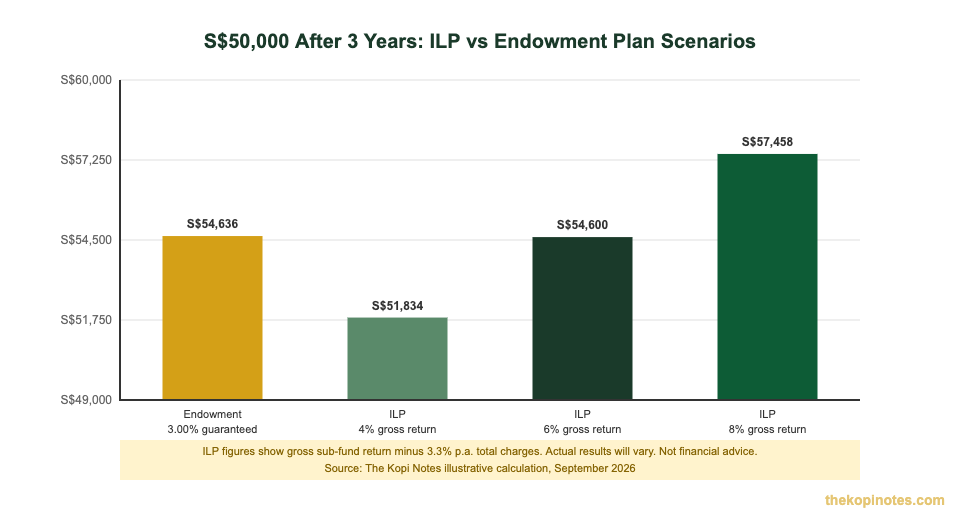
Here is what S$50,000 looks like after 3 years in each product:
| Scenario | ILP (assumed gross return) | Endowment (3.00% guaranteed) |
|---|---|---|
| Starting amount | S$50,000 | S$50,000 |
| 4% gross sub-fund return | ~S$51,834 net | S$54,636 |
| 6% gross sub-fund return | ~S$54,600 net | S$54,636 |
| 8% gross sub-fund return | ~S$57,458 net | S$54,636 |
Source: The Kopi Notes illustrative calculation. ILP figures assume 3.3% p.a. total charges deducted. Actual results will vary. Not financial advice.
Over a short 3-year window, even a 6% gross return from your ILP sub-fund barely beats the guaranteed endowment rate after charges. If your sub-fund returns only 4-5% gross, you lose to the endowment. This is the core problem with ILPs for short-to-medium term investors.
Which Should You Choose?
The right answer depends on your time horizon, risk tolerance, and what you already have in your portfolio.
Choose an Endowment Plan If You:
- Need the money in 2-5 years (education fees, property downpayment, emergency reserve)
- Cannot afford to see your investment value fall
- Want certainty over growth potential
- Already have equity exposure through your CPF, SRS, or ETF portfolio
- Are looking to deploy cash sitting in a savings account earning 0.05%-0.5% p.a.
A post-rate-hike endowment plan at 3.00% p.a. guaranteed over 3 years beats most savings accounts and is competitive with Singapore Savings Bonds. The key advantage: higher guaranteed return with full capital protection. You know exactly what you are getting.
You can explore current endowment options through Endowus referral code for fee-efficient access, or directly through insurers. Always compare tranches before committing, as rates change when a tranche closes.
Choose an ILP If You:
- Have a 15-25 year investment horizon and will not need the money sooner
- Want insurance coverage alongside market-linked growth
- Are willing to actively monitor and switch sub-funds as market conditions change
- Understand the fee drag and have stress-tested lower-than-expected return scenarios
That said, most financial planners now recommend the “buy term invest the rest” approach over ILPs for pure wealth-building. You can get better market exposure via ETFs through Syfe referral code and sign-up bonus or FSMOne referral code at far lower cost than most ILPs charge.
If you already hold an ILP, the September 2026 rate hike is a good moment to review your sub-fund allocation. Consider shifting from long-duration bond sub-funds to shorter-duration or dividend equity sub-funds. See how different choices affect your long-term picture with our Singapore retirement calculator.
For those building long-term passive income, read how passive income Singapore strategies compare across different asset classes.
Frequently Asked Questions
Is an ILP better than an endowment plan?
Should I surrender my ILP after the rate hike?
Can I put SRS funds into an endowment plan?
What happens to my ILP if I stop paying premiums?
Are endowment plan returns guaranteed?
How does the Fed rate hike affect endowment plan yields?
Get Free Insurance Advice
Speak with a licensed insurance advisor. No obligation, no cost.
By submitting this form, you agree to our Privacy Policy.
This article was researched with the help of AI. While we strive to keep all information accurate and up to date, there may be errors. If you notice any discrepancies, please contact us.