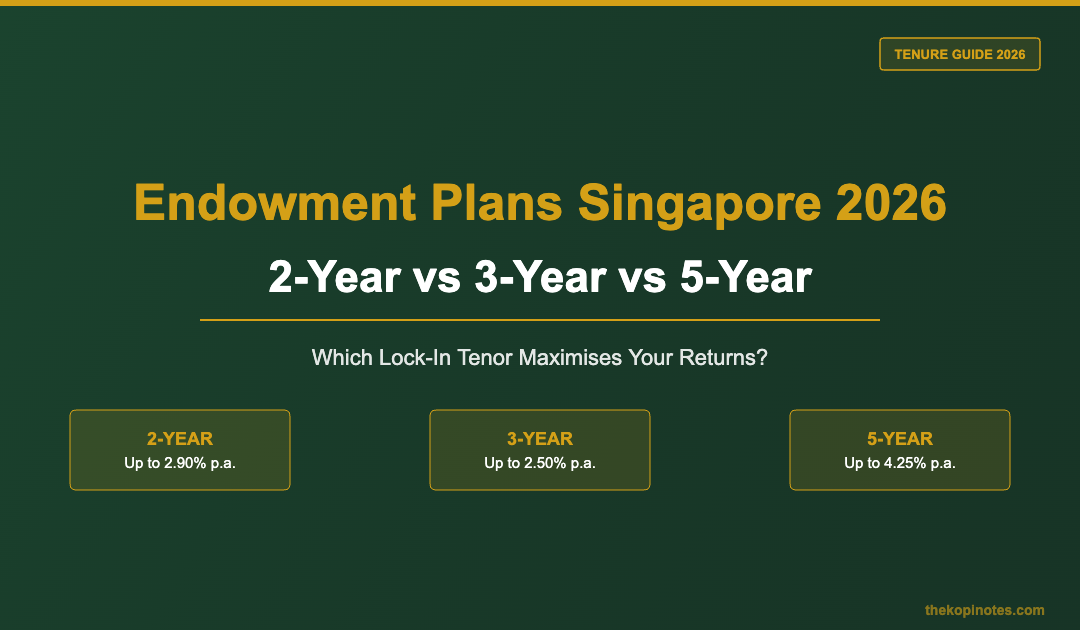
Endowment Plans Singapore 2026: 2-Year vs 3-Year vs 5-Year — Which Tenor Wins?
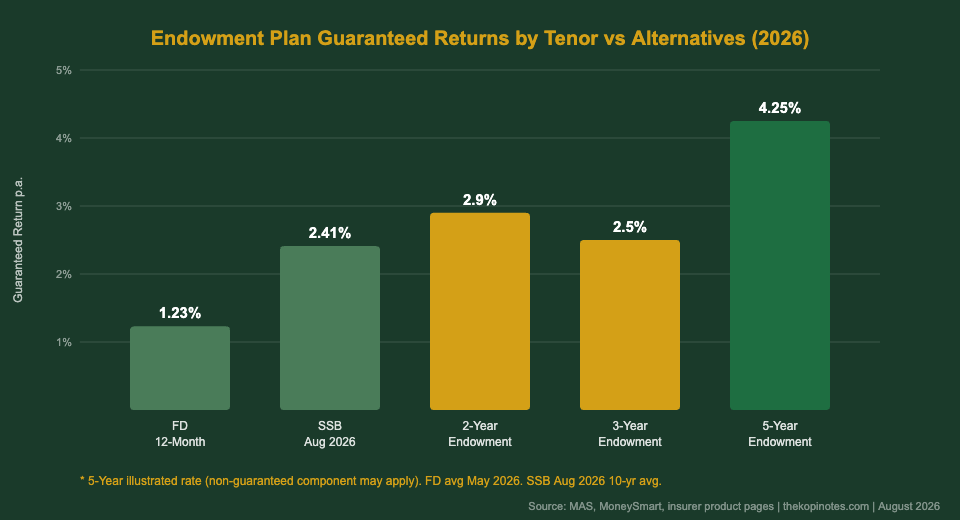
Endowment plans in Singapore let you lock in a guaranteed return for a fixed term — typically 2, 3, or 5 years — and receive your capital back at maturity. With SORA declining in 2026 and fixed deposits averaging just 1.23% p.a. (MAS, May 2026), choosing the right tenor can meaningfully boost your returns. This guide breaks down each option so you can match your lock-in to your exact financial timeline.
Not financial advice. All figures are for educational reference only. Data verified as at 30 August 2026. Speak with a licensed financial adviser before purchasing any insurance product.
- 2-year plans: up to 2.90% p.a. guaranteed — best for short-term goals and maximum flexibility
- 3-year plans: 1.70–2.50% p.a. guaranteed — balanced option for medium-term savers
- 5-year plans: up to 4.25% p.a. illustrated — highest potential returns for SRS and retirement planning
Why Your Choice of Tenor Matters More Than Ever in 2026
Picking the right lock-in period is arguably more important than picking the right insurer. Here’s why.
SORA — Singapore’s benchmark interbank rate — has been on a downward path as global central banks ease monetary policy. When SORA falls, returns on short-term instruments like fixed deposits (FDs) and T-bills fall quickly. Endowment plans, however, lock in a guaranteed rate at purchase. If you buy a 5-year plan today, you secure that rate for the full term — even if market rates fall further.
On the flip side, if you believe rates might rebound, a shorter 2-year tenor gives you flexibility to reinvest at potentially better terms sooner.
The three core trade-offs: liquidity vs return (longer lock-in = higher potential return, but less access to your money); rate certainty vs flexibility (locking in now protects you from rate cuts; shorter tenors keep options open); and goal alignment (a renovation fund needed in 2 years needs a different tenor than an SRS retirement portfolio).
2-Year Endowment Plans: Fast-Track Capital Protection
Two-year plans are the most popular short-term endowment option in Singapore. They suit savers who want better-than-FD guaranteed returns without a long commitment.
Current 2-Year Plans (August 2026)
| Plan | Insurer | Type | Guaranteed Return | Min. Premium |
|---|---|---|---|---|
| GREAT SP Series | Great Eastern / OCBC | Non-participating | Up to 2.90% p.a. | S$10,000 |
| Max Saver II | Singlife | Non-participating | 2.00% p.a. | S$5,000 |
| Manulife Goal 2026 (I) | Manulife / DBS/POSB | Participating | 1.44% p.a. guaranteed + non-guaranteed bonus | S$5,000 |
Source: OCBC, Singlife, Manulife/DBS product pages; MoneySmart.sg comparison data. Tranche availability changes — verify current rates with your insurer or adviser before purchasing. Data as at August 2026.
See our full OCBC 2-Year Endowment Plan guide for the complete breakdown of the GREAT SP product.
Who Should Pick a 2-Year Plan?
- You have a specific goal in about 2 years — wedding, home renovation, car upgrade
- You want better returns than FD without a long-term commitment
- You want to keep your reinvestment options open in case rates improve after 2026
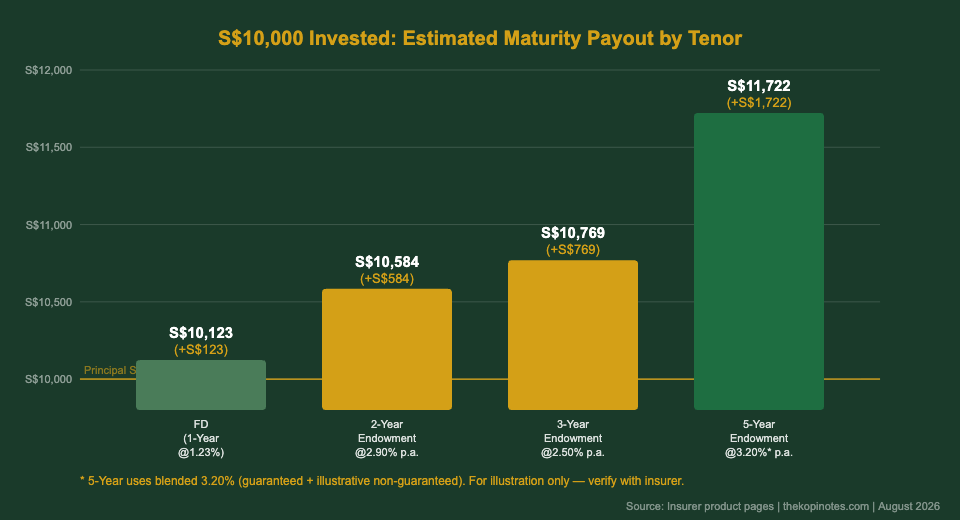
Real example: S$20,000 into GREAT SP Series at 2.90% p.a. guaranteed returns approximately S$21,168 at maturity — S$1,168 more than your principal, beating even the highest FD promotional rates.
3-Year Endowment Plans: The Middle Ground
Three-year plans offer a balance — slightly longer than a 2-year product, but without the full 5-year commitment. They suit medium-term savings goals where you can afford to wait a bit longer for a better guaranteed rate.
What to Expect from 3-Year Plans
Guaranteed returns on 3-year plans typically range from 1.70% to 2.50% p.a., depending on whether the plan is participating or non-participating. Prudential’s PRUAssure Growth, for example, offers 1.70% p.a. guaranteed for a 3-year single-premium plan from S$5,000. Some non-participating 3-year plans from other insurers offer rates at the higher end of this range.
The key distinction: participating plans can pay more via non-guaranteed bonuses, but that upside depends on the insurer’s fund performance — you can’t count on it. Non-participating plans deliver exactly what the policy illustration says, no more, no less.
Compare this with the DBS SavvyEndowment plan — a 2-year bank-distributed product — to see how a shorter tenor from a bank compares to 3-year insurer plans.
Who Should Pick a 3-Year Plan?
- You have a goal in the 3-year window — renovation fund, education savings, or an investment buffer
- You want more certainty than rolling over a 2-year plan (reinvesting every 2 years carries reinvestment rate risk)
- You want higher guaranteed returns than a 2-year plan, without the full 5-year lockup
Note on availability: Unlike 2-year products that open in regular tranches throughout the year, 3-year plans tend to be launched as part of broader product suites. Check availability with your insurer or financial adviser, as not all plans are offered continuously.
5-Year Endowment Plans: Lock In Higher Rates for Longer
Five-year endowment plans are the longest of the short-term category. They suit savers who want to maximise returns and are confident they won’t need the money for at least 5 years.
Why 5-Year Plans Pay More
Insurers reward you for the longer commitment. Plans like Singlife Choice Saver offer illustrated returns of up to 4.25% p.a. — though note this includes non-guaranteed components based on the participating fund’s performance. The guaranteed portion alone will be lower, so always review the guaranteed column separately in your policy illustration.
SRS Compatibility: A Key Advantage
Many 5-year plans are compatible with Supplementary Retirement Scheme (SRS) funds. If you have SRS savings sitting in a low-yield bank account, a 5-year endowment can put those funds to work at meaningfully higher rates. Use our Singapore retirement calculator to model how a 5-year endowment fits your overall retirement plan.
For a broader view of how endowment plans sit alongside government-backed savings, also read our guide on Singapore Savings Bonds 2026 — which offer full liquidity but typically lower rates than endowment plans.
Who Should Pick a 5-Year Plan?
- You’re building a retirement or education fund with a 5+ year horizon
- You’re an SRS contributor wanting to maximise tax-deferred returns
- You believe rates will fall further and want to lock in current rates for the longest possible term
- You won’t need liquidity from this sum for 5 full years
Early surrender warning: For 5-year plans, surrendering in the first 2–3 years almost always results in a significant loss versus your total premiums paid. Only commit funds you are certain you can leave untouched for the full term.
Side-by-Side Comparison: 2-Year vs 3-Year vs 5-Year
| Factor | 2-Year | 3-Year | 5-Year |
|---|---|---|---|
| Guaranteed Return Range | 2.00–2.90% p.a. | 1.70–2.50% p.a. | 2.00–3.50%+ p.a.* |
| Illustrated Return (incl. bonuses) | Up to 2.90% | Up to ~3.00% | Up to 4.25% |
| Min. Single Premium | S$5,000–S$10,000 | S$5,000–S$10,000 | S$5,000–S$20,000+ |
| Capital Guarantee at Maturity | ✅ Most plans | ✅ Most plans | ✅ Most plans |
| SRS Compatible | Some plans | Some plans | ✅ Many plans |
| Best For | Short-term goals, maximum flexibility | Medium-term goals, balanced approach | Retirement, SRS, long-term wealth |
| Reinvestment Risk | High — must reinvest in 2 years | Moderate | None — fully locked for 5 years |
*5-year guaranteed rates vary widely. Higher-end figures may include participating bonus assumptions. Source: Insurer product pages, MoneySmart.sg. Data as at August 2026 — always verify directly with your insurer.
How to Choose the Right Endowment Tenor for You
The “best” tenor isn’t universal — it depends on your goals, timeline, and risk appetite. Use this five-step framework.
Step 1: Define your goal and timeline. When do you need the money? Match the tenor to your timeline exactly. A 5-year plan when you need funds in 3 years creates a dangerous mismatch — surrendering early will cost you.
Step 2: Assess your liquidity needs. Endowment plans are not liquid. Keep a separate emergency fund in a liquid account, Singapore T-bills (see our Singapore T-bills 2026 guide), or a high-interest savings account before committing to a plan.
Step 3: Compare guaranteed vs illustrated rates. Always ask your adviser to show you the guaranteed cash value projection separately from the illustrated value. The guaranteed column is the floor you can rely on regardless of market conditions. The illustrated column is aspirational.
Step 4: Check SRS eligibility if applicable. If you have SRS savings in a low-yield bank account, a 3- or 5-year endowment can put that money to work tax-efficiently. Confirm which plans accept SRS premiums with your adviser.
Step 5: Consider the rate environment. With SORA declining in 2026, locking in a longer tenor protects you from future rate cuts. A 2-year plan means you’ll be reinvesting in late 2028, when rates may be lower. A 5-year plan eliminates that reinvestment risk entirely.
Practical Tips Before You Sign
- Read the policy illustration in full. The guaranteed and non-guaranteed columns are separate. Only the guaranteed column is contractually binding — don’t assume the illustrated amount will materialise.
- Use the 14-day free-look period. After receiving your policy documents, you have 14 days to cancel with a full refund. Re-read the terms, ask questions, and confirm you’re comfortable with the lock-in before it lapses.
- Check if the plan is a tranche product. Many short-term endowment plans are sold in limited tranches. Act early if the current terms suit you — but never rush into a poor fit just because a tranche is closing.
- Ask about Total Distribution Cost (TDC). TDC is the total commission and distribution cost disclosed in your policy illustration. A higher TDC means more of your premium goes to agent commissions rather than your policy’s cash value.
- Consider a tenor ladder strategy. Split your savings across a 2-year plan and a 5-year plan. You get partial liquidity in 2 years while still locking in higher rates on the balance for the long run.
If you’re also exploring liquid alternatives, platforms like Endowus (referral code: 2V343) and Syfe (referral code: SRPRFFFCD) offer cash management funds with daily liquidity — useful to hold alongside a locked-in endowment strategy for rainy-day access.
Frequently Asked Questions
Is a 2-year endowment plan better than a fixed deposit?
Can I surrender my endowment plan early if I need the money?
What is the difference between participating and non-participating endowment plans?
Are endowment plans safe? What protection exists if the insurer fails?
Can I use SRS funds to buy an endowment plan?
What is the minimum amount needed to buy an endowment plan in Singapore?
Bottom Line: Match Your Tenor to Your Timeline
There is no single “best” endowment tenor — only the best one for your situation. A 2-year plan at up to 2.90% p.a. guaranteed beats every FD in Singapore right now and suits short-term goals. A 3-year plan offers a sensible middle ground. A 5-year plan’s higher illustrated rates make a compelling case for retirement or SRS savers who can commit for the full term.
The non-negotiable rule: match the lock-in to your actual timeline. Stretching for a higher rate with a tenure that doesn’t fit your goals is the single most common — and costly — endowment plan mistake.
Always read the policy illustration in full, confirm the guaranteed returns separately from the illustrated returns, and use the 14-day free-look period to make absolutely sure you’re comfortable before committing.
Get Free Insurance Advice
Speak with a licensed insurance advisor. No obligation, no cost.
By submitting this form, you agree to our Privacy Policy.
This article was researched with the help of AI. While we strive to keep all information accurate and up to date, there may be errors. If you notice any discrepancies, please contact us.