Endowment Plan vs Whole Life Insurance Singapore 2026: Guaranteed Savings vs Lifelong Protection
Two very different tools that get compared for the wrong reasons — here’s how they actually work.
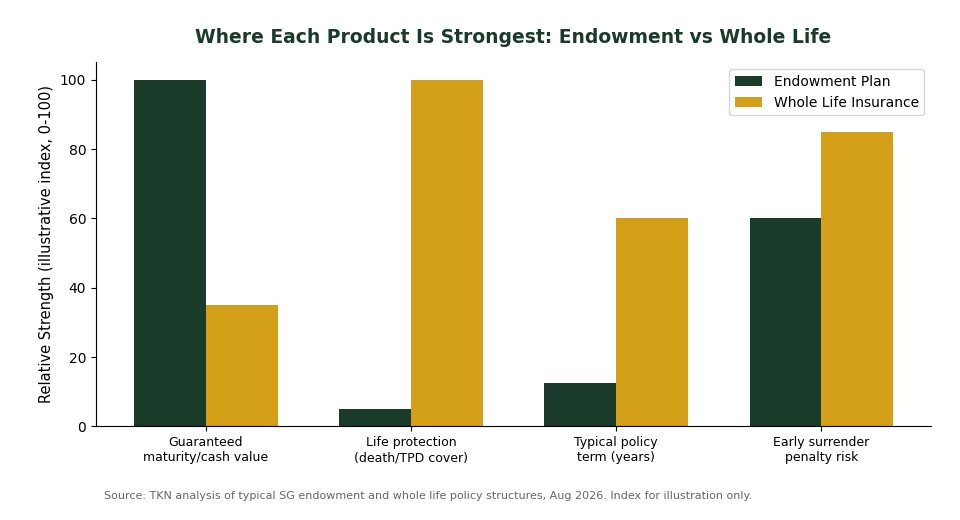
An endowment plan is a pure savings product with a guaranteed maturity value and little to no life protection, typically over 2-25 years. Whole life insurance is a lifelong protection plan that also builds cash value, but only a small part of that cash value is guaranteed — the rest depends on your insurer’s participating fund performance, capped by regulator-set illustration rates of 3.00% to 4.25% p.a.
Not financial advice. All figures are for educational reference only. Data verified as at August 2026 unless noted.
- Endowment plans guarantee your maturity payout upfront — whole life plans only guarantee a fraction of what you’ll eventually get
- Whole life insurance covers you for death and total permanent disability for your entire life; endowments barely cover you at all
- If you want a fixed number for a specific goal (house, wedding, kid’s education), use an endowment. If you want protection that also builds value over decades, use whole life
What Is an Endowment Plan?
An endowment plan is an insurance-wrapped savings product. You pay premiums — either a single lump sum or regular monthly amounts — for a fixed term, and the insurer pays you a guaranteed maturity value at the end.
Most endowment plans in Singapore run 2 to 25 years. The endowment plan Singapore guide covers the full mechanics if you’re new to the product. The life protection element is usually minimal — often just 101-105% of premiums paid, sometimes with an accidental death rider.
You’re buying a savings outcome. You’re not really buying insurance protection.
What Is Whole Life Insurance?
Whole life insurance covers you until age 99 or 100, for death and Total Permanent Disability (TPD). Unlike term life, it also builds cash value — a savings component you can withdraw from or surrender for cash later.
Here’s the part people miss. Most whole life plans in Singapore are participating (par) policies. That means your cash value has two components:
- Guaranteed cash value — locked in from day one, stated in your benefit illustration, and it doesn’t change
- Non-guaranteed bonuses — depend on how well the insurer’s par fund performs, and can be revised down
For example, whole life insurance products like Tiq by Etiqa’s whole life plans structure cash value this way — part guaranteed, part performance-linked. That’s a fundamentally different promise from an endowment’s single guaranteed number.
Key Differences at a Glance
| Feature | Endowment Plan | Whole Life Insurance |
|---|---|---|
| Primary purpose | Savings toward a goal | Lifelong protection + cash value |
| Death/TPD coverage | Minimal (101-105% of premiums) | Full sum assured, lifelong |
| Guaranteed payout | Full maturity value guaranteed | Only guaranteed cash value portion |
| Policy term | 2-25 years, fixed | Lifelong (to age 99-100) |
| Early surrender | Often below premiums paid in first few years | Usually below premiums paid for 10-20 years |
| Best used for | A specific, dated savings goal | Family protection + legacy planning |
Source: TKN analysis of published Singapore endowment and whole life product structures, August 2026.
The Guarantee Gap: Why “Guaranteed” Means Different Things
This is where most comparisons go wrong. Both products use the word “guaranteed.” They don’t mean the same thing.
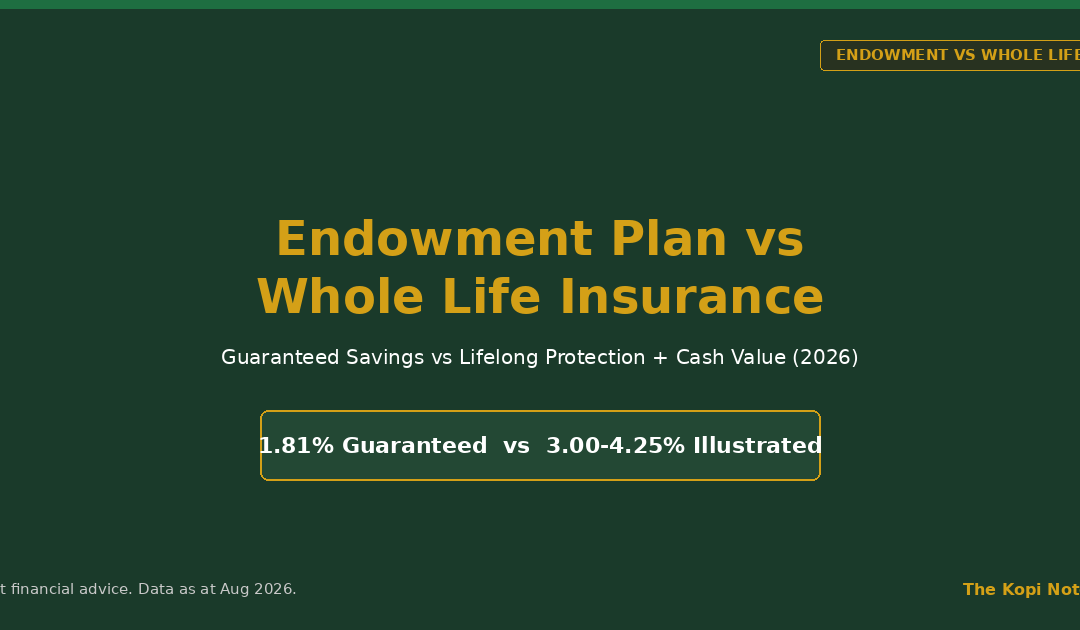
An endowment’s guaranteed maturity value is exactly that — a fixed number stated in your policy contract. Across the seven major Singapore insurers TKN has reviewed, the average guaranteed return works out to about 1.81% p.a.
Whole life insurance is different. The Life Insurance Association Singapore (LIA) caps how insurers can illustrate future returns on participating policies at two rates: an Upper Illustration Rate of 4.25% p.a. and a Lower Illustration Rate of 3.00% p.a. But here’s the catch — only the guaranteed cash value component of that illustration is locked in. Everything above it depends on the insurer’s par fund performance and can move with bonus declarations.
In practice, the guaranteed cash value alone in a whole life policy is often lower than total premiums paid for the first decade or more. That’s the trade-off for lifelong protection. It’s not a flaw — it’s how the product is designed to work.
The Numbers: S$500/Month for 20 Years
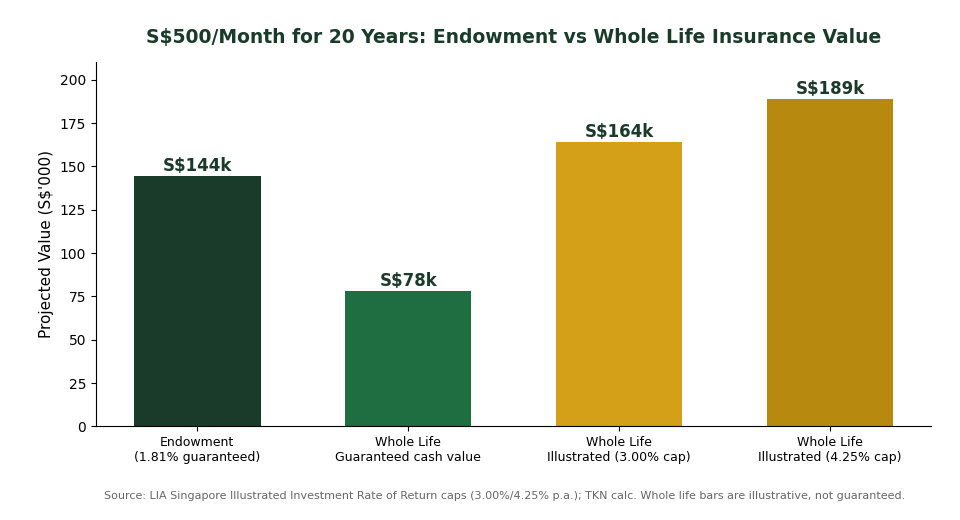
Say you put S$500 a month into each product for 20 years. Total premiums paid: S$120,000. Here’s how the guaranteed and illustrated outcomes compare.
| Scenario | 20-Year Value | Guaranteed? |
|---|---|---|
| Endowment (1.81% p.a.) | ~S$144,500 | Fully guaranteed |
| Whole life, guaranteed cash value only | ~S$78,000 (illustrative) | Fully guaranteed |
| Whole life, illustrated total (3.00% cap) | ~S$164,100 | Not guaranteed |
| Whole life, illustrated total (4.25% cap) | ~S$188,600 | Not guaranteed |
Source: LIA Singapore Illustrated Investment Rate of Return for Par Policies (lia.org.sg); endowment figure per TKN’s 7-insurer guaranteed-rate average. Whole life guaranteed cash value is a representative illustrative figure — actual guaranteed cash value varies by insurer, age at entry, and product; always check your own benefit illustration.
Notice the gap. Whole life’s illustrated total beats the endowment — but only the guaranteed slice of it is locked in, and that slice alone falls well short of what you paid in. You’re also getting lifelong death and TPD cover the whole time, which the endowment doesn’t offer. That’s the actual trade you’re making, not a simple returns comparison.
Who Should Buy Which
Buy an endowment plan if you have a specific, dated goal — a house down payment in 10 years, a child’s university fund, a wedding. You want a fixed number you can plan around, and you don’t need the life cover.
Buy whole life insurance if your priority is protecting your family if you die or become disabled, and you like the idea of some cash value building alongside that cover over decades. It’s a protection-first product that happens to save, not a savings product that happens to protect.
If you already have adequate term life or whole life protection and just want growth, a low-cost ETF portfolio or a unit trust via FSMOne or Endowus will usually outperform both over the long run, at the cost of giving up any guarantee. Run your own numbers with TKN’s retirement planning calculator before committing to either product.
Frequently Asked Questions
Is whole life insurance better than an endowment plan?
Can I cash out a whole life policy early like an endowment?
What is the LIA Illustrated Investment Rate of Return?
Does whole life insurance guarantee my premiums back?
Should I buy whole life insurance for the investment return?
Can I hold both an endowment plan and whole life insurance?
How does an endowment's guaranteed rate compare across insurers?
Get Free Insurance Advice
Speak with a licensed insurance advisor. No obligation, no cost.
By submitting this form, you agree to our Privacy Policy.
This article was researched with the help of AI. While we strive to keep all information accurate and up to date, there may be errors. If you notice any discrepancies, please contact us.