Endowment Plan vs ETF Investing Singapore 2026: Guaranteed Returns vs Global Market Growth
A side-by-side look at endowment plans against globally diversified ETFs like VWRA and CSPX — guaranteed rates, real historical returns, fees, tax, and who should pick which in 2026.
An endowment plan locks in a guaranteed return of around 1.81% p.a. (7-insurer average), while a globally diversified ETF like VWRA has returned 10.96% p.a. annualised over the past 10 years and 7% p.a. or more over most long-term periods — but with no guarantee and real drawdown risk. For most Singapore investors saving for retirement over 10+ years, ETFs offer far higher expected growth; endowments offer certainty.
Not financial advice. All figures are for educational reference only. Data verified as at 4 August 2026 unless otherwise noted.
- Endowment plans guarantee about 1.81% p.a. — your capital and returns are locked in, but growth is modest.
- VWRA (globally diversified) and CSPX (S&P 500) have no guarantee, but VWRA has returned 10.96% p.a. net over the last 10 years — real market data, not a promise.
- If you can stomach volatility and don’t need the money for 10+ years, ETFs usually build more wealth. If you want certainty, an endowment still has a role.
Table of Contents
Contents — Click to expand
- What Is an Endowment Plan?
- What Is ETF Investing? VWRA and CSPX Explained
- Key Differences at a Glance
- Guaranteed Returns vs Historical ETF Performance
- Costs and Fees Compared
- Risk and Volatility: What You’re Really Signing Up For
- Liquidity and Flexibility
- Tax Treatment for Singapore Investors
- 10-Year Growth Comparison: The Numbers
- Who Should Choose Which?
- Frequently Asked Questions
What Is an Endowment Plan?
An endowment plan is a life insurance policy that also functions as a savings product. You pay premiums — either as a single lump sum or over several years — and the insurer guarantees you a fixed payout at maturity, usually 3 to 25 years later.
Most Singapore insurers currently guarantee around 1.5% to 2.1% p.a., averaging 1.81% p.a. across the 7 major players (Great Eastern, Prudential, AIA, Manulife, NTUC Income, HSBC Life, and Etiqa). That guarantee is the whole point: you know exactly what you’ll get back, regardless of what happens in the stock market.
What Is ETF Investing? VWRA and CSPX Explained
An Exchange-Traded Fund (ETF) is a basket of stocks that trades on an exchange like a single share. Two of the most popular ETFs among Singapore investors are VWRA and CSPX — both Ireland-domiciled, both listed on the London Stock Exchange (LSE), and both accumulating (dividends are reinvested automatically, not paid out as cash).
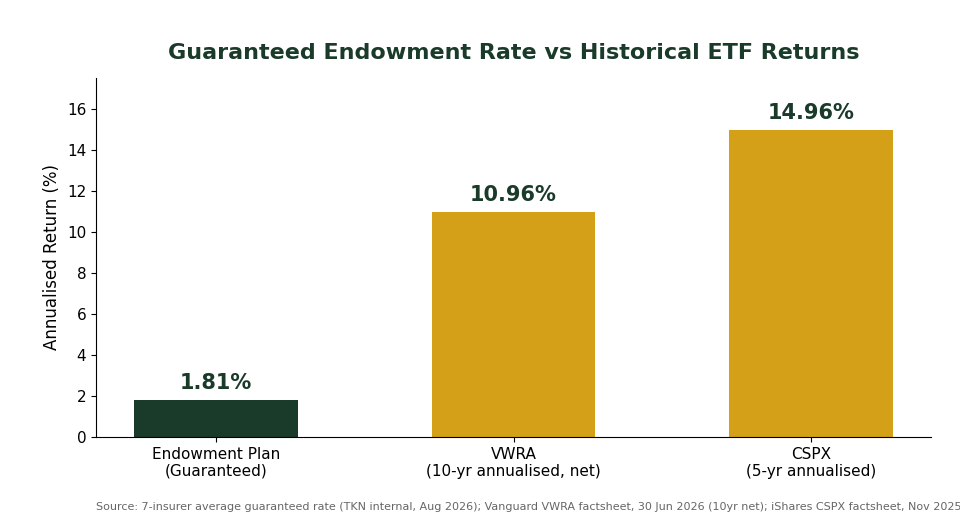
VWRA (Vanguard FTSE All-World UCITS ETF) tracks the FTSE All-World Index — roughly 3,780 stocks across developed and emerging markets, with about 62% in the US and the rest spread across Japan, the UK, China, and dozens of other countries. Its ongoing charges figure (OCF) is 0.19% p.a., and it has returned 10.96% p.a. annualised (net of fees) over the 10 years to 30 June 2026, according to the Vanguard VWRA factsheet.
CSPX (iShares Core S&P 500 UCITS ETF) tracks the S&P 500 — the 500 largest US-listed companies. It’s cheaper, with a TER of just 0.07% p.a., and has returned about 14.96% p.a. annualised over the 5 years to November 2025, per the iShares CSPX factsheet. The trade-off: it’s concentrated entirely in one country and one currency (USD).
Key Differences at a Glance
| Feature | Endowment Plan | VWRA | CSPX |
|---|---|---|---|
| Structure | Insurance policy | UCITS ETF | UCITS ETF |
| Return | Guaranteed ~1.81% p.a. | Not guaranteed — 10.96% p.a. (10yr net) | Not guaranteed — 14.96% p.a. (5yr) |
| Diversification | N/A (insurer’s balance sheet) | ~3,780 stocks, 40+ countries | 500 stocks, US only |
| Fees | Built into guaranteed rate (opaque) | 0.19% p.a. OCF | 0.07% p.a. TER |
| Liquidity | Locked in; surrender penalty if early | Sell any trading day | Sell any trading day |
| Capital protection | Yes, at maturity (SDIC-insured up to limits) | No — value fluctuates daily | No — value fluctuates daily |
Source: Vanguard VWRA factsheet (30 Jun 2026), iShares CSPX factsheet (Nov 2025), TKN 7-insurer endowment average (Aug 2026).
Guaranteed Returns vs Historical ETF Performance
Here’s the number that matters most: an endowment plan’s 1.81% p.a. is a promise, written into your policy contract. VWRA’s 10.96% p.a. (10 years to 30 June 2026) is not a promise — it’s what actually happened, and the next 10 years won’t necessarily look the same.
That said, the 2016–2026 decade was an unusually strong one for global equities. Long-term averages over longer, less cherry-picked windows are typically lower — the MSCI World Index has averaged closer to 7–8% p.a. since the late 1990s. For this reason, the projection later in this article uses a more conservative 7% p.a. assumption for VWRA, not the actual 10.96% figure, so you don’t walk away over-optimistic.
CSPX’s 14.96% p.a. (5 years to November 2025) reflects a strong run for US mega-cap tech stocks — NVIDIA, Apple, Microsoft, and Alphabet alone make up close to 15% of the FTSE All-World Index and an even larger share of the S&P 500. Concentration cuts both ways: it boosted CSPX’s recent returns, but it also means CSPX carries more single-market risk than VWRA.
Costs and Fees Compared
ETF fees are transparent and published. Endowment plan costs are not — distribution commissions, mortality charges, and the insurer’s cost of guaranteeing your capital are all baked into the low guaranteed rate you receive, rather than shown as a separate line item.
| Product | Annual Fee | Cost on SGD 50,000 | Fee Visibility |
|---|---|---|---|
| CSPX | 0.07% p.a. TER | S$35/year | Fully disclosed |
| VWRA | 0.19% p.a. OCF | S$95/year | Fully disclosed |
| Endowment Plan | Not separately disclosed | Embedded in the 1.81% guaranteed rate | Opaque |
Source: iShares CSPX factsheet, Vanguard VWRA factsheet (both accessed Aug 2026). Excludes broker commission and FX spread, which apply to both ETFs.
You’ll also pay brokerage commission and a small FX spread to buy VWRA or CSPX through platforms like Syfe or a standalone broker — typically a few dollars per trade. An endowment plan has no equivalent trading cost, but you’re locked into one insurer’s product for the policy’s full term.
Risk and Volatility: What You’re Really Signing Up For
This is where the two products diverge most sharply. An endowment plan’s value only moves in one direction — up, toward your guaranteed payout. An ETF’s value moves every single trading day, and sometimes it moves a lot.
During the March 2020 COVID crash, the S&P 500 — the index CSPX tracks — fell more than 30% in about five weeks. In 2022, global equities (the FTSE All-World Index that VWRA tracks) fell around 18% for the full year as interest rates rose sharply. Anyone who sold during either downturn would have locked in a real loss. Anyone who held on recovered and then some, but that recovery was never guaranteed in advance.
An endowment plan protects you from all of this. If you’re the kind of investor who’d panic-sell an ETF portfolio during a 20% drawdown, the guaranteed rate — low as it is — may genuinely be the better fit for your temperament, not just your returns.
Liquidity and Flexibility
VWRA and CSPX can be sold on any trading day, with proceeds typically settling within 1–2 business days. There’s no penalty for selling early beyond the small bid-ask spread.
Endowment plans work the opposite way. Surrender your policy before maturity, and you’ll typically receive less than the premiums you’ve paid — sometimes significantly less in the first few years, as early surrender values are structured to recoup the insurer’s upfront distribution costs. If there’s a real chance you’ll need the money before maturity, that illiquidity is a genuine cost that doesn’t show up in the headline guaranteed rate.
Tax Treatment for Singapore Investors
Good news on both sides: neither product creates a Singapore tax bill for individual investors. Endowment plan payouts are capital in nature and not taxed. ETF capital gains are also untaxed in Singapore, since there’s no capital gains tax here for individuals investing in a personal capacity.
There is one subtle difference. Because VWRA and CSPX are Ireland-domiciled, they benefit from the Ireland-US tax treaty, which caps withholding tax on the US dividends inside the fund at 15% — versus 30% for a directly US-domiciled ETF like VOO. That 15% is deducted before the fund’s return is calculated, so it’s already reflected in the 10.96% and 14.96% figures above — you don’t need to do anything extra to claim it.
10-Year Growth Comparison: The Numbers
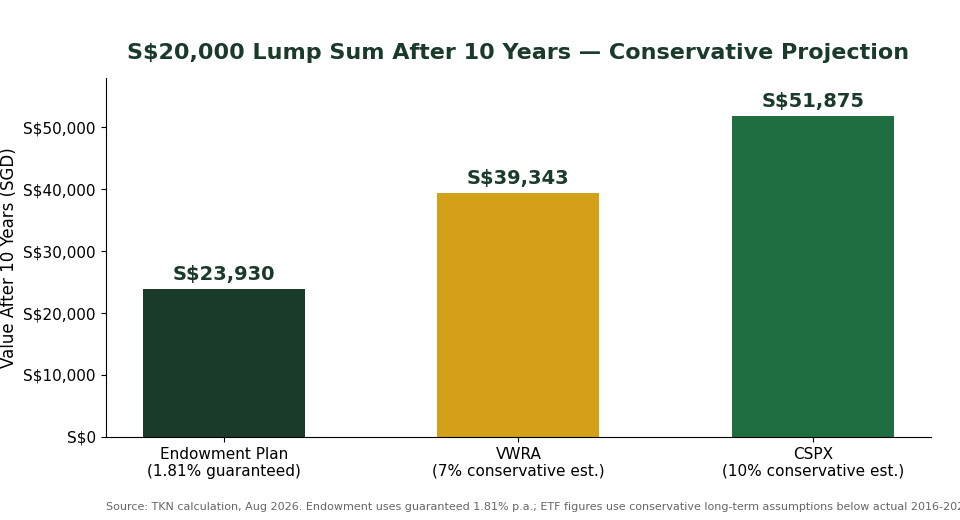
Take a S$20,000 lump sum and leave it untouched for 10 years. Using the endowment’s guaranteed 1.81% p.a., and deliberately conservative (below-actual-track-record) assumptions of 7% p.a. for VWRA and 10% p.a. for CSPX:
- Endowment Plan (1.81% guaranteed): S$23,929.54
- VWRA (7% conservative estimate): S$39,343.03 — a gap of S$15,413.49 over the endowment
- CSPX (10% conservative estimate): S$51,874.85 — a gap of S$27,945.31 over the endowment
Stretch the horizon to 20 years and the gap widens further: the endowment grows to roughly S$28,631, while VWRA at the same conservative 7% assumption reaches about S$77,394 — a difference of nearly S$48,763. This is the practical cost of certainty: the longer your time horizon, the more a guaranteed low rate leaves on the table compared to even a conservative equity assumption.
These are projections, not promises. If markets go through a prolonged downturn similar to 2000–2010 (when the S&P 500 delivered close to a 0% total return for the decade), the ETF outcome could look very different — and that’s the risk you’re paid to take on.
Who Should Choose Which?
An endowment plan may suit you if: you need a specific sum guaranteed by a specific date (e.g. a child’s university fees), you have zero tolerance for seeing your balance drop, or you want forced savings discipline through fixed premiums.
ETF investing (VWRA/CSPX) may suit you if: your horizon is 10+ years, you can leave the money untouched through a downturn, and you want your savings to actually outpace inflation and grow real wealth rather than just preserve capital.
One practical note: VWRA and CSPX, being LSE-listed, are not CPF-Ordinary-Account investable and don’t currently sit on the CPFIS-approved list — but they are SRS-compatible if you buy them through a broker that accepts SRS funds. Many endowment plans, by contrast, can be paid for using CPF-OA. If you’re specifically trying to put CPF-OA funds to work, that’s a real structural difference worth checking with your CPF investment strategy in mind.
Most Singapore investors don’t need to pick just one. A common approach is to hold a modest endowment plan for a specific guaranteed goal, while directing the bulk of long-term retirement savings into globally diversified ETFs or a robo-advisor platform like Endowus that invests in similar underlying funds with less manual work. For a deeper look at that trade-off, see our comparison of endowment plans against robo-advisor investing, or how endowments stack up against S-REITs for dividend income. If you’re building a broader passive income plan, our passive income Singapore guide and retirement calculator are good next steps.
Not financial advice. This article is for educational purposes only and does not account for your individual financial situation. Consult a licensed financial adviser before making investment or insurance decisions.
Frequently Asked Questions
Is an ETF better than an endowment plan for a Singapore investor?
It depends on your goal. For long-term wealth growth over 10+ years, globally diversified ETFs like VWRA have historically outperformed endowment plans by a wide margin. For a specific guaranteed sum by a fixed date, an endowment plan’s certainty is hard to replace with an ETF, which carries no guarantee.
What is the historical return of VWRA compared to an endowment plan's guaranteed rate?
VWRA has returned 10.96% p.a. annualised (net of fees) over the 10 years to 30 June 2026, according to Vanguard’s official factsheet. The average Singapore endowment plan guarantees around 1.81% p.a. across the 7 major insurers. Past ETF performance is not a guarantee of future results.
Are ETF gains taxed in Singapore?
No. Singapore does not tax capital gains for individual investors, so profits from selling VWRA or CSPX are not taxed locally, the same as endowment plan payouts. The US dividends inside these Ireland-domiciled ETFs already have a 15% withholding tax deducted at source before the fund’s return is calculated.
Can I lose money investing in ETFs, unlike an endowment plan?
Yes. Unlike an endowment plan, ETF values fluctuate daily and can fall sharply — the S&P 500 dropped over 30% during the March 2020 crash. If you sell during a downturn, you can realise a real loss. An endowment plan guarantees your payout at maturity, provided the insurer remains solvent.
What are the fees on VWRA and CSPX compared to an endowment plan?
VWRA charges 0.19% p.a. (about S$95/year on a S$50,000 holding) and CSPX charges 0.07% p.a. (about S$35/year). Endowment plans don’t disclose a separate fee — distribution and guarantee costs are built into the lower guaranteed rate you receive instead.
Should I choose CSPX or VWRA over an endowment plan for retirement savings?
For most retirement savers with a 10+ year horizon, a globally diversified ETF like VWRA is generally more suitable than an endowment plan, because it offers meaningfully higher expected growth and better inflation protection. VWRA is more diversified than CSPX, which is concentrated in US stocks only. An endowment plan can still play a smaller, complementary role for goals that need certainty.
Can I combine an endowment plan and ETF investing in my portfolio?
Yes, and many Singapore investors do exactly this — a smaller endowment plan for a specific guaranteed goal, alongside a larger ETF or robo-advisor portfolio for long-term retirement growth. This lets you keep some certainty while still capturing most of the market’s long-term growth potential.
Ready to Start Growing Your Money?
Whether you choose guaranteed returns or market growth, start with the right platform.
Get Free Insurance Advice
Speak with a licensed insurance advisor. No obligation, no cost.
By submitting this form, you agree to our Privacy Policy.
This article was researched with the help of AI. While we strive to keep all information accurate and up to date, there may be errors. If you notice any discrepancies, please contact us.