Etiqa Endowment Plan Singapore 2026: Tiq CashSaver, Enrich Saver & Flex Plus Compared
Etiqa’s full savings plan lineup reviewed — capital-guaranteed endowments from just $125/month, with real numbers from official product pages.
Etiqa Insurance Singapore offers four endowment plans in 2026: Tiq CashSaver (from $125/month, capital guaranteed), Enrich saver (5-year pay, 10-year term), Enrich flex plus (whole-of-life, up to age 125), and Enrich goal (7-year pay, 15/24/29-year term). All are capital-guaranteed at maturity, backed by Etiqa’s participating fund, and protected under the SDIC Policy Owners’ Protection Scheme.
Not financial advice. All figures are for educational reference only. Data verified as at 22 July 2026 against official Etiqa Insurance Singapore product pages.
- Etiqa’s endowment plans are all capital-guaranteed, but the actual “growth” varies a lot — Enrich saver’s guaranteed portion works out to under 1% p.a., so don’t skip the fine print.
- Tiq CashSaver is the most flexible entry point (from $125/month, no medical check, 6–15 year savings horizon) and pays yearly cash from year 2.
- If you just want a safe place to park cash, compare Etiqa’s illustrated returns against CPF OA (2.50% p.a.) and the SG T-bill (1.55% p.a., 16 Jul 2026) before signing up — you may find you don’t need the insurance wrapper.
Table of Contents
Contents — Click to expand
- Who Is Etiqa Insurance Singapore?
- Etiqa’s 4 Endowment Plans at a Glance
- Tiq CashSaver: The Flexible Entry-Level Plan
- Enrich Saver: Pay 5, Get a Lump Sum After 10
- Enrich Flex Plus: The Whole-of-Life Option
- Enrich Goal: The 7-Pay Long-Term Plan
- Are Etiqa’s Returns Actually Good? CPF OA & T-Bill Comparison
- Etiqa vs Other Insurers’ Endowment Plans
- Pros and Cons
- Who Should (and Shouldn’t) Buy an Etiqa Endowment Plan
- FAQ
Who Is Etiqa Insurance Singapore?
Etiqa Insurance Pte. Ltd. has protected customers in Singapore since 1961, originally under the name United General Insurance Co. Sdn. Bhd. It became the Singapore branch of Etiqa Insurance Berhad in 2009. Today it’s licensed and regulated by the Monetary Authority of Singapore (MAS) under the Insurance Act 1966.
Etiqa is rated “A” by credit rating agency Fitch for its “Favorable” business profile. The company is owned by Maybank Ageas Holdings Berhad — a joint venture that’s 69% Maybank (the fourth-largest banking group in Southeast Asia) and 31% Ageas, an international insurance group operating across 13 countries.
You may know Etiqa better through its digital brand, Tiq by Etiqa, which sells insurance online without an agent. Two of the four plans in this guide — Tiq CashSaver and the Tiq 3-Year Endowment Plan — are sold this way. Full product details for every plan covered here are available on Etiqa’s own Savings & Retirement product page.
Etiqa’s 4 Endowment Plans at a Glance
Before you dive into each plan, here’s the full lineup side by side. All four are participating endowment plans, meaning your returns depend partly on how Etiqa’s par fund performs — but each also has a capital-guaranteed component.
| Plan | Policy Term | Premium Term | Min. Entry | Medical Check |
|---|---|---|---|---|
| Tiq CashSaver | 6–15 years | 2 or 5 years | $125/month | None |
| Enrich saver | 10 years | 5 years | Not publicly listed | None (basic plan) |
| Enrich flex plus | Up to age 125 | 3, 5, 10, 15 or 20 years | Not publicly listed | None (guaranteed issuance) |
| Enrich goal | 15, 24 or 29 years | 7 years | Not publicly listed | None (basic plan) |
Source: Etiqa Insurance Singapore product pages, accessed 22 July 2026.
Notice that “not publicly listed” appears a lot. Etiqa (like most insurers) doesn’t publish minimum premiums on its product pages — you’ll only see the exact figure once you request a benefit illustration through an adviser or the Tiq app.
Tiq CashSaver: The Flexible Entry-Level Plan
Tiq CashSaver launched on 30 May 2024, aimed squarely at young families and adults who find it hard to save consistently. You can start from just $125 a month. That’s a low bar compared to most endowment plans on the market.
Here’s how it works. You choose one of two combinations: pay premiums for 2 years and save for 6 to 10 years total, or pay for 5 years and save for 11 to 15 years total. You can pay monthly, quarterly, half-yearly, or yearly — whatever fits your cash flow.
From the end of Policy Year 2, you receive a yearly cash payout. The guaranteed portion is 3.9% of your policy’s face value every year. On top of that, there’s a non-guaranteed portion of 2.5%, based on Etiqa’s illustrated investment rate of return of 4.25% p.a. Together, that’s up to 6.4% of face value paid out each year — but remember, “face value” isn’t the same as your total premiums paid, and only the 3.9% is contractually guaranteed.
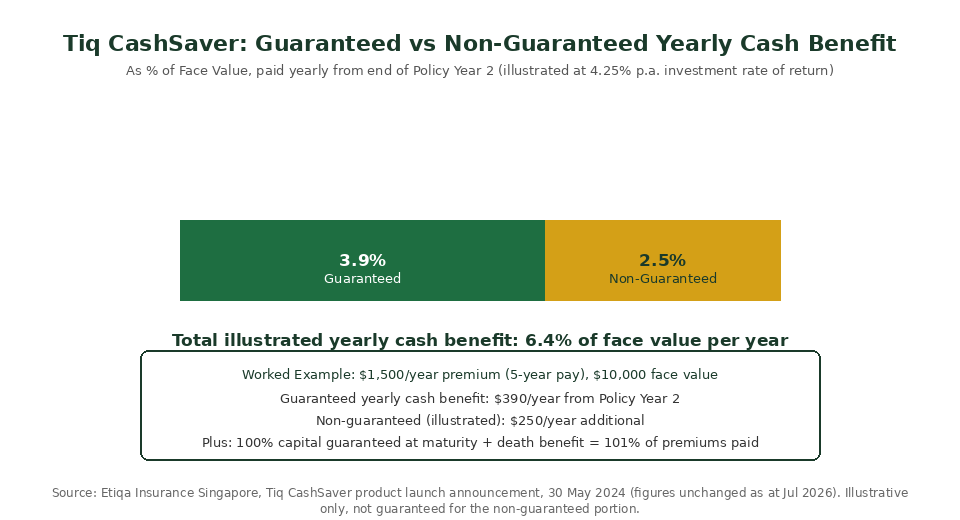
Tiq CashSaver also comes with protection built in. If the life insured dies or is diagnosed with a terminal illness, Etiqa pays 101% of total premiums paid (excluding any advance premium). Die in an accident before age 80, and there’s an extra 50% of total premiums on top of that. If you become totally and permanently disabled during the premium term (before age 86), your remaining premiums are waived so the policy continues.
There’s also an Extended Grace Period Option, usable up to twice, that gives you a 60-day buffer to keep paying if you’re retrenched (and unemployed for 30+ consecutive days before age 65) or on 60+ days of hospitalisation leave as a self-employed person. That’s a genuinely useful feature if job security is a concern — you won’t find this on every endowment plan in Singapore.
Enrich Saver: Pay 5, Get a Lump Sum After 10
Enrich saver is Etiqa’s shorter-commitment plan. You pay premiums for 5 years, then let the policy run for another 5 years before it matures at the 10-year mark. An Automatic Premium Benefit (APB) feature pays the remaining premiums from year 6 to 10 out of the policy’s own accumulated value, once your first 5 years of full premiums are in.
No health check-up is required for the basic plan, and you get death coverage throughout the full 10-year term.
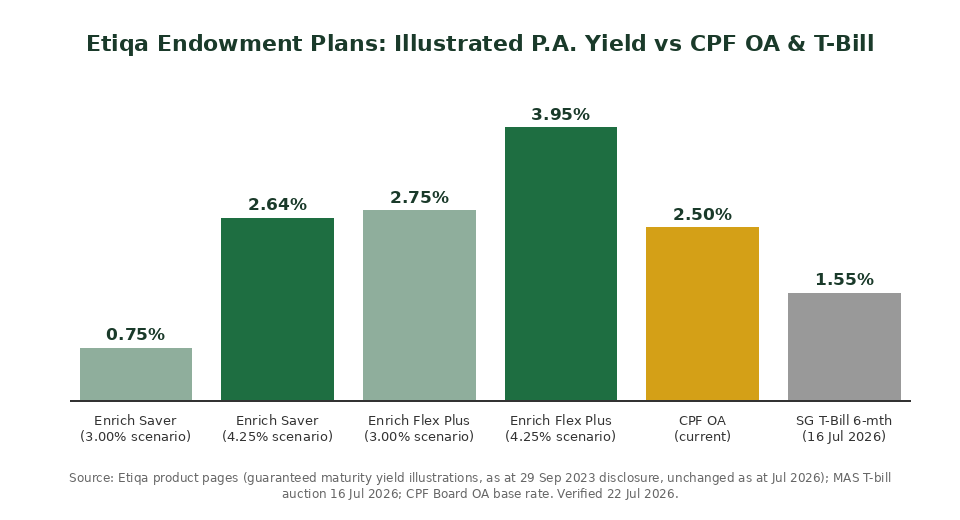
Here’s the part that matters most: at maturity, you receive a lump sum made up of a guaranteed amount and a non-guaranteed amount. Etiqa illustrates this as returns of up to 2.64% p.a. under a 4.25% p.a. investment rate of return scenario, or just 0.75% p.a. under the more conservative 3.00% p.a. scenario. That 3.00% figure is closer to what you should treat as your “floor” expectation — the 4.25% number is not guaranteed and depends entirely on how Etiqa’s participating fund performs.
Enrich Flex Plus: The Whole-of-Life Option
Enrich flex plus is different from the other three — it’s not a fixed-term endowment. The policy runs up to age 125, with your choice of a 3, 5, 10, 15, or 20-year premium term. Think of it as a savings plan that doubles as whole-of-life coverage, with the flexibility to withdraw your accumulated cash value whenever you need it.
Based on a male, non-smoker, aged 1, with a 3-year premium term, Etiqa illustrates a guaranteed maturity yield of up to 1.65% p.a., with a potential total maturity yield (guaranteed plus non-guaranteed) of up to 3.95% p.a. at the 4.25% investment rate of return scenario. At the more conservative 3.00% scenario, that total drops to 2.75% p.a. Your capital is 100% guaranteed from as early as policy year 5, extending to year 15 depending on which premium term you pick.
You can add two optional riders: Extra secure waiver II, which continues your policy without further premiums if you’re diagnosed with any of 37 covered severe-stage critical illnesses, and Extra payer waiver II, which does the same on death, total and permanent disability, or critical illness diagnosis of the policyholder (before age 86). There’s also an option to name a secondary life insured, so the policy continues for a loved one after you pass on — useful if you’re setting this up as a long-term family legacy plan rather than a pure savings vehicle.
Enrich Goal: The 7-Pay Long-Term Plan
Enrich goal asks for a longer commitment upfront — 7 years of premiums — but gives you three ways to structure your payout. Choose a lump sum with a 15-year policy term, 10 yearly payments spread across a 24-year term, or 15 yearly payments across a 29-year term. From policy year 8 onward, the Automatic Premium Benefit kicks in to cover remaining costs from the policy’s own value.
Your capital is 100% guaranteed at the end of the 15th policy year (or the equivalent milestone for the longer terms), and death coverage runs for the full policy duration. There’s also an Extra cancer care waiver rider — compulsory for life insured aged 17 to 60 — that waives premiums if you’re diagnosed with a major cancer.
Etiqa’s public product page for Enrich goal doesn’t disclose specific illustrated yield percentages the way Enrich saver and Enrich flex plus do. You’ll need to request a personalised benefit illustration to see the actual guaranteed and non-guaranteed figures for your age and premium amount.
Are Etiqa’s Returns Actually Good? CPF OA & T-Bill Comparison
Here’s the question every Singaporean should ask before signing up for any endowment plan: is this actually better than parking my money somewhere simpler? Let’s put Etiqa’s illustrated figures next to two benchmarks you already have access to — your CPF Ordinary Account and Singapore’s own T-bills.
| Option | Illustrated / Current Rate | Guaranteed? | Lock-in |
|---|---|---|---|
| CPF Ordinary Account | 2.50% p.a. | Yes (legislated floor) | None (withdrawable per CPF rules) |
| SG T-Bill (6-month, 16 Jul 2026) | 1.55% p.a. | Yes | 6 months |
| Enrich saver (3.00% scenario) | 0.75% p.a. | Partially | 10 years |
| Enrich saver (4.25% scenario) | 2.64% p.a. | Partially (non-guaranteed portion) | 10 years |
| Enrich flex plus (3.00% scenario) | 2.75% p.a. total | 1.65% p.a. portion guaranteed | To age 125 (withdrawable earlier) |
| Enrich flex plus (4.25% scenario) | 3.95% p.a. total | 1.65% p.a. portion guaranteed | To age 125 (withdrawable earlier) |
Source: Etiqa product pages (yield illustrations dated 29 Sep 2023, unchanged as at Jul 2026), CPF Board, MAS Singapore Government Securities auction results (16 Jul 2026). Compiled 22 July 2026.
The honest takeaway: under the conservative 3.00% p.a. scenario, both Enrich saver and Enrich flex plus underperform CPF OA and even the T-bill. You’re only ahead of CPF OA if the 4.25% p.a. scenario actually plays out over the full policy term — and that’s not guaranteed. If your money is already sitting in CPF OA and you don’t need life insurance coverage, moving it into one of these plans purely for “growth” doesn’t clearly make sense on the numbers alone.
Where these plans can make sense is if you value the forced-savings discipline, want the death/TPD protection bundled in, or you’re saving money that sits outside CPF and would otherwise earn close to 0% in a regular bank account. For a fuller comparison of endowment plans against other guaranteed options, see our Singapore T-bills 2026 guide and our Singapore Savings Bonds guide. The 16 Jul 2026 T-bill cut-off yield is sourced from MAS’s Singapore Government Securities auction results.
Etiqa vs Other Insurers’ Endowment Plans
Etiqa isn’t the only insurer running endowment plans with a “capital guaranteed at maturity” pitch. Here’s how it stacks up against the insurer-specific reviews we’ve already published on TKN.
| Insurer | Standout Feature |
|---|---|
| Etiqa | Lowest entry point ($125/month via Tiq CashSaver), no medical checks across the range |
| AIA | Non-par single-premium options with 2-3 year illustrated fixed returns |
| HSBC Life | Bank-distributed, aggregation-limited no-medical-evidence underwriting |
| Great Eastern | Largest local insurer, widest agent distribution network |
| Manulife | Strong par fund track record disclosure |
| NTUC Income | Cooperative structure, mass-market accessibility |
Source: TKN insurer-specific endowment reviews, published 2026.
The pattern across all these insurers is the same: a “guaranteed” headline that only covers part of the return, and a bigger non-guaranteed slice that depends on how well the insurer’s par fund performs. Don’t compare insurers purely on their advertised maximum illustrated yield — compare the guaranteed floor, because that’s the number you can actually count on.
Pros and Cons
| Pros | Cons |
|---|---|
| Low entry point via Tiq CashSaver ($125/month) | Guaranteed-only returns are often below CPF OA and T-bills |
| No medical check-up required across all four plans | Enrich goal doesn’t disclose illustrated yields publicly |
| SDIC protection under the Policy Owners’ Protection Scheme | Surrendering early can mean getting back less than you paid in |
| Built-in death/TPD protection bundled with savings | Non-guaranteed portion depends on par fund performance, not fixed |
| Flexible premium terms across the range (2 to 20 years) | Money is locked in for years; not for short-term needs |
Who Should (and Shouldn’t) Buy an Etiqa Endowment Plan
An Etiqa endowment plan could suit you if you struggle to save on your own and want the discipline of a fixed monthly commitment, you want some death or TPD protection bundled with your savings, or you’re setting aside money for a specific milestone (a child’s education, a wedding, retirement) and don’t want the volatility of the stock market.
It’s probably not for you if you already max out your CPF contributions and just want the highest safe return — CPF OA at 2.50% p.a. beats several of these plans’ guaranteed floor. It’s also not ideal if you might need the cash within 2–3 years, since early surrender usually means a loss, or if you’re comfortable managing your own diversified portfolio and don’t need the insurance wrapper.
If you’re weighing this against building your own portfolio instead, our CPF investment strategy guide and Singapore retirement calculator are good starting points to model out both paths side by side.
Want to Compare Against Investing Instead?
If you’d rather build your own diversified portfolio instead of relying on an insurer’s par fund, platforms like Endowus and Syfe let you invest CPF, SRS, or cash directly into low-cost portfolios.
FAQ
Is Etiqa a good insurance company in Singapore?
What is the minimum amount to start an Etiqa endowment plan?
Do Etiqa endowment plans require a medical check-up?
Are Etiqa's endowment plan returns guaranteed?
How does Tiq CashSaver's yearly cash benefit work?
Is an Etiqa endowment plan better than CPF OA or a T-bill?
What happens if I surrender an Etiqa endowment plan early?
Can foreigners buy an Etiqa endowment plan in Singapore?
What's the difference between Enrich saver and Enrich goal?
Get Free Insurance Advice
Speak with a licensed insurance advisor. No obligation, no cost.
By submitting this form, you agree to our Privacy Policy.
This article was researched with the help of AI. While we strive to keep all information accurate and up to date, there may be errors. If you notice any discrepancies, please contact us.