What Is Universal Life Insurance? Singapore’s Complete Guide (2026)
Permanent coverage meets flexible savings — what every Singapore investor needs to knowTable of Contents
Universal Life Insurance (ULI) is a type of permanent life insurance that combines lifelong death benefit coverage with a flexible savings component. Unlike term insurance, it never expires. Unlike whole life insurance, you can adjust your premium payments within set limits. Your policy builds cash value at the insurer’s declared interest rate. Singapore’s major insurers — AIA, Prudential, Manulife, and Great Eastern — all offer MAS-regulated ULI products.
Not financial advice. All figures are for educational reference only. Data verified as at September 2026 unless noted.
- Universal Life Insurance gives you permanent coverage and a savings component in one policy
- Premiums are flexible — pay more in good months, less in lean ones (within limits)
- Cash value grows over time, but the Cost of Insurance rises as you age — understand the charges before signing
What Is Universal Life Insurance?
Universal Life Insurance is a type of permanent life insurance. It covers you for your entire life — not just for a fixed term of 10, 20, or 30 years like a term policy.
What makes it “universal” is the flexibility. You set a target premium, but you can increase or reduce payments as your financial situation changes. Pay more, and the extra funds go into a cash value account. Pay less (above the minimum), and the shortfall is covered by your existing cash value.
This cash value grows at an interest rate declared by the insurer. It is not the same as an investment return — the insurer sets the rate based on prevailing market conditions and their portfolio performance. Most policies carry a guaranteed minimum floor so the rate cannot fall below a certain level.
In Singapore, ULI is regulated by the Monetary Authority of Singapore (MAS) under the Insurance Act. Insurers must be licensed and must present you with a Product Summary and Benefit Illustration before you sign — this is required by law.
How Does Universal Life Insurance Work?
When you pay your ULI premium, it does not all go into your savings account. It gets split three ways.
First, a portion covers the Cost of Insurance (COI). This is the pure protection charge — what the insurer deducts to keep your death benefit active. The COI increases every year as you get older.
Second, administrative charges are deducted. These are the insurer’s operating costs, typically a flat monthly fee.
Third, whatever remains is credited to your cash value account, where it earns interest at the insurer’s declared rate.
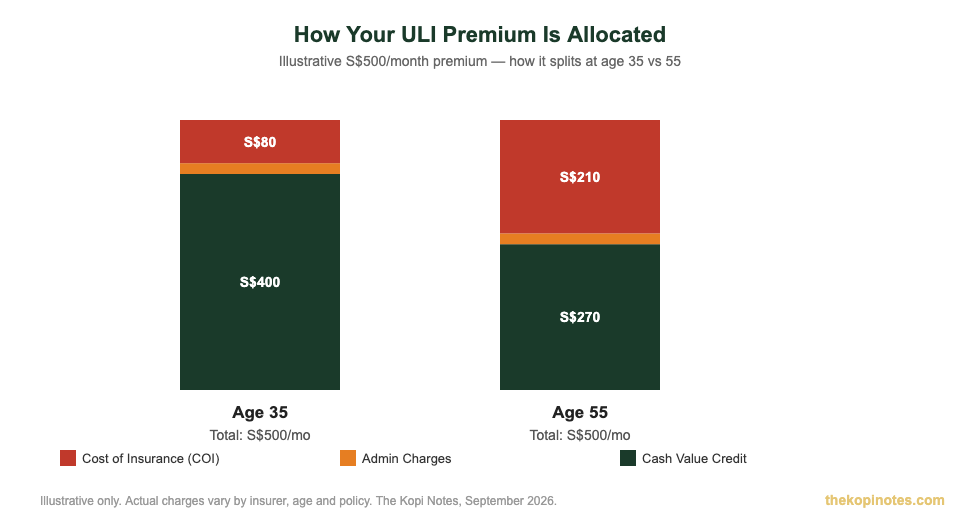
Here is a simplified example. Say you pay S$500 per month. S$80 might go to the COI, S$20 to admin charges, and the remaining S$400 builds your cash value. As you age, the COI rises. At age 55, the same S$500 premium might see S$210 going to the COI — leaving much less to build your savings. The chart below shows how this works.
The cash value is yours to access. You can make a partial withdrawal (which reduces your death benefit) or take a policy loan against it — typically up to 85–90% of the surrender value. Policy loans accrue interest, so they are not free money.
If your cash value falls to zero — usually because you underpay premiums for too long — the policy lapses and your coverage ends. This is the key risk most buyers do not understand upfront.
Universal Life vs Whole Life vs Term Insurance
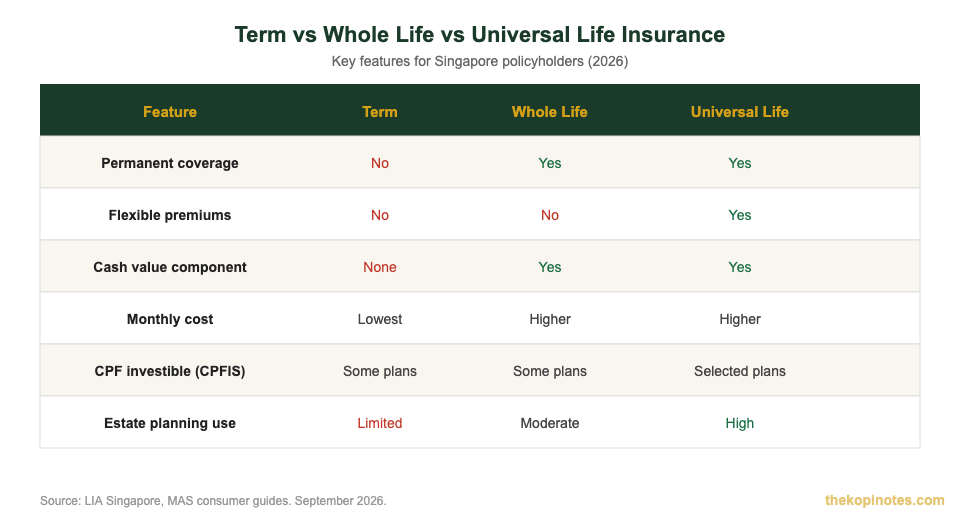
These three types of life insurance are often confused. Here is how they compare across the key dimensions Singapore buyers care about.
| Feature | Term Insurance | Whole Life Insurance | Universal Life Insurance |
|---|---|---|---|
| Coverage period | Fixed term (e.g. 20 years) | Entire life | Entire life |
| Premium flexibility | Fixed | Fixed | Flexible (within limits) |
| Cash value component | None | Yes (participating fund) | Yes (declared rate or market-linked) |
| Monthly cost | Lowest | Higher | Higher |
| CPF investible | Some plans via CPFIS | Some plans via CPFIS | Selected plans via CPFIS-OA |
| Estate planning use | Limited | Moderate | High |
Source: LIA Singapore, MAS consumer guides, individual insurer product summaries. September 2026.
The key takeaway: term insurance is the cheapest way to get covered but leaves you with nothing at the end. Whole life and ULI both build cash value, but ULI gives you more control over how much you pay each year.
Types of Universal Life Insurance in Singapore
Not all ULI policies are the same. There are two main categories in Singapore.
Traditional Universal Life Insurance grows your cash value at an interest rate the insurer declares periodically. This rate is not guaranteed above a minimum floor — but it is also shielded from direct market swings. You know roughly what you will earn each year. AIA and Great Eastern offer this type. Declared rates have typically ranged from 3% to 6% per annum depending on the insurer and market conditions.
Variable Universal Life Insurance (VUL) links your cash value to investment sub-funds you choose — similar to an Investment-Linked Policy (ILP). Returns can be higher, but so can losses. If your chosen funds perform poorly, your cash value shrinks. This suits investors comfortable with market risk who want both protection and market exposure in one policy.
A third, less common variant is the Indexed Universal Life Insurance (IUL). It links cash value returns to a market index such as the S&P 500, with a guaranteed floor so you cannot lose value in a down year. IUL is more prevalent in the United States and is less widely available in Singapore, but select international insurers operating here do offer it.
Before choosing, read our guide to the endowment plan vs ILP in Singapore to see how ULI compares with other savings-linked insurance products.
ULI Costs and Charges to Know
This is the section most people skip — and then regret. Universal Life Insurance has several layers of charges that directly reduce how fast your cash value grows.
| Charge Type | What It Is | How It Changes Over Time |
|---|---|---|
| Cost of Insurance (COI) | Pure protection charge for your death benefit | Rises every year as you age |
| Admin Charges | Fixed monthly policy management fee | Usually flat; may step up at intervals |
| Surrender Charges | Penalty for early policy termination | Highest in first 5–15 years; tapers to zero |
| Fund Management Fee | For VUL: annual fee on underlying investment sub-funds | Typically 1–2% p.a.; varies by sub-fund |
| Policy Loan Interest | Interest on loans taken against your cash value | Check with your insurer; typically 5–7% p.a. |
Source: MAS consumer guides, LIA Singapore, individual insurer product summaries. September 2026.
The COI is the biggest cost to watch. In your 30s it is small. By your 60s, it can consume a large chunk of every premium payment. This is why ULI works best when you start young and let the cash value compound before the COI climbs steeply.
Always ask your adviser for the Benefit Illustration — a MAS-mandated document that shows projected policy values under different return scenarios. Compare the projected surrender values at year 10, year 20, and year 30. Then compare those numbers to what you might accumulate by putting the same money into a Singapore Savings Bond or low-cost ETF.
Pros and Cons of Universal Life Insurance
No financial product is perfect for everyone. Here is an honest look at both sides.
Advantages of Universal Life Insurance
Premium flexibility is the biggest selling point. If you are a business owner or freelancer with variable income, ULI lets you pay more in strong years and reduce payments during lean periods — without losing coverage, as long as enough cash value remains to cover the COI.
Lifelong coverage means no renewal headaches. Once insured, your coverage continues for life regardless of any health changes after the policy is issued. This is valuable if you develop a pre-existing condition later — you cannot be declined on renewal.
Cash value gives you a living benefit. Unlike term insurance, your policy has a monetary value you can tap via loans or partial withdrawals. This can serve as an emergency buffer or an estate planning tool.
Estate planning efficiency is why high-net-worth individuals use ULI. Death benefits paid to named beneficiaries typically bypass the estate and are not subject to probate — they reach your family faster and privately.
Disadvantages of Universal Life Insurance
Complexity is a real drawback. The layered charges, the declared rate mechanics, and the lapse risk make ULI harder to understand than a simple term policy. Many buyers do not realise the COI eventually exceeds their minimum premium — and their policy lapses.
Higher cost than term insurance is unavoidable. You pay for both coverage and the savings component. If your goal is pure protection for the lowest cost, a term policy combined with a separate low-cost ETF portfolio via Syfe referral code and sign-up bonus almost always delivers better value.
Returns are not guaranteed above the floor. In a prolonged low-rate environment, declared rates disappoint. You are exposed to the insurer’s investment performance, not a transparent market index.
Who Should Consider Universal Life Insurance?
ULI is not the right product for everyone. It tends to suit specific profiles.
You are a good candidate if you have variable income and need premium flexibility. Business owners, freelancers, and commission-based earners benefit most from being able to adjust payments year-to-year without losing coverage.
You are a good candidate if you are building an estate plan. High-net-worth individuals use large ULI policies to create a tax-efficient inheritance. A S$1–2 million death benefit pays to your beneficiaries immediately — bypassing the sometimes lengthy probate process.
You are a good candidate if you start young — mid-20s to early 40s. The COI is low at young ages, letting your cash value compound for decades before the charges become meaningful. Starting at 50+ makes the economics difficult for most people.
You are probably not the right fit if your primary goal is affordable protection. A 30-year-old wanting S$1 million coverage will pay a fraction of the ULI premium with a term policy. The savings, invested in a low-cost global ETF, will likely outperform the ULI cash value over 20 years.
You may also not be suited if you prefer simplicity. If tracking declared rates, COI charges, and cash value balances sounds stressful, a simpler product is a better match — and one you are more likely to maintain long-term.
Use our Singapore retirement calculator to model whether ULI fits your broader financial plan alongside CPF, ETFs, and S-REITs. For comparison, see our analysis of the best investment plan for retirement in Singapore.
How to Buy Universal Life Insurance in Singapore
Buying ULI in Singapore requires going through a licensed financial adviser or bank relationship manager. You cannot purchase it directly online — MAS requires a needs analysis and proper financial planning process before any recommendation can be made.
Here is how the process works in practice.
Step 1: Needs analysis. Your adviser is legally required to assess your financial situation, income, existing coverage, and goals before recommending ULI. This is part of the Financial Advisory Process under the Financial Advisers Act.
Step 2: Compare product illustrations. Ask your adviser for Benefit Illustrations from at least three insurers at the same coverage amount. Compare projected surrender values at year 10, year 20, and year 30. The numbers will differ more than you expect.
Step 3: Read the Benefit Illustration carefully. MAS mandates that all illustrations show projected policy values under different scenarios. Pay close attention to the surrender value columns — not just the death benefit figure.
Step 4: Use the free-look period. After signing, you have a 14-day free-look period mandated by MAS. You can cancel for a full refund of premiums paid (minus any medical examination costs). Use this time to re-read all documents carefully.
Step 5: Review annually. ULI is not a set-and-forget product. Check your policy statement every year. Confirm your cash value is growing, the COI has not spiked unexpectedly, and your coverage still matches your needs.
To complement your ULI with low-cost investment products, explore the Endowus referral code for CPF-investible funds, or the Syfe referral code and sign-up bonus for robo-advisory investing alongside your insurance plan. You may also want to read our guide on endowment plan vs ILP to understand where ULI sits in the broader insurance savings landscape.
Frequently Asked Questions
”What
”What
”Can
Get Free Insurance Advice
Speak with a licensed insurance advisor. No obligation, no cost.
By submitting this form, you agree to our Privacy Policy.
This article was researched with the help of AI. While we strive to keep all information accurate and up to date, there may be errors. If you notice any discrepancies, please contact us.