Endowment Plan Interest Rate Singapore 2026: What “Guaranteed” Actually Means
LIA’s 4.25% and 3.00% illustration rate caps explained, and how to tell your guaranteed return from a projection.
Singapore endowment plans often advertise a “guaranteed” return, but that figure usually blends two different things: a contractual guaranteed benefit, and a non-guaranteed illustrated return capped by the Life Insurance Association (LIA) at 4.25% (upper) and 3.00% (lower) per annum in 2026. Only the guaranteed portion is certain — everything above it depends on real fund performance.
Not financial advice. All figures are for educational reference only. Data verified as at 14 August 2026 unless noted.
- The “interest rate” you see on an endowment plan brochure is usually the illustrated return, not a promise — LIA caps it at 4.25% p.a. (upper) and 3.00% p.a. (lower) for 2026.
- Your actual guaranteed amount is a separate, smaller figure written into the policy contract — often just your capital back, or close to it.
- Before you buy, ask your agent for the guaranteed cash value column on the benefit illustration (BI), not just the headline “up to X% p.a.” number.
Table of Contents
Contents — Click to expand
Why “Guaranteed X% a Year” Ads Can Mislead You
You’ve probably seen the pitch: “guaranteed 3% p.a.” or “up to 4.25% p.a. return.” It sounds like a fixed deposit with a better rate. In practice, it usually isn’t.
Most Singapore endowment plans are participating (par) policies. You get two kinds of payout. The first is a guaranteed cash value — a fixed dollar figure written into your contract that the insurer must pay you, no matter what happens to markets. The second is a non-guaranteed bonus, which depends on how well the insurer’s participating fund actually performs.
Here’s the catch: the “X% p.a.” you see quoted in marketing materials is almost always the illustrated rate — a projection of guaranteed plus non-guaranteed benefits combined, shown at two standardised scenarios set by the industry. It is not a promise. If the insurer’s fund underperforms, your actual payout can land well below the number on the brochure.
This matters more in 2026 than it did five years ago. You’re reading this because interest rate expectations have shifted since the 2022–2023 rate-hike cycle, and many Singaporeans are comparing endowment plans against T-bills, Singapore Savings Bonds (SSBs), and CPF — all of which have genuinely guaranteed rates. Knowing exactly what part of your endowment plan quote is guaranteed lets you make an apples-to-apples comparison.
How Endowment Plan Interest Rates Actually Work
To understand your quote, you need to separate three numbers that often get blurred into one headline figure.
1. Guaranteed cash value. This is the amount the insurer is contractually obliged to pay you at maturity (or on surrender, at a lower amount). For many short-term single-premium plans, the guaranteed value is close to — or even slightly below — your original capital. It does not depend on investment performance.
2. Non-guaranteed bonuses. These come in two forms. A reversionary bonus is declared annually by the insurer and, once added to your policy, normally can’t be taken away. A terminal bonus is a one-off top-up paid only if you hold the policy to maturity or surrender it. Both depend entirely on the performance of the insurer’s par fund — a pool of your premiums invested across bonds, equities, and property.
3. Illustrated investment rate. This is not a bonus rate at all — it’s a projection tool. Insurers are required to show your policy’s total value under an “upper” and a “lower” investment return scenario, so you can see a plausible range of outcomes. These are the two numbers capped by LIA (covered next).
That’s why two policyholders in the same plan can end up with different actual returns — their guaranteed value is identical, but the bonuses declared over the years depend on how the fund actually performed, not on what the original brochure illustrated.
The 2026 LIA Illustration Rate Caps
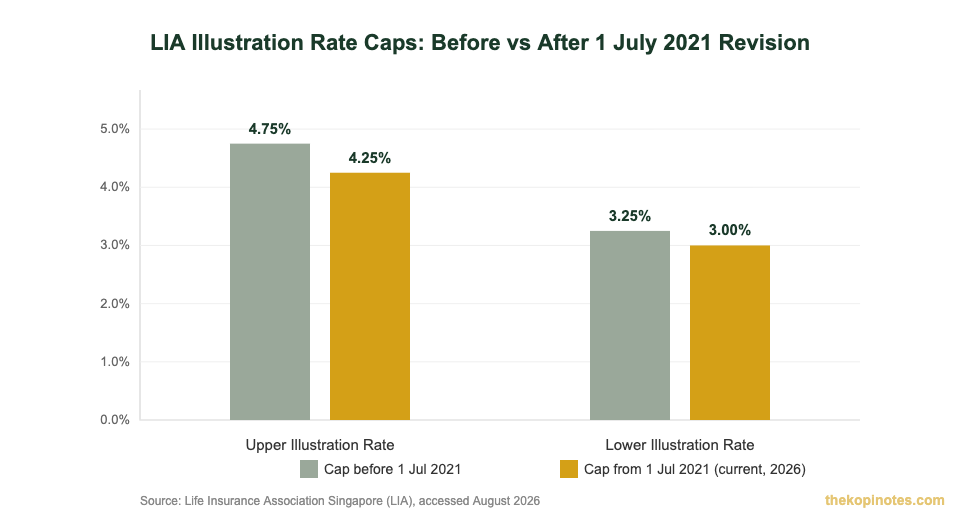
The Life Insurance Association of Singapore (LIA) sets an industry-wide cap on the “Upper Illustration Rate” that insurers can use in a benefit illustration (BI). The “Lower Illustration Rate” must sit at least 1.25 percentage points below it. Insurers cannot illustrate above these caps, even if they believe their fund can do better.
Following the last revision, effective for policies sold from 1 July 2021, the caps are 4.25% p.a. (upper) and 3.00% p.a. (lower). LIA reviews these caps annually — as at August 2026, the 4.25%/3.00% caps remain current, confirmed directly on LIA’s own illustration-rate page.
| Scenario | Cap Before 1 Jul 2021 | Cap From 1 Jul 2021 (Current, 2026) |
|---|---|---|
| Upper Illustration Rate | 4.75% p.a. | 4.25% p.a. |
| Lower Illustration Rate | 3.25% p.a. | 3.00% p.a. |
Source: Life Insurance Association Singapore, accessed 14 August 2026.
Two things are worth remembering here. First, LIA is explicit that these rates “do not represent upper and lower limits of the investment performance” of a fund — your actual bonus could, in theory, land outside this range if the fund does unusually well or badly. Second, the cap applies to the illustration, not to what insurers must actually deliver. It stops insurers from over-promising in a brochure; it doesn’t guarantee the fund will hit even the lower figure.
On the ground, most major insurers’ 2025 participating fund updates — Prudential, Manulife, and Income among them — reported broadly stable bonus rates rather than sharp cuts, based on their own published fund updates. That’s reassuring, but it can change from year to year, which is exactly why the guaranteed portion of your policy matters more than the illustrated one.
Guaranteed-Only vs Participating Plans: Which Rate Can You Trust?
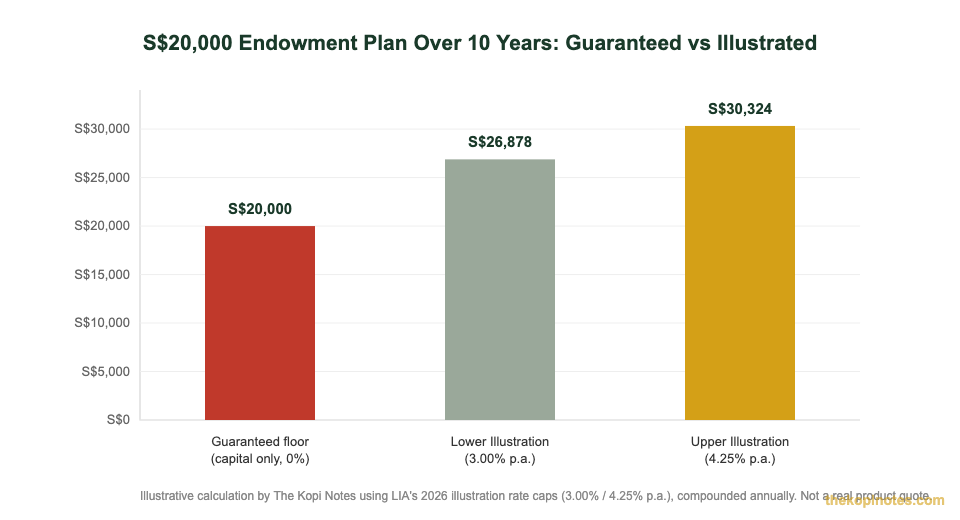
Let’s put real numbers to this. Say you put a S$20,000 single premium into a 10-year participating endowment plan. Here’s how the guaranteed floor compares with the two illustrated scenarios, compounded annually using LIA’s 2026 caps.
| Scenario | Rate Used | Value After 10 Years | Is This Guaranteed? |
|---|---|---|---|
| Guaranteed floor (capital only) | 0% p.a. | S$20,000 | Yes |
| Lower Illustration Rate | 3.00% p.a. | S$26,878 | No — projection |
| Upper Illustration Rate | 4.25% p.a. | S$30,324 | No — projection |
Illustrative calculation by The Kopi Notes using LIA’s 2026 illustration rate caps, compounded annually. Actual products vary — some guarantee a small return above capital, others guarantee slightly less than capital if surrendered early.
Notice the spread: S$3,446 separates the lower and upper illustrated outcomes on the same policy, and the entire S$6,878–S$10,324 gain above your capital is non-guaranteed. This example uses a plan with zero guaranteed growth for simplicity — some plans, like short-term single-premium products such as DBS SavvyEndowment, do guarantee a small return above capital. Always check your own policy’s guaranteed cash value table rather than assuming either extreme.
How to Read Your Benefit Illustration Before You Buy
Your BI has columns most people skim past. Here’s what to actually check, in order.
1. Find the “guaranteed” column. Every BI shows guaranteed cash value year by year, separately from the total (guaranteed + non-guaranteed) value. If your agent only quotes the total, ask specifically for the guaranteed figure at your intended holding period.
2. Check the surrender value in early years. Many plans have a guaranteed value below your paid premiums if you surrender in the first few years — this is the real downside risk, not the “worst case” illustrated scenario.
3. Look up the insurer’s bonus track record. Insurers publish annual participating fund updates. A history of maintaining declared bonuses (rather than cutting them) is a better trust signal than any single year’s illustration.
4. Compare the guaranteed rate against risk-free alternatives. CPF Special Account, T-bills, and Singapore Savings Bonds all pay a rate that’s contractually guaranteed for their full term — not just illustrated. If your endowment plan’s guaranteed portion is lower than these, you’re paying for the non-guaranteed upside and the insurance/protection wrapper, not for a better guaranteed rate. Our endowment plan vs CPF LIFE comparison walks through this trade-off in detail.
5. Read the fine print on non-guaranteed bonuses. Once a reversionary bonus is declared and vested, it typically can’t be revoked — but future declarations are never promised. Terminal bonuses are the least certain of all, since they’re only paid at maturity or surrender.
If you’re comparing endowment plans as part of a broader retirement or savings strategy, it’s worth running the numbers through our Singapore retirement calculator alongside your CPF investment strategy to see how a guaranteed-vs-illustrated gap affects your actual retirement number, not just the policy’s headline rate.
For a broader view of how endowment plans stack up as a category, see our full Endowment Plan Singapore 2026 buyer’s guide.
Disclaimer: This article is for educational purposes only and is not financial advice. Endowment plan terms vary significantly by insurer and product — always read your actual policy contract and benefit illustration before purchasing.
Frequently Asked Questions
What does 'guaranteed' interest rate mean in a Singapore endowment plan?
It refers only to the guaranteed cash value written into your policy contract — the minimum amount the insurer must pay you at maturity or surrender, regardless of investment performance. It does not include non-guaranteed bonuses, and it’s usually a much smaller figure than the “up to X% p.a.” rate shown in marketing materials.
What are the LIA illustration rate caps for 2026?
As at August 2026, the Life Insurance Association of Singapore caps the Upper Illustration Rate at 4.25% p.a. and the Lower Illustration Rate at 3.00% p.a. for SGD-denominated participating policies. These caps have applied to policies sold from 1 July 2021 and are reviewed annually by LIA.
Why did my endowment plan's projected returns look lower than a few years ago?
LIA lowered the illustration rate caps from 4.75%/3.25% to 4.25%/3.00% for policies sold from 1 July 2021. Any policy bought after that date will show lower illustrated figures than an older policy, purely because of this industry-wide cap — it isn’t necessarily a sign that your specific insurer’s fund is performing worse.
Is the illustrated rate the same as what I will actually receive?
No. The illustrated rate is a standardised projection tool, not a promise. LIA itself states that the upper and lower rates “do not represent upper and lower limits” of actual fund performance. Your real payout depends on the bonuses your insurer actually declares over the life of the policy, which can be higher or lower than illustrated.
How can I find just the guaranteed return on my endowment plan?
Look at the “Guaranteed” column in your benefit illustration (BI) — it’s shown separately from the “Total” (guaranteed + non-guaranteed) column at each policy year. Some agents will only walk you through the total column verbally, so ask specifically for the guaranteed cash value at your intended holding period, in writing.
Are endowment plan returns guaranteed by MAS or the Singapore government?
No. MAS regulates how insurers operate and how illustrations must be disclosed (including LIA’s illustration rate caps), but it does not guarantee the returns of any endowment plan. The guarantee, where one exists, comes solely from the insurer’s contractual obligation under your policy — not from the government.
Comparing Guaranteed vs Illustrated Returns?
See how a guaranteed-rate alternative like Endowus stacks up against a participating endowment plan for your savings goal.
Get Free Insurance Advice
Speak with a licensed insurance advisor. No obligation, no cost.
By submitting this form, you agree to our Privacy Policy.
This article was researched with the help of AI. While we strive to keep all information accurate and up to date, there may be errors. If you notice any discrepancies, please contact us.