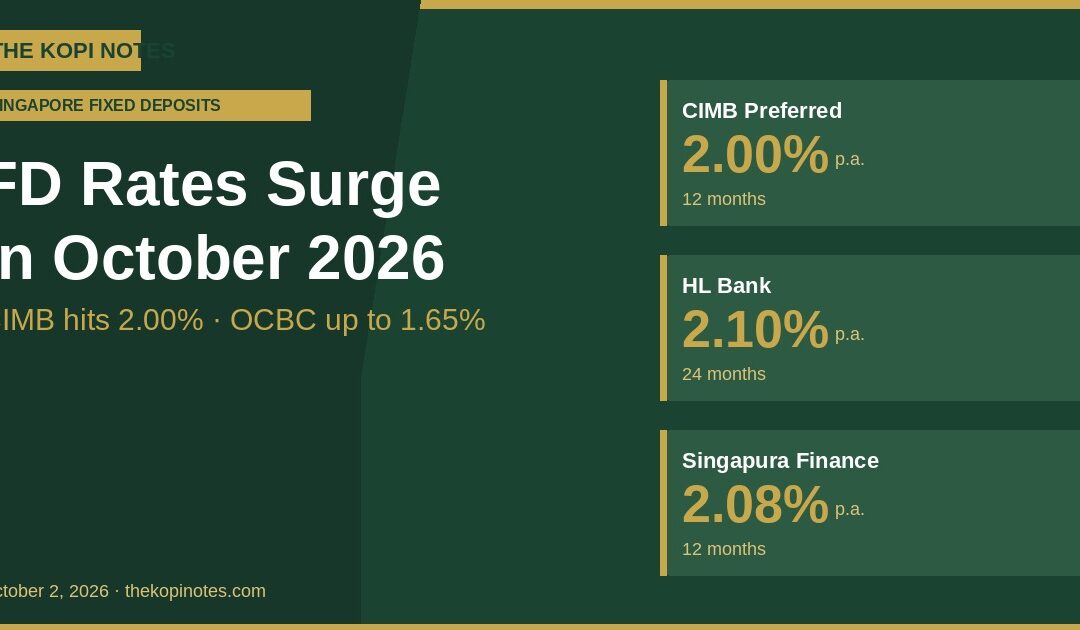
Singapore’s fixed deposit landscape just shifted — and savers need to pay attention. On October 1, 2026, multiple banks quietly raised their SGD promotional fixed deposit rates. CIMB jumped to 2.00% for Preferred Banking customers (up from 1.75%), while OCBC climbed to 1.65% online for 12-month placements (up from ~1.40%). With the Fed’s September rate hike and a potential MAS tightening in late October, cash-holders now have their best suite of options in months.
This is an editorial analysis. Not financial advice. Data verified as at 2 October 2026.
What Changed on October 1, 2026
The start of Q4 2026 brought a quiet but meaningful reset for Singapore’s fixed deposit market. Two of the most widely tracked banks — OCBC and CIMB — updated their promotional SGD fixed deposit rates effective October 1, 2026.
OCBC’s 12-month online rate moved to 1.65% per annum, up from the ~1.40% that had been in place through Q3. For 6-month placements, online customers now earn 1.50%. A minimum of S$20,000 in fresh funds is required, and placements must be made digitally to qualify for the higher tier.
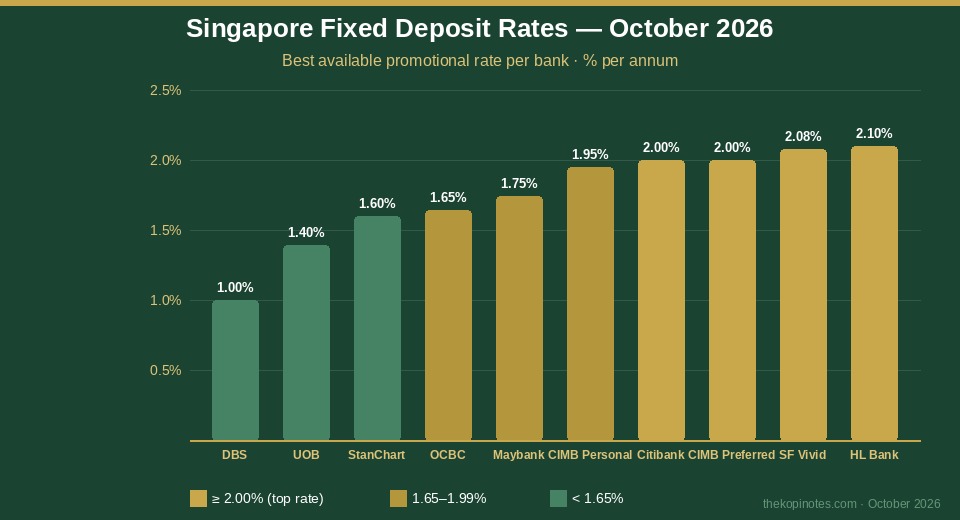
CIMB, meanwhile, made a larger move. Personal Banking customers can now lock in 1.95% per annum for 12 months, while CIMB Preferred Banking customers — those meeting certain relationship requirements — can earn 2.00% per annum for the same tenure. Six- and nine-month placements are available at 1.75% and 1.80% respectively for personal banking customers, with Preferred rates 0.05 percentage points higher across all tenures.
These are not trivial moves. A S$100,000 placement at 1.65% earns S$1,650 over 12 months. At 2.00%, that same sum earns S$2,000 — a difference of S$350 per S$100,000 per year. For savers with S$500,000 in a 12-month FD, the difference between 1.65% and 2.00% is S$1,750 a year.
October 2026 Fixed Deposit Rate Comparison Table
Here is how the Singapore fixed deposit market looks as of October 2, 2026, across major banks and finance companies:
| Bank / Institution | Best Rate | Tenure | Min. Deposit | Notes |
|---|---|---|---|---|
| Singapura Finance (Vivid FD) | 2.08% p.a. | 12 months | S$10,000 | Range S$10K–S$100K |
| HL Bank | 2.10% p.a. | 24 months | S$10,000 | 2.05% for 6 months |
| Bank of China | 2.18% p.a.* | 4–8 months | S$200,000 | *Large deposit only |
| Citibank | 2.00% p.a. | 6 months | S$10,000 | Eligible customers |
| CIMB (Preferred Banking) | 2.00% p.a. | 12 months | S$10,000 | Preferred tier required |
| CIMB (Personal Banking) | 1.95% p.a. | 12 months | S$10,000 | Online placement |
| Maybank | 1.75% p.a. | 6 months | S$20,000 | Promotional |
| RHB Bank | 1.70% p.a. | 6–12 months | S$20,000 | Online |
| Standard Chartered | 1.60% p.a. | 12 months | S$25,000 | Priority Banking for higher tier |
| OCBC | 1.65% p.a. | 12 months | S$20,000 | Online; fresh funds only |
| UOB | 1.40% p.a. | 12 months | S$10,000 | Online; i-Account |
| DBS | 1.00% p.a. | 8–12 months | S$1,000 | eFixed Deposit |
Rates are promotional and subject to change. Verify directly with each bank before placing funds. Rates compiled from official bank websites and comparison trackers as of 1–2 October 2026.
Why Are Singapore FD Rates Rising Now?
The rate increases didn’t happen in isolation. Three converging forces are pushing Singapore FD yields higher heading into Q4 2026.
1. The US Federal Reserve’s September 2026 Rate Hike
The US Federal Reserve raised its benchmark rate in September 2026, bringing the Fed funds target range to 3.75%–4.00% — the first hike since 2023. This matters for Singapore because global liquidity conditions and Singapore’s own SORA (Singapore Overnight Rate Average) are influenced by US monetary policy. When US rates rise, competitive pressure on Singapore banks to offer higher deposit returns intensifies.
2. Singapore Core Inflation at a Two-Year High
Singapore’s core inflation reached 2.2% in August 2026 — a two-year high — driven by services inflation and elevated food costs. For savers, this is a critical signal: any fixed deposit rate below 2.2% means you are still losing real purchasing power. The good news is that Singapura Finance, HL Bank, and CIMB Preferred customers can now at least approach or match this threshold. For most retail savers, FDs remain a slight negative-real-return option, making yield-maximisation essential.
3. MAS Tightening Expected in Late October 2026
The Monetary Authority of Singapore (MAS) is widely expected to announce its October 2026 monetary policy decision in the final week of October. According to our earlier coverage on the MAS October 2026 Meeting Preview, analysts including CIMB Securities are forecasting a third consecutive tightening of the Singapore Dollar NEER (Nominal Effective Exchange Rate) policy slope, adding an additional +25 basis points. If MAS tightens again, this typically signals an environment where higher interest rates persist — encouraging banks to compete more aggressively for deposits.
How FDs Compare to T-Bills and SSB in October 2026
Fixed deposits are only one tool in the Singapore saver’s toolkit. Two other popular options — Treasury Bills (T-bills) and Singapore Savings Bonds (SSBs) — offer alternative yield profiles that are worth benchmarking.
Singapore 6-Month T-Bills
The most recent 6-month T-bill auction (September 24, 2026) cleared at a cut-off yield of 1.92%, with a median yield of 1.79%. This means competitive bidders received between 1.79% and 1.92% annualised. T-bills can be purchased via CPF-OA, SRS, or cash — making them extremely flexible for different buckets of savings. However, the non-competitive bid (which guarantees allocation) yields the median rate of ~1.79%, which is lower than what several FD providers now offer for 12-month tenures. Read our comprehensive guide on T-bills in Singapore 2026 for the full picture.
Singapore Savings Bond (SSB) November 2026
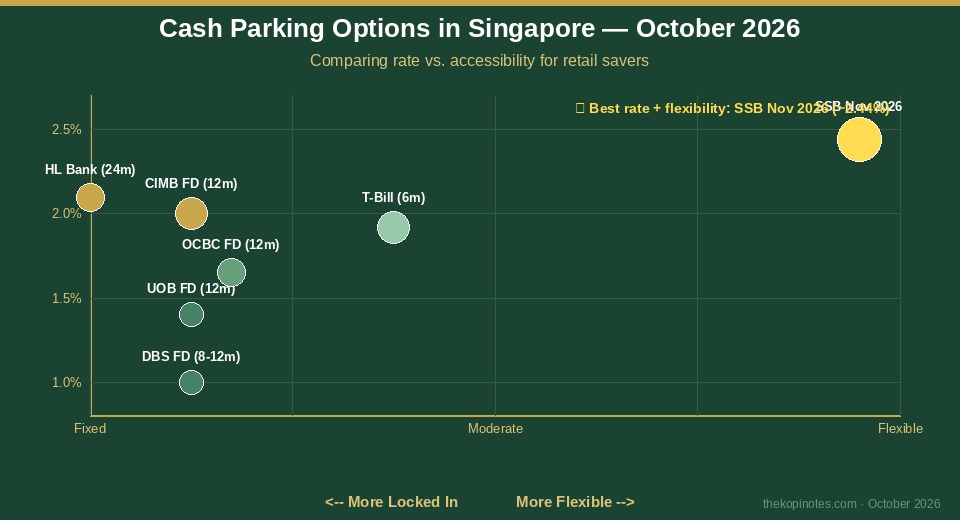
The November 2026 SSB — with the application window closing October 25, 2026 — is projected to offer a Year 1 rate of approximately 2.44%, based on prevailing SGS bond yields. This would make the November 2026 SSB highly competitive relative to FD offerings. Unlike FDs, SSBs can be redeemed before maturity (at the start of each month), carry no lock-in penalty, and are backed by the Singapore government. The catch: there is a S$200,000 per person lifetime limit for SSBs, and the year 1 projected rate could shift before final announcement. See our article on the November 2026 SSB for details and how to apply.
Here is how the three options compare for savers with S$50,000 of cash:
| Option | Indicative Rate | Flexibility | CPF Eligible? | Lock-in? |
|---|---|---|---|---|
| SSB November 2026 | ~2.44% (Year 1)* | High (monthly exit) | No (cash only) | No |
| 6-Month T-Bill | ~1.79%–1.92% | Medium (held to maturity) | Yes (CPF-OA, SRS) | 6 months |
| CIMB FD (Preferred, 12M) | 2.00% | Low (fixed tenure) | No | 12 months |
| OCBC FD (12M online) | 1.65% | Low (fixed tenure) | No | 12 months |
| DBS FD (8–12M) | 1.00% | Low | No | 8–12 months |
*SSB November 2026 rate is projected and subject to change upon final announcement.
Which Option Is Right for You?
The “best” rate is rarely the whole story. Here is how to match the right instrument to your situation.
If you need absolute flexibility: Consider the SSB first. The November 2026 projected 2.44% Year 1 rate beats most FDs and T-bills, and you can exit without penalty from as early as one month in. The S$200K lifetime cap means large savers need to supplement with other instruments.
If you have a specific 6-month horizon: The T-bill at 1.79%–1.92% works well, especially if you have CPF-OA funds looking for a short-term yield boost. Non-competitive bids via ATM or internet banking are straightforward. For cash, Citibank’s 6-month FD at 2.00% is attractive if you qualify.
If you want certainty for 12 months: CIMB Preferred at 2.00% is the best 12-month FD among major banks for those meeting Preferred Banking requirements. Singapura Finance’s Vivid FD at 2.08% for S$10K–S$100K is worth exploring for retail-sized placements. HL Bank’s 24-month at 2.10% suits those willing to lock in for longer.
If you bank with DBS or UOB primarily: DBS’s 1.00% and UOB’s 1.40% FD rates lag the market significantly. You are better served moving at least a portion of your idle cash to CIMB or Singapura Finance for the FD placement, while retaining DBS/UOB accounts for day-to-day banking. The switching cost is low; the yield difference is meaningful.
For a broader framework on where to allocate savings across products, see our guide on the Best Savings Plan in Singapore 2026.
What Comes Next: MAS Tightening and Rate Outlook
The forward picture for Singapore interest rates is nuanced. If MAS tightens the SGD NEER slope in late October 2026, this will likely put further upward pressure on interbank borrowing costs and in turn on deposit rates. Banks competing for sticky retail deposits — particularly as digital banking increases the ease of rate-shopping — have an added incentive to maintain or improve promotional FD rates through Q4.
However, the magnitude of further increases is uncertain. Singapore’s own economic trajectory — with Q2 2026 GDP at 5.9% YoY and core inflation at 2.2% — gives MAS room to act without triggering a hard landing. If global uncertainty picks up or if the Fed pauses in November/December 2026, Singapore banks could stabilise rates at current levels rather than pushing them higher.
For context, the Singapore Q3 2026 market wrap showed T-bill yields at their highest in over a year and SSBs offering rates not seen since early 2025. The trajectory has been upward since mid-2026, and October’s FD rate increases are consistent with that broader trend. Read the full analysis in our Singapore Q3 2026 Market Wrap.
For savers whose FDs are maturing in the next 4–8 weeks, the smartest move is likely a short hold in a high-yield savings account or a short-tenure FD (3–6 months), then reassess after the MAS October 2026 decision and the November 2026 SSB application window closes. If SSB November 2026 locks in above 2.40%, that may be the clear winner for flexible cash above the T-bill level.
Bottom Line for SG Investors
October 1, 2026 brought meaningful FD rate increases from OCBC and CIMB — the clearest signal yet that Singapore’s higher-rate environment is here for the near term. With CIMB Preferred offering 2.00%, Singapura Finance at 2.08%, and HL Bank at 2.10% for longer tenures, there are now genuine options for Singapore savers to earn meaningfully above 2% on cash deposits for the first time in over a year.
The one instrument that may beat all of them — the November 2026 SSB at ~2.44% projected Year 1 — has its application window closing October 25. If flexibility matters and you have not yet hit your S$200K lifetime SSB limit, applying for the November 2026 SSB before checking off the FD boxes is worth considering. For a broader comparison on how all your savings products line up, visit our Singapore Savings Plans vs T-Bills vs SSB 2026 guide.
One more thing: if you are tempted by DBS’s 1.00% or your existing bank’s low-rate FD out of convenience — crunch the numbers first. On S$100,000, the difference between 1.00% and 2.00% is S$1,000 a year. That is one good market return worth picking up for a 30-minute account opening.
Frequently Asked Questions
What is the best fixed deposit rate in Singapore in October 2026?
As of October 2, 2026, HL Bank offers 2.10% for a 24-month tenure (S$10,000 minimum online), while Singapura Finance’s Vivid Fixed Deposit offers 2.08% for 12 months (S$10K–S$100K). CIMB Preferred Banking customers can earn 2.00% for 12 months, and Citibank offers 2.00% for 6-month placements of S$10,000 or more.
Did OCBC raise fixed deposit rates in October 2026?
Yes. As of October 1, 2026, OCBC raised its online 12-month promotional FD rate to 1.65% per annum (up from ~1.40%) and its 6-month online rate to 1.50%. A minimum of S$20,000 in fresh funds is required for these promotional rates.
How does CIMB’s October 2026 FD rate compare to T-bills?
CIMB’s best 12-month rate (2.00% for Preferred Banking) exceeds the September 24, 2026 T-bill cut-off yield of 1.92% for a longer commitment. T-bills offer a 6-month tenure and can be funded via CPF-OA, making them suitable for a different use case. If flexibility matters, the November 2026 SSB (projected ~2.44% Year 1) may be the better option.
Why are Singapore fixed deposit rates rising in Q4 2026?
Three main drivers: (1) the US Federal Reserve raised rates in September 2026 to 3.75%–4.00%, tightening global liquidity; (2) Singapore core inflation reached a 2-year high of 2.2%, prompting banks to offer more competitive returns to retain deposits; and (3) the MAS is widely expected to tighten its exchange rate policy further in late October 2026, signalling a continued higher-rate environment.
Is the November 2026 Singapore Savings Bond (SSB) better than a fixed deposit?
Potentially, yes — depending on your situation. The November 2026 SSB is projected to offer ~2.44% in Year 1, which exceeds most current FD rates. SSBs also allow early redemption without penalty (effective from the start of each month), unlike FDs which typically penalise early withdrawal. However, SSBs have a S$200,000 per person lifetime cap and cannot be funded with CPF. The application window closes October 25, 2026.
Should I switch banks to get a better FD rate?
For meaningful sums, yes. The difference between DBS’s 1.00% and CIMB’s 2.00% is S$1,000 per S$100,000 per year. Opening a CIMB or Singapura Finance FD account takes 30–60 minutes online. You can maintain your main bank for day-to-day banking while placing savings in a higher-yielding account. Always confirm current rates directly with the bank before placing funds, as promotional rates change frequently.
This article was researched with the help of AI. While we strive to keep all information accurate and up to date, there may be errors. If you notice any discrepancies, please contact us.