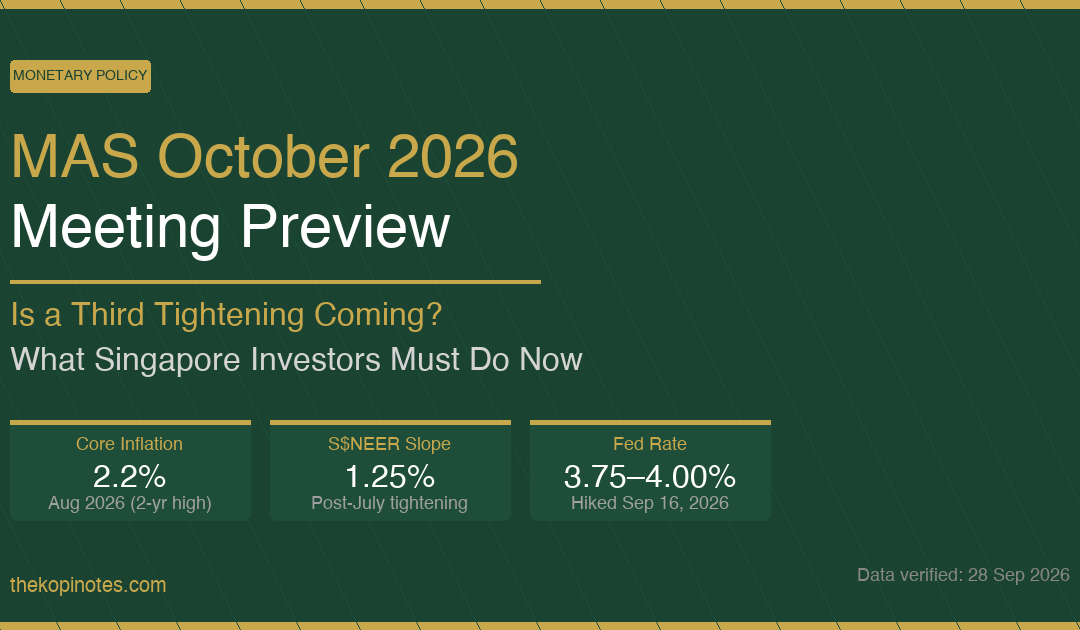
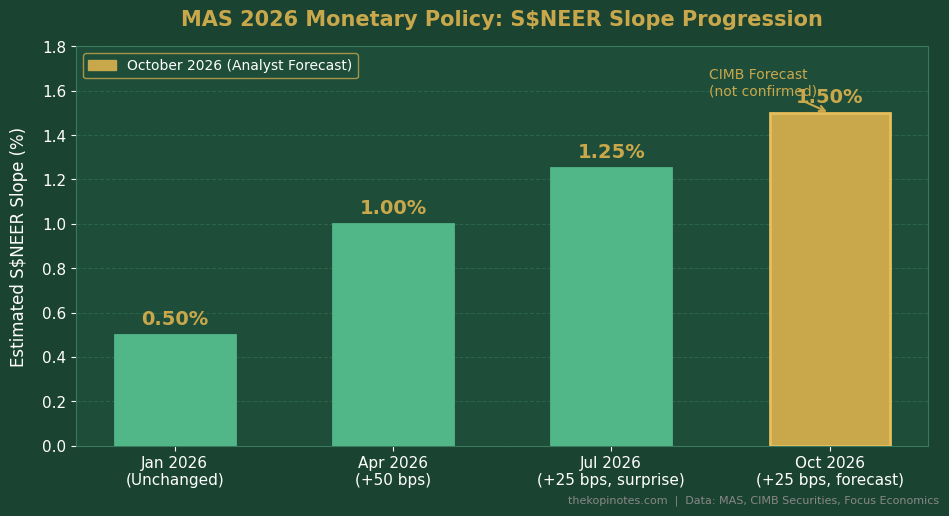
The Monetary Authority of Singapore (MAS) has already surprised markets twice in 2026—tightening in April (+50 bps) and again in July (+25 bps, surprise move)—pushing the S$NEER policy slope to 1.25%. Now, with Singapore’s core inflation hitting a 2-year high of 2.2% in August 2026 and the US Fed hiking rates to 3.75%–4.00% on 16 September, CIMB Securities is forecasting a third consecutive tightening at the MAS October 2026 meeting. Here’s what every Singapore retail investor needs to know—and how to position your portfolio before the decision lands.
This is an editorial analysis. Not financial advice. Data verified as at 28 September 2026.
What Is the MAS Monetary Policy Statement?
Unlike most central banks that set a benchmark interest rate (like the US Federal Reserve’s fed funds rate), MAS uses the Singapore Dollar Nominal Effective Exchange Rate (S$NEER) as its primary monetary policy tool. The S$NEER is a trade-weighted basket of Singapore dollar exchange rates against its major trading partners.
MAS manages the S$NEER through three levers:
- Slope: The rate of appreciation or depreciation of the S$NEER band. A steeper positive slope means MAS is allowing—and indeed engineered—the SGD to strengthen faster. This is Singapore’s version of “raising rates.”
- Width: How wide the trading band is around the central parity point.
- Centre: The midpoint of the policy band, which can be shifted upward (re-centred) to immediately strengthen the SGD.
When MAS tightens, it typically increases the slope (steeper appreciation), re-centres the band upward, or both. A stronger SGD helps contain imported inflation, since Singapore imports roughly 90% of its food and energy. MAS meets four times a year: January, April, July, and October.
The 2026 MAS Tightening Cycle: What’s Happened So Far
Going into 2026, MAS held its policy steady in January 2026—leaving the S$NEER at a modest appreciation slope after the rate-cut cycle of 2025. But two things changed by April: Singapore’s economy was growing strongly (driven by AI-fuelled semiconductor demand and data-centre capital expenditure), and an Iran energy shock was pushing global oil prices higher, threatening to lift Singapore’s import costs.
In April 2026, MAS delivered a significant +50 basis point increase in the S$NEER slope. In July 2026, the central bank surprised 13 of 18 surveyed analysts by tightening again, adding another +25 basis points and bringing the slope to approximately 1.25%.
MAS cited two key reasons for the July move:
- Core inflation was expected to “rise from July and remain elevated into early 2027” due to pass-through effects from the Iran energy shock.
- Singapore’s Q2 2026 GDP grew 5.7% year-on-year, well above trend—meaning there was room to tighten without choking growth.
At the time of the July meeting, most analysts said it would be the last move for 2026. But since then, the economic landscape has shifted.
Why October Tightening Odds Have Risen: Three Key Developments
1. Core Inflation Climbed to a 2-Year High in August 2026
Singapore’s core inflation (which excludes accommodation and private road transport costs) rose to 2.2% year-on-year in August 2026—the third consecutive monthly increase and the highest level since 2024, according to data from Singapore’s Department of Statistics (SingStat) and corroborated by Bloomberg. Headline CPI also edged up to 2.3% y-o-y in August, from 2.2% in July.
Key drivers of the August 2026 inflation uptick include:
- Airfares: +12.9% y-o-y
- Point-to-point transport: +12.3% y-o-y
- Clothing and footwear: +3.1% y-o-y
- Food: +2.3% y-o-y
While 2.2% core inflation is still within MAS’s 2026 forecast range of 1.5%–2.5%, the trend direction—upward for three consecutive months—signals that inflationary pressures have not yet peaked.
2. The US Fed Raised Rates on 16 September 2026
On 16 September 2026, the US Federal Reserve raised the federal funds rate by 25 basis points to a target range of 3.75%–4.00%—its first rate hike in three years. This move has several knock-on effects for Singapore:
- Higher US rates tend to put upward pressure on Singapore’s own short-term rates (SORA), which could increase borrowing costs for Singaporeans with floating-rate mortgages and business loans.
- Capital flows may shift toward US dollar assets if the USD strengthens, creating potential SGD depreciation pressure—something MAS may want to counteract by tightening.
- S-REITs (Singapore Real Estate Investment Trusts) came under immediate pressure: the iEdge S-REIT Index is now down 8.2% for 2026 year-to-date.
3. Singapore’s GDP Remains Robust at 5%
The MAS Survey of Professional Forecasters (September 2026) raised the 2026 GDP growth forecast to 5.0% (up from 3.5% in the June survey). With Singapore’s economy well above its potential growth rate, MAS has the growth “headroom” to tighten without fearing a recession—a key condition for policy action.
CIMB’s October 2026 Forecast: A Third +25 bps Tightening
Following the July 2026 meeting, CIMB Securities revised its MAS outlook and now expects a further 25-basis-point increase in the S$NEER appreciation slope at the October 2026 meeting—bringing it to approximately 1.50%. This would be the third consecutive tightening in 2026.
Currency analysts have pencilled in a USD/SGD target of 1.2620 by 30 October 2026 if MAS delivers the expected tightening—compared to today’s rate of approximately 1.2780 (as of 27 September 2026). That implies the Singapore dollar could strengthen about 1.25% against the USD in one month.
| MAS Meeting | Policy Decision | S$NEER Slope (est.) | Core Inflation at Time | Singapore GDP |
|---|---|---|---|---|
| January 2026 | Unchanged | ~0.50% | 1.4% (Dec 2025) | 3.5% (2025 full year) |
| April 2026 | +50 bps (slope) | ~1.00% | 1.7% (Mar 2026) | 4.8% (Q1 2026) |
| July 2026 | +25 bps (slope, surprise) | ~1.25% | 1.9% (Jun 2026) | 5.7% (Q2 2026) |
| October 2026 | +25 bps (forecast) | ~1.50% (est.) | 2.2% (Aug 2026) | 5.0% (2026F) |
Sources: MAS Monetary Policy Statements, Focus Economics, SingStat, CIMB Securities (July 2026 forecast). October figures are analyst forecasts, not confirmed MAS decisions.
What a Third MAS Tightening Would Mean for Singapore Investors
Singapore Dollar: Expect Further Strengthening
A tighter MAS policy stance directly translates to a stronger Singapore dollar over time. If MAS lifts the S$NEER slope to 1.50% in October, analysts expect the SGD to appreciate further versus the USD—potentially reaching 1.2620 by month end. This is good news for Singaporeans who:
- Hold US dollar expenses (overseas education, travel, USD-denominated assets like CSPX and VWRA)
- Have income in foreign currencies that they convert to SGD
However, for Singapore companies with significant overseas revenue (such as exporters and tourism-related businesses), a stronger SGD eats into earnings when translated back.
S-REITs: Short-Term Pain, But Watch for DPU Recovery
S-REITs are the most rate-sensitive asset class in Singapore’s market. When MAS tightens and SORA rises, REIT borrowing costs increase—compressing distributions per unit (DPUs) for highly leveraged trusts.
That said, it’s critical to look at the actual DPU data, not just sentiment. Despite the 2026 market selloff, Singapore’s major REITs are reporting growing distributions:
- CapitaLand Integrated Commercial Trust (CICT): DPU of 6.02 cents for 1H 2026—a 7.1% year-on-year increase
- Lendlease Global Commercial REIT (LREIT): DPU of S$0.037 (+3.0% increase)
- AIMS APAC REIT: DPU of S$0.02337 (+2.5% in Q1 FY2027)
The S-REIT market is down 8.2% YTD—but if DPUs continue to grow, yield-on-cost for investors who buy the dip is actually improving.
T-Bills, SSBs, and FDs: A Potential Yield Bump?
Here’s the nuance most articles miss: MAS’s S$NEER policy doesn’t directly set Singapore’s short-term interest rates. However, a tighter MAS policy stance—especially when combined with the US Fed hike—tends to put modest upward pressure on SORA (Singapore Overnight Rate Average) and SIBOR over time.
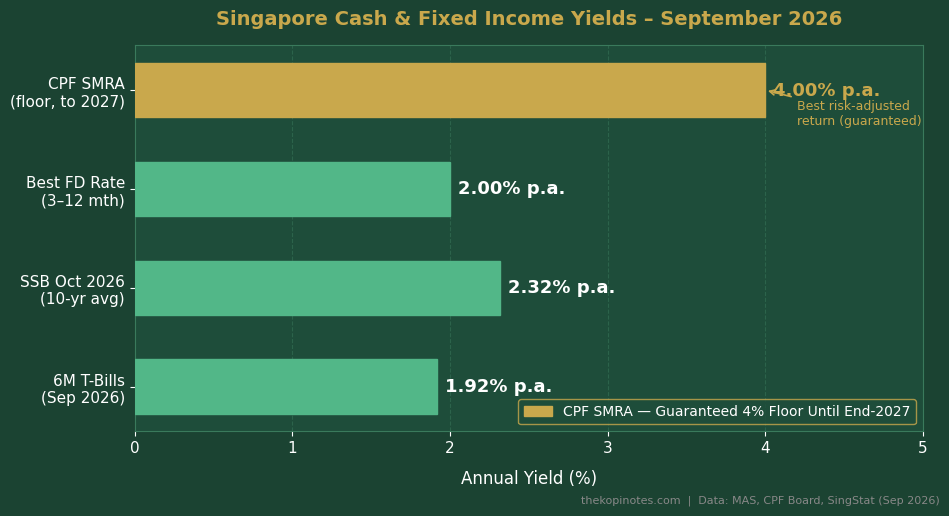
Current yields (as of late September 2026) are:
| Instrument | Current Yield | Lock-In Period | Key Consideration |
|---|---|---|---|
| Singapore T-Bills | 1.92% p.a. | 6 months | Yields may rise further in Q4 2026 |
| Singapore Savings Bonds (SSB Oct) | 2.32% p.a. (10-yr avg) | Up to 10 years | 14-month high; flexible redemption |
| Fixed Deposits (best rate) | 2.00% p.a. | 3–12 months | Multiple banks offering new promotions |
| CPF (SMRA) | 4.00% p.a. | Until end-2027 | Best risk-adjusted return; hard to beat |
If MAS tightens in October, we could see T-bill yields nudge higher toward 2.0%–2.2% in Q4 2026 auctions, as the rate environment adjusts. SSB rates may also shift upward for the November or December 2026 issuance.
Singapore Bank Stocks: Set to Benefit Further
As highlighted in our earlier analysis of DBS, OCBC, and UOB after the Fed rate hike, Singapore’s three local banks stand to benefit from a higher rate environment through wider net interest margins (NIM), stronger loan yields on new floating-rate loans, and potential uplift to wealth management income.
The banks have already outperformed the STI in 1H 2026. A third MAS tightening would extend this tailwind into Q4 2026.
Portfolio Positioning Checklist: Before the October 2026 MAS Decision
Here is a practical checklist for Singapore retail investors ahead of the MAS October 2026 meeting:
| Action | Rationale | Priority |
|---|---|---|
| Maximise CPF Ordinary Account top-up to Special/MediSave Accounts | 4% floor locked in until end-2027; unbeatable risk-adjusted yield | High |
| Consider SSB application (October 2026 at 2.32%) | 14-month high; flexible redemption if yields rise further | High |
| Hold off locking in long FDs (6–12 months) until after October decision | FD rates may rise if MAS tightens; wait for Q4 promotions | Medium |
| Review S-REIT exposure; avoid highly leveraged REITs | Another tightening = more short-term REIT pressure; focus on REITs with low gearing (<35%) and growing DPU | Medium |
| Keep DCA running on CSPX, VWRA, or IWDA | Long-term SGD appreciation benefits USD-priced ETF returns; don’t time the market | Low (maintain) |
| Monitor mortgage repricing dates | If on floating SORA rate, a tightening environment means higher monthly payments in Q4 2026 | High (if applicable) |
Bottom Line for SG Investors
The MAS October 2026 monetary policy meeting is shaping up to be one of the most significant in recent memory. The convergence of three consecutive tightening catalysts—rising core inflation (2.2% in August), a Fed rate hike (3.75%–4.00%), and strong Singapore GDP (5%)—has shifted market consensus toward another 25-basis-point tightening.
If CIMB’s forecast proves correct, expect the Singapore dollar to strengthen toward 1.26–1.27 versus the USD, T-bill and SSB yields to edge upward into Q4 2026, bank stocks to outperform, and S-REITs to face continued near-term headwinds (even as underlying DPU fundamentals remain healthy).
The silver lining? Singapore’s economy is in robust health. A tighter MAS policy to contain inflation is a sign of strength—not weakness. For long-term investors, this is a period to focus on cash management efficiency (CPF top-ups, SSBs, ladder T-bills) and high-quality S-REITs with growing distributions and manageable debt—not to panic-sell.
Watch for the MAS October 2026 Monetary Policy Statement, expected around late October 2026.
Frequently Asked Questions (FAQ)
When exactly is the MAS October 2026 Monetary Policy Statement?
The MAS typically releases its monetary policy statements four times per year: January, April, July, and October. Based on historical patterns (January 29, April 14, July 27), the October 2026 statement is expected in the last week of October 2026—likely around 26–30 October 2026. TKN will publish a full breakdown when the date is confirmed.
What exactly does MAS changing the S$NEER slope mean for ordinary Singaporeans?
When MAS steepens the S$NEER slope, it engineers a faster appreciation of the Singapore dollar. In practice, this means imported goods (food, electronics, oil) become relatively cheaper in SGD terms, helping to contain inflation. But it also means Singapore exporters earn less in SGD when converting overseas revenue. For the average Singaporean, the most direct effects are lower import inflation, modest upward pressure on mortgage rates (via SORA), and a stronger SGD for overseas spending.
How does MAS tightening affect S-REIT prices?
Higher interest rates increase the cost of debt for S-REITs (most of which borrow significantly to finance their property portfolios). This can compress distributions per unit (DPU) if interest costs rise faster than rental income. It also raises the “risk-free” rate—the yield investors can get from T-bills or bonds—making REIT yields relatively less attractive unless REIT prices fall (which they have in 2026). However, not all REITs are equally affected: those with fixed-rate debt and growing rental income (like CICT, which grew DPU 7.1% in 1H 2026) are more resilient.
Should I buy more S-REITs now before the MAS October meeting?
TKN does not provide financial advice, but here is the analytical framework: If MAS tightens in October, expect near-term S-REIT price pressure. However, if you are a long-term income investor and the REITs you are buying have (a) growing DPUs, (b) low gearing (<35%), and (c) long weighted average debt maturity (WADE), buying at depressed prices can increase your yield-on-cost. Dollar-cost averaging (DCA) across multiple months reduces timing risk.
Will CPF interest rates change if MAS tightens in October?
CPF interest rates are governed by a separate framework from MAS’s S$NEER policy. The CPF SMRA (Special, MediSave, and Retirement Account) 4% floor has been extended until end-2027, so it will not change due to MAS’s October decision. The CPF OA rate (currently 2.5%) is reviewed quarterly and is tied to major Singapore bank rates—it may see modest upward pressure if SORA rises. However, any change would be marginal compared to the SMRA floor’s guaranteed 4%.
How does a stronger SGD affect my CSPX, VWRA, or IWDA ETF investment?
CSPX (S&P 500 ETF), VWRA (global equity ETF), and IWDA (world ETF) are all priced in USD. When the Singapore dollar strengthens against the USD, your SGD returns from these ETFs are reduced even if the underlying assets rise in price. For example, if CSPX rises 5% in USD but the SGD strengthens 2% against the USD, your effective SGD return is only ~3%. This is known as currency drag. Over the long term, this effect tends to even out, and many Singapore investors intentionally hold SGD-denominated ETF equivalents or hedge through CPF/SRS to manage this.
What is the difference between MAS tightening and the US Fed raising rates?
The US Federal Reserve raises the federal funds rate (currently 3.75%–4.00%), which is an interest rate on overnight lending between US banks. Singapore’s MAS does not set a similar benchmark rate—instead, it manages the exchange rate. The key transmission mechanism is that higher US rates tend to strengthen the USD, putting pressure on currencies like SGD. MAS pre-emptively manages this by also adjusting its S$NEER policy, which is why the two central banks’ actions are closely watched together by Singapore investors.
This article was researched with the help of AI. While we strive to keep all information accurate and up to date, there may be errors. If you notice any discrepancies, please contact us.