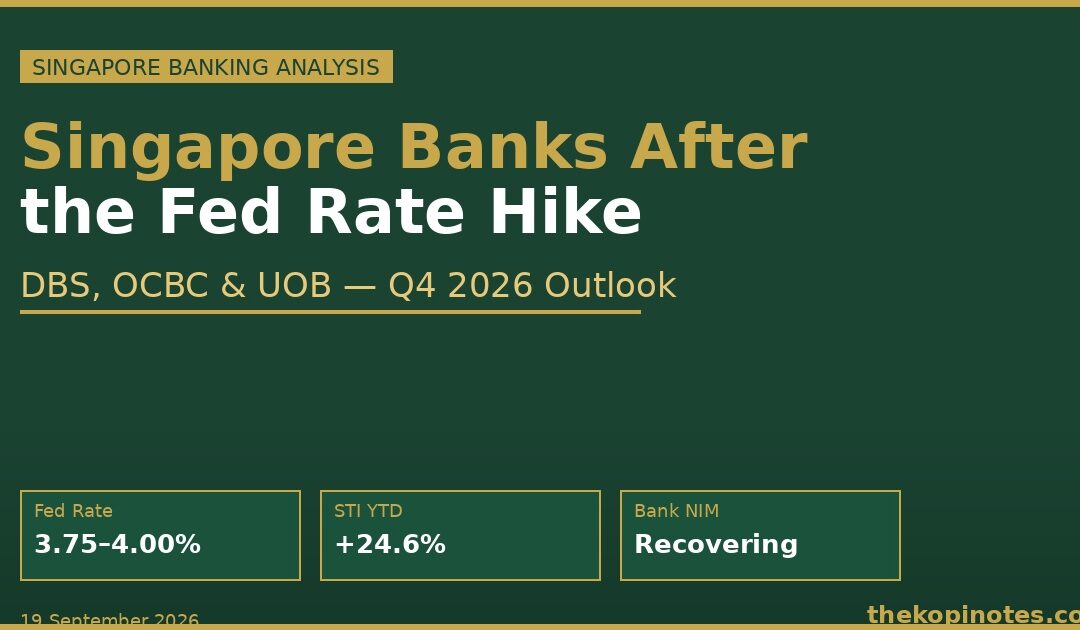
On 16 September 2026, the US Federal Reserve raised interest rates by 25 basis points to a 3.75%–4.00% target range — its first hike since 2023. While Wall Street retreated, Singapore’s Straits Times Index rose 0.5%. The reason: DBS, OCBC, and UOB — which together make up roughly 40–54% of the STI — are among the biggest beneficiaries of rising rates. Here is what retail investors need to know now.
This is an editorial analysis. Not financial advice. Data verified as at 19 September 2026.
Why This Rate Hike Is Different — And Why It Matters More Than You Think
For the past three years, Singapore investors navigated a rate-cutting environment. The Federal Reserve had been easing since 2023, and local banks saw their net interest margins (NIM) — the key profitability driver — steadily compress. DBS’s NIM fell from a peak above 2.2% in 2023 to 1.87% by 2Q2026. OCBC and UOB followed similar trajectories, with NIMs declining to approximately 1.70% and 1.74% respectively by 2Q2026.
Then came 16 September 2026. The Fed’s unanimous decision to raise rates to 3.75%–4.00% — citing elevated inflation and strong domestic demand — reversed the narrative. For Singapore’s banks, this is not just a macro headline. It is a direct tailwind to the single metric that most determines their earnings: net interest margin.
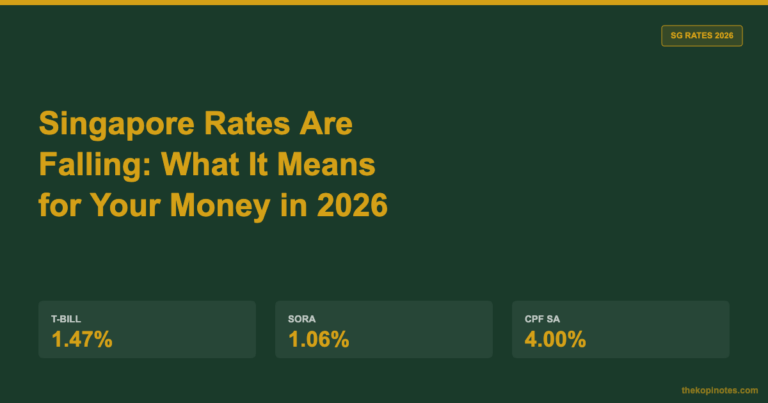
SORA (the Singapore Overnight Rate Average), the primary benchmark for Singapore dollar lending, was already trending higher in early September 2026, with the 3-month compounded SORA at approximately 1.20%–1.26%. With the Fed now back in hike mode and projecting at least one more increase before year-end, SORA has a clear upward path — and so do bank NIMs.
How Rate Hikes Benefit Singapore Banks — The NIM Mechanism
The mechanics are straightforward. When interest rates rise, banks charge more for loans (variable-rate mortgages, corporate credit, trade finance) while deposit rates adjust more slowly. This widens the spread — and NIM expands.
DBS has explicitly quantified its rate sensitivity at approximately S$11 million in net interest income per basis point of SGD rate movement. A 25 basis point hike translates to roughly S$275 million in additional net interest income annually for DBS alone — for a bank that earned S$3.08 billion in net profit in Q2 2026 (up 9% year-on-year), that is meaningful. UOB management had already flagged in mid-2026 that SORA appeared to be “bottoming out” and could trend higher in 2H2026 — that call has now been vindicated.
The Numbers: DBS, OCBC & UOB Post-Hike Snapshot
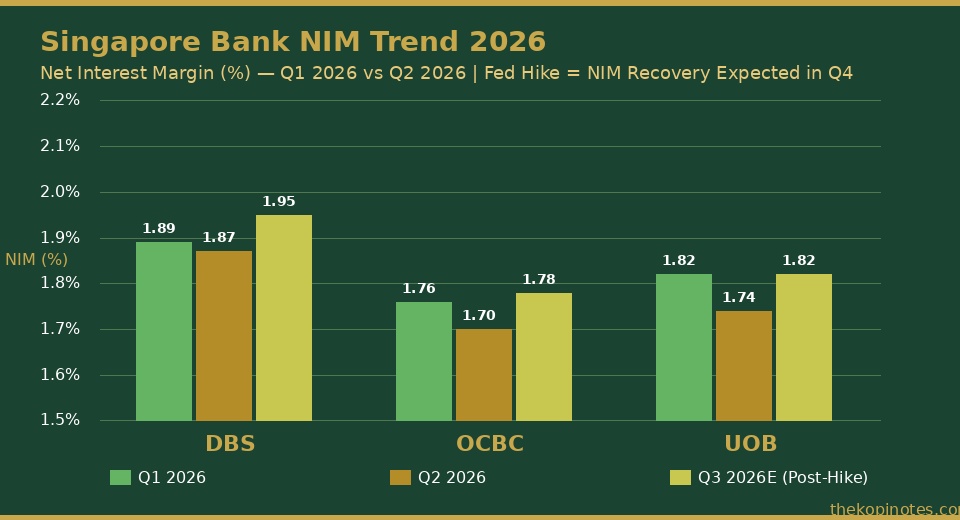
| Bank | SGX Code | Share Price (17 Sep 2026) | 2Q2026 NIM | QoQ NIM Change | Div Yield (FY26 Est.) |
|---|---|---|---|---|---|
| DBS Group | D05 | S$76.94 | 1.87% | -2 bps | ~4.1% trailing |
| OCBC Bank | O39 | ~S$19.90 | ~1.70% | -6 bps | ~5.4% (FY26F consensus) |
| UOB | U11 | ~S$37.00 | 1.74% | -8 bps | ~5.4% (FY26F consensus) |
Sources: Company Q2 2026 filings, Bloomberg, SGX. DBS dividend yield is trailing; OCBC/UOB are FY26F consensus estimates. Share prices as of 17 Sep 2026. Data verified 19 Sep 2026.
STI vs. S-REITs: The Great 2026 Divergence
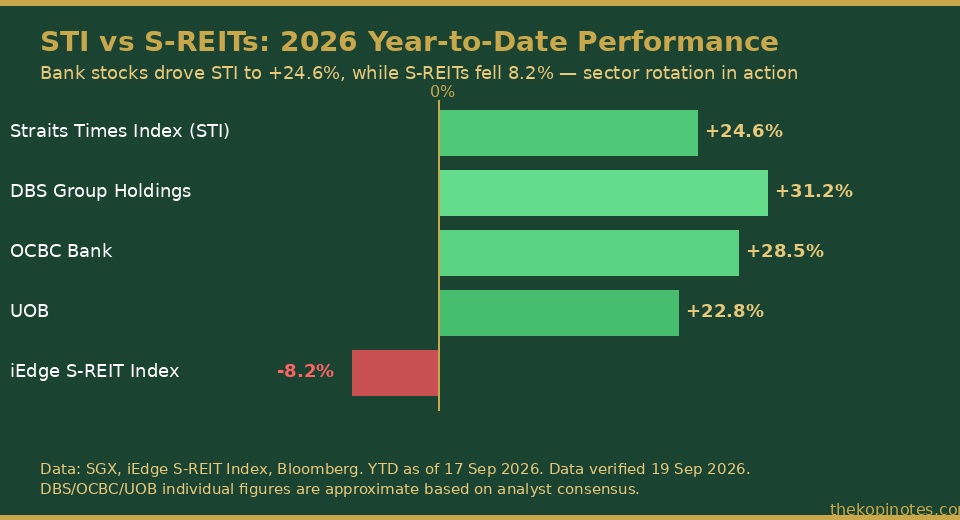
The 2026 performance gap between Singapore banks and S-REITs tells the rate story with stark clarity. While the iEdge S-REIT Index is down 8.2% year-to-date, the broader STI has surged 24.6% — driven overwhelmingly by DBS, OCBC, and UOB.
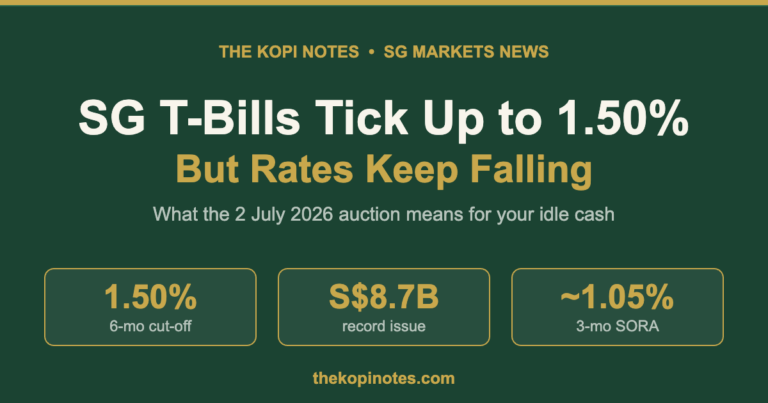
Rising rates compress REIT valuations because REITs carry significant debt (higher refinancing costs cut into distributions), REIT yields compete less favourably against rising risk-free rates, and asset values can decline as capitalisation rates rise. The September 2026 T-bill cut off at 1.70%, its highest of 2026. Banks experience the exact opposite dynamic — higher rates expand margins, support earnings, and make dividend yields more sustainable.
Are Singapore Bank Stocks a Buy Now?
The fundamental case is improving, but all three banks have already rallied significantly in 2026. The STI hit a record 5,801.96 in early September, with DBS, OCBC, and UOB posting weekly gains of 3–4% as markets priced in the hike. DBS at S$76.94 is near all-time highs — the easy money has likely already been made.
Key risks to monitor: loan growth may slow as rates rise; refinancing risk could surface asset quality issues; deposit competition will partially offset NIM gains; and the timing and magnitude of any second 2026 hike matters. That said, at dividend yields of 4–5.4% with strong balance sheets and record profits, Singapore’s big three banks remain among the most attractive income stocks in the region. For long-term investors, watch for pullbacks of 5–8% from all-time highs as better entry points.
What This Means for CPF, Fixed Deposits, and Home Loans
- CPF rates: The OA remains at the 2.5% floor and SMRA at the 4% floor through 31 December 2026. As 10-year SGS yields rise (they stood at 2.43% in early September 2026), the formula-derived SMRA rate may approach 4% before the floor expires — increasing the probability of a higher effective CPF rate in 2027.
- Fixed deposits: The best 12-month FD rate is currently around 1.70% p.a. Expect incremental increases over the next 4–8 weeks post-hike.
- HDB home loans: HDB concessionary loan rates remain at 2.6% p.a. through Q3 2026 and are unchanged. Private SORA-linked mortgages will increase gradually with a 1–3 month lag.
- ETFs: For VWRA, CSPX, and STI ETF investors, see our dedicated ETF post-hike analysis.
Bottom Line for SG Investors
The September 2026 Fed rate hike is a structural positive for DBS, OCBC, and UOB. After years of NIM compression, Singapore’s banks are positioned to recover margins as SORA trends higher. Their combination of record profits, strong capital positions, and 4–5.4% dividend yields makes them among the most resilient income plays in the STI.
The STI’s 24.6% YTD gain — driven heavily by banks — contrasts sharply with the 8.2% fall in S-REITs. This rotation reflects a fundamental shift in the rate environment. Investors who missed the 2026 bank rally should watch for pullbacks as entry points rather than chasing all-time highs. And don’t panic-sell your REITs: the S-REIT yield spread has widened to historically attractive levels, and quality REITs with strong sponsors will weather the rate cycle.
Monitor the next FOMC meeting in November 2026, and watch the MAS October 2026 monetary policy statement for any SGD NEER signal that would further influence Singapore’s rate environment.
Why did Singapore's STI rise when Wall Street fell after the Fed rate hike?
How much will DBS, OCBC, and UOB NIM improve after the September 2026 rate hike?
Are Singapore bank stocks still a buy at current prices after the 2026 rally?
What happens to S-REITs if Singapore rates keep rising?
Will HDB home loan rates increase after the Fed rate hike?
Will CPF interest rates rise in 2027 following the Fed rate hike?
Which Singapore bank stock is best to buy now — DBS, OCBC, or UOB?
This article was researched with the help of AI. While we strive to keep all information accurate and up to date, there may be errors. If you notice any discrepancies, please contact us.