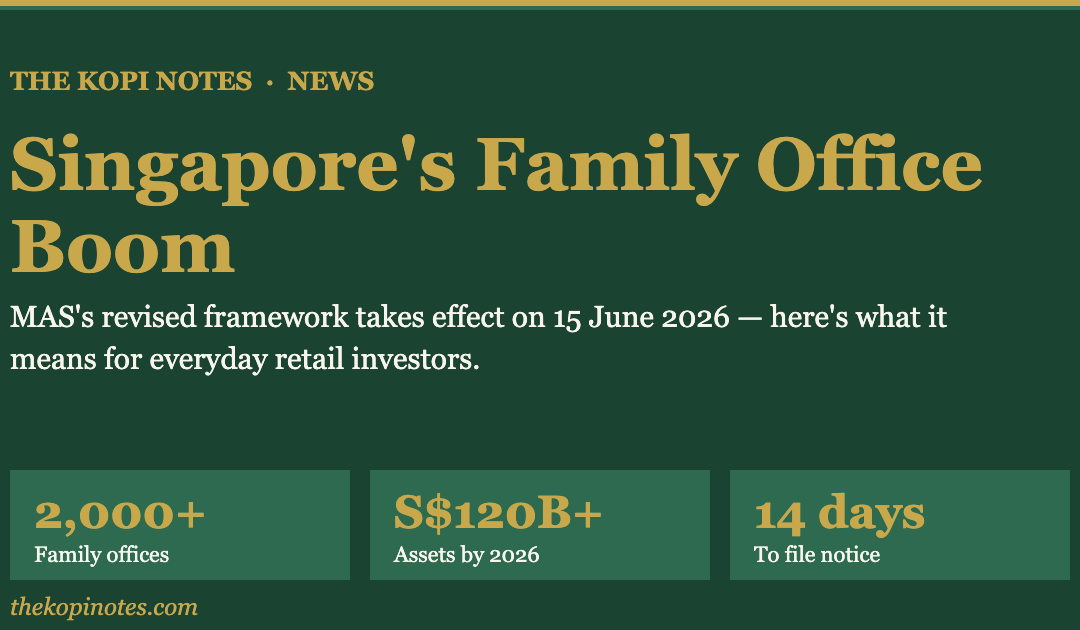
Singapore’s revised Single Family Office (SFO) framework took effect on 15 June 2026, replacing case-by-case approvals with a streamlined, notification-based class exemption. The change cements Singapore’s status as Asia’s wealth hub — home to more than 2,000 family offices — even as it tightens anti-money-laundering oversight. Here is what the shift means for ordinary retail investors, not just the ultra-rich.
This is an editorial analysis. Not financial advice.
- MAS’s new framework gives qualifying SFOs a class exemption from licensing — they now notify MAS rather than seek bespoke approval.
- Singapore hosts 2,000+ single family offices, up roughly five-fold from about 400 in 2020, with assets projected to breach S$120 billion in 2026.
- New SFOs must file a Notice of Commencement within 14 days, bank with a MAS-licensed bank, and submit an annual return; existing SFOs have until 15 June 2027 to comply.
- The reforms follow the 2023 S$3 billion money-laundering scandal, pairing easier setup with tougher source-of-wealth checks.
- Retail investors can ride the same structural themes — private credit, real estate, and dividends — through accessible, low-cost instruments.
What Changed: MAS’s New Class Exemption
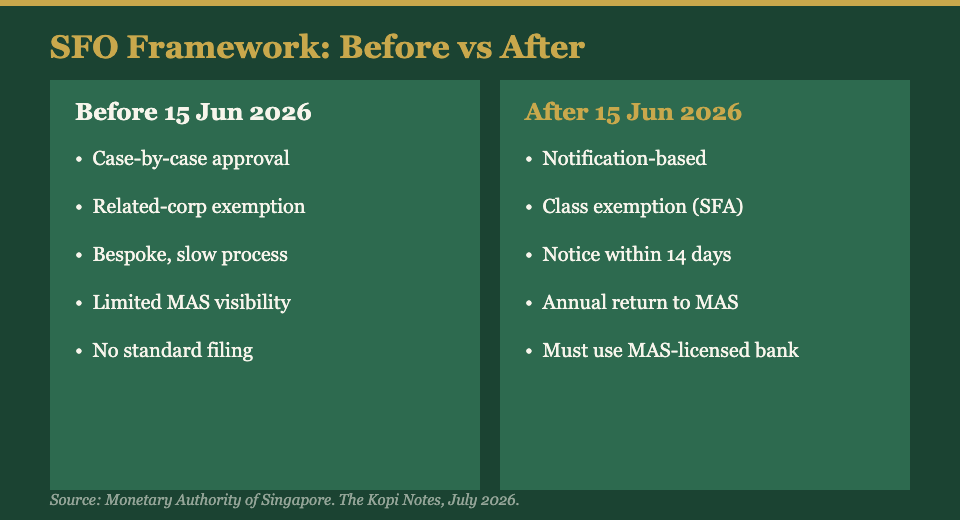
For years, setting up a single family office in Singapore meant navigating a patchwork of exemptions. Most SFOs relied on the related-corporation exemption under the Securities and Futures Act, or negotiated a bespoke, case-by-case exemption with the Monetary Authority of Singapore. It worked, but it was slow, inconsistent, and hard for MAS to monitor at scale.
From 15 June 2026, that changes. The revised framework introduces a single, structure-agnostic class exemption from licensing for all qualifying SFOs. In plain terms: if a family office meets the criteria, it no longer needs to apply and wait for approval. It simply notifies MAS that it has begun operating. A new SFO has 14 days from the start of business to file a Notice of Commencement, must maintain an account with a MAS-licensed bank, and files a straightforward annual return — reporting total assets under management, its bank, and basic operating details — within four months of its financial year-end.
Existing family offices are not left scrambling. They have a one-year transition period, to 15 June 2027, to meet the new conditions. The design goal is deliberate: make it easier to set up shop, while giving the regulator a clearer, standardised line of sight into who is managing what.
Why Singapore Became a Family Office Magnet
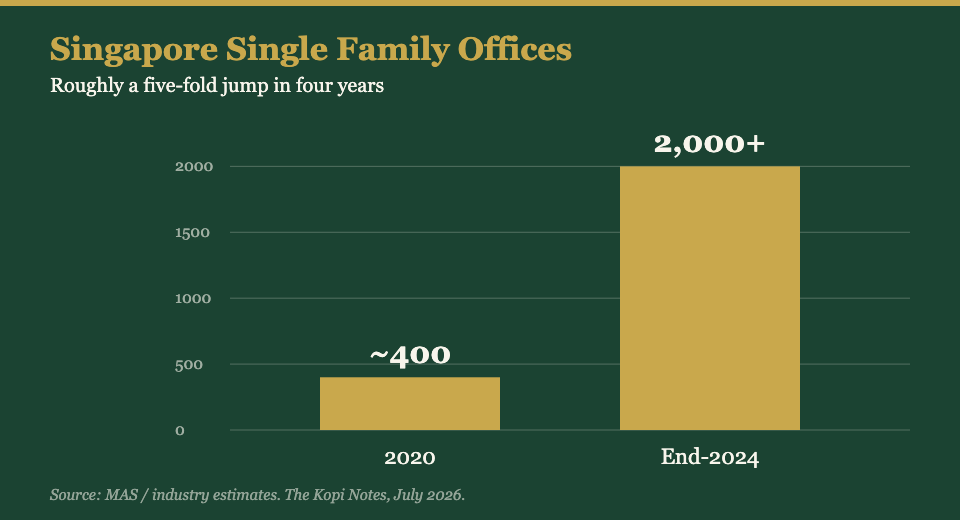
The numbers explain the urgency. Singapore’s single family office count exploded from roughly 400 in 2020 to more than 2,000 by the end of 2024 — a five-fold jump in four years. Collectively, these vehicles managed around S$90 billion at end-2022, and industry projections suggest total assets will breach S$120 billion in 2026, powered by inbound capital from China, India, and Indonesia.
| Milestone | Figure | What it signals |
|---|---|---|
| Single family offices (2020) | ~400 | Pre-boom baseline |
| Single family offices (end-2024) | 2,000+ | ~5x growth in four years |
| Assets under management (2022) | ~S$90 billion | Deep, sticky capital pools |
| Assets under management (2026, projected) | S$120 billion+ | Continued regional inflows |
| Average AUM per SFO | Close to S$900 million | Institutional-scale players |
The AML Backstory: Tightening After the S$3 Billion Scandal
The easier setup comes with a catch, and it is intentional. In 2023, Singapore was rocked by its largest-ever money-laundering case — more than S$3 billion in seized and frozen assets — which exposed gaps in how wealth flows were policed. The episode was a reputational jolt for a jurisdiction that sells itself on trust.
The revised framework is the flip side of that lesson. Qualifying SFOs must bank with MAS-licensed institutions, which brings robust know-your-customer and know-your-source-of-wealth checks into the fund flow. Annual returns give MAS ongoing visibility, and tax-incentivised offices must declare AUM, local spending, and investment-professional headcount to MAS and IRAS. The message to the world’s wealthy is clear: Singapore is open for business, but the screening is real.
What This Means for Singapore Retail Investors
You cannot set up a single family office with a CPF balance and a brokerage account — the entry point runs into the tens of millions. So why should an everyday investor care? Because the capital these offices deploy shapes the markets you already invest in, and the themes they chase are increasingly accessible to you.
| Family office trend | Retail read-across |
|---|---|
| Heavy allocation to private credit and private equity | Rising retail access via listed alternatives, business development vehicles, and diversified funds |
| Real estate and infrastructure focus | The same income logic sits behind S-REITs and infrastructure trusts on the SGX |
| Co-investing to bypass fund fees | A reminder to mind your own costs — low-fee ETFs and platforms compound in your favour |
| Long horizons, income compounding | Validates a patient, dividend-reinvestment approach for ordinary portfolios |
| Deeper Singapore capital markets | More liquidity and listings can benefit local index and dividend investors over time |
The family office wave is, at heart, a bet on Singapore as a durable place to grow and protect wealth. That is the same bet a retail investor makes when they build a long-term portfolio here — just at a different scale.
How Everyday Investors Can Ride the Same Themes
You do not need a family office to invest like one; you need discipline and low costs. The private-markets allocations that dominate SFO portfolios have income and real-asset cousins that are fully accessible on the SGX and through local platforms. If you want durable payouts, our guide to dividend investing in Singapore lays out the fundamentals, while income hunters can compare high-yield REITs and screen for the best S-REITs for 2026.
Real estate exposure — a family office staple — is available to anyone through blue-chip landlords such as CapitaLand Ascendas REIT, whose distributions are directly affected by Singapore’s falling interest rates. And for a broader income base, our roundup of high-dividend Singapore stocks shows how to spread risk across sectors. The lesson from the family office playbook is simple: think in decades, keep fees low, and let compounding do the heavy lifting.
| If you are… | Consider | Why |
|---|---|---|
| A first-time income investor | A diversified S-REIT or dividend ETF | Real-asset income without single-stock risk |
| Cost-conscious | Low-fee platforms and index funds | Mirrors how SFOs co-invest to avoid fees |
| Building for retirement | Reinvested dividends plus CPF/SRS top-ups | Long-horizon compounding, tax-efficient |
| Watching interest rates | REITs and rate-sensitive income plays | Falling SORA supports distributions |
Bottom Line for SG Investors
MAS’s revised family office framework is a confident move: it lowers the friction of setting up while raising the bar on transparency. For Singapore, it reinforces a wealth-hub status that took decades to build. For the ultra-rich, it is a faster on-ramp. For everyone else, it is a signal — global capital continues to vote for Singapore as a place to compound wealth over the long run.
Retail investors should not read this as a call to chase exotic private deals. Read it instead as validation of the boring, durable strategy that works at any scale: own quality income assets, keep costs low, stay diversified, and think in decades. The family offices moving here are doing exactly that. You can too, one CPF top-up and dividend reinvestment at a time.
Frequently Asked Questions
What is a single family office in Singapore? A single family office (SFO) is a private entity that manages the investments and wealth of one family. In Singapore, SFOs typically manage assets on behalf of a single family and, under the revised framework, operate via a class exemption from fund-management licensing rather than a bespoke approval.
When did the new MAS family office framework take effect? The revised framework took effect on 15 June 2026. New SFOs must file a Notice of Commencement within 14 days of starting operations, while existing SFOs have a transition period until 15 June 2027 to comply.
How many family offices are there in Singapore? Singapore is home to more than 2,000 single family offices as of end-2024, up from around 400 in 2020. Combined assets under management are projected to exceed S$120 billion in 2026.
Why did MAS change the family office rules? To streamline setup with a standardised class exemption while improving oversight. The reforms also strengthen anti-money-laundering controls following Singapore’s S$3 billion money-laundering case in 2023.
Does the family office boom affect ordinary retail investors? Indirectly, yes. Family office capital deepens Singapore’s markets and chases themes — private credit, real estate, and dividends — that retail investors can access through S-REITs, dividend stocks, and low-cost ETFs.
Do I need millions to benefit from these trends? No. While setting up an SFO requires substantial wealth, the underlying income and real-asset strategies are available to any investor through diversified, low-fee instruments and a long-term, cost-aware approach.
This article was researched with the help of AI. While we strive to keep all information accurate and up to date, there may be errors. If you notice any discrepancies, please contact us.