Group Term Life Insurance Singapore: Complete 2026 Guide
Group term life insurance is an employer-provided policy that covers all eligible employees under a single master plan. In Singapore, it typically pays 12 to 36 months of your annual salary if you die or become totally and permanently disabled while employed. It requires no medical examination for basic coverage and is usually fully employer-paid — but it ends permanently the moment you leave the company.
Not financial advice. All figures are for educational reference only. Data as at July 2026 unless noted.
- Group term life covers death and Total Permanent Disability (TPD) — with no medical exam for basic sums insured.
- Coverage usually caps at 1–5× your annual salary, which may not be enough for your family’s long-term needs.
- Coverage is tied to your job: resign, get retrenched, or retire and the cover disappears — often with no grace period.
What Is Group Term Life Insurance?
Group term life insurance (commonly called GTL or group life) is a life insurance policy that covers multiple people — usually all eligible employees of the same organisation — under one master contract. Your employer is the policyholder. You are the insured member. You do not need to apply, fill out forms, or choose coverage amounts. You are simply enrolled automatically when you join.
The insurer prices the plan based on the collective risk profile of the entire workforce, not any individual’s health history. Because risk is pooled across dozens or hundreds of employees, group premiums are significantly cheaper per person than an equivalent individual policy. For most employees, this means completely free life protection just for being employed.
Most Singapore group term life plans cover two core events:
- Death benefit: A lump-sum payment (called the Sum Assured) paid to your nominated beneficiary if you die while employed at the company.
- Total and Permanent Disability (TPD): A lump-sum benefit paid to you if you are permanently unable to work due to illness or injury.
Some plans add an Accidental Death Benefit (ADB) rider that doubles the payout if death results from an accident. Others include a Critical Illness (CI) rider — though this is far less common in group plans than in individual policies.
How Does Group Term Life Work in Singapore?
In Singapore, group term life is voluntary for employers to offer for local employees. It is not legally mandated the way Work Injury Compensation (WICA) is for certain foreign worker categories. However, most mid-size and large employers provide it as part of their employee benefits package.
Here is how the process typically works:
- Your employer selects a group plan from an insurer — AIA, Prudential (PRUworks), NTUC Income, Great Eastern, Singlife, or Tokio Marine are the common providers in Singapore.
- You are automatically enrolled when you join. In most cases, no forms, no health declarations, and no waiting period for basic coverage.
- A Free Cover Limit (FCL) applies — typically SGD 200,000 to SGD 500,000. Below the FCL, no medical underwriting is needed. Above it, the insurer may require a health declaration or medical evidence.
- Your employer pays the premiums. You may contribute only if you opt into higher coverage tiers or rider add-ons.
- If you need to claim, you notify your HR department, who coordinates the claim paperwork with the insurer’s group claims team.
One important note: group term life is a pure protection product. There is no savings component, no cash value, and no surrender value. When coverage ends, you walk away with nothing — unlike a whole life or endowment plan.
How Much Group Term Life Coverage Do You Get?
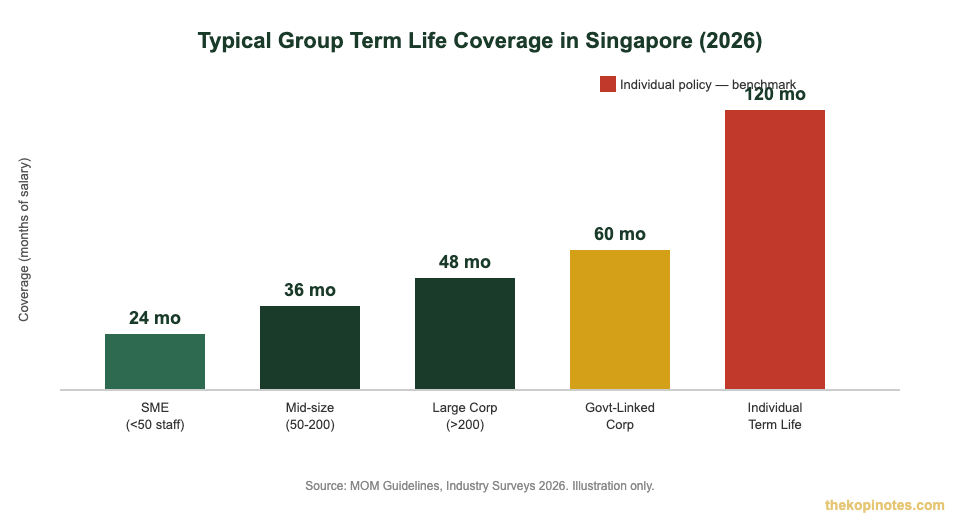
Coverage amounts vary significantly by employer. Most Singapore group plans express the Sum Assured as a multiple of your annual salary. Here are typical benchmarks based on industry data:
| Employer Type | Typical Coverage Multiple | Example (SGD 60k salary) |
|---|---|---|
| SME (<50 employees) | 12–24 months salary | SGD 60k–120k |
| Mid-size (50–200 staff) | 24–36 months salary | SGD 120k–180k |
| Large corporation (>200) | 36–48 months salary | SGD 180k–240k |
| Government-Linked Company | 48–60 months salary | SGD 240k–300k |
Source: MOM Guidelines, Industry Surveys (2026). Figures are illustrative — actual coverage varies by plan and insurer.
Now consider what SGD 120,000–180,000 actually covers for a typical Singapore household:
- Outstanding HDB mortgage: SGD 200,000–400,000 (for a flat bought in the last 10 years)
- 5 years of family living expenses: SGD 150,000–250,000
- Children’s university education: SGD 80,000–250,000 per child
For most Singapore families with a mortgage and children, group term life alone falls well short. This is why financial planners recommend treating group cover as a supplement, not a complete solution. Use the Singapore retirement calculator to estimate how much your family actually needs.
Group Term Life vs Individual Term Life Insurance
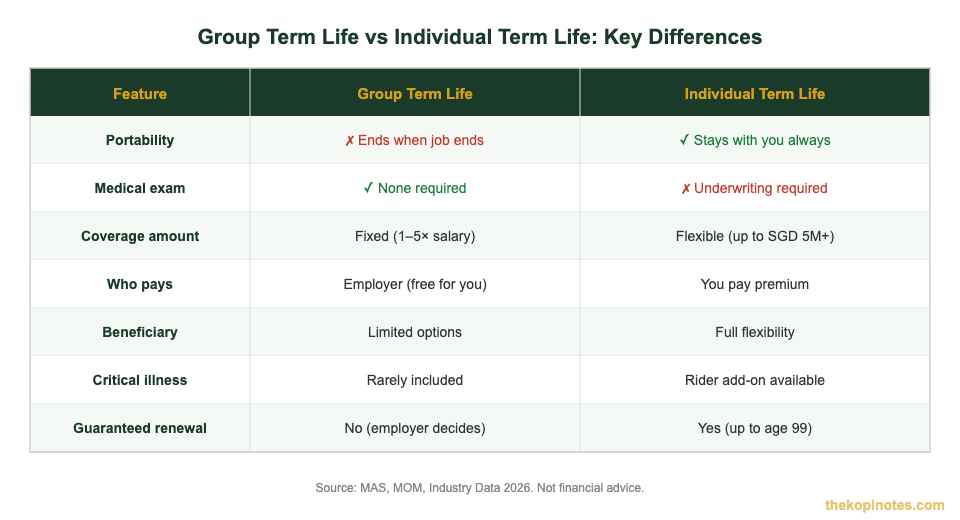
The single most important difference between group and individual term life is portability. Your group cover exists only while you are employed at that specific company. Your individual policy stays with you for life — regardless of where you work, whether you take a career break, or whether you go freelance.
Here is how the two compare across the dimensions that matter most to Singapore employees:
| Feature | Group Term Life | Individual Term Life |
|---|---|---|
| Portability | Ends when job ends | Stays with you always |
| Medical underwriting | None (for basic sum) | Health declaration required |
| Coverage amount | Fixed (1–5× salary) | Flexible (up to SGD 5M+) |
| Who pays | Employer (free for you) | You pay premium |
| Beneficiary choice | Limited options | Full flexibility |
| Critical illness rider | Rarely included | Add-on available |
| Guaranteed renewal | No (employer decides) | Yes (up to age 99) |
Source: MAS, MOM, Industry Data 2026. Not financial advice.
The table above makes clear why Singapore financial advisers consistently say: treat your group cover as a bonus, not a safety net. For a detailed comparison of specific individual plans, see TKN’s guide on life insurance comparison in Singapore.
Pros and Cons of Group Term Life Insurance
Group term life is a genuinely useful benefit — but it is important to understand exactly what it does and does not do before relying on it as your primary life protection.
Advantages of group term life:
- No cost to you. Your employer absorbs the premium. Every dollar of coverage is genuinely free.
- No medical exam for basic sums. If you have a pre-existing condition, group coverage may give you protection that would otherwise be declined or loaded with exclusions on an individual policy.
- Automatic enrollment. No paperwork, no decisions. You are protected from day one of employment.
- Simple claims process. HR handles the initial coordination with the insurer, reducing the administrative burden on your family at a difficult time.
Disadvantages of group term life:
- Not portable. The single biggest limitation. Leave your job for any reason and you leave your cover behind.
- Coverage often insufficient. Two years of salary rarely covers a Singapore family’s full financial exposure, especially with a mortgage.
- No control over the plan. Your employer can change insurers, reduce coverage, or eliminate the benefit entirely — and you have no say.
- No cash value. Pure term protection. Nothing accumulates and nothing is returned at the end.
- Underwriting risk on exit. If you develop a health condition while employed, you may face exclusions or higher premiums when buying individual coverage later.
What Happens to Your Group Term Life When You Leave Your Job?
Your group term life coverage terminates when your employment ends — in most cases, your last working day or the last day of your notice period. There is no grace period, no option to extend, and no COBRA-style continuation right in Singapore.
This creates three distinct risks that many employees overlook:
- Coverage gap. If your new employer’s group plan has a waiting period, or if you take time between jobs, you may have zero life coverage for weeks or months. During this window, your family is financially exposed.
- Health change risk. If you develop a condition — diabetes, heart disease, a cancer diagnosis — while employed, your group cover protects you. But when you leave, that condition becomes a pre-existing condition on any individual application. The insurer may exclude it, load a higher premium, or decline your application.
- Self-employment risk. If you leave to start a business or go freelance, you have no group cover at all. Many entrepreneurs discover this gap only when it is too late to act on it affordably.
The practical lesson: do not wait until your last day of employment to think about individual life coverage. Apply while you are still healthy and still employed — before any of these scenarios arise.
Should You Get Your Own Individual Life Insurance Policy?
In almost every case, yes — especially if you have dependents, a mortgage, or plans to ever change jobs, take a career break, or go self-employed. The question is not whether to get individual coverage, but when and how much.
Here is a simple rule of thumb used by Singapore financial planners:
Then subtract your existing group cover to find the gap your individual policy needs to fill.
For a Singapore employee earning SGD 72,000 per year with a SGD 350,000 mortgage and one child:
- Target: 10 × SGD 72,000 + SGD 350,000 + SGD 100,000 (education) = SGD 1.17 million
- Less group cover: SGD 144,000 (24 months salary)
- Individual policy needed: at least SGD 1 million
A SGD 1 million, 30-year term policy for a healthy 30-year-old non-smoker in Singapore costs approximately SGD 40–65 per month. That is less than most gym memberships — and the consequences of not having it are irreversible.
For a structured comparison of individual plans, TKN’s guide on life insurance comparison in Singapore walks through how to evaluate term vs whole life, and what to look for when comparing quotes. You can also check the Life Insurance Association of Singapore (LIA) for consumer resources and licensed adviser directories.
When shopping for individual term life, consider these tips:
- Buy early: premiums increase with age. A policy bought at 28 costs roughly half what it costs at 38.
- Avoid bundling unnecessary riders unless they solve a specific need (critical illness coverage is worth considering — see TKN’s guide on Life Insurance Association Singapore for context).
- Check the insurer’s claims payout ratio — a financially strong insurer with a high payout ratio matters when it counts most.
- Consider Direct Purchase Insurance (DPI) products from MAS-approved insurers — these are commission-free and straightforward for standard coverage needs.
Make Your Savings Work While You Sort Out Coverage
While you review your life insurance needs, keep your emergency fund and short-term savings in MAS-regulated platforms earning competitive rates:
Frequently Asked Questions: Group Term Life Insurance Singapore
Is group term life insurance compulsory for Singapore employers?
Does group term life insurance cover pre-existing conditions?
Can I continue my group term life insurance after I resign?
How much group term life insurance is enough?
Is group term life insurance taxable in Singapore?
What happens to my group term life if my employer changes insurers?
Who should I name as beneficiary for my group term life?
What is the difference between group term life and group personal accident insurance?
Can freelancers or self-employed Singaporeans get group term life?
Does group term life cover death by suicide?
Get Free Insurance Advice
Speak with a licensed insurance advisor. No obligation, no cost.
By submitting this form, you agree to our Privacy Policy.
This article was researched with the help of AI. While we strive to keep all information accurate and up to date, there may be errors. If you notice any discrepancies, please contact us.