How to Withdraw Money From Your CPF Ordinary Account (2026 Guide)
Housing, CPFIS-OA investing, and education — what you can actually access before age 55, and what it costs you.
Your CPF Ordinary Account isn’t locked away until age 55. You can withdraw or use OA savings now for three approved purposes: buying a home, investing under CPFIS-OA, or paying for approved education. Each has its own limit and rules. This guide breaks down exactly how much you can access, what it costs you in lost interest, and how to apply.
Not financial advice. All figures are for educational reference only. Data as at August 2026 unless noted.
- Your OA isn’t frozen till 55 — you can use it now for housing, CPFIS-OA investing, or approved education, each with its own cap.
- Every dollar you pull out stops earning the 2.5% p.a. OA floor interest, so “free” money isn’t really free.
- None of these pay cash straight to your bank account — funds go to HDB, your agent bank, or the school, not to you.
Free download: The Singapore Money Playbook — 7 money mindset shifts written for Singapore, with the CPF-adjusted retirement number most guides get wrong (PDF + Notion).
What Your CPF Ordinary Account Can Actually Be Used For
Your CPF Ordinary Account (OA) — the account your monthly CPF contributions flow into by default — earns a floor interest rate of 2.5% per annum. That’s guaranteed by the government, not market-linked.
Before you turn 55, the law restricts what you can do with it. You can’t just empty your OA into your bank account. Instead, CPF only lets you use OA savings for three approved purposes: buying a home, investing through the CPF Investment Scheme (CPFIS-OA), or paying for approved education. Each use case has its own limit, and each one is applied for differently — there’s no single “withdraw my CPF OA” button.
| Use Case | What It Covers | Key Limit | Where You Apply |
|---|---|---|---|
| Housing | Downpayment and monthly mortgage instalments for HDB flats and private property | Capped at your property’s CPF Withdrawal Limit, tied to its valuation | HDB (for an HDB loan) or your bank (for a private loan) |
| CPFIS-OA investing | Unit trusts, ILPs, endowment policies, SGS bonds, T-bills, fixed deposits, shares, gold | First $20,000 of OA must stay put; stocks/property funds/corporate bonds capped at 35%, gold at 10% of investible savings | Your CPFIS agent bank (DBS, OCBC or UOB) |
| Education (CPF Education Loan Scheme) | Your own or your child’s approved local diploma or degree course fees | Up to 40% of accumulated OA savings, or your remaining OA balance, whichever is lower | CPF Board’s Education Loan Scheme, usually via your institution’s financial aid office |
Source: CPF Board, cpf.gov.sg (accessed August 2026)
Using Your OA for Housing
Housing is where most people’s OA money actually goes. You can use it for the downpayment and monthly instalments on an HDB flat or private property, whether you’re taking an HDB loan or a bank loan.
However, you can’t use unlimited OA on one property. Each property has a CPF Withdrawal Limit tied to its valuation. Once your total OA withdrawals for that property hit the limit, you’ll need to pay the rest in cash. You can check your exact limit through the my cpf digital services portal before you commit to a purchase.
Here’s the part many buyers forget: you don’t repay the OA money you use for housing while you live there. But CPF charges accrued interest — the 2.5% per annum you would have earned had the money stayed in your OA. When you eventually sell the property, this accrued interest gets deducted from your sale proceeds and returned to your CPF account. It’s not a penalty, but it does reduce your net cash proceeds, so it’s worth factoring into your numbers before you decide how much OA to use versus cash.
For the full picture on your CPF’s role in home financing, CPF Board’s housing page has the official worked examples and current Withdrawal Limit calculations.
Investing Your OA Through CPFIS-OA
The CPF Investment Scheme – Ordinary Account (CPFIS-OA) lets you invest part of your OA savings instead of leaving everything at the 2.5% floor rate. But there are guardrails.
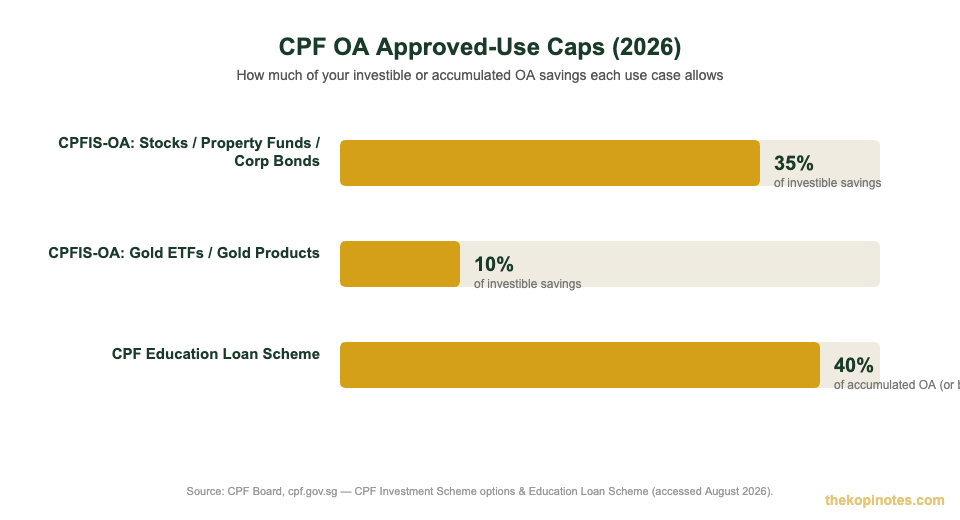
First, CPF Board requires you to keep $20,000 in your OA at all times before you can invest any of the remainder. Second, even after that, you’re capped: up to 35% of your “investible savings” can go into shares, property funds, or corporate bonds, and up to 10% into gold ETFs or other gold products. Investible savings means your OA balance plus whatever you’ve already withdrawn for investment and education — not just your current balance.
Eligible products under CPFIS-OA include unit trusts, investment-linked insurance products, annuities, endowment policies, Singapore Government Bonds, Treasury Bills, selected ETFs, fixed deposits, shares, property funds, corporate bonds, and gold. You can check exactly how much of your OA is available to invest by logging into my cpf digital services or the CPF Mobile app under “My Investment.”
One thing worth being honest about: CPFIS-OA is not a free lunch. Investing always carries risk, and CPF Board itself has repeatedly flagged that a meaningful share of CPFIS-OA investors end up with returns below the 2.5% OA rate once fees are accounted for. If you’re not confident about picking or managing investments, leaving the money in your OA to earn the guaranteed floor rate is a completely reasonable choice.
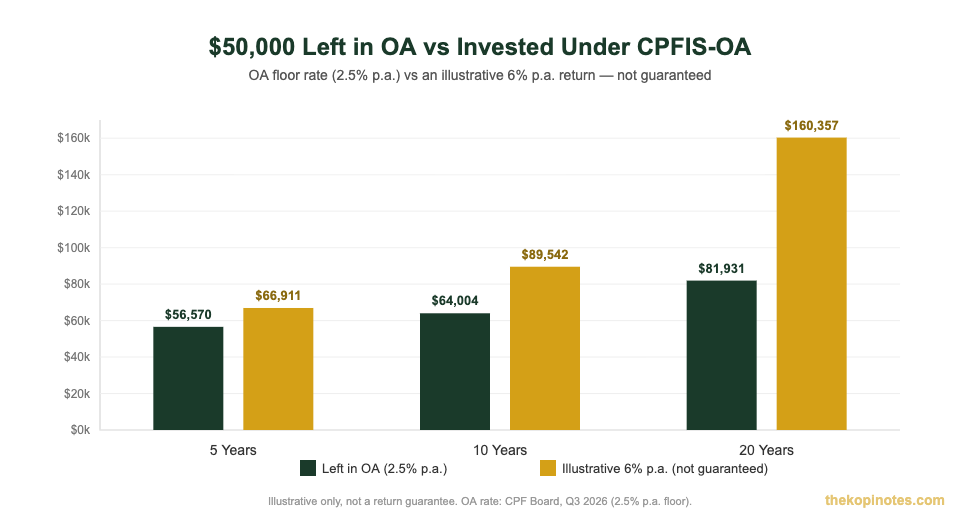
To put the trade-off in numbers: $50,000 left untouched in your OA grows to about $64,000 in 10 years and roughly $82,000 in 20 years at the 2.5% floor rate — guaranteed, no effort required. The same $50,000 growing at an illustrative (not guaranteed) 6% per annum would reach around $89,500 in 10 years and $160,000 in 20 years. That gap is the real cost of leaving money idle — but it only shows up if your investments actually deliver 6%, which is never certain. If you’d rather explore CPFIS-OA investing through a managed platform, Endowus lets you invest your CPF and SRS savings alongside cash, with a single dashboard tracking all three.
Once you’ve invested through CPFIS-OA, you may also want to check which ETFs are actually eligible — see our CPFIS-approved ETF guide for the current list.
Using Your OA for Education
The CPF Education Loan Scheme lets you use OA savings to pay for your own, or your child’s, approved full-time diploma or degree course at an Approved Educational Institution in Singapore. You can withdraw up to 40% of your accumulated OA savings, or your remaining OA balance — whichever is lower.
This isn’t free money. Interest starts accruing from the day you withdraw, at the same rate your OA would otherwise earn — currently 2.5% per annum. You’re effectively borrowing from your own future retirement savings, and you’ll need to repay it (with interest) once you or your child starts working.
If you’re using the scheme to help a spouse, child, or other relative rather than yourself, note that CPF only lets you cover 50% of their tuition fee through this scheme — the remaining half has to come from another source, such as savings, a bursary, or a bank study loan.
What Happens to Your OA When You Turn 55
At 55, your OA and Special Account savings combine into a new Retirement Account (RA), up to your chosen retirement sum (Basic, Full, or Enhanced Retirement Sum). Anything above that amount — including any remaining OA balance — is released to you, and can be withdrawn as a lump sum if you wish.
This age-55 process is a completely different mechanism from everything covered above, with its own rules on how much you can take out immediately versus what stays for your CPF LIFE payouts. We’ve covered it in full in our CPF withdrawal at age 55 guide.
Step-by-Step: How to Actually Use Your OA Funds
The process differs by use case, but the pattern is the same: your OA money never lands in your personal bank account. It goes directly to the seller, agent bank, or institution.
For housing
- Check your property’s CPF Withdrawal Limit via my cpf digital services or the CPF Mobile app.
- Submit your application through HDB (for an HDB loan or flat purchase) or authorise the withdrawal through your bank (for a private property loan).
- CPF Board disburses funds directly to HDB, your bank, or the seller’s solicitor — not to you.
For CPFIS-OA investing
- Check your available investible OA savings via my cpf digital services or the CPF Mobile app.
- Open a CPFIS Investment Account with one of the three agent banks — DBS, OCBC, or UOB.
- Place your trades or investments through the agent bank, or a linked platform such as Endowus.
- Funds move directly from your OA into the investment product, not into your bank account.
For education
- Apply for the CPF Education Loan, usually processed through your (or your child’s) institution’s financial aid office.
- CPF Board disburses the approved amount directly to the institution.
- Interest starts accruing from disbursement; repayment typically begins once studies are completed or employment starts.
Common Mistakes to Avoid
A few mistakes come up again and again when people try to access their CPF OA savings early:
- Assuming you can withdraw OA cash directly to your bank account before 55. You can’t. All three approved uses pay the institution, bank, or seller directly — not you.
- Forgetting the accrued interest on housing withdrawals. It’s deducted from your sale proceeds later, which surprises many first-time sellers.
- Applying to invest under CPFIS-OA without checking your investible savings first. This wastes time and can mean a rejected or partial application.
- Assuming CPFIS-OA guarantees better returns than the OA rate. It doesn’t — and CPF Board’s own data shows many investors end up worse off after fees.
- Using the Education Loan Scheme without comparing its 2.5% interest against a bank study loan. Depending on rates at the time, a bank loan that doesn’t touch your retirement savings may work out better.
Not sure how your CPF OA fits into your broader retirement plan? Run your numbers through our Singapore retirement calculator, or check exactly what you’ll receive later in life with our CPF LIFE payout calculator. And if you’re on the other side of the equation — topping up rather than withdrawing — see our guide on how to top up your CPF Ordinary Account.
Frequently Asked Questions
Can I withdraw my CPF Ordinary Account money in cash before I turn 55?
No. Before 55, OA funds are restricted to approved uses — housing, CPFIS-OA investing, or education. None of these pay cash to your personal bank account; funds go directly to the seller, agent bank, or institution. You can only take a cash lump sum from age 55, and even then only after setting aside your Retirement Sum.
How much of my CPF OA can I use for a HDB flat?
It depends on your flat’s CPF Withdrawal Limit, which is tied to its valuation. Once your OA withdrawals for that property hit the limit, you’ll need to pay any remaining amount in cash. Check your exact limit via the my cpf digital services portal before committing to a purchase.
Do I have to pay back CPF OA money used for housing?
You don’t repay it while you own the property, but CPF charges “accrued interest” — the 2.5% per annum you would have earned had the money stayed in your OA. This accrued interest is deducted from your sale proceeds and returned to your CPF account when you sell.
What's the minimum I must keep in my OA before I can invest under CPFIS-OA?
$20,000. CPF Board requires you to set aside this amount in your OA before you can invest any of the remainder under CPFIS-OA, and even then you’re capped at 35% of investible savings in stocks, property funds, or corporate bonds, and 10% in gold.
Can I use my CPF OA to pay for my child's university fees?
Yes, through the CPF Education Loan Scheme, up to 40% of your accumulated OA savings, or your remaining balance, whichever is lower. If you’re funding a relative’s fees rather than your own, the scheme only covers 50% of their tuition — the rest has to come from another source.
Does CPF charge interest on money withdrawn under the Education Loan Scheme?
Yes. Interest accrues from the day the funds are withdrawn, at the same rate your OA would otherwise earn (currently 2.5% per annum). It isn’t free money — you’re borrowing from your own future retirement savings.
This article was researched with the help of AI. While we strive to keep all information accurate and up to date, there may be errors. If you notice any discrepancies, please contact us.