SRS Withdrawal Singapore 2026: Age Rules, Tax Concession & How to Withdraw Without Overpaying
Your SRS withdrawal age just changed for 2026 — here is exactly how the 50% tax concession works, and how staggering your withdrawal can save you thousands.
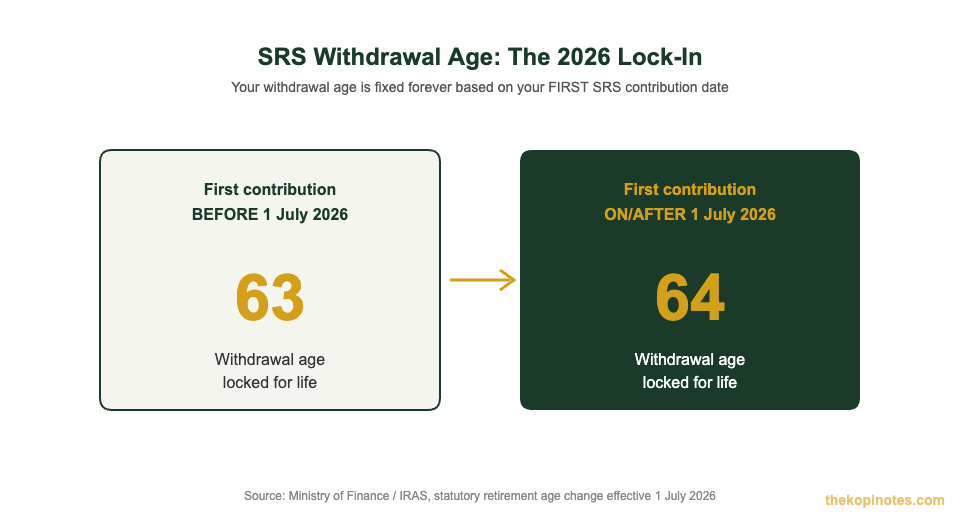
Your SRS (Supplementary Retirement Scheme) withdrawal age is permanently fixed at the statutory retirement age on the date of your first SRS contribution — 63 if that was before 1 July 2026, or 64 if it was on or after that date. Withdraw before this age and 100% of the amount is taxable plus a 5% penalty. Withdraw at or after it, and only 50% is taxable, with no penalty, and you can spread withdrawals over 10 years to cut your tax bill further.
Not financial advice. All figures are for educational reference only. Data as at July 2026 unless noted.
- Your SRS withdrawal age is locked forever based on your first contribution date — 63 before 1 July 2026, 64 from that date onward.
- Withdraw at or after that age and only half the amount is taxed, with zero penalty.
- Spreading a $400,000 SRS balance over 10 years instead of withdrawing it all at once can cut your tax bill from over $21,000 to close to $0.
Free download: The Singapore Money Playbook — 7 money mindset shifts written for Singapore, with the CPF-adjusted retirement number most guides get wrong (PDF + Notion).
Table of Contents
Contents — Click to expand
What Is Your SRS Withdrawal Age?
The Supplementary Retirement Scheme (SRS) is a voluntary savings scheme. You get dollar-for-dollar tax relief on what you put in, up to a yearly cap. Singapore Citizens and Permanent Residents can contribute up to $15,300 a year. Foreigners get a bigger cap of $35,700 a year.
But SRS is not free money forever. There is a catch: your SRS withdrawal age. This is the age at which you can start drawing down your SRS savings without a penalty, and with a generous tax break on top.
It is not your CPF retirement age. It is not 65. It is a separate number entirely, and here is the part most people miss: it is locked in the moment you make your first SRS contribution, and it never changes again — even if the government later raises the statutory retirement age.
The 2026 Change: Age 63 vs Age 64
Singapore statutory retirement age rose from 63 to 64 on 1 July 2026, part of a broader schedule that will eventually take it to 65. If you want the fuller story on what this means for your CPF, read our guide to Singapore Retirement Age 2026.
For SRS specifically, the effect is simple but permanent. Here is how it breaks down:
| First SRS Contribution | Your SRS Withdrawal Age (Locked for Life) |
|---|---|
| Before 1 July 2026 | 63 |
| On or after 1 July 2026 | 64 |
Source: Ministry of Finance / IRAS, as at July 2026
If you already had an SRS account and contributed before 1 July 2026, you locked in age 63. You do not need to do anything else. If you had not opened an account yet, contributing even $1 before the cut-off would have locked in the lower age. If you are reading this after the cut-off and opening your first account now, your withdrawal age is 64, whether you like it or not. We covered the mechanics of the deadline itself in our SRS Account Deadline 2026 piece.
Why does one extra year matter? Because it is one more year your money stays locked up before you can access it penalty-free. It also shifts your entire 10-year staggered withdrawal window a year later, which we will get to shortly.
Withdrawing Before Your SRS Withdrawal Age
Withdraw before you hit your locked-in withdrawal age, and the tax treatment is unforgiving. Two things happen at once:
- 100% of the amount withdrawn is added to your taxable income for that year
- On top of that, you pay a 5% penalty on the gross amount withdrawn
So if you pull out $50,000 early, you owe income tax on the full $50,000 at your marginal rate, plus a flat $2,500 penalty, before any tax is even calculated. It is about as close to a “do not touch this” warning as Singapore tax code gets.
There are exceptions. IRAS waives the 5% penalty, though the withdrawal may still be taxable, if you are withdrawing because of:
- Death — the funds pass to your estate or nominees
- Terminal illness
- Bankruptcy
- Physical or mental incapacity that prevents you from working
- Leaving Singapore and West Malaysia permanently, with proof
Outside these situations, early withdrawal rarely makes financial sense. If you need liquidity, look elsewhere first. If you are 55 or older, a CPF Ordinary Account withdrawal usually costs you far less than blowing up your SRS tax treatment — see our CPF Withdrawal guide for the rules there.
Withdrawing At or After Your SRS Withdrawal Age
This is where SRS earns its keep. Once you reach your withdrawal age, the rules flip in your favour:
- Only 50% of the amount you withdraw is taxable
- There is no 5% penalty
- You have up to 10 years from your withdrawal age to draw down the full balance under this favourable treatment
Here is a worked example. Say you are 64, having locked in the new age, with $150,000 in your SRS account. You withdraw $30,000 in your first year. Only $15,000 of that counts as taxable income. If that is your only taxable income for the year, and CPF withdrawals, including CPF LIFE payouts, are not taxed at all, that $15,000 sits entirely inside Singapore 0% tax bracket. You pay no tax on it.
The 10-Year Staggered Withdrawal Strategy
Here is the strategy that separates people who simply “use” SRS from people who actually benefit from it: do not withdraw everything the moment you become eligible. Spread it out.
Singapore income tax is progressive. The more you earn, or withdraw, in a single year, the higher the rate on each additional dollar. Because only 50% of your SRS withdrawal is taxable, and CPF income is not taxed at all, retirees who stagger their SRS withdrawals over the full 10-year window can often keep their taxable income low enough to pay very little tax on it, sometimes none.
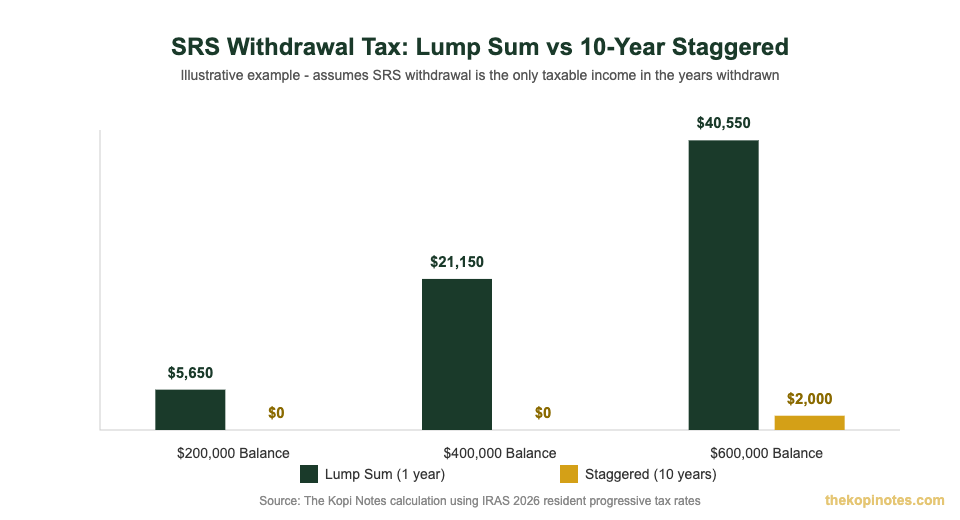
| SRS Balance | Lump Sum Tax (1 year) | 10-Year Staggered Tax | Tax Saved |
|---|---|---|---|
| $200,000 | $5,650 | $0 | $5,650 |
| $400,000 | $21,150 | $0 | $21,150 |
| $600,000 | $40,550 | $2,000 | $38,550 |
Source: The Kopi Notes calculation using IRAS 2026 resident progressive tax rates. Illustrative example, assumes the SRS withdrawal is the individual only taxable income in the years withdrawn.
That is not a rounding error. On a $400,000 SRS balance, staggering the withdrawal instead of taking it all at once can be the difference between a $21,150 tax bill and effectively nothing.
Use our SRS Withdrawal Tax Calculator to run your own numbers. Plug in your balance and see the lump sum versus staggered comparison for your own situation.
Real life is not always this clean. If you have other income in retirement, part-time work, rental income, or dividends outside CPF, your optimal strategy will look different. The core principle stays the same though: smaller annual withdrawals almost always beat one large one.
SRS Withdrawal Rules for Foreigners
Foreigners get one additional escape hatch. If you have held your SRS account for at least 10 years from the date of your first contribution, you can withdraw the full balance without the 5% penalty, even if you have not reached the statutory retirement age and even if you have already left Singapore. This exists because foreigners often cannot stay in Singapore long enough to naturally reach their SRS withdrawal age.
The withdrawal is still subject to Singapore tax. If you are a non-resident at the time of withdrawal, the bank or SRS operator will typically withhold tax at source before paying you. Rules here get technical fast. If this applies to you, check IRAS guidance for foreigners and PRs directly, or speak to a tax advisor before you withdraw.
5 Common SRS Withdrawal Mistakes
- Withdrawing everything the year you hit your SRS withdrawal age. You do not have to. You have 10 years. Use them.
- Forgetting your withdrawal age is locked to your first contribution, not a later one. Topping up your SRS account in your 50s does not reset the clock.
- Assuming CPF retirement age changes automatically shift your SRS withdrawal age. They do not, once you have made your first contribution.
- Withdrawing early for a “better investment opportunity.” The 5% penalty plus 100% taxable treatment almost never pays for itself.
- Not planning for the end of the 10-year window. Any balance left in your SRS account after 10 years is deemed withdrawn and taxed accordingly, whether or not you have actually taken the cash out.
If you have not opened an SRS account yet, or want the full picture on contribution caps, tax relief, and where to hold your SRS funds, our SRS Account Singapore Complete Guide covers the accumulation side in depth. For your CPF savings specifically, see our guide to CPF Special Account 2026.
Put Your SRS Withdrawal Plan Together
Run your own numbers with our free calculator, or explore where to hold and invest your SRS funds before you get to withdrawal age.
Frequently Asked Questions
What age can I withdraw my SRS savings?
Your SRS withdrawal age is the statutory retirement age in effect when you made your first SRS contribution: 63 if that was before 1 July 2026, or 64 if it was on or after that date. It is locked for life once set.
What happens if I withdraw from SRS before my withdrawal age?
100% of the amount is added to your taxable income for that year, and you also pay a 5% penalty on the gross withdrawal, unless you qualify for an exception such as death, terminal illness, bankruptcy, incapacity, or permanently leaving Singapore and West Malaysia.
How much tax do I pay on SRS withdrawals after I reach my withdrawal age?
Only 50% of the amount withdrawn is treated as taxable income, and there is no penalty. The actual tax you pay depends on your total taxable income and Singapore progressive tax rates for that year.
Can I withdraw my entire SRS balance in one go?
Yes, but it is rarely the smartest move. Because Singapore tax is progressive, withdrawing a large lump sum in one year pushes more of it into higher tax brackets. Spreading withdrawals over your 10-year window usually results in far less tax.
What is the best way to withdraw SRS to minimise tax?
Spread withdrawals evenly across the 10 years from your withdrawal age, and keep each year taxable amount, which is 50% of what you withdraw, within the lower tax brackets. Ideally under $20,000 if it is your only taxable income that year, since that falls entirely within the 0% band.
Does the retirement age rising to 64 in 2026 change my SRS withdrawal age?
Only if you make your first SRS contribution on or after 1 July 2026, in which case your withdrawal age is 64. If you already contributed before that date, your withdrawal age stays locked at 63 regardless of future retirement age increases.
What if I need to withdraw SRS money early due to a medical emergency or financial hardship?
Terminal illness and physical or mental incapacity are recognised exceptions that waive the 5% penalty, though tax treatment still applies. General financial hardship on its own is not a recognised exception. Early withdrawal for that reason still triggers the full 100% taxable treatment plus penalty.
Do foreigners have different SRS withdrawal rules?
Foreigners can withdraw their full SRS balance penalty-free after 10 years from their first contribution, even before reaching the statutory retirement age. The withdrawal is still taxable, and non-residents typically have tax withheld at source.
What happens to SRS savings I do not withdraw within the 10-year window?
Any balance still in your SRS account at the end of the 10-year withdrawal period is deemed withdrawn on that date and taxed accordingly, whether or not you have actually taken the cash out.
This article was researched with the help of AI. While we strive to keep all information accurate and up to date, there may be errors. If you notice any discrepancies, please contact us.