Webull vs Moomoo Singapore: Which Broker Is Cheaper in 2026?
A fee-by-fee comparison of two of Singapore’s most popular zero-commission brokers, verified against official pricing pages.
Webull and moomoo are both zero-commission brokers in Singapore, but their fee structures differ sharply. Webull charges $0 commission and $0 platform fee on US stocks with no conditions, while moomoo charges $0 commission but a US$0.99 platform fee per US trade. For Singapore stocks, Webull’s flat 0.05% fee usually beats moomoo’s fees after your first free year.
Not financial advice. All figures are for educational reference only and were verified against Webull SG and moomoo SG official pricing pages. Data verified as at July 2026.
- Webull wins on US stocks: truly $0 commission and $0 platform fee, no time limit.
- Moomoo wins on markets and features: Japan stocks, licensed crypto trading, and a longer Singapore track record.
- Neither broker gives you direct LSE access, so you’ll still need IBKR or Saxo for CSPX or VWRA.
What Is Webull? What Is Moomoo?
Webull Securities (Singapore) Pte. Ltd. entered the Singapore market in 2022. It holds a Capital Markets Services (CMS) Licence from the Monetary Authority of Singapore (MAS) and is backed by Webull Corporation, which listed on Nasdaq in April 2025. You can trade US, Singapore, and Hong Kong stocks, China A-shares, options, and futures through the app.
Moomoo Financial Singapore Pte. Ltd. has been around a little longer, launching in Singapore in March 2021. It also holds a CMS Licence and a Major Payment Institution Licence from MAS. Moomoo’s parent, Futu Holdings Limited (NASDAQ: FUTU), runs a much larger regional operation. In June 2022, moomoo became the first digital brokerage to gain full membership of the Singapore Exchange (SGX). By April 2024, it had crossed 1 million Singapore users, and it won “Best Retail Broker in Singapore” from the Securities Investors Association of Singapore (SIAS) in both 2023 and 2024.
Both brokers offer commission-free trading promotions, mobile-first apps, and access to fractional shares. Where they differ is in the details: platform fees, market coverage, and what happens once your welcome promotion ends.
Fee Comparison at a Glance
Here’s how Webull and moomoo stack up on the numbers that matter most to Singapore investors, verified against both brokers’ official pricing pages in July 2026.
| Feature | Webull | Moomoo |
|---|---|---|
| MAS Licence | CMS101150 | CMS101000 |
| Launched in Singapore | 2022 | 2021 |
| Parent Company | Webull Corporation (Nasdaq-listed) | Futu Holdings (NASDAQ: FUTU) |
| US Stock Commission | $0 | $0 |
| US Stock Platform Fee | $0 | US$0.99/order |
| SG Stock Commission (Year 1) | Free | Free |
| SG Stock Fee (After Year 1) | 0.05% total, min S$1.60 | ~0.06% total, min ~S$1.98 |
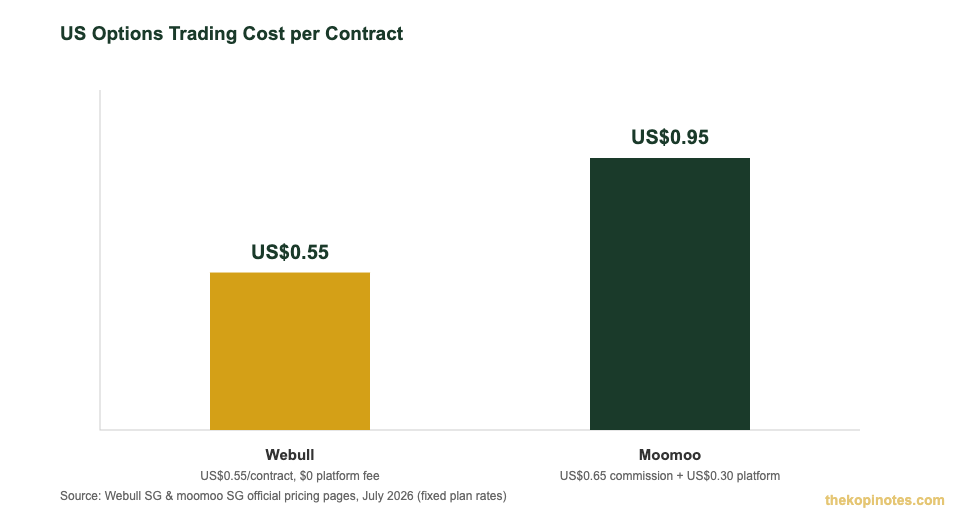
| US Options (fixed plan) | US$0.55/contract | US$0.95/contract |
| Markets Available | US, SG, HK, China A-shares | US, SG, HK, China A-shares, Japan |
| Minimum Deposit | None | None |
| Margin Rate (USD) | As low as 0%* (promo) | 4.80% p.a. |
Source: Webull SG official pricing page and moomoo SG official fee schedule, both verified July 2026. *Webull’s promotional margin rate is time-limited; T&Cs apply.
US Stocks & ETFs: Fee Breakdown
If you mostly buy US-listed stocks and ETFs, Webull is the cheaper broker. Webull’s US stock and ETF trading carries $0 commission and $0 platform fee, with no minimum holding period and no fine print. Webull’s own pricing page states this applies with no conditions.
Moomoo also advertises $0 commission on US stocks, and that part is genuinely free for life. But moomoo adds a US$0.99 platform fee per order on top. For a Singapore investor who trades US ETFs like CSPX or VOO once a month, that’s roughly US$11.88 a year in platform fees alone, money Webull users don’t pay.
Both brokers pass through US regulatory fees you can’t avoid on any broker: the SEC’s trading activity fee (a fraction of a cent per share on sell orders) and, for options, exchange fees. These are tiny, usually a few cents per trade, and apply industry-wide.
For active traders, the gap widens further across FX spreads and derivatives, an area covered in more depth in our moomoo trading fees guide, where moomoo’s FX spread (around 0.1%) is competitive but not the tightest in the market. If you’re building a CSPX or VOO position through many small trades rather than lump sums, Webull’s zero-platform-fee structure adds up in your favour.
Singapore Stocks: Fee Breakdown
Both brokers give new clients a free first year on SG-listed stocks and ETFs. On moomoo, a platform fee of 0.03% (minimum S$0.99 per order) still applies even during your free year, only the commission is waived. Webull works the same way: its 0.025% platform fee (minimum S$0.80) runs from day one, with only the commission portion free for year one.
Here’s what happens once your first year ends:
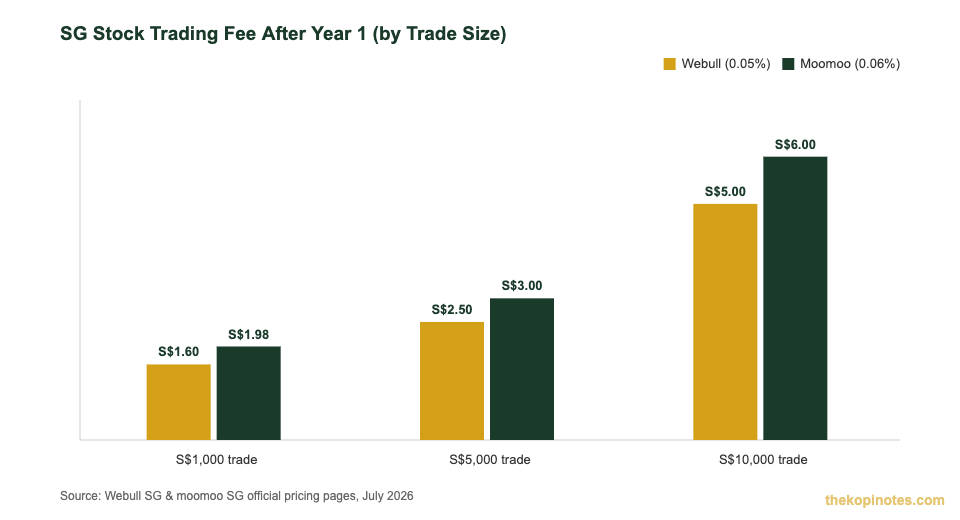
- Webull: 0.025% commission + 0.025% platform fee = 0.05% total, minimum S$1.60 per order
- Moomoo: 0.03% commission + 0.03% platform fee = roughly 0.06% total, minimum roughly S$1.98 per order
On paper, Webull is marginally cheaper for SG stock trading after year one. In practice, the difference is small change unless you’re trading frequently: on a S$10,000 SG stock purchase, that’s S$5.00 with Webull versus S$6.00 with moomoo, a S$1 difference.
Two things apply on top of these numbers, regardless of broker. First, SGX charges its own clearing and trading levies (roughly S$1–2 per trade). Second, Singapore’s Goods and Services Tax (GST) applies at 9% to all brokerage commissions, platform fees, and exchange charges, per IRAS rules. Neither broker absorbs GST for you.
If you’re specifically building a portfolio of SG dividend stocks or REITs, our moomoo Singapore review takes a deeper look at moomoo’s SG stock trading experience beyond just fees.
Real Cost Example: A S$10,000 Trade
Here’s exactly what a Singapore investor pays to place two common trades on each broker, using each broker’s own published fee schedule as at July 2026.
Buying US$10,000 of a US-listed ETF (e.g. VOO), after any welcome promotion ends:
- Webull: US$0 commission + US$0 platform fee = US$0.00
- Moomoo: US$0 commission + US$0.99 platform fee = US$0.99
Buying S$10,000 of an SGX-listed stock, after your first free year:
- Webull: 0.025% + 0.025% = 0.05% × S$10,000 = S$5.00
- Moomoo: 0.03% + 0.03% = 0.06% × S$10,000 = S$6.00
Neither gap is life-changing for a buy-and-hold investor making a handful of trades a year. But if you’re dollar-cost averaging into US ETFs monthly, say S$1,000 a month into CSPX or a similar fund, moomoo’s US$0.99 platform fee adds up to roughly US$11.88 a year that Webull simply doesn’t charge. Over a 10-year DCA plan, that’s close to US$120 in platform fees alone, before accounting for any future fee changes.
Platforms, Markets & Features
Fees are only half the picture. Here’s where the two brokers pull apart on functionality.
Market coverage: Moomoo covers one more market than Webull, Japan stocks, alongside its crypto trading offering (Singapore’s only MAS-licensed digital brokerage for crypto). Webull sticks to US, SG, HK, and China A-shares, but adds futures trading, which moomoo does not offer to SG retail clients in the same way.
The London Stock Exchange gap: Neither broker gives Singapore investors direct access to LSE-listed UCITS ETFs like CSPX or VWRA, the ETFs many SG investors prefer for lower withholding tax and no US estate tax exposure. If LSE access matters to you, you’ll need a broker like IBKR or Saxo instead. Read our IBKR Singapore review or our guide to buying CSPX in Singapore if that’s your priority.
Fractional shares: Both support fractional US shares from as little as US$1, useful if you want to build a position in a high-priced stock without waiting to save up for a full share.
Cash management: Webull’s Moneybull product has offered yields of around 3.7% p.a. on idle USD cash (as at January 2026); moomoo’s equivalent is Cash Plus. Both let you earn a return on cash sitting between trades.
Regular investing: Both offer Regular Savings Plans (RSP) for dollar-cost averaging into US stocks and ETFs automatically, useful if you’re not trying to time the market.
Charting and tools: Webull is generally seen as the stronger platform for active and options traders, with a dedicated options screener and 13 options strategies. Moomoo leans into fundamentals and community features, including Wall Street analyst ratings and institutional holdings tracking.
Who Should Pick Webull vs Moomoo?
Webull is the better pick if:
- You mainly trade US stocks and ETFs and want the lowest possible per-trade cost
- You’re an active or options trader who values charting tools and a dedicated options screener
- You want a flat, predictable SG stock fee structure once your free year ends
Moomoo is the better pick if:
- You want access to Japan stocks or MAS-licensed crypto trading in the same app
- You value a longer local track record and full SGX membership since 2022
- You’re a buy-and-hold SG dividend investor who won’t trade often enough for the platform fee to matter
For most passive, buy-and-hold ETF investors, the fee difference between the two brokers is small enough that platform features, market access, and personal preference should decide it. If you’re chasing the lowest cost per US ETF trade specifically, Webull currently has the edge. If you want one app for a wider range of Asian and US markets, moomoo’s broader coverage may be worth the extra 99 cents a trade.
Neither broker replaces a CPF-linked or SRS-compatible platform for retirement planning, both are cash/margin brokerage accounts. If you’re building a full retirement plan around your ETF investing, our Singapore retirement calculator can help you model how today’s trading costs affect your long-term returns.
Frequently Asked Questions
What is the main difference between Webull and moomoo for Singapore investors?
The biggest difference is the US stock platform fee. Webull charges $0 commission and $0 platform fee on US stocks and ETFs, with no conditions. Moomoo also charges $0 commission but adds a US$0.99 platform fee per order. For Singapore stocks, both waive commission for one year, and their post-year-one fees are close (0.05% for Webull versus roughly 0.06% for moomoo).
Which has lower fees for US stocks, Webull or moomoo?
Webull. Its US stock and ETF trades carry $0 commission and $0 platform fee, unconditionally. Moomoo’s US stocks are also $0 commission, but it charges a US$0.99 platform fee per order, which Webull does not.
Does Webull or moomoo let me buy CSPX or VWRA on the London Stock Exchange?
Neither. Both Webull and moomoo Singapore cover US, SG, Hong Kong, and China A-share markets (moomoo also offers Japan), but neither provides direct LSE access. If you want to buy CSPX or VWRA, you’ll need a broker like Interactive Brokers (IBKR) or Saxo Markets instead.
Is Webull or moomoo safer for Singapore investors?
Both are regulated by the Monetary Authority of Singapore (MAS) under a Capital Markets Services Licence, Webull under CMS101150 and moomoo under CMS101000, and moomoo additionally holds a Major Payment Institution Licence. Moomoo has operated in Singapore since 2021 and holds full SGX membership; Webull launched in 2022 and is backed by Nasdaq-listed Webull Corporation. Both are legitimate, MAS-regulated brokers with no MAS enforcement actions on record.
Can I use CPF or SRS funds with Webull or moomoo?
Neither Webull nor moomoo is a CPF Investment Scheme (CPFIS) approved broker for CPF Ordinary Account funds. SRS eligibility can change, so check each broker’s current terms directly before funding an account with SRS money.
Which broker is better for beginners, Webull or moomoo?
Both are beginner-friendly with no minimum deposit and easy account opening via Singpass MyInfo. Moomoo has a larger Singapore user base (over 1 million users) and stronger community and educational features. Webull’s interface leans slightly more toward active and options traders. For a first-time investor starting with US ETFs, either works, the deciding factor is usually whether you value moomoo’s broader market access or Webull’s lower US trading costs.
Ready to Open a Brokerage Account?
Compare fees, then open the account that fits how you actually trade. Use our referral links for sign-up bonuses.
This article was researched with the help of AI. While we strive to keep all information accurate and up to date, there may be errors. If you notice any discrepancies, please contact us.