Best Dividend ETFs for Singapore Investors (2026 Guide)
Your complete guide to income-generating ETFs — yields, tax efficiency, and which brokers to use.
Dividend ETFs for Singapore investors work best when domiciled in Ireland and listed on the London Stock Exchange (LSE) — these pay only 15% withholding tax (WHT) on US dividends versus 30% for US-listed equivalents, and carry no US estate tax risk above USD 60,000. Top options include iShares IDVY, Vanguard VHYL, and SPDR SPYD, all available through Interactive Brokers, Syfe, or Saxo Markets with yields of 3.5–4.8% as at June 2026.
Not financial advice. All figures are for educational reference only. Data as at June 2026 unless noted.
Table of Contents
Contents — Click to expand
- What Is a Dividend ETF?
- Why Ireland-Domiciled ETFs Matter for Tax
- Best Dividend ETFs for Singapore Investors
- Yield & Cost Comparison Table
- Withholding Tax Impact (SGD Scenarios)
- How to Buy Dividend ETFs in Singapore
- S-REIT vs Dividend ETF: Which Is Better?
- Who Should Buy Dividend ETFs?
- Frequently Asked Questions
What Is a Dividend ETF?
A dividend ETF is an exchange-traded fund that holds a basket of dividend-paying stocks and distributes their income to investors — typically quarterly or semi-annually. Unlike accumulating ETFs (which reinvest dividends automatically), distributing dividend ETFs pay out cash, making them popular with income-focused investors and those seeking passive income in retirement.
For Singapore investors, dividend ETFs serve as a complement — or alternative — to best S-REITs in Singapore 2026, which focus on property income. Dividend ETFs offer broader geographic and sector diversification, typically holding hundreds of global dividend stocks rather than Singapore-listed REITs alone.
Key metrics to evaluate a dividend ETF:
- Distribution yield — annual income paid out as a percentage of NAV
- TER (Total Expense Ratio) — the annual cost drag on your returns
- Domicile — determines withholding tax rate on dividends
- Number of holdings — more holdings = more diversification
- Dividend growth track record — consistency matters for income planning
Why Ireland-Domiciled ETFs Matter for Tax
This is the single most important decision a Singapore dividend ETF investor makes. The domicile of an ETF determines how much withholding tax (WHT) is deducted from US-source dividends before they reach you.
Under the Ireland-US tax treaty, Ireland-domiciled ETFs pay only 15% WHT on dividends from US companies. By contrast, US-domiciled ETFs (like VYM or SCHD listed on NYSE) pay 30% WHT — double the rate. For a dividend ETF with a 4% yield, that difference costs Singapore investors approximately 0.6 percentage points of annual return.
| ETF Type | Domicile | US Dividend WHT | US Estate Tax Risk | Verdict |
|---|---|---|---|---|
| Ireland-domiciled (LSE) | Ireland | 15% | None | ✓ Recommended |
| US-domiciled (NYSE/NASDAQ) | USA | 30% | Yes (above USD 60k) | ✗ Avoid for SG investors |
| SGX-listed (S-REIT ETFs) | Singapore | 0% (no US exposure) | None | ✓ Good for SG income |
Source: Ireland-US tax treaty; IRS Publication 515; MAS, June 2026
Additionally, Ireland-domiciled ETFs carry no US estate tax exposure for holdings above USD 60,000 — a significant risk for US-domiciled ETF holders. Singapore investors holding US ETFs directly are subject to a 40% estate tax on the portion of their US-situs assets above USD 60,000. This risk disappears entirely with LSE-listed, Ireland-domiciled dividend ETFs.
For more detail on the LSE advantage, the Singapore REIT ETF guide covers the domicile decision in depth.
Best Dividend ETFs for Singapore Investors
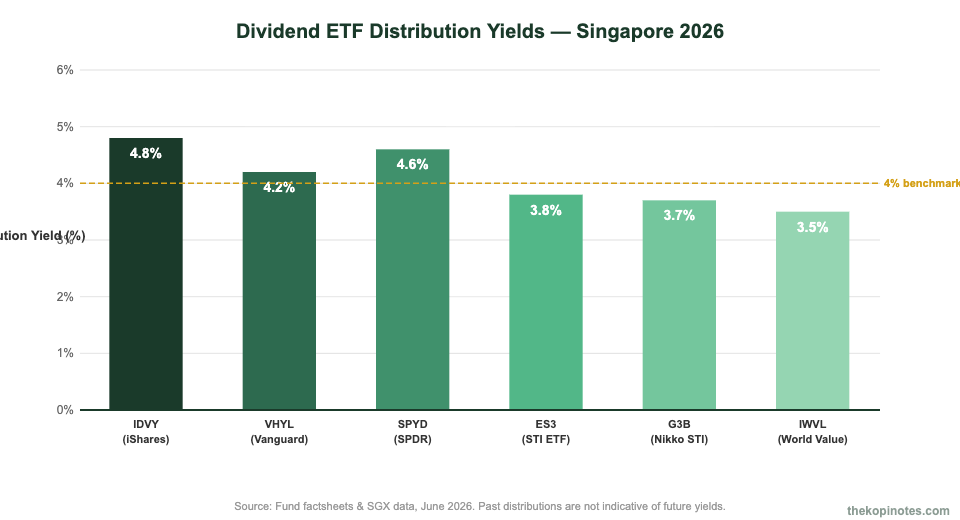
The following ETFs are all Ireland-domiciled, listed on the London Stock Exchange, and available to Singapore investors through major brokers. All data is sourced from fund factsheets as at Q2 2026.
1. iShares MSCI World Quality Dividend ESG UCITS ETF (IWVL)
IWVL tracks the MSCI World High Dividend Yield ESG Reduced Carbon Target Index, holding approximately 300 high-quality dividend stocks globally. Its ESG screen excludes controversial sectors while maintaining a solid yield of around 3.5% as at June 2026. TER: 0.38% p.a. This is a good option for investors who want quality companies with a sustainability overlay alongside a meaningful dividend.
2. iShares MSCI Europe Quality Dividend ESG UCITS ETF (IDVY)
IDVY is one of the highest-yielding dividend ETFs available on the LSE, offering approximately 4.8% distribution yield as at June 2026. It tracks European dividend-paying stocks and benefits from the Ireland domicile for favourable WHT treatment. TER: 0.28% p.a. European dividend stocks tend to pay higher yields than their US counterparts, making IDVY compelling for pure income generation. AUM: approximately USD 1.5 billion (Q1 2026).
3. Vanguard FTSE All-World High Dividend Yield UCITS ETF (VHYL)
VHYL tracks the FTSE All-World High Dividend Yield Index, holding over 1,700 stocks across developed and emerging markets. Its broad diversification and Vanguard’s reputation make it a reliable core income holding. Distribution yield: approximately 4.2% as at June 2026. TER: 0.29% p.a. VHYL distributes quarterly and is accumulation-friendly for long-term investors — though Singapore investors should note that the distributing version (VHYL) pays out cash rather than reinvesting automatically. AUM: approximately USD 5.2 billion (Q1 2026, according to the Vanguard VHYL fund page).
4. SPDR S&P Global Dividend Aristocrats UCITS ETF (GBDV)
GBDV focuses on companies with consistent dividend growth track records — the “dividend aristocrats” of the global market. Yield: approximately 4.6% as at June 2026. TER: 0.45% p.a. While its TER is higher than VHYL or IDVY, its focus on dividend growth quality (companies that have grown dividends for 10+ consecutive years) appeals to investors who want both income today and income growth tomorrow.
5. iShares STOXX Global Select Dividend 100 UCITS ETF (ISPA)
ISPA holds the 100 highest-yielding stocks globally from developed markets, weighted by dividend yield. Distribution yield: approximately 4.5% as at June 2026. TER: 0.46% p.a. It provides concentrated exposure to the world’s most income-generous companies. Note: higher-yielding stocks sometimes signal dividend distress, so ISPA requires more monitoring than a broad dividend fund like VHYL.
Singapore-Listed Options: STI ETFs
For investors wanting to buy in SGD with no currency conversion, the SGX-listed STI ETFs (ES3 by SPDR and G3B by Nikko AM) offer yields of approximately 3.7–3.8% as at June 2026, with dividends paid semi-annually. These are simpler to buy (available through any Singapore brokerage, including FSMOne, DBS Vickers, and Syfe) and are CPFIS-eligible. However, they provide concentrated Singapore exposure with only ~30 holdings versus 300–1,700 for the global options above. Use your Syfe referral code to open a brokerage account with a sign-up bonus.
Yield & Cost Comparison Table
All figures sourced from fund factsheets and SGX data as at June 2026. Past distributions are not indicative of future yields.
| ETF | Ticker | Exchange | Yield (approx) | TER | Holdings | Domicile |
|---|---|---|---|---|---|---|
| iShares MSCI Europe Quality Div | IDVY | LSE | ~4.8% | 0.28% | ~130 | Ireland |
| SPDR S&P Global Div Aristocrats | GBDV | LSE | ~4.6% | 0.45% | ~100 | Ireland |
| iShares STOXX Global Sel Div 100 | ISPA | LSE | ~4.5% | 0.46% | ~100 | Ireland |
| Vanguard FTSE All-World High Div | VHYL | LSE | ~4.2% | 0.29% | ~1,700 | Ireland |
| iShares MSCI World Quality Div | IWVL | LSE | ~3.5% | 0.38% | ~300 | Ireland |
| SPDR STI ETF | ES3 | SGX | ~3.8% | 0.28% | 30 | Singapore |
| Nikko AM STI ETF | G3B | SGX | ~3.7% | 0.30% | 30 | Singapore |
Source: Fund factsheets (iShares, Vanguard, SPDR), SGX data, June 2026. Yields are trailing 12-month distribution yields and may vary.
Withholding Tax Impact (SGD Scenarios)
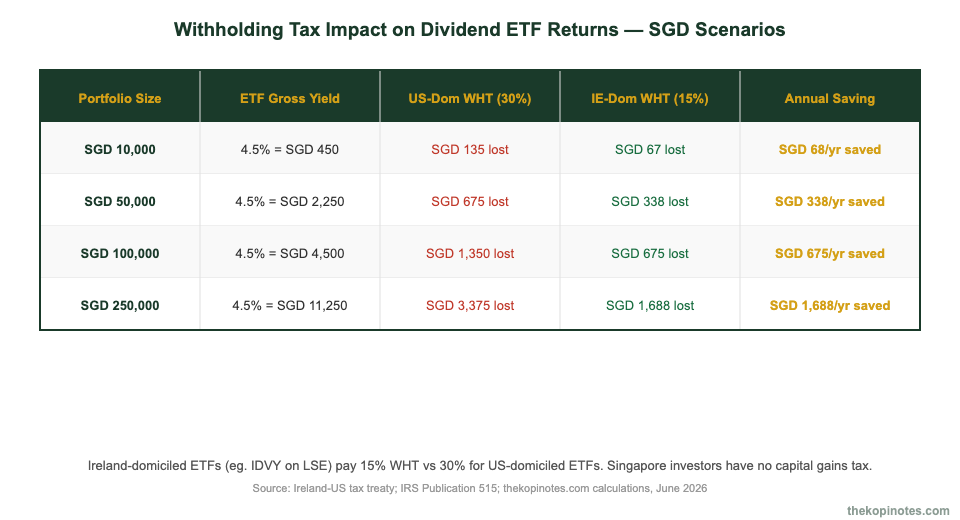
Here is how the 15% vs 30% WHT difference translates into actual SGD savings across different portfolio sizes. These calculations assume a 4.5% gross dividend yield and that the entire dividend income is US-sourced (for global dividend ETFs, the actual US-sourced portion is typically 30–60%).
Original calculation by The Kopi Notes: On a SGD 100,000 dividend ETF portfolio with a 4.5% yield, a Singapore investor using an Ireland-domiciled ETF (15% WHT) saves approximately SGD 675 per year versus a US-domiciled equivalent (30% WHT). Over 20 years compounded, this saving compounds to over SGD 20,000 in additional portfolio value — a meaningful difference that justifies the slightly higher TER of some Ireland-domiciled options.
Use the Singapore retirement calculator to model how dividend ETF income fits into your long-term retirement income plan alongside CPF Life payouts and S-REIT distributions.
How to Buy Dividend ETFs in Singapore
Buying LSE-listed dividend ETFs requires an international brokerage account. Here are the recommended options:
Interactive Brokers (IBKR) — Best for Large Portfolios
IBKR offers the lowest commissions for LSE-listed ETFs: USD 1.70 per trade for GBP-denominated ETFs via their tiered pricing. FX conversion costs approximately 0.002% (nearly zero). For portfolios above SGD 50,000, IBKR is the most cost-efficient option. Use referral code jianxiong368 when signing up.
Syfe Brokerage — Best for Beginners
Syfe offers commission-free trading on US and LSE stocks for the first 6 months (subject to terms). The interface is clean and mobile-first, making it the easiest entry point for first-time ETF investors. Sign up with the Syfe referral code SRPRFFFCD to get an exclusive bonus.
FSMOne — Best for Regular Savings Plans
FSMOne offers Regular Savings Plans (RSPs) that allow automatic monthly purchases of selected ETFs. This is ideal for investors who want to dollar-cost average into VHYL or IDVY every month without manual action. Use the FSMOne referral code P0544985 when opening your account.
Endowus — Best for CPF/SRS Investing
While LSE-listed dividend ETFs are not directly CPF-investable, Endowus allows SRS account investments into dividend-focused funds. Use the Endowus referral code 2V343 for a fee rebate on your first investment. See the CPF investment strategy Singapore guide for how to optimise your SRS alongside a dividend ETF portfolio.
Step-by-Step: Buying VHYL on LSE via IBKR
- Open and fund your IBKR account (minimum USD 0 — no minimum balance required)
- Search for ticker VHYL in the IBKR platform
- Select exchange: LSE (London Stock Exchange)
- Choose currency: GBP (or USD for the USD share class)
- Place a limit order at or near the last traded price
- Dividends are automatically credited to your IBKR cash balance quarterly
S-REIT vs Dividend ETF: Which Is Better?
This is one of the most common questions from Singapore income investors. The honest answer: both have a role, and the right mix depends on your risk tolerance, tax situation, and income goals.
| Factor | S-REITs | Global Dividend ETFs (LSE) |
|---|---|---|
| Typical Yield (2026) | 5–7% | 3.5–4.8% |
| Geographic Exposure | Mostly Asia-Pacific | Global (US, Europe, EM) |
| Sector Concentration | Property only | Multi-sector |
| CPF/SRS Eligible | Yes (select REITs) | SRS only (via broker) |
| Currency | SGD | GBP/USD (FX risk) |
| Interest Rate Sensitivity | High (leveraged structures) | Moderate |
| Dividend Frequency | Quarterly/Semi-annual | Quarterly/Semi-annual |
Source: SGX REIT data; fund factsheets, June 2026
Our recommendation: use S-REITs for higher-yield Singapore property exposure and passive income Singapore plays, and pair them with 1–2 global dividend ETFs (VHYL or IDVY) for geographic diversification. A 60/40 split between S-REITs and global dividend ETFs gives a blended yield of approximately 4.5–5.5% while spreading risk across sectors and geographies.
Who Should Buy Dividend ETFs?
Dividend ETFs are ideal if you:
- Want regular cash income paid quarterly or semi-annually
- Prefer lower volatility than growth ETFs (dividend stocks tend to be more stable)
- Are in or near retirement and need income without selling units
- Want global diversification beyond Singapore-listed REITs and stocks
- Have an SRS account and want to invest it in income-generating assets
Consider alternatives if you:
- Are in the wealth-accumulation phase and prefer tax-efficient reinvestment — VWRA or CSPX (accumulating ETFs) may be better since Singapore investors pay no dividend tax but lose compounding efficiency with cash payouts
- Need CPF-investable options — LSE dividend ETFs are not CPFIS-eligible; use STI ETFs (ES3/G3B) instead
- Want the highest yields — S-REITs at 5–7% still outyield most global dividend ETFs
For retirement planning context, see how dividend ETF income fits alongside CPF Life payouts in our passive income Singapore guide.
Disclaimer: This article is for educational purposes only and does not constitute financial advice. Past distributions are not indicative of future returns. All investment decisions should be made in consideration of your personal financial situation. Data as at June 2026.
Frequently Asked Questions
What is the best dividend ETF for Singapore investors in 2026?
For most Singapore investors, VHYL (Vanguard FTSE All-World High Dividend Yield UCITS ETF) is the best overall dividend ETF — it offers broad global diversification across 1,700+ stocks, a ~4.2% distribution yield, a low TER of 0.29%, and is Ireland-domiciled (15% WHT on US dividends). For higher income with a European focus, IDVY offers ~4.8% yield at 0.28% TER. Both are available on the London Stock Exchange through IBKR, Syfe, or Saxo.
Are dividend ETFs taxable in Singapore?
Singapore has no dividend tax and no capital gains tax, so distributions from dividend ETFs are received tax-free in your hands. However, withholding tax is deducted at source before dividends reach you — 15% for Ireland-domiciled ETFs, 30% for US-domiciled ETFs. This WHT is not recoverable by Singapore investors but can be minimised by choosing Ireland-domiciled options listed on the LSE.
Can I buy dividend ETFs with CPF or SRS?
LSE-listed dividend ETFs (VHYL, IDVY, GBDV) are not eligible for CPF Investment Scheme (CPFIS). However, you can invest SRS funds into dividend ETFs through eligible brokers like Endowus or DBS Vickers. For CPF investing, the SGX-listed STI ETFs (ES3, G3B) are CPFIS-approved and offer similar income exposure with Singapore blue-chip stocks.
What is the difference between a dividend ETF and an accumulating ETF?
A dividend ETF (distributing) pays out income to investors as cash — typically quarterly. An accumulating ETF automatically reinvests those dividends back into the fund, so no cash is distributed. For income-seekers in retirement, distributing ETFs are better as they generate regular cash flow. For wealth accumulators, accumulating ETFs like VWRA or CSPX are more tax-efficient in Singapore since no cash is distributed and compounding is uninterrupted.
Which broker is cheapest for buying dividend ETFs in Singapore?
Interactive Brokers (IBKR) is the cheapest for LSE-listed ETFs at approximately USD 1.70 per trade with near-zero FX spread. For smaller portfolios or beginners, Syfe offers commission-free trading in the first 6 months. FSMOne is best for automated Regular Savings Plans. All three brokers allow trading of VHYL, IDVY, and GBDV on the LSE.
How often do dividend ETFs pay distributions?
Most LSE-listed dividend ETFs pay distributions quarterly or semi-annually. VHYL pays quarterly (March, June, September, December). IDVY pays semi-annually. GBDV pays quarterly. The exact ex-dividend and payment dates are published on each fund’s factsheet. Singapore investors receive distributions net of withholding tax directly into their brokerage cash account.
Is a 4% dividend ETF yield better than S-REITs for passive income?
S-REITs typically offer higher yields of 5–7% versus 3.5–4.8% for global dividend ETFs, but dividend ETFs offer broader geographic diversification and lower sector concentration risk. The best approach for most Singapore income investors is to hold both: S-REITs for higher Singapore property income, and 1–2 global dividend ETFs for international diversification. A blended portfolio can target a 4.5–5.5% overall yield with much lower concentration risk than either approach alone.
Start Earning Dividend Income Today
Open a brokerage account and buy your first dividend ETF. Use our referral links for sign-up bonuses.
This article was researched with the help of AI. While we strive to keep all information accurate and up to date, there may be errors. If you notice any discrepancies, please contact us.