Keppel DC REIT Share Price Analysis: P/NAV Valuation, DPU Yield & Fair Value (2026)
A complete valuation guide for Singapore investors — current P/NAV ratio, historical yield spread vs risk-free rate, fair value estimation, and a clear investment case for KDC REIT in 2026.
Keppel DC REIT (SGX: AJBU) is Singapore’s largest data centre REIT by AUM, currently trading at approximately 1.05x its Net Asset Value (NAV) per unit — near its lowest P/NAV premium in five years. At this valuation, KDC REIT offers a forward distribution yield of approximately 4.3%, with a yield spread of roughly 1.5% over the Singapore 10-year government bond. This guide breaks down KDC REIT’s current share price, historical P/NAV band, DPU growth track record, and our fair value framework for Singapore investors in 2026.
Not financial advice. All figures are for educational reference only. Data as at October 2026 unless noted. Always verify live prices on SGX before making investment decisions.
- KDC REIT trades at ~1.05x NAV — near a 5-year low premium, historically an attractive entry zone
- Forward DPU yield of ~4.3%, with a positive yield spread vs risk-free rate
- Portfolio of 23 data centres across 9 countries; AI demand structural tailwind intact
- Gearing at ~37% — healthy headroom for acquisitions without equity fundraising
- Our simple fair-value range: SGD 1.95–2.30 based on P/NAV and yield-spread models
Table of Contents
Contents — Click to expand
- What Is Keppel DC REIT?
- Key Facts at a Glance (Oct 2026)
- KDC REIT Share Price History & Trading Range
- P/NAV Valuation Analysis
- DPU Yield vs Historical Average & Risk-Free Rate
- Fair Value Estimate: SGD 1.95–2.30 (2026)
- Investment Case: Buy, Hold, or Avoid?
- Key Risks to Monitor
- Frequently Asked Questions
What Is Keppel DC REIT?
Keppel DC REIT (SGX: AJBU) is Asia’s first and Singapore’s largest pure-play data centre REIT, listed on the Singapore Exchange in December 2014 under the Keppel Group. The REIT owns and manages a portfolio of data centre assets that provide critical digital infrastructure for colocation, managed hosting, and cloud services.
As of Q3 2026, KDC REIT’s portfolio comprises 23 data centres across 9 countries — Singapore, Australia, Germany, the Netherlands, the United Kingdom, Ireland, Italy, Malaysia, and Japan — with a total assets under management (AUM) of approximately SGD 3.7 billion. The REIT is managed by Keppel DC REIT Management Pte Ltd, a wholly-owned subsidiary of Keppel Corporation.
KDC REIT distributes income quarterly and is structured as a unit trust. It is eligible for investment via CPF Investment Scheme (CPFIS) and Supplementary Retirement Scheme (SRS). As Singapore’s largest best S-REITs in Singapore 2026 by data centre AUM, it commands a natural premium to NAV given the scarcity value of its portfolio and the structural AI-driven demand for data infrastructure.
Key Facts at a Glance (Oct 2026)
| Metric | Data |
|---|---|
| SGX Ticker | AJBU |
| Share Price (indicative, Oct 2026) | ~SGD 2.20 |
| NAV Per Unit (Jun 2026) | ~SGD 2.10 |
| P/NAV (est. Oct 2026) | ~1.05x |
| Market Cap | ~SGD 3.9 billion |
| Forward DPU Yield (est.) | ~4.3% |
| DPU (FY2025 annualised) | ~9.2 Singapore cents |
| Gearing Ratio | ~37% (MAS limit: 50%) |
| No. of Data Centres | 23 (9 countries) |
| Distribution Frequency | Quarterly |
Source: KDC REIT SGX filings, Q2 2026 results. Share price is indicative; verify at SGX before trading.
KDC REIT Share Price History & Trading Range
Keppel DC REIT’s share price has experienced significant volatility over the past four years, reflecting the broader S-REIT sector’s sensitivity to interest rates. At its peak in 2021, KDC REIT traded as high as SGD 3.68 per unit — driven by the pandemic-fuelled digital transformation boom and near-zero interest rates. The subsequent sharp rise in interest rates through 2022–2023 pushed the share price down to a trough of approximately SGD 1.55–1.65 in early 2024.
As at October 2026, KDC REIT has partially recovered to the SGD 2.15–2.25 range, as the US Federal Reserve’s rate-cutting cycle and Singapore’s easing monetary conditions provide tailwinds for REIT valuations. This represents a recovery of roughly 40% from trough, but still approximately 38–40% below the 2021 peak.
| Period | Approx. Share Price Range | Key Driver |
|---|---|---|
| 2020–2021 (Peak) | SGD 2.80 – 3.68 | COVID digital surge, near-zero rates |
| 2022 (Rate hike shock) | SGD 2.10 – 2.80 | Fed rate hike cycle begins, REIT de-rating |
| 2023 (Rate peak) | SGD 1.65 – 2.20 | High borrowing costs, NAV write-downs |
| 2024 (Trough & base) | SGD 1.55 – 2.00 | Rate pivot expectations, selective recovery |
| 2025–2026 (Recovery) | SGD 2.00 – 2.30 | Fed cuts, AI demand, DPU recovery |
Source: SGX historical data, TKN estimates. Data rounded for educational purposes. Always check live prices on SGX.
P/NAV Valuation Analysis
The Price-to-Net Asset Value (P/NAV) ratio is one of the most important valuation metrics for S-REITs. It tells you whether you’re buying the REIT’s underlying portfolio at a premium or discount to its book value. For KDC REIT specifically, tracking P/NAV is critical because its portfolio of institutional-grade data centres is difficult to replicate — unlike retail or office assets, data centre replacement cost and land scarcity justify a structural NAV premium.
KDC REIT’s historical P/NAV range:
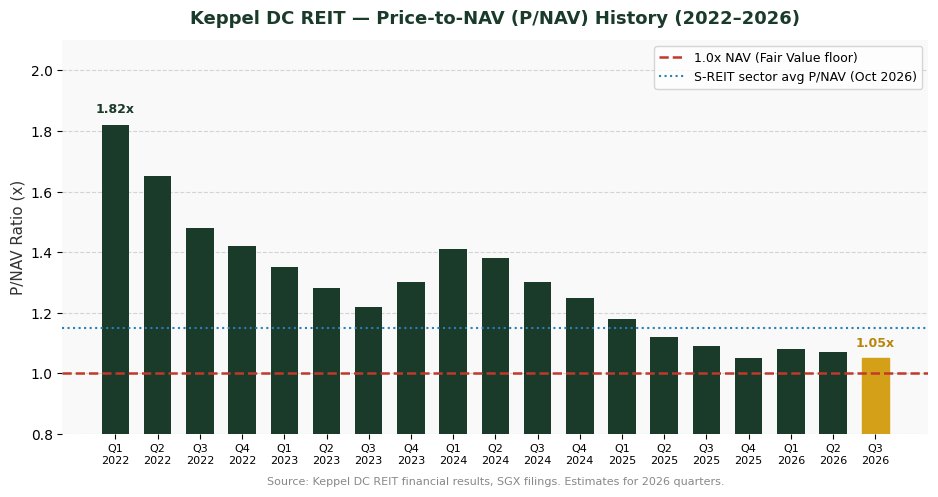
- Peak premium (2021): ~1.8x NAV — driven by zero-rate environment and ESG/tech sector enthusiasm
- Historical average (2018–2026): ~1.35x NAV
- Rate-hike trough (2024): ~1.05–1.10x NAV — near-book-value floor
- Current (Oct 2026): ~1.05x NAV — historically low
At ~1.05x P/NAV, KDC REIT is trading at its lowest premium in five years. For context, a reversion to its 10-year average P/NAV of ~1.35x would imply a share price target of approximately SGD 2.84 — a potential 29% upside from current levels. Even a reversion to the more conservative post-2022 average of ~1.20x NAV implies ~SGD 2.52, or ~14% upside.
For a Singapore investor holding 10,000 units at SGD 2.20, this represents a potential unrealised gain of SGD 3,200–6,400 over a 12–24 month horizon on P/NAV normalisation alone (before DPU income). You can estimate your portfolio growth using our Singapore retirement calculator.
DPU Yield vs Historical Average & Risk-Free Rate
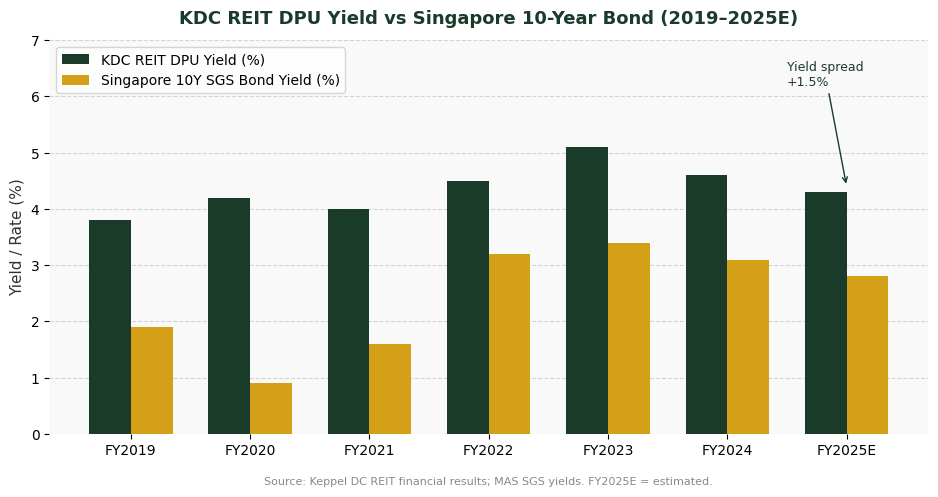
A REIT’s DPU (Distribution Per Unit) yield relative to the risk-free rate — typically the Singapore 10-year government securities (SGS) bond — is the second pillar of REIT valuation. This “yield spread” measures the risk premium investors earn for owning KDC REIT instead of a risk-free government bond.
KDC REIT’s DPU yield at current prices (~4.3%) vs the Singapore 10Y SGS bond (~2.8% as at Oct 2026) gives a yield spread of approximately +1.5%. Historically, KDC REIT has traded at a yield spread of +1.0% to +2.2% over the 10-year SGS. The current spread of +1.5% sits near the middle of its historical range — suggesting the market is pricing in moderate but not extreme risk premium for holding KDC REIT.
A worked example for Singapore investors: If you invest SGD 50,000 in KDC REIT at an entry yield of 4.3%, you would receive approximately SGD 2,150 per year in quarterly distributions — equivalent to SGD 537.50 per quarter. By comparison, a SGD 50,000 position in Singapore Savings Bonds at the current 10Y average yield of ~2.8% would generate approximately SGD 1,400 per year. KDC REIT therefore offers approximately SGD 750 more in annual income per SGD 50,000 invested, in exchange for the higher risk of REIT ownership (price volatility, gearing, concentration in data centres). For more context on risk-free alternatives, see our guide on Singapore Savings Bonds and Singapore T-bills 2026.
Fair Value Estimate: SGD 1.95–2.30 (2026)
Based on two complementary valuation frameworks, we estimate KDC REIT’s fair value range at SGD 1.95–2.30 per unit as at October 2026:
| Method | Assumption | Implied Fair Value |
|---|---|---|
| P/NAV (Conservative) | 1.05–1.10x NAV of ~SGD 2.10 | SGD 2.20 – 2.31 |
| Yield Spread (Conservative) | Target yield 4.5% (spread +1.7% vs SGS) | SGD 2.04 (DPU 9.2c / 4.5%) |
| Yield Spread (Base) | Target yield 4.0% (spread +1.2% vs SGS) | SGD 2.30 (DPU 9.2c / 4.0%) |
| P/NAV (10Y avg reversion) | 1.30x NAV of ~SGD 2.10 | SGD 2.73 (bull case) |
Source: TKN estimates based on KDC REIT Q2 2026 results, MAS SGS data, Oct 2026. Not investment advice.
Our base case fair value is SGD 2.00–2.30, with a bull case of SGD 2.50–2.70 if interest rates continue to fall and data centre demand accelerates. At the current price of ~SGD 2.20, KDC REIT appears fairly valued to slightly undervalued — not deep-value, but offering a reasonable entry for long-term investors who believe in the structural AI data centre demand story.
Investment Case: Buy, Hold, or Avoid?
Based on the valuation analysis above, here is how Singapore investors should think about KDC REIT at current price levels:
Consider buying KDC REIT if:
- You want exposure to the AI infrastructure megatrend through a Singapore-listed, MAS-regulated vehicle
- You’re investing for a 3–5 year horizon and can tolerate short-term price volatility
- You want quarterly distributions (yield ~4.3%) with potential for DPU growth as AI demand lifts occupancy and rental rates
- You are investing via SRS or CPFIS (OA or SA) for tax efficiency — KDC REIT is CPFIS-approved
- You can access Syfe or FSMOne for low-cost fractional or regular savings plan exposure
Approach with caution if:
- You need maximum yield — KDC REIT’s 4.3% yield is below higher-distributing retail or commercial S-REITs (e.g. 6–8%)
- You are sensitive to P/NAV risk — at 1.05x, there is limited margin of safety on a book-value basis
- You are overweight data centres already (e.g. if you hold Digital Core REIT, Mapletree Industrial Trust, or CapitaLand Ascendas REIT)
- You have a short time horizon of under 12 months
For a balanced S-REIT portfolio, most Singapore investors pair KDC REIT with higher-yielding retail or industrial REITs to achieve a blended yield of 5–6%. See our guide on passive income in Singapore for a full portfolio construction framework.
Key Risks to Monitor
No investment is without risk. For KDC REIT specifically, the key risks include:
- Interest rate re-escalation: If global central banks reverse course and raise rates again, KDC REIT’s P/NAV premium and DPU yield spread will compress. A 1% rate rise could theoretically push fair value down to ~SGD 1.80–1.95.
- Tenant concentration: KDC REIT’s Singapore assets have high single-tenant exposure to major hyperscalers. Any non-renewal or renegotiation at lower rates could impact DPU.
- FX risk: ~60% of KDC REIT’s NPI is sourced from overseas (Germany, Netherlands, UK, Australia). SGD strengthening against EUR/AUD reduces SGD-denominated DPU.
- Valuation write-downs: If data centre cap rates expand (rise) due to higher rates or softening demand, NAV per unit could decline — compressing the P/NAV floor.
- Competition and supply: Hyperscalers building their own data centres could reduce colocation demand, affecting KDC REIT’s longer-term occupancy rates.
For a deeper look at KDC REIT’s fundamentals and asset sustainability, see our KDC REIT dividend sustainability analysis. If you’re considering the investment case relative to peers, our KDC REIT vs Digital Core REIT comparison is also useful context.
For CPF and SRS investors building a passive income portfolio, you can also explore our CPF investment strategy Singapore guide for a full framework on deploying CPF-OA savings into REITs like KDC REIT.
Frequently Asked Questions
What is the current Keppel DC REIT share price?
Keppel DC REIT (SGX: AJBU) was trading at approximately SGD 2.15–2.25 per unit as at October 2026. Share prices fluctuate daily — always check the live price on the Singapore Exchange (SGX) website or your brokerage platform before making any investment decision. The indicative prices in this article are for educational reference only.
Is Keppel DC REIT undervalued or overvalued in 2026?
At approximately 1.05x P/NAV as at October 2026, Keppel DC REIT is trading near its lowest premium to book value in five years — historically a relatively attractive entry zone. However, “undervalued” depends on your investment thesis. If you believe AI demand will sustain occupancy and DPU growth, the current valuation represents a margin of safety. If you’re concerned about rising rates or supply headwinds, the premium to NAV may still be a risk. Our fair value estimate is SGD 1.95–2.30 on a base case.
What is Keppel DC REIT's dividend yield in 2026?
Based on an annualised DPU of approximately 9.2 Singapore cents and a share price of ~SGD 2.20, Keppel DC REIT offers a forward distribution yield of approximately 4.2–4.3% as at October 2026. Distributions are paid quarterly. Note that DPU can fluctuate based on portfolio performance, borrowing costs, and FX movements — particularly EUR/SGD exposure from the European portfolio.
How does Keppel DC REIT's P/NAV compare to other S-REITs?
Keppel DC REIT typically commands a premium P/NAV relative to most other S-REITs (which often trade at discounts to NAV in a higher-rate environment). As at October 2026, the broader S-REIT sector trades at approximately 0.85–0.95x NAV on average, while KDC REIT trades at ~1.05x — reflecting the market’s view that data centre assets are scarcer and higher-quality than retail or office properties. Within the data centre sub-sector, Digital Core REIT trades at a larger discount to NAV, making KDC REIT the premium option.
Can I buy Keppel DC REIT with CPF or SRS?
Yes. Keppel DC REIT (SGX: AJBU) is included on the CPF Investment Scheme (CPFIS) Ordinary Account approved list, meaning you can invest your CPF-OA savings in KDC REIT via an approved CPFIS agent bank. It is also SRS-eligible, allowing SRS account holders to invest via brokers like FSMOne or Syfe. Using SRS for KDC REIT can provide significant tax savings for high-income earners. Note: CPFIS-SA investment in REITs is not permitted.
What is Keppel DC REIT's gearing ratio and how does it affect investors?
As at Q2 2026, Keppel DC REIT’s gearing ratio was approximately 37% — comfortably below MAS’s 50% statutory cap for S-REITs and below the 45% threshold above which a REIT must offer unitholders a vote on acquisitions. A lower gearing ratio gives KDC REIT more balance sheet headroom to make debt-funded acquisitions without issuing new units (which would be dilutive to existing unitholders). For investors, gearing of ~37% represents a moderate, manageable level for a data centre REIT with long-duration, investment-grade leases.
Start Building Your S-REIT Portfolio Today
Use our referral links to open a brokerage account and invest in KDC REIT and other S-REITs with exclusive sign-up bonuses.
This article was researched with the help of AI. While we strive to keep all information accurate and up to date, there may be errors. If you notice any discrepancies, please contact us.