Keppel DC REIT vs Digital Core REIT: Which Singapore Data Centre REIT Should You Buy? (2026)
Published October 2026 | S-REITs | Data Centre REITs
📋 Table of Contents
Show Table of Contents
- KDC REIT vs Digital Core REIT: Quick Summary
- What Is Keppel DC REIT (AJBU)?
- What Is Digital Core REIT (DCRU)?
- Head-to-Head: Key Metrics Comparison (2026)
- Yield Comparison: SGD vs USD Distributions
- Portfolio Quality & Geographic Diversification
- Valuation: P/NAV & Share Price Analysis
- Risk Factors Investors Must Know
- KDC REIT vs DCRU: Which Should You Buy?
- How to Buy Both REITs in Singapore
- Frequently Asked Questions
KDC REIT vs Digital Core REIT: Quick Summary
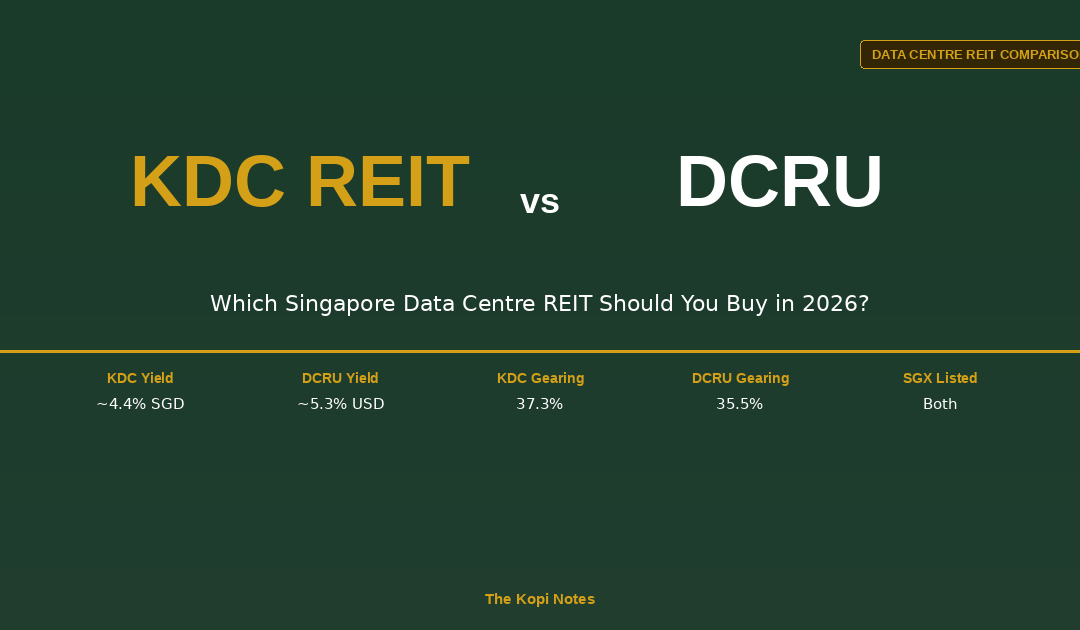
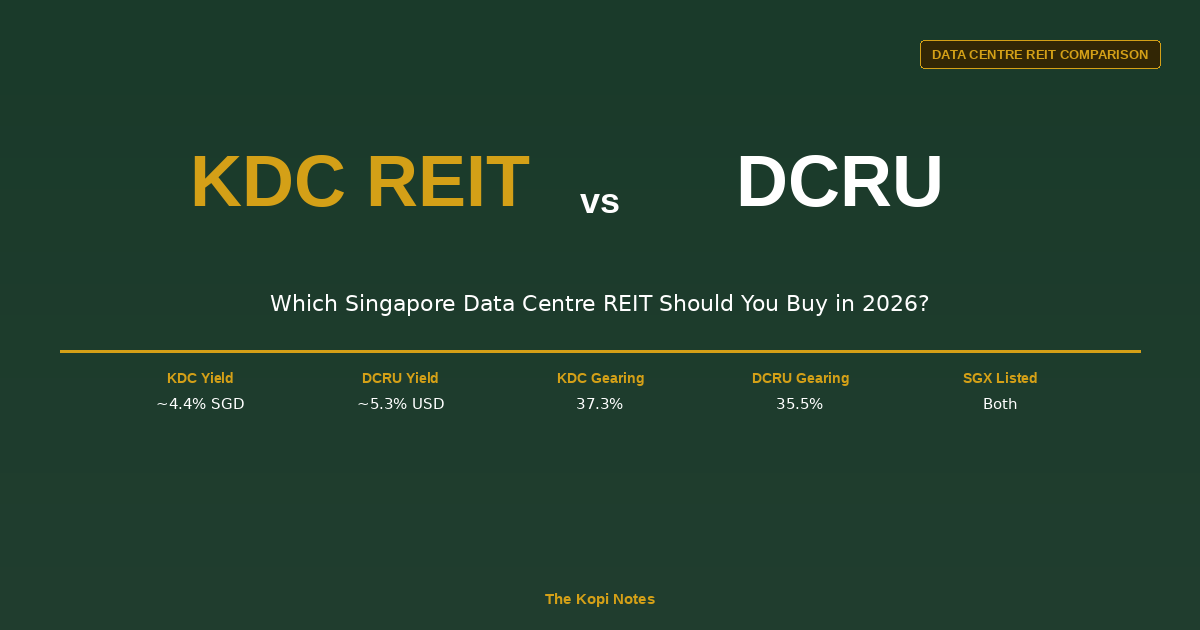
Keppel DC REIT (SGX: AJBU) and Digital Core REIT (SGX: DCRU) are Singapore’s two listed pure-play data centre REITs, but they serve very different investor profiles. KDC REIT offers SGD-denominated distributions, a diversified 21-asset portfolio across Singapore and Europe, and a proven track record since 2014. Digital Core REIT distributes in USD, owns 10 hyperscale data centres across the USA, Europe and Japan with Digital Realty as its sponsor, and trades at a meaningful discount to NAV — making it potentially attractive for investors comfortable with currency risk and seeking higher USD yield.
Not financial advice. All figures are for educational reference only. Data as at October 2026 unless noted.
What Is Keppel DC REIT (AJBU)?
Keppel DC REIT (SGX: AJBU) is Asia’s first and Singapore’s largest listed data centre REIT by assets under management. Launched in December 2014, it is sponsored by Keppel Group — one of Singapore’s largest conglomerates with deep infrastructure expertise.
As at Q3 2026, KDC REIT’s portfolio comprises 21 data centres across 9 countries, with assets under management of approximately S$3.7 billion. The portfolio spans Singapore (its largest market), Germany, Netherlands, United Kingdom, Ireland, Italy, Australia, and Malaysia. The REIT derives the majority of its income from Singapore and Europe, providing meaningful geographic diversification while retaining SGD as its distribution currency for unitholders.
KDC REIT’s tenant base is long-tenured, with a weighted average lease expiry (WALE) of around 7.3 years as at the latest reporting period. Top tenants include major technology firms and cloud providers on long-term leases, providing high occupancy stability typically above 97%.
The REIT has grown its DPU consistently since listing, reflecting the structural tailwind of rising data consumption. For FY2026, the annualised DPU stands at approximately 9.15 SGD cents per unit, representing a distribution yield of around 4.4% at the prevailing share price of S$2.08.
What Is Digital Core REIT (DCRU)?
Digital Core REIT (SGX: DCRU) listed on SGX in December 2021, making it a more recent addition to Singapore’s REIT landscape. Its sponsor is Digital Realty Trust (NYSE: DLR), one of the world’s largest data centre companies with assets across six continents.
DCRU’s portfolio is concentrated in premium hyperscale data centres — facilities leased to single or very few large-scale cloud and enterprise tenants on long-term contracts. The portfolio currently comprises 10 data centres located in San Jose (California), Chicago, Northern Virginia, Frankfurt (Germany), Tokyo (Japan), and Osaka (Japan). These are tier-3 and tier-4 facilities with high power density and mission-critical specifications.
A key differentiator is that DCRU distributes in USD rather than SGD. For Singapore investors, this introduces foreign exchange risk — the DPU you receive in SGD terms will fluctuate with the USD/SGD exchange rate. As at October 2026, the USD/SGD rate is approximately 1.35, which is important to factor into your yield calculations.
DCRU currently trades at a discount to its net asset value (NAV), with a P/NAV ratio of approximately 0.87x, compared to KDC REIT’s slight premium to NAV at ~1.05x. This discount reflects higher borrowing costs impacting US asset valuations and some uncertainty around the USD distribution cadence.
Head-to-Head: Key Metrics Comparison (2026)
Before diving into the qualitative comparison, let’s look at the numbers side by side. The table below summarises the key investment metrics for both data centre REITs as at October 2026.
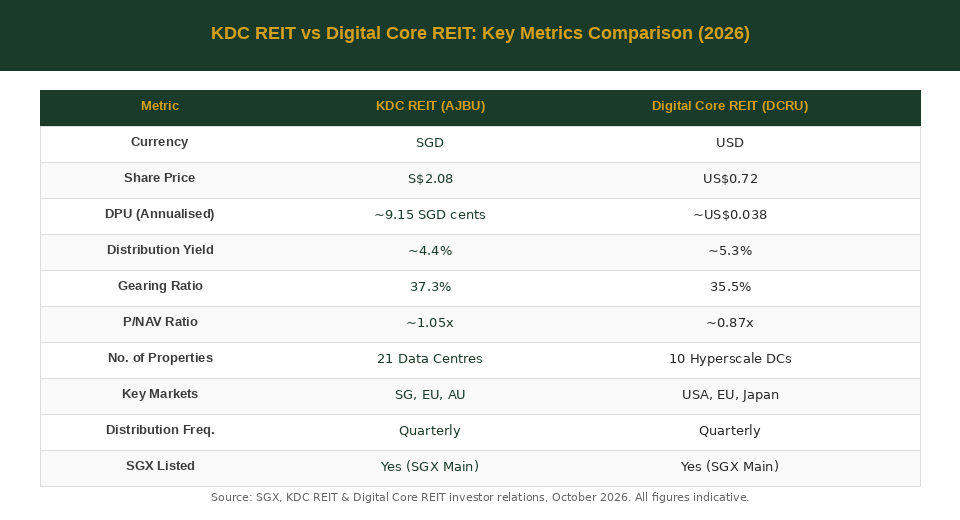
| Metric | KDC REIT (AJBU) | Digital Core REIT (DCRU) |
|---|---|---|
| Distribution Currency | SGD | USD |
| Share Price (Oct 2026) | ~S$2.08 | ~US$0.72 (~S$0.97) |
| Annualised DPU | ~9.15 SGD cents | ~US$0.038 |
| Distribution Yield | ~4.4% (SGD) | ~5.3% (USD) |
| Gearing Ratio | 37.3% | 35.5% |
| Price-to-NAV | ~1.05x (slight premium) | ~0.87x (discount to NAV) |
| Number of Properties | 21 data centres | 10 hyperscale DCs |
| Key Markets | SG, Germany, EU, AU, MY | USA, Germany, Japan |
| Sponsor | Keppel Group | Digital Realty Trust (DLR) |
| Listed Since | December 2014 | December 2021 |
| WALE | ~7.3 years | ~6.8 years |
Source: SGX, KDC REIT and Digital Core REIT investor relations, October 2026. All figures indicative — verify with latest filings before investing.
Yield Comparison: SGD vs USD Distributions
The yield comparison between the two REITs is nuanced due to the currency difference. KDC REIT pays in SGD, meaning what you see is what you get — no currency conversion risk. DCRU pays in USD, so your actual SGD income fluctuates with the exchange rate.
At the current USD/SGD rate of approximately 1.35, DCRU’s annualised DPU of US$0.038 per unit translates to roughly SGD 0.051 per unit. At DCRU’s share price of ~US$0.72 (~S$0.97), this gives an SGD yield of approximately 5.3%. However, if the USD weakens to 1.30 against SGD (as it has historically), the effective SGD yield drops to approximately 5.1%.
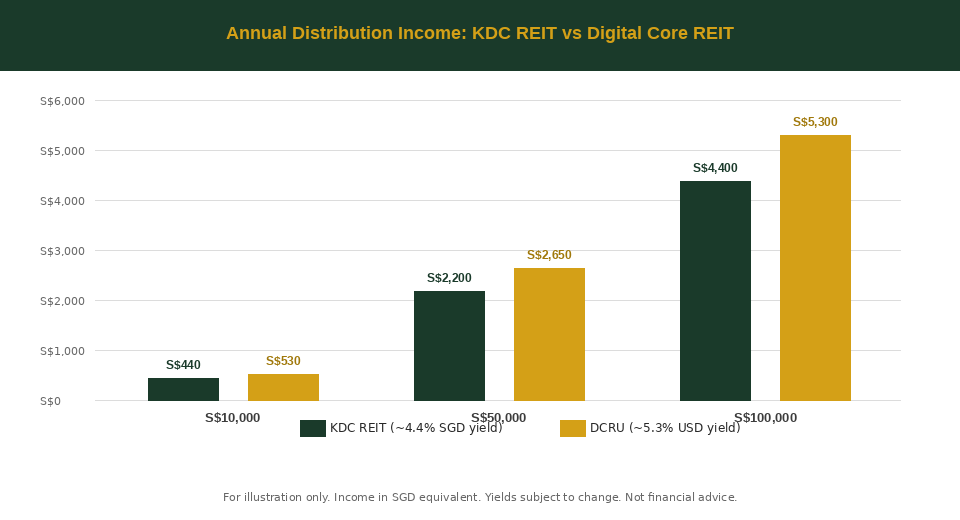
Here is a worked example comparing actual income for a Singapore investor with S$50,000 invested in each REIT:
For S$50,000 in KDC REIT at S$2.08 per unit: you hold approximately 24,038 units × 9.15 SGD cents DPU = S$2,199 per year in SGD distributions.
For S$50,000 in DCRU at S$0.97 per unit (equivalent): you hold approximately 51,546 units × US$0.038 DPU × 1.35 (USD/SGD) = S$2,644 per year in distributions — but this figure will move with the exchange rate.
The income chart below illustrates the annual distribution income comparison at three portfolio sizes.
Portfolio Quality & Geographic Diversification
Both REITs own institutional-quality data centre assets, but with meaningfully different portfolio characteristics that suit different investor preferences.
KDC REIT provides diversification across 21 assets, which reduces concentration risk. Its Singapore assets are colocation-type data centres serving enterprise clients, while its European assets include high-specification built-to-suit facilities for major cloud providers. The REIT has consistently maintained portfolio occupancy above 97%, which is exceptional even by global data centre standards. Singapore’s sovereign-grade internet connectivity and political stability make its assets particularly defensible.
DCRU is concentrated in 10 hyperscale data centres — far fewer assets, but each is massive in scale. Hyperscale facilities are built to specification for single anchor tenants like Google Cloud, Microsoft Azure, or Amazon Web Services, with lease terms often exceeding 10 years. The downside is greater concentration risk: if one major tenant does not renew, the impact on DPU is significant.
DCRU’s US-heavy portfolio benefits from the world’s deepest hyperscale market but also faces higher refinancing costs in the USD rate environment. Its Japan properties in Tokyo and Osaka represent strong markets given Japan’s own AI infrastructure buildout and limited land supply in key data centre zones.
Valuation: P/NAV & Share Price Analysis
Valuation is where the two REITs diverge most clearly. KDC REIT trades at approximately 1.05x its net asset value — a slight premium reflecting its market leadership, SGD distribution, and track record. Historically, quality Singapore REITs with strong growth profiles trade between 1.0–1.2x NAV.
DCRU, by contrast, trades at a meaningful discount of approximately 0.87x NAV. This discount has been driven by several factors: the higher interest rate environment in the US (raising its cost of debt), some uncertainty around the pacing of future DPU growth, and the relative illiquidity of the stock compared to KDC REIT.
For value-oriented investors, DCRU’s P/NAV discount is attractive IF you believe: (a) interest rates will fall further, compressing cap rates and boosting valuations, (b) the USD will remain strong against SGD, and (c) the hyperscale demand story underpinned by AI infrastructure capex remains intact. All three conditions have a reasonable basis in the current macro environment.
For investors who prefer a lower-risk, “sleep well at night” data centre exposure, KDC REIT’s track record, SGD distributions, and diversified portfolio make it the steadier choice — even at a slight premium to NAV.
Risk Factors Investors Must Know
Both data centre REITs face macro risks including rising interest rates (which increase refinancing costs), Singapore MAS gearing regulations (45% cap for S-REITs), and the possibility of a data centre supply glut in certain markets. However, their specific risks differ significantly.
| Risk Factor | KDC REIT | DCRU |
|---|---|---|
| FX / Currency Risk | Low — SGD distributions | High — USD distributions |
| Tenant Concentration | Moderate — 21 assets, diversified | High — 10 assets, hyperscale |
| Interest Rate Sensitivity | Moderate — 37.3% gearing | Moderate — 35.5% gearing |
| Liquidity | High (SGX Top 30) | Lower (smaller free float) |
| DPU Growth Track Record | 11+ years, consistent growth | Listed Dec 2021, shorter track |
| Supply Glut Risk | Low-Medium (SG moratorium lifted) | Medium (US market competitive) |
Source: Author’s analysis based on REIT filings, October 2026. Risk ratings are qualitative and subject to change.
KDC REIT vs DCRU: Which Should You Buy?
The right choice depends on your investment profile and risk tolerance. Here’s our framework to help you decide:
Choose KDC REIT (AJBU) if you:
- Prefer SGD-denominated distributions with no FX risk
- Value a long track record (11+ years of DPU growth)
- Want higher portfolio diversification across 21 assets and 9 countries
- Are building a core S-REIT portfolio aligned with the best S-REITs in Singapore 2026 framework
- Prefer higher market liquidity (easier to exit a large position)
Choose Digital Core REIT (DCRU) if you:
- Are comfortable with USD distributions and currency fluctuation
- Seek higher yield (5.3% USD vs 4.4% SGD) and see potential NAV recovery as rates fall
- Believe in the hyperscale data centre thesis (AI demand driving mega-DC requirements)
- Want exposure to the US and Japan data centre markets not available via KDC REIT
- Are a value investor attracted by the ~0.87x P/NAV discount
Consider holding both for genuine diversification across two distinct data centre sub-sectors — KDC REIT for core stability and SGD income, DCRU for higher growth potential and USD asset exposure. Combining them at 70:30 or 60:40 (KDC:DCRU) gives you the stability of KDC with some optionality on DCRU’s discount-to-NAV recovery.
Whichever REIT you choose, both are accessible via most Singapore brokers using Syfe Trade or through fund platforms like FSMOne if you prefer a brokerage with broader research tools. You can also access KDC REIT via your CPF Investment Scheme (CPFIS-OA) account — see our CPF investment strategy Singapore guide for details.
If you are targeting passive income in Singapore, both data centre REITs can supplement a dividend-focused portfolio alongside retail and industrial REITs. Use our Singapore retirement calculator to model how much you need invested in REITs to hit your target monthly income.
How to Buy KDC REIT & Digital Core REIT in Singapore
Both SGX-listed REITs can be purchased through any Singapore brokerage with SGX access. Here’s a quick comparison of popular options as at October 2026:
Syfe Trade — Commission-free trades for SGX stocks and REITs (capped conditions apply). Use Syfe referral code SRPRFFFCD for a sign-up bonus. Good for regular small purchases. Note: DCRU is traded in USD lots on SGX — check that your broker supports USD-denominated SGX securities.
FSMOne — Flat-fee brokerage with extensive REIT research tools and reports. Use FSMOne referral code P0544985 for account opening benefits. Good if you want integrated research and portfolio tracking.
Interactive Brokers (IBKR) — Lowest commissions for active traders, supports multi-currency accounts. Referral link jianxiong368 for account sign-up. Best if you are holding both SGD and USD cash for DCRU distributions.
For CPF investing: KDC REIT is CPFIS-approved and can be bought using CPF Ordinary Account funds via a CPFIS agent bank. DCRU is not currently CPFIS-eligible due to its USD denomination and fund structure.
Frequently Asked Questions: KDC REIT vs Digital Core REIT
Is KDC REIT or Digital Core REIT better for passive income in Singapore?
For Singapore dollar passive income with no FX risk, KDC REIT is the better choice. It pays ~4.4% SGD yield, has a 11+ year track record of consistent distributions, and is more liquid. If you can tolerate USD currency exposure for higher yield, Digital Core REIT’s ~5.3% USD yield may appeal, but your actual SGD income will fluctuate with USD/SGD movements.
Can I buy Digital Core REIT (DCRU) with CPF funds?
No. Digital Core REIT is currently not on the CPF Investment Scheme (CPFIS) approved list due to its USD denomination and fund structure. Keppel DC REIT (AJBU) is CPFIS-OA eligible, allowing you to invest CPF Ordinary Account funds into it. Check with your CPF agent bank or the CPF Board’s approved investment list for the latest status before investing.
Which data centre REIT has higher yield in 2026?
Digital Core REIT offers a higher USD yield of approximately 5.3%, compared to KDC REIT’s 4.4% SGD yield. However, the comparison is not straightforward — DCRU’s USD distributions mean your SGD income is exposed to exchange rate movements. If USD weakens versus SGD, the effective SGD yield from DCRU falls. On a like-for-like SGD basis, the yield difference narrows to approximately 0.5–0.8 percentage points depending on the exchange rate.
What is KDC REIT's latest dividend per unit (DPU) in 2026?
Keppel DC REIT’s most recent quarterly DPU is approximately 2.288 SGD cents per unit (1Q FY2026), representing an annualised DPU of approximately 9.15 SGD cents. This translates to a yield of around 4.4% at the prevailing share price of approximately S$2.08. KDC REIT distributes quarterly. Always verify the latest DPU on the official KDC REIT investor relations page before making investment decisions.
Is Digital Core REIT a good buy at a discount to NAV?
DCRU trading at ~0.87x NAV means you are buying its data centre assets at a 13% discount to their appraised value. This can be attractive if you expect interest rates to fall (boosting NAV) and USD to remain steady or strengthen versus SGD. The risks are that US real estate valuations could decline further, sponsor-related issues could arise, or the USD weakens materially. Value investors may find DCRU compelling; income-focused investors who want predictable SGD distributions may prefer KDC REIT.
Should I hold both KDC REIT and Digital Core REIT in my portfolio?
Holding both provides complementary exposure: KDC REIT for SGD income stability and diversified global data centres, DCRU for higher USD yield and hyperscale US/Japan market access. A 70:30 or 60:40 split (KDC:DCRU by portfolio value) balances income reliability with growth optionality. Ensure your total data centre REIT allocation is sized appropriately within your broader S-REIT portfolio — we generally suggest capping any single sub-sector at 30–40% of your REIT allocation.
Does Singapore have withholding tax on REIT distributions?
Singapore resident individual investors are exempt from the 17% withholding tax on S-REIT distributions — distributions are received in full, tax-free at source. This applies to both KDC REIT and Digital Core REIT when held by Singapore tax residents. Non-resident investors and companies may be subject to withholding tax. Consult a tax advisor for your specific situation, especially regarding DCRU’s USD distributions and any US source income considerations.
Disclaimer: The Kopi Notes is not a licensed financial adviser. All content is for educational purposes only and does not constitute financial advice. Data centre REIT distributions are not guaranteed. Past DPU performance does not guarantee future distributions. Always do your own due diligence and consult a qualified financial adviser before investing. All figures as at October 2026 and subject to change.
This article was researched with the help of AI. While we strive to keep all information accurate and up to date, there may be errors. If you notice any discrepancies, please contact us.