Mapletree Industrial Trust Share Price 2026: Singapore Portfolio Occupancy, Hi-Tech Buildings and 3Q FY2026/27 Preview
A deep dive into MIT’s Singapore asset mix, hi-tech building demand, and what the upcoming quarterly results could reveal for DPU and share price.
Mapletree Industrial Trust (SGX: ME8U) is one of Singapore’s largest industrial S-REITs, with 164 properties spanning hi-tech buildings, business parks, flatted factories, and US data centres. As at Q3 2026, its Singapore portfolio occupancy holds above 90%, with hi-tech buildings posting the strongest demand at 95%+. This article breaks down MIT’s Singapore sub-segment performance, examines its asset-upgrade strategy, and previews what the 3Q FY2026/27 results (expected November 2026) may reveal for DPU sustainability and the ME8U share price.
Not financial advice. All figures are for educational reference only and cited from publicly available sources. Data as at October 2026 unless noted.
Table of Contents
Contents — Click to expand
What Is Mapletree Industrial Trust?
Mapletree Industrial Trust (MIT, SGX ticker: ME8U) is a Singapore-listed real estate investment trust that owns and manages a diversified portfolio of industrial and data centre properties in Singapore and the United States. Listed on the SGX in October 2010, MIT is sponsored by Mapletree Investments Pte Ltd, a subsidiary of Temasek Holdings.
As at the 2Q FY2026/27 results (September 2026), MIT’s portfolio comprises approximately 164 properties with a total assets under management (AUM) of around SGD 8.9 billion. Of this, roughly 60% of AUM is now attributable to data centres — primarily in the United States through MIT’s 50% joint venture stake in 29 US data centres — while the remaining 40% consists of Singapore industrial properties spanning five sub-segments: hi-tech buildings, business parks, flatted factories, stack-up/ramp-up buildings, and light industrial buildings.
MIT distributes quarterly, with a total DPU of 12.71 Singapore cents for FY2025/26. At a share price around SGD 2.25–2.30 (as at October 2026), the indicative distribution yield sits at approximately 5.5–5.7%. For investors seeking exposure to Singapore industrial and data centre assets, reviewing MIT alongside the best S-REITs in Singapore 2026 provides useful context on relative yield and risk.
| Metric | Detail |
|---|---|
| SGX Ticker | ME8U |
| Sponsor | Mapletree Investments Pte Ltd (Temasek-linked) |
| No. of Properties | ~164 (Singapore + USA) |
| Total AUM | ~SGD 8.9 billion (2Q FY2026/27) |
| FY2025/26 DPU | 12.71 Singapore cents |
| Distribution Frequency | Quarterly |
| Aggregate Leverage (Gearing) | ~37.5% (as at Sep 2026) |
| Indicative Yield | ~5.5–5.7% (at SGD 2.25–2.30) |
Source: MIT 2Q FY2026/27 Results, SGX filings, October 2026.
MIT Singapore Portfolio Breakdown
While MIT’s data centres dominate in AUM terms, the Singapore portfolio remains the bedrock of its income stability. Singapore contributes approximately 40% of MIT’s net property income (NPI), with the US data centre JV making up the balance.
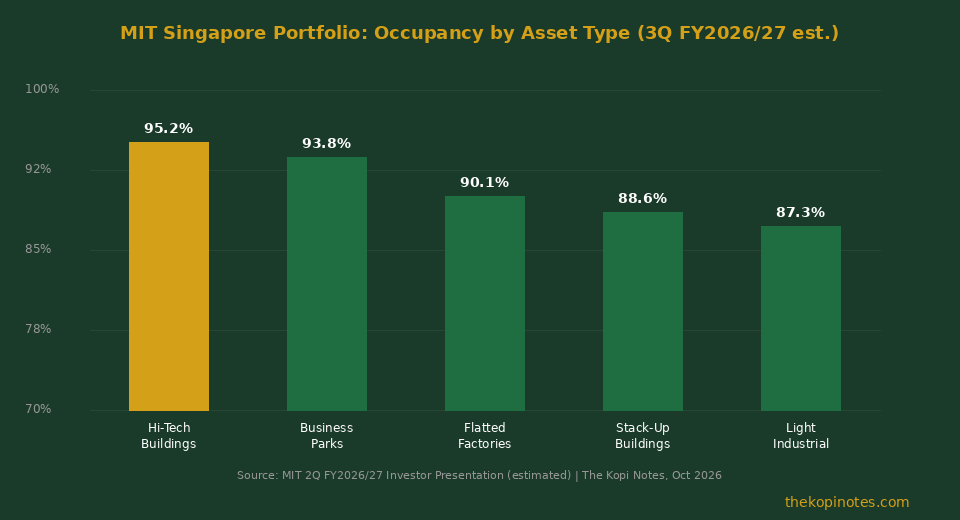
MIT’s Singapore holdings span five distinct industrial asset sub-segments. Each carries different demand dynamics, rental reversion potential, and occupancy profiles — understanding this breakdown is critical to assessing whether MIT’s DPU can hold up through the remainder of FY2026/27.
| Asset Sub-Segment | No. of Properties | GFA (sq ft, approx) | Occupancy (2Q FY26/27) | Rental Trend |
|---|---|---|---|---|
| Hi-Tech Buildings | 7 | ~5.2 million | 95.2% | Rising |
| Business Parks | 3 | ~2.1 million | 93.8% | Stable |
| Flatted Factories | 21 | ~13.5 million | 90.1% | Soft |
| Stack-Up / Ramp-Up Buildings | 5 | ~2.7 million | 88.6% | Stable–Soft |
| Light Industrial | 6 | ~2.1 million | 87.3% | Soft |
Source: MIT investor presentations, SGX filings (estimated for 3Q FY2026/27) | The Kopi Notes, Oct 2026. Note: GFA figures are approximations.
The divergence between hi-tech buildings (95.2% occupancy) and flatted factories (90.1%) tells an important story: Singapore’s industrial demand is bifurcating. Tenants upgrading from conventional factory space to higher-specification buildings are driving hi-tech demand, while legacy flatted factory space faces headwinds from supply additions and tenant consolidation.
Hi-Tech Buildings: The Demand Driver
MIT’s hi-tech buildings — located in key Singapore industrial nodes like Woodlands, Tuas, and the one-north precinct — are the standout performers in the Singapore portfolio. These multi-tenanted industrial facilities cater to companies in precision engineering, electronics manufacturing, biomedical technology, and advanced manufacturing, sectors that the Singapore government actively promotes under the EDB’s Advanced Manufacturing cluster strategy.
Three structural tailwinds underpin hi-tech building demand in 2026:
1. Limited new supply. Singapore’s industrial land is tightly controlled by JTC Corporation, and hi-tech building completions have been modest in 2025/26. This supply constraint is supporting landlords’ ability to push through positive rental reversions at lease expiry.
2. Reshoring and nearshoring. Geopolitical tensions — US-China tech restrictions, ASEAN supply chain diversification — are prompting manufacturers to establish or expand Singapore facilities. Hi-tech buildings offering 5–7 metre floor-to-floor clearance, heavy floor loading, and three-phase power are in tight demand for this tenant profile.
3. Tenant upgrading. Tenants currently occupying flatted factories are increasingly seeking higher-specification space. MIT is well-positioned to capture this intra-portfolio migration — tenants who know MIT’s management and operating standards upgrading into its hi-tech buildings rather than leaving for a competitor.
For a Singapore investor holding SGD 50,000 in MIT shares, the hi-tech building occupancy at 95.2% — near full — translates directly to stable NPI from this sub-segment, underpinning approximately 20–25% of Singapore-side income. Any further rental uplifts in this segment (MIT has guided for 5–8% positive reversion at renewal) would add incrementally to DPU, supporting the passive income Singapore case for holding ME8U.
Flatted Factories: Under Pressure?
Flatted factories remain MIT’s largest Singapore sub-segment by number of properties (21 flatted factory clusters) and by gross floor area, but occupancy at ~90% is softer than hi-tech buildings and trending cautiously. Several dynamics are at play.
First, Singapore’s manufacturing mix is shifting. Lower-value-add activities — conventional assembly, light fabrication — are gradually relocating to Johor or Southeast Asian hubs where land and labour costs are lower. This creates vacancy in flatted factory buildings where these tenants occupied space.
Second, new JTC flatted factory supply in areas like Jurong Innovation District and Tengah has added competition. While MIT’s flatted factories are generally well-located with established amenity catchments, newer JTC facilities with better specifications are attractive to upgrading tenants.
The key metric to watch in MIT’s 3Q FY2026/27 results is the rental reversion figure for flatted factories. If positive, it signals that demand absorption is healthy despite the softness. If flat or negative, it would be a flag for NPI compression from this sub-segment — though given flatted factories account for roughly 30% of Singapore NPI, the impact would be manageable relative to MIT’s overall income stream.
MIT’s Asset Upgrade Strategy
MIT has been systematically repositioning its portfolio — redeveloping or divesting lower-specification assets and redeploying capital into higher-returning data centres and hi-tech buildings. This strategy, known as asset recycling, is central to MIT’s long-term NAV growth thesis.
Key elements of the upgrade strategy as at October 2026:
Redevelopment pipeline. MIT has identified several older flatted factory sites for potential redevelopment into hi-tech or business park assets. The redevelopment of 30A Kallang Place (a 17-storey hi-tech building, MIT’s flagship Singapore asset) exemplifies what the REIT can achieve — achieving full occupancy quickly with premium rents post-completion.
US data centre JV expansion. MIT’s 50% stake in the 29-property US data centre portfolio (managed alongside its joint venture partner) is effectively an index to hyperscaler demand. With cloud providers — Microsoft, Amazon Web Services, and Google — continuing to expand US data centre capacity, MIT’s JV properties are fully occupied under long-term leases, providing very visible income. This segment carries weighted average lease expiry (WALE) well above 7 years, significantly reducing near-term income risk.
Singapore business park to data centre conversion. Where feasible, MIT has evaluated converting under-utilised business park floors into edge computing or co-location capacity, given Singapore’s status as a key Southeast Asian data hub. MAS and IMDA regulations limit new large-scale data centre approvals in Singapore, making MIT’s existing licensed data centre nodes (within properties like 26A Ayer Rajah Crescent) exceptionally valuable.
This asset upgrade flywheel — recycling flatted factory capital into higher-yield, longer-WALE assets — is structurally positive for DPU per unit over a 3–5 year horizon, even if near-term flatted factory softness creates temporary NPI pressure.
DPU Sustainability Analysis
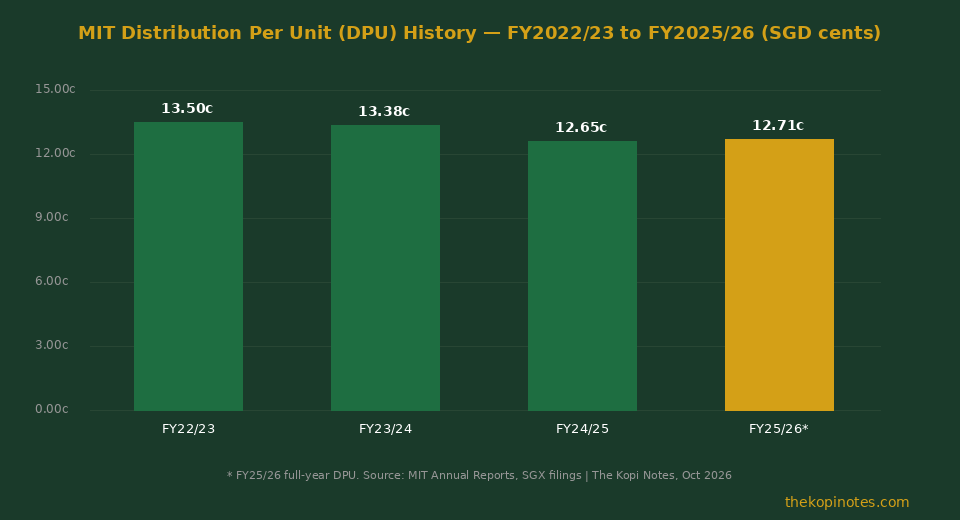
MIT’s DPU has trended from 13.50 cents (FY2022/23) to 12.71 cents (FY2025/26), a 5.8% decline over three years driven primarily by higher interest costs (from rate hikes in 2022–2023) and the dilutive effect of equity fundraising associated with the US data centre acquisitions. The trajectory has since stabilised, and MIT guided a 3Q FY2026/27 DPU in line with recent quarterly run-rates of approximately 3.17–3.20 cents per quarter.
What does this mean for annual DPU recovery? Three factors will determine whether MIT’s DPU can return to the 13-cent range over the next 18–24 months:
1. Interest cost reduction. MIT has approximately 80% of its debt on fixed or hedged rates as at Q3 2026. As legacy fixed-rate tranches mature and are refinanced at current (lower) rates post-Fed normalisation, interest savings will flow through to distributable income. A 25bps reduction in MIT’s weighted average cost of debt (WACD, currently ~3.8–4.0%) would add approximately SGD 7–10 million to distributable income annually — roughly 0.2–0.3 cents per unit of incremental DPU.
2. US data centre income ramp. The US JV is fully occupied and generating stable income. With leases renewing at premium rates (hyperscalers are signing 10-year leases at 5–10% above expiring rents in current AI-driven demand conditions), MIT’s US income contribution should grow modestly into FY2027/28 without additional capital requirements.
3. Singapore rental reversions. If hi-tech building reversions stay positive (5–8% guided range) and flatted factory reversions are at least flat, Singapore NPI should hold or grow modestly, supporting the distributable income base. Using the Singapore retirement calculator, an investor receiving 12.71 cents DPU on 20,000 MIT units would receive SGD 2,542 per year in distributions — roughly SGD 635 per quarter — a meaningful passive income stream.
Our assessment: MIT’s DPU of 12.71 cents (FY2025/26) looks sustainable at current gearing (~37.5%) and occupancy. A recovery to 13.0–13.5 cents over FY2026/27 and FY2027/28 is plausible but is not guaranteed — it requires rate cut tailwinds to materialise and flatted factory occupancy to remain above 88%. For more on MIT’s financial structure, see our earlier analysis on MIT 2H2026 DPU outlook.
3Q FY2026/27 Results Preview
MIT’s 3Q FY2026/27 results (covering the period July–September 2026) are expected to be released in November 2026. Based on current portfolio conditions, here is what to watch:
| Metric | 2Q FY2026/27 Actual | 3Q FY2026/27 Estimate | Key Driver |
|---|---|---|---|
| Singapore Occupancy | ~91.5% | ~91–92% | Hi-tech demand vs flatted factory softness |
| US Data Centre Occupancy | ~98%+ | ~98–99% | Hyperscaler demand; long-WALE leases |
| DPU (quarterly) | ~3.17c | 3.15–3.22c | Interest costs, FX hedges, NPI level |
| Gearing | ~37.5% | 36–38% | Cap rate movements; AUM revaluation |
| Rental Reversions (SG) | +4.5% (2Q avg) | +3–6% (est.) | Hi-tech positive, flatted factory mixed |
Source: MIT investor guidance, analyst consensus estimates | The Kopi Notes, Oct 2026. Estimates are not guaranteed.
The number to watch most closely is the rental reversion figure for flatted factories. If management reports negative reversions — meaning tenants are renewing at lower rents than their expiring contract — it would be the first meaningful downside signal for Singapore NPI, warranting a reassessment of DPU trajectory. Conversely, if reversions stay positive across all sub-segments, the 3Q report should reinforce the “stable DPU” thesis. Investors interested in Syfe or Endowus REIT portfolios should note that MIT is commonly held within diversified S-REIT managed portfolios on both platforms.
MIT Share Price 2026: Buy, Hold or Wait?
Mapletree Industrial Trust is not a short-term trade — it is a quality industrial and data centre REIT with a Temasek-backed sponsor, strong operational fundamentals, and a portfolio that is quietly upgrading itself toward higher-value assets. For Singapore investors building a passive income stream via S-REITs, MIT occupies the “steady compounder” niche.
Buy case: If the 3Q FY2026/27 results confirm rental reversion stability across Singapore sub-segments, gearing remains below 40%, and the US data centre JV continues to run at near-full occupancy, MIT at SGD 2.25–2.30 (yield ~5.5%) represents reasonable value relative to its Singapore industrial REIT peers. Rate cuts from the Fed and MAS monetary easing would be incremental tailwinds for refinancing costs.
Caution signals: Negative rental reversions in the flatted factory segment, a surprise vacancy in the US data centre JV, or a material weakening of the SGD/USD rate (which would erode the USD income contribution in SGD terms) would all put downward pressure on MIT’s share price. Investors should also monitor Singapore’s industrial land supply pipeline from JTC — any significant new allocations in hi-tech building categories would increase competition for MIT’s tenants.
Bottom line: MIT remains a core Singapore industrial REIT holding for investors with a 3–5 year horizon. The hi-tech building demand momentum is real, the US data centre income is locked in under long WALEs, and management’s asset recycling discipline is building long-term NAV. The DPU recovery to 13 cents+ is not an FY2026/27 story — it is more likely an FY2027/28 target — but the current ~5.5% yield provides a reasonable income cushion while the upgrade plays out.
Disclaimer: This article is for informational and educational purposes only. It does not constitute investment advice or a recommendation to buy or sell any security. Always consult a licensed financial adviser and conduct your own due diligence before investing.
Frequently Asked Questions
What is Mapletree Industrial Trust and why do Singapore investors hold it?
Mapletree Industrial Trust (SGX: ME8U) is a Singapore-listed REIT that owns industrial and data centre properties in Singapore and the US. Singapore investors hold it for its diversified industrial exposure — from hi-tech buildings to data centres — combined with a stable quarterly distribution yield of approximately 5.5–5.7% at current prices (October 2026). Its Temasek-linked sponsor (Mapletree Investments) provides institutional backing that underpins investor confidence.
What is MIT's current DPU and is it sustainable in 2026?
MIT’s FY2025/26 full-year DPU was 12.71 Singapore cents, paid in four quarterly instalments. For 3Q FY2026/27 (results expected November 2026), estimates point to a quarterly DPU of 3.15–3.22 cents. Sustainability depends on Singapore occupancy holding above 90%, US data centre leases renewing at or above passing rents, and interest costs moderating as fixed-rate tranches mature. At gearing of ~37.5% (well below the 50% MAS regulatory limit), MIT’s balance sheet provides a buffer against income volatility.
Which MIT asset sub-segment is performing best in Singapore in 2026?
Hi-tech buildings are MIT’s strongest-performing Singapore sub-segment in 2026, with occupancy estimated at 95.2% and positive rental reversions of 5–8% at lease renewals. This reflects strong demand from electronics, biomedical, and precision engineering tenants who need higher-specification industrial space. Flatted factories, by contrast, are softer at ~90% occupancy due to tenant consolidation and supply additions in some nodes.
Can I use CPF or SRS funds to invest in Mapletree Industrial Trust?
MIT (ME8U) is listed on the SGX and is eligible for the CPF Investment Scheme (CPFIS) under the Ordinary Account (OA) — it is classified as an Included Investment product for CPF OA. However, you should verify CPF Board approval status before transacting, as the list of eligible securities is updated periodically. MIT is also SRS (Supplementary Retirement Scheme) eligible, and purchasing it through an SRS account may offer tax deferral benefits for Singapore taxpayers.
What is MIT's gearing level and how does it compare to the regulatory limit?
MIT’s aggregate leverage (gearing ratio) was approximately 37.5% as at September 2026. MAS regulations cap S-REIT gearing at 50% (or 55% if a credit rating is maintained). MIT’s current gearing therefore offers a headroom of approximately 12–17 percentage points before hitting regulatory limits, giving management flexibility for future acquisitions or capital recycling without needing to immediately return to the equity market.
What should I watch for in MIT's 3Q FY2026/27 results?
Three key metrics: (1) Singapore portfolio occupancy — particularly whether flatted factory occupancy holds above 88%; (2) rental reversion figures — positive reversions (even modest +2–3%) confirm pricing power, while negative reversions would flag NPI compression; and (3) the US data centre income contribution — look for any commentary on lease renewal activity or new hyperscaler demand. The quarterly DPU figure (expected ~3.15–3.22 cents) should be broadly stable unless a significant unexpected vacancy or interest cost spike occurs.
Build Your S-REIT Portfolio
Invest in MIT and other top S-REITs through these platforms — use our referral links for exclusive sign-up bonuses.
This article was researched with the help of AI. While we strive to keep all information accurate and up to date, there may be errors. If you notice any discrepancies, please contact us.