How to Top Up Your CPF Ordinary Account in Singapore (2026 Step-by-Step Guide)
A complete guide for Singapore Citizens and PRs — voluntary contributions, annual limits, tax relief, and step-by-step instructions.
To top up your CPF Ordinary Account (OA) in Singapore, you make a Voluntary Contribution (VC) through the CPF Board’s e-Cashier portal. Unlike RSTU top-ups (which go to SA/RA only), a VC splits across all three accounts — OA, SA, and MA — in the same ratio as your mandatory contributions. You can contribute up to the CPF Annual Limit of $37,740 for 2026, minus your year-to-date mandatory contributions. Tax relief of up to $8,000 (self) applies to the MediSave portion only.
Not financial advice. All figures are for educational reference only. Data as at October 2026 unless noted.
What Does “Topping Up CPF OA” Actually Mean?
Many Singaporeans search for how to top up their CPF Ordinary Account expecting a direct OA deposit button — but CPF doesn’t work quite that way. There are two distinct mechanisms, and understanding the difference is critical before you transfer any money.
Voluntary Contributions (VC) — This is the primary route if you want to increase your OA balance. When you make a VC, CPF Board splits the amount across all three accounts (OA, SA, MA) in the same proportion as your mandatory contribution ratio. For example, a Singaporean under 35 sees approximately 62% go to OA, 16% to SA, and 22% to MA. So if you contribute $5,000 as a VC, roughly $3,100 lands in your OA.
RSTU Cash Top-Up — The Retirement Sum Topping-Up Scheme sends money directly to your SA (if you’re under 55) or Retirement Account (if 55 and above). It does not go into the OA. This is the scheme most people associate with “CPF top-ups” because it attracts the most generous tax relief.
If your goal is to invest OA money in unit trusts or repay HDB loans faster, you need the Voluntary Contribution route. If your goal is maximising retirement savings and tax relief, RSTU or direct MA top-ups are more efficient. Understanding your objective saves time and money.
CPF OA Top-Up at a Glance
| Item | Details (2026) |
|---|---|
| CPF Annual Limit | $37,740 (mandatory + voluntary combined) |
| OA Interest Rate | 2.5% p.a. (first $20k earns extra 1% = 3.5%) |
| OA Allocation (age ≤35) | ~62% of VC goes to OA |
| VC Portal | CPF e-Cashier (my.cpf.gov.sg) |
| Payment Methods | PayNow, eNETS, GIRO |
| Who Can Top Up | Singapore Citizens and PRs only |
| Tax Relief (VC) | MediSave portion only; up to $8,000 combined relief via Voluntary MA top-up route |
Source: CPF Board, October 2026
Step-by-Step: How to Top Up Your CPF via Voluntary Contribution
Follow these steps to make a Voluntary Contribution that increases your OA balance. The entire process takes under 10 minutes once you have your SingPass ready.
Step 1 — Check Your Remaining Annual Limit
Log in to my.cpf.gov.sg using SingPass. Navigate to My Account → My Statement and look for your year-to-date mandatory contributions. Subtract that from $37,740 to find your maximum additional VC for the calendar year.
Example: Your employer has contributed $18,000 in mandatory CPF this year. You can voluntarily contribute up to $37,740 − $18,000 = $19,740. This entire $19,740 would be distributed across OA/SA/MA at your applicable allocation rates.
Step 2 — Navigate to CPF e-Cashier
From the CPF homepage, go to Tools & Services → e-Cashier. Alternatively, search “CPF e-Cashier” on Google. Log in with SingPass 2FA.
Step 3 — Select “Contribute to My Own CPF Account”
Choose the option for your own account (not topping up a family member’s). Select the contribution type: Voluntary Contribution (VC). Enter your NRIC number and the amount you wish to contribute.
Step 4 — Choose Payment Method and Confirm
CPF e-Cashier accepts PayNow QR, eNETS (direct bank debit), or GIRO. PayNow is instant. GIRO takes 3–5 business days. Once payment clears, CPF Board processes the split within 3 working days and credits each account accordingly.
Step 5 — Verify the Credit
Log back into my.cpf.gov.sg after 3–5 working days. Navigate to My Account → My Statement to confirm the OA, SA, and MA credits. The OA amount should reflect roughly 62% of your total VC if you are aged 35 or below.
If your primary goal is to invest the OA in CPF-approved unit trusts or managed funds, consider using the funds via a platform like Endowus referral code — Endowus is one of the few platforms authorised to invest CPF OA and SA monies in a diversified portfolio.
CPF Top-Up Methods Compared
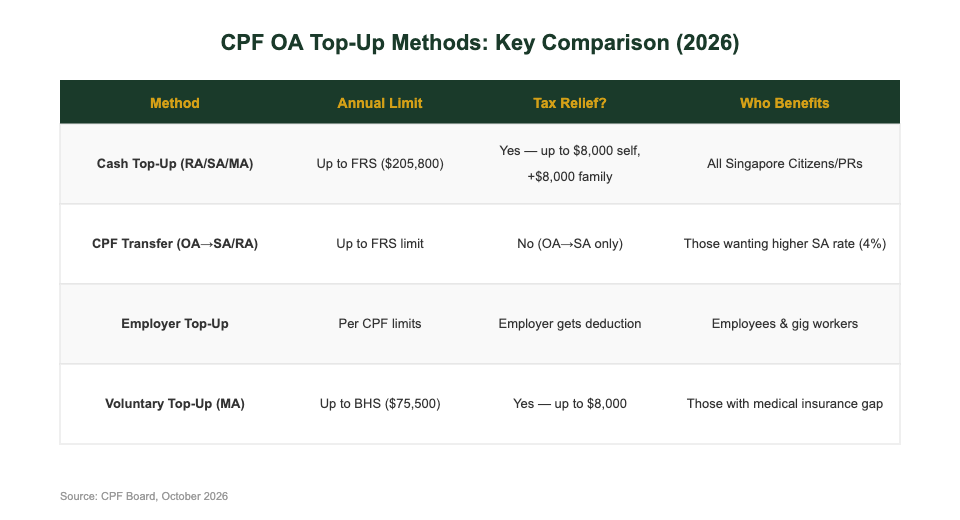
Depending on your objective — boosting OA for investment, building your retirement nest egg in SA/RA, or ensuring MediSave adequacy — different top-up routes offer different benefits. The table below maps each method to its tax efficiency and target account.
| Method | Target Account | Annual Limit | Tax Relief | Best For |
|---|---|---|---|---|
| Voluntary Contribution (VC) | OA + SA + MA split | Up to Annual Limit ($37,740) minus mandatory contributions | MA portion only (limited) | Boosting OA for investment / HDB loan |
| RSTU Cash Top-Up | SA (under 55) / RA (55+) | Up to FRS ($205,800) minus current balance | Up to $8,000 self + $8,000 family | Maximising retirement savings |
| MediSave Top-Up | MA only | Up to Basic Healthcare Sum (BHS $75,500) | Up to $8,000 self + $8,000 family | Medical coverage + tax relief |
| OA → SA Transfer | SA only (from OA) | Up to FRS limit (irreversible) | None | Earning 4% vs 2.5% — only if you don’t need OA for housing |
Source: CPF Board, October 2026. FRS = Full Retirement Sum. BHS = Basic Healthcare Sum.
Tax Relief for CPF Cash Top-Ups: How Much Can You Save?
Tax relief is the primary financial incentive for making voluntary CPF contributions beyond mandatory amounts. However, the relief structure differs significantly depending on which top-up route you use — and the OA-focused VC route is actually the least tax-efficient of the three options.
Tax Relief for RSTU (SA/RA) Cash Top-Ups
The Retirement Sum Topping-Up Scheme is Singapore’s most generous CPF tax relief pathway. You can claim:
- Up to $8,000 for topping up your own SA or RA
- Additional $8,000 for topping up the SA/RA of your parents, grandparents, spouse, or siblings
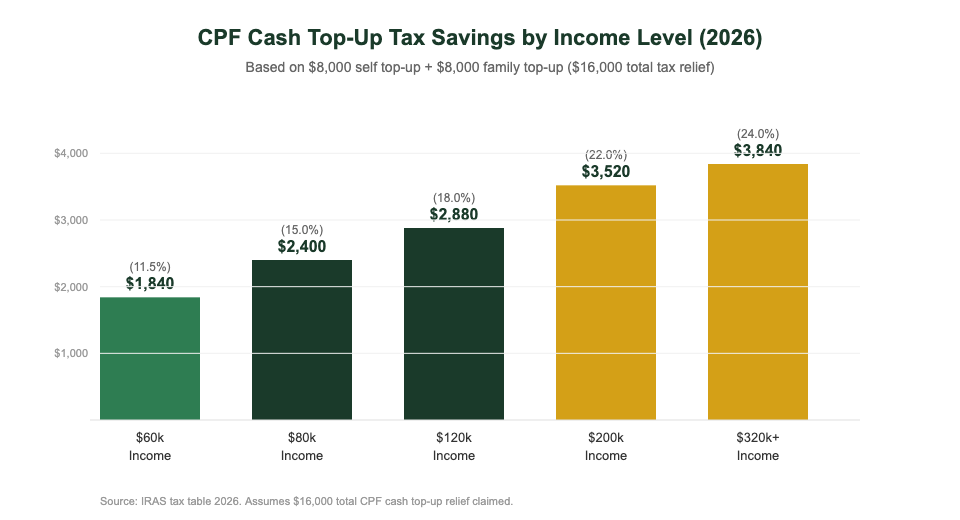
- Maximum combined relief: $16,000 per year
At a marginal income tax rate of 18% (applicable to chargeable income of $120,000–$160,000), a $16,000 RSTU top-up saves you $2,880 in tax annually. For higher earners at the 24% bracket ($320,000+), the saving reaches $3,840 per year. Over a 10-year horizon, this compounds meaningfully — especially alongside the 4% guaranteed SA interest rate.
Tax Relief for MediSave Top-Ups
Topping up your MA directly (to the Basic Healthcare Sum of $75,500 in 2026) also qualifies for up to $8,000 relief for self and $8,000 for qualifying family members. This is separate from the RSTU relief limit — meaning theoretically a Singapore investor could claim up to $16,000 under RSTU and $16,000 under MA top-up relief, for a maximum $32,000 reduction in chargeable income annually (subject to meeting all other CPF contribution rules).
Tax Relief for Voluntary Contributions (VC) to OA
Here’s the less-publicised truth: voluntary contributions to your OA do not attract the $8,000 RSTU-style relief directly. The only tax relief available under a general VC is on the MediSave portion of the contribution. If you contribute $10,000 via VC and ~22% goes to MA, you are contributing ~$2,200 to MA — and only that MediSave portion can offset against your tax, capped by the annual MA top-up relief limit.
This is why many CPF-savvy Singaporeans separate their top-up strategy: use VC for growing OA (for investment or HDB purposes), while using the dedicated RSTU or direct MA top-up routes for maximum tax relief.
To see how your CPF contributions fit into your overall retirement plan, try the Singapore retirement calculator to model different contribution scenarios across your working years.
Who Should Top Up Their CPF Ordinary Account?
Topping up your OA makes most sense in three specific scenarios. Outside these, you are likely better served by allocating voluntary contributions toward SA or MA first.
Top Up OA If You’re Planning a Property Purchase
If you have an upcoming HDB flat purchase or BTO exercise within 1–2 years, a higher OA balance means a larger CPF usage amount — potentially reducing the amount of cash you need to bring to the table at completion. The OA earns 2.5% (3.5% on the first $20,000) while your money waits for the key collection date. A $30,000 voluntary contribution made 18 months before key collection earns approximately $1,125 in interest while growing your housing budget.
Top Up OA for CPF Investment Scheme (CPFIS) Access
The CPF Investment Scheme (CPFIS) allows you to invest OA savings exceeding $20,000 in CPF-approved unit trusts, ETFs, and REITs. Platforms like Endowus and Syfe are authorised CPFIS operators. If your OA balance is below $20,000 or you want to grow the investable pool, a VC increases the sum available for CPFIS deployment. The CPF investment strategy for Singapore investors covers this in detail — see the CPF investment strategy guide for a full breakdown of CPFIS-eligible products and allocation frameworks.
Top Up OA for Self-Employed or Gig Workers
Self-employed Singaporeans are only mandated to contribute to MediSave — OA and SA contributions are entirely voluntary. If you are a freelancer or business owner, making regular VCs to build your OA gives you access to the housing purchase pipeline and CPFIS that salaried employees accumulate automatically. A self-employed person earning $60,000 per year who contributes $1,000/month via VC over 20 years (assuming 2.5% compounding on OA) accumulates approximately $240,000 in OA alone — a meaningful housing or investment cushion.
Consider Alternatives First
If your SA balance is below the Full Retirement Sum ($205,800 in 2026), you will almost always generate more wealth by topping up SA via RSTU first. The 4% SA interest rate plus $8,000 of annual tax relief on a $16,000 RSTU contribution produces a first-year effective yield of ~12–20% depending on your tax bracket — no market risk, government-guaranteed. For passive income generation beyond CPF, Singapore investors commonly diversify into dividend-paying assets; see our passive income Singapore guide for how CPF compares to S-REITs and T-Bills as an income vehicle.
All CPF contribution limits and tax relief figures quoted are for the calendar year 2026 and may be revised by the Singapore Government. Always verify the latest figures at cpf.gov.sg before making financial decisions.
Frequently Asked Questions
How do I top up my CPF Ordinary Account directly?
You cannot add money solely to the OA in isolation. To increase your OA balance, you make a Voluntary Contribution (VC) via the CPF e-Cashier portal at my.cpf.gov.sg. The VC is automatically split across OA, SA, and MA at your applicable allocation rates based on age. For Singaporeans aged 35 and below, approximately 62% of a VC flows into the OA. Log in with SingPass, select “Contribute to My Own CPF Account”, choose Voluntary Contribution, enter your desired amount (up to the Annual Limit of $37,740 minus year-to-date mandatory contributions), and pay via PayNow or eNETS.
What is the maximum I can top up to my CPF in 2026?
The CPF Annual Limit is $37,740 for 2026. This cap applies to the total of your mandatory contributions (from you and your employer) plus any voluntary contributions you make. To find out how much room remains for voluntary top-ups, log in to my.cpf.gov.sg and check your year-to-date mandatory contribution figure, then subtract it from $37,740. Note that the Annual Limit does not apply to the Retirement Sum Topping-Up Scheme (RSTU) for SA/RA, which has its own separate limit tied to the Full Retirement Sum ($205,800 in 2026).
Do I get tax relief for topping up my CPF OA?
Voluntary contributions to your OA do not qualify for the $8,000 RSTU tax relief directly — that relief is specifically for top-ups to SA (under 55) or RA (55 and above). However, the MediSave portion of your VC may qualify for the MA top-up relief, capped at $8,000 for self and $8,000 for qualifying family members. For maximum tax relief, top up your SA via RSTU first, then your MA directly — OA top-ups are best motivated by investment access or property planning, not tax optimisation.
Can foreigners or non-PR holders top up CPF?
No. Only Singapore Citizens and Permanent Residents can make CPF contributions, including voluntary top-ups. Work pass holders on Employment Pass, S Pass, or other non-PR statuses do not have CPF accounts and cannot use the e-Cashier portal. Foreigners who become PRs will have CPF accounts opened automatically and can then begin making voluntary contributions alongside their mandatory contributions.
Can I invest CPF OA money after topping up?
Yes. Once your OA balance exceeds $20,000, the amount above $20,000 is eligible for investment under the CPF Investment Scheme (CPFIS-OA). Approved CPFIS operators include Endowus and Syfe, who allow you to invest OA savings in diversified unit trusts and managed portfolios. Note that the first $20,000 must remain in OA earning 3.5% (2.5% base + 1% extra interest) and cannot be invested. If you top up your OA via VC and your existing OA is already above $20,000, the new funds are immediately investable. Use the referral code SRPRFFFCD for Syfe and 2V343 for Endowus when opening an account to access any available sign-up bonuses.
How long does a CPF voluntary contribution take to reflect?
PayNow payments are processed immediately by CPF Board and the contribution typically reflects in your CPF account within 3 working days. eNETS payments take slightly longer — usually 3 to 5 working days from the transaction date. GIRO payments may take up to 7 working days. Once credited, you can view the breakdown of how much went to each account (OA, SA, MA) in your CPF Statement under My Account → My Statement on my.cpf.gov.sg.
Is it worth topping up CPF OA instead of investing in S-REITs or ETFs?
CPF OA earns a guaranteed 2.5% (3.5% on the first $20,000) with zero risk — it is capital-protected and government-backed. S-REITs and LSE-listed ETFs offer higher potential returns (S-REITs yield 4–7% currently, global ETFs may return 7–10% over the long term) but carry market risk. The right allocation depends on your housing plans, existing CPF balances, and risk tolerance. Many Singapore investors treat CPF OA as their safe, low-risk base and deploy discretionary savings into REITs and ETFs for growth. For a broader view of passive income strategies, the Singapore retirement calculator can help you model CPF versus market scenarios side by side.
This article was researched with the help of AI. While we strive to keep all information accurate and up to date, there may be errors. If you notice any discrepancies, please contact us.