CPF LIFE Payout Table 2026: How Much You’ll Get at BRS, FRS & ERS
Standard, Basic and Escalating Plan payouts by Retirement Sum, plus how deferring to age 70 changes your monthly income.
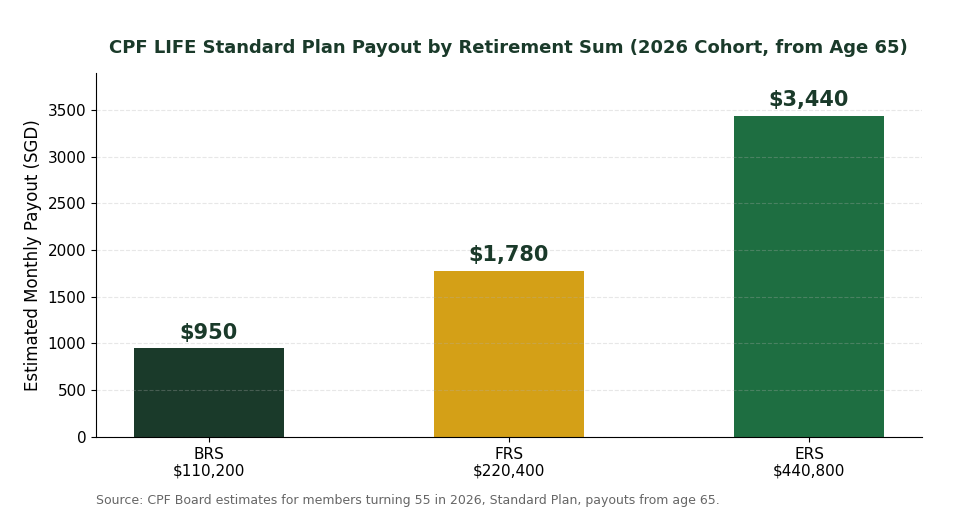
The CPF LIFE payout table for 2026 shows Standard Plan members get about $950 a month at the Basic Retirement Sum ($110,200), $1,780 at the Full Retirement Sum ($220,400), or $3,440 at the Enhanced Retirement Sum ($440,800) — all from age 65. Your actual number depends on your Retirement Account balance, your plan choice, and the age you start payouts.
Not financial advice. All figures are educational estimates from CPF Board’s published 2026 cohort data (members turning 55 in 2026). Data as at August 2026 unless noted.
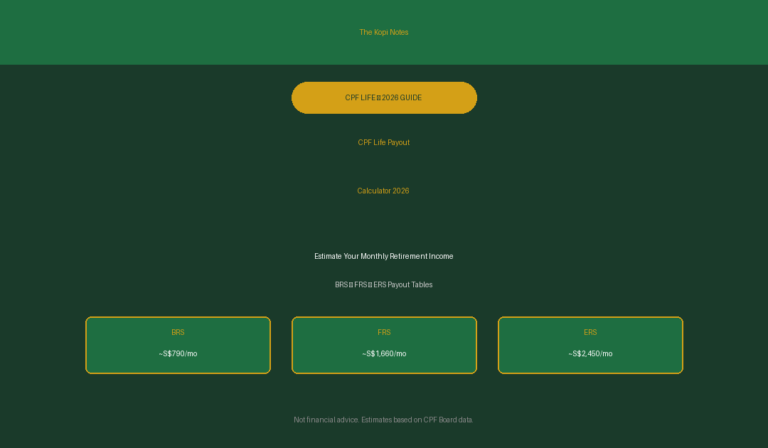
- Standard Plan: BRS $110,200 → ~$950/month, FRS $220,400 → ~$1,780/month, ERS $440,800 → ~$3,440/month, all from age 65.
- Basic Plan pays 10–20% less than Standard but leaves a bigger bequest. Escalating Plan starts about 20% lower but rises 2% every year.
- Deferring from 65 to 70 can lift your payout by up to 35% — but only makes sense if you can afford to wait.
Free download: The Singapore Money Playbook — 7 money mindset shifts written for Singapore, with the CPF-adjusted retirement number most guides get wrong (PDF + Notion).
Table of Contents
Contents — Click to expand
- What Is the CPF LIFE Payout Table?
- CPF LIFE Payout Table 2026: Standard Plan by Retirement Sum
- Basic vs Standard vs Escalating: Payout Comparison
- How Deferring Your Payout Changes the Table
- The CPF Interest Rates Behind Your Payout
- How to Increase Your CPF LIFE Payout
- Which CPF LIFE Plan Should You Choose?
- Frequently Asked Questions
What Is the CPF LIFE Payout Table?
CPF LIFE (Lifelong Income For The Elderly) is Singapore’s national annuity scheme. At age 55, savings from your CPF Special Account (SA) and Ordinary Account (OA) are moved into a new Retirement Account (RA), up to your cohort’s Full Retirement Sum. That RA balance becomes the “premium” for CPF LIFE.
The CPF LIFE payout table simply maps that premium to a monthly income you’ll receive for life from age 65, or later if you defer. You’re automatically enrolled if you’re a Singapore Citizen or Permanent Resident, born in 1958 or after, with at least $60,000 in retirement savings when payouts start. If you want a broader walkthrough of how the scheme works, see our full CPF LIFE payout guide.
Here’s why the table matters: two people with very different RA balances can end up with wildly different retirement incomes. Knowing where you sit on the table — and how your plan choice shifts it — helps you plan the rest of your retirement income around it, including other passive income sources you may need to fill the gap.
CPF LIFE Payout Table 2026: Standard Plan by Retirement Sum
For members turning 55 in 2026, the three official Retirement Sums rose 3.5% from 2025 levels. Here’s the Standard Plan CPF LIFE payout table CPF Board publishes for this cohort, starting payouts at age 65:
| Desired Monthly Payout (from 65) | CPF LIFE Premium at 65 | Savings Needed at 55 |
|---|---|---|
| $490 | $82,400 | $50,000 |
| $950 | $170,200 | $110,200 (BRS) |
| $1,250 | $227,900 | $150,000 |
| $1,780 | $330,100 | $220,400 (FRS) |
| $2,380 | $445,600 | $300,000 |
| $3,440 | $650,100 | $440,800 (ERS) |
Source: CPF Board, illustrative figures for members turning 55 in 2026 (Standard Plan, male member, payouts from age 65). Figures may be adjusted for long-term changes in interest rates or life expectancy.
Notice the jump between rows. Going from BRS to FRS roughly doubles your RA savings (from $110,200 to $220,400) and nearly doubles your payout too. That’s because CPF LIFE payouts scale close to linearly with your premium — there’s no bonus for going bigger, just proportionally more income.
Basic vs Standard vs Escalating: Payout Comparison
The numbers above are for the Standard Plan, CPF’s default. But you get to choose between three plans at 65, and each trades off monthly income against inheritance for your loved ones differently.
Standard Plan pays the highest steady monthly income of the three. It’s the default if you don’t actively choose otherwise.
Basic Plan pays roughly 10–20% less than Standard each month. In exchange, less of your RA savings is used as CPF LIFE premium upfront, so a bigger chunk remains as bequest for your beneficiaries if you pass away.
Escalating Plan starts about 20% lower than Standard, but your payout increases by a fixed 2% every year. If you started at $1,000 a month at 65, you’d be receiving around $1,500 a month by 85. By roughly year 15, Escalating overtakes Standard — useful if you’re worried inflation will erode a flat payout over a 20–30 year retirement.
| Plan | Payout at 65 (FRS Example) | Payout Growth | Bequest to Loved Ones |
|---|---|---|---|
| Standard | ~$1,780/month | Flat for life | Moderate |
| Basic | ~$1,420–$1,600/month | Flat, may taper if RA falls below $60,000 | Highest |
| Escalating | ~$1,420/month | +2% every year | Lowest early, catches up over time |
Source: CPF Board plan descriptions. Basic and Escalating figures are illustrative ranges based on CPF’s stated 10–20% and ~20% differentials versus Standard.
Here’s the trade-off in plain terms: pick Standard or Escalating if maximising lifetime income (or inflation protection) matters more to you than what’s left behind. Pick Basic if leaving money to your family is a bigger priority than squeezing out the last dollar of monthly payout.
How Deferring Your Payout Changes the Table
You don’t have to start CPF LIFE at 65. You can defer any time up to age 70, and each year you wait, your eventual payout increases by up to 7%. Defer the full five years, and you could be looking at up to 35% more than if you’d started at 65.
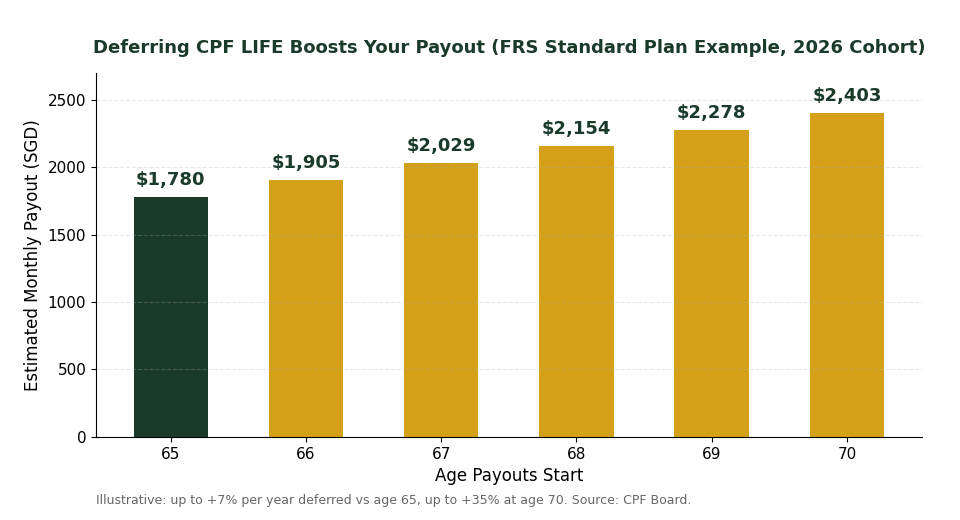
Using the FRS example above, a Standard Plan member who defers from 65 to 70 could see their payout rise from about $1,780 to around $2,403 a month — without adding a single extra dollar to their Retirement Account. That’s your existing RA savings simply having more time to earn interest before payouts begin.
That said, deferral only makes sense if you have other income to bridge the gap — savings, part-time work, or investments — while you wait. If you need the money at 65, take it at 65. A bigger payout later doesn’t help you if you’re short on cash now.
The CPF Interest Rates Behind Your Payout
Your CPF LIFE premium keeps earning interest even after it’s locked into the scheme. As at August 2026, CPF LIFE premiums earn the interest rate floor of 4% per year on Special, MediSave and Retirement Account monies (extended by the government through 31 December 2026), plus up to 2% extra interest on the first $60,000 of your combined balances if you’re 55 or older — 2% on the first $30,000, 1% on the next $30,000.
This is why the “savings needed at 55” figure in the payout table is lower than the “premium at 65” figure. For example, $110,200 set aside at 55 grows to a $170,200 premium by 65 through compounding, before it ever pays out a single monthly payout.
The catch: once your CPF LIFE premium starts generating payouts, the interest earned on it is pooled across all CPF LIFE members to fund payouts for those who live longer than average. Your beneficiaries only receive your remaining premium balance when you pass away, not the interest that balance would otherwise have earned.
How to Increase Your CPF LIFE Payout
If your RA balance falls short of the retirement sum you’re targeting, you have a few levers:
Top up your RA with cash or CPF transfers. A Retirement Sum Top-Up (RSTU) lets you add cash directly to your RA, which also qualifies for CPF tax relief. Since the SA closes automatically at 55 for members born in 1961 or later, transfers to grow your RA now largely happen through cash top-ups rather than SA-to-RA moves.
Use the Matched Retirement Savings Scheme (MRSS). Eligible lower-income members get a dollar-for-dollar government match on every top-up, up to $2,000 a year and $20,000 over your lifetime — effectively free money added to your future payout.
Defer your payout start date. As covered above, waiting until 70 instead of 65 can add up to 35% to your eventual monthly income.
Want to run your own numbers instead of relying on the table above? Our CPF LIFE payout calculator lets you plug in your actual RA balance and target start age.
You can also explore CPF investment strategy options before age 55 to try to grow your OA and SA balances faster than the base CPF interest rate, though this comes with investment risk that guaranteed CPF interest doesn’t carry.
Which CPF LIFE Plan Should You Choose?
Standard Plan suits you if: you want the highest possible steady monthly income and aren’t especially focused on leaving a large CPF inheritance. This is the right default for most people who plan to rely on CPF LIFE as a meaningful chunk of retirement income.
Basic Plan suits you if: leaving money behind for your family matters more to you than a slightly higher monthly payout, and you already have other income sources covering your day-to-day needs.
Escalating Plan suits you if: you’re younger at 65 with a long expected retirement ahead, and you’re worried a flat payout will feel smaller in real terms 15 or 20 years from now due to inflation.
Whichever plan you land on, it helps to see the full picture of your retirement income first. Our Singapore retirement calculator lets you combine your expected CPF LIFE payout with other savings and investments to check if you’re on track.
Frequently Asked Questions
How much is the CPF LIFE payout at BRS, FRS and ERS in 2026?
For members turning 55 in 2026, Standard Plan payouts from age 65 are estimated at about $950 a month at the Basic Retirement Sum ($110,200), $1,780 at the Full Retirement Sum ($220,400), and $3,440 at the Enhanced Retirement Sum ($440,800). These are CPF Board estimates and may be adjusted over time for changes in interest rates or life expectancy.
What is the difference between the CPF LIFE Basic, Standard and Escalating plans?
Standard pays the highest flat monthly income. Basic pays 10–20% less than Standard but leaves a larger bequest to your beneficiaries. Escalating starts about 20% lower than Standard but grows 2% every year, overtaking Standard’s payout around year 15 — useful for protecting against inflation over a long retirement.
How much more do I get if I defer my CPF LIFE payout to age 70?
Each year you defer past 65 can add up to 7% to your eventual monthly payout. Deferring the full five years to age 70 can increase your payout by up to 35% compared with starting at 65, since your existing Retirement Account savings simply have more time to earn interest before payouts begin.
Can I top up my Retirement Account to increase my CPF LIFE payout?
Yes. A Retirement Sum Top-Up (RSTU) lets you add cash to your RA, which also qualifies for CPF tax relief. Eligible lower-income members can also receive a dollar-for-dollar government match through the Matched Retirement Savings Scheme, up to $2,000 a year and $20,000 over your lifetime.
Do CPF LIFE payouts get taxed in Singapore?
No. CPF LIFE monthly payouts are fully tax-exempt in Singapore, regardless of which plan you choose or how large your payout is.
What happens to my CPF LIFE savings when I pass away?
Your beneficiaries receive your CPF LIFE premium balance, calculated as the total premium you paid minus the total payouts you’ve already received. For example, if you paid a $100,000 premium and received $500 a month for 10 months, your loved ones would receive $95,000. This balance is paid in addition to any other CPF savings you hold, and does not include interest the premium would otherwise have earned.
Plan Your Full Retirement Income, Not Just CPF LIFE
CPF LIFE is one piece of the puzzle. See how it fits with your other savings and investments.
This article was researched with the help of AI. While we strive to keep all information accurate and up to date, there may be errors. If you notice any discrepancies, please contact us.