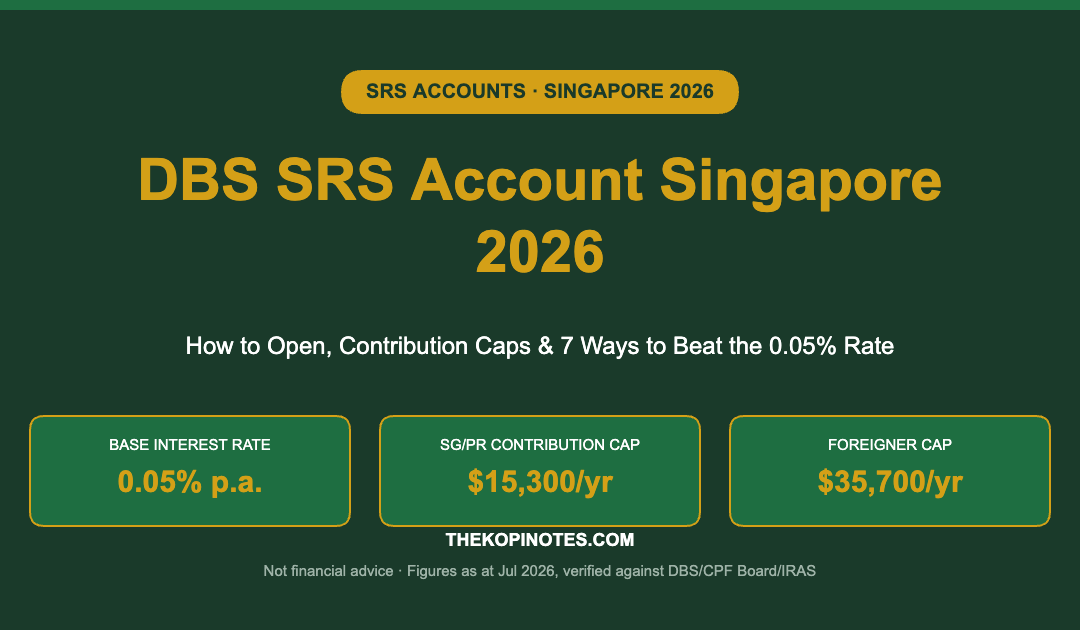
DBS SRS Account Singapore 2026: How to Open & Beat the 0.05% Rate
A step-by-step guide to opening a DBS Supplementary Retirement Scheme account, the 2026 contribution caps, and seven ways to stop your SRS cash earning just 0.05% p.a.
The Supplementary Retirement Scheme (SRS) is a voluntary CPF top-up scheme that gives you dollar-for-dollar income tax relief on every contribution — but the cash you leave uninvested inside it only earns 0.05% p.a., identical across DBS, OCBC and UOB. This guide covers how to open a DBS SRS account, how much you can contribute in 2026, and how to make sure your SRS money isn’t quietly losing to inflation.
Not financial advice. Figures verified against DBS, CPF Board and IRAS sources as at July 2026.
Free download: The Singapore Money Playbook — 7 money mindset shifts written for Singapore, with the CPF-adjusted retirement number most guides get wrong (PDF + Notion).
Table of Contents
”Contents
- Key Facts at a Glance
- Who Can Open a DBS SRS Account
- How to Open a DBS SRS Account (7 Steps)
- SRS Contribution Caps for 2026
- Why the 0.05% Rate Matters
- Tax Savings Worked Example
- 7 Ways to Invest Your DBS SRS Funds
- The DBS Multiplier Angle
- DBS vs OCBC vs UOB: Which SRS Operator?
- Withdrawal Rules Recap
- Common Mistakes to Avoid
- Frequently Asked Questions
Key Facts at a Glance
| Item | 2026 Figure |
|---|---|
| SRS cash interest rate (DBS) | 0.05% p.a. (same at OCBC & UOB) |
| Contribution cap — Singaporean/PR | $15,300/year |
| Contribution cap — Foreigner | $35,700/year |
| Account opening channel | digibank online (instant) or DBS/POSB branch |
| Digibank opening hours | 7am–10pm daily (7am–7pm on last business day of month) |
| Penalty-free withdrawal age | 63 (before 1 Jul 2026 first contribution) / 64 (from 1 Jul 2026) |
| Withdrawal tax | 50% of withdrawal taxable after statutory retirement age |
| Deposit insurance | SGD SRS balances covered up to $75,000 (SDIC) |
Who Can Open a DBS SRS Account
You’re eligible to open a DBS SRS account if you:
- Are a Singaporean, Singapore Permanent Resident, or foreigner aged at least 18
- Are not an undischarged bankrupt
- Do not already hold an SRS account (or a pending SRS application) with another bank — you can only have one SRS account across DBS, OCBC and UOB
Foreigners should note: you’ll need to declare your foreigner status at a DBS branch to unlock the higher $35,700 contribution cap. This declaration resets yearly, since the SRS contribution limit refreshes every 1 January.
How to Open a DBS SRS Account (7 Steps)
If you apply via digibank online during opening hours, your DBS SRS account is opened instantly. Here’s the exact flow:
- Log in to digibank online with your User ID and PIN.
- Complete the authentication process (SMS OTP or digibank token).
- Click Apply on the left menu, then under Invest, select View all.
- Select Supplementary Retirement Scheme at the top and click Apply now under SRS account.
- Read through the information and click Start.
- Check your personal details, select a Reference Account for signature and address, and choose whether to make an initial SRS contribution (enter the amount and funding account).
- Verify your details and click Submit to complete account opening.
Don’t use digibank? You can walk into any DBS or POSB branch with your NRIC or passport and open an SRS account over the counter instead.
SRS Contribution Caps for 2026
The SRS contribution cap is set by IRAS, not by DBS, so it’s identical whichever bank you choose:
- Singapore Citizens & PRs: $15,300 per year
- Foreigners: $35,700 per year
Contributions can be made anytime during the calendar year (subject to digibank’s daily 7am–10pm window), and unused cap does not roll over — it resets to zero every 1 January. Many DBS customers make a lump-sum contribution in December to lock in the same year’s tax relief before the window closes.
Why the 0.05% Rate Matters
According to DBS’s own SRS statistics (end December 2024), 19% of total SRS contributions — S$3.91 billion — sat as idle cash earning almost nothing. At 0.05% p.a., a $15,300 balance earns roughly $7.65 a year, while inflation quietly erodes its purchasing power. Compare that to what the same money could earn elsewhere:
This isn’t a DBS-specific problem — OCBC and UOB pay the identical 0.05% base rate on uninvested SRS cash. The gap only closes once you actually put the money to work (see the investment options below).
Tax Savings Worked Example
The real value of an SRS account isn’t the interest rate — it’s the income tax relief on every dollar contributed, at your marginal tax rate. On a full $15,300 contribution:
At the 22% bracket, a single $15,300 contribution saves $3,366 in tax — 440 times more than the $7.65 the same balance would earn in a year of idle SRS interest. This is why the standard advice is: contribute for the tax relief, then invest the funds rather than leaving them as cash.
7 Ways to Invest Your DBS SRS Funds
DBS lets you deploy SRS funds across a wide range of assets — profits and dividends flow back into your SRS account, not to you directly:
- Singapore Government Securities (SGS) & Singapore Savings Bonds (SSB) — low-risk, purchasable with SRS funds since 1 Feb 2019
- Fixed deposits — DBS’s own SGD fixed deposit rates (around 1.40% p.a. on standard tenors) already beat idle SRS cash
- Foreign currency fixed deposits — for investors comfortable with FX risk
- Shares, ETFs & REITs — traded via a linked DBS Vickers account, SGX-listed only (no direct access to US-listed counters with SRS funds)
- Single premium insurance — endowment or annuity-style products that accept SRS contributions
- Unit trusts — access diversified funds via DBS’s unit trust platform
- digiWealth robo-advisory — DBS’s in-app tool gives a personalised portfolio recommendation if you’d rather not pick investments yourself
Before investing, it’s worth using the SRS Tax Savings Calculator to see how contribution size interacts with your tax bracket, and read our full breakdown of the 0.05% SRS rate for the complete list of eligible instruments.
The DBS Multiplier Angle
One thing that’s specific to DBS: if you also hold a DBS Multiplier account, your SRS-linked activity can help boost your bonus interest there. DBS counts dividends credited into your SRS account (from CDP, DBS Vickers, DBS Unit Trusts, DBS Invest-Saver and similar) as part of your monthly “Investments” transaction category, and investment purchases made through your linked SRS/CPFIA accounts count toward Multiplier’s eligible transactions too. More qualifying categories in a month means a higher bonus interest tier — up to 4.10% p.a. on your first $100,000 if you stack enough categories (salary credit, card spend, home loan, insurance, investments). This doesn’t change the 0.05% paid on your SRS cash itself, but it’s a reason SRS-plus-Multiplier customers sometimes come out ahead of a standalone SRS account at another bank.
DBS vs OCBC vs UOB: Which SRS Operator?
The 0.05% base rate and $15,300/$35,700 caps are set by MOF/IRAS and identical everywhere — the real differences are in opening channel, investment access and linked-account perks:
| Bank | Opening Channel | Key Differentiator |
|---|---|---|
| DBS | digibank online (instant) or branch | DBS Vickers link, digiWealth robo tool, Multiplier bonus-interest synergy |
| OCBC | OCBC app / internet banking (needs an existing OCBC current/savings account first) or branch | Requires a 360 Account or other OCBC account as a prerequisite |
| UOB | UOB TMRW app (Myinfo) or branch | Account number mailed within 7 working days, not shown in-app immediately |
In practice, most investors pick whichever bank they already hold their CDP-linked brokerage or current account with, since it simplifies funding and dividend routing. If you’re starting from scratch, DBS’s fully in-app opening flow (no prerequisite account, unlike OCBC) is the most frictionless.
Withdrawal Rules Recap
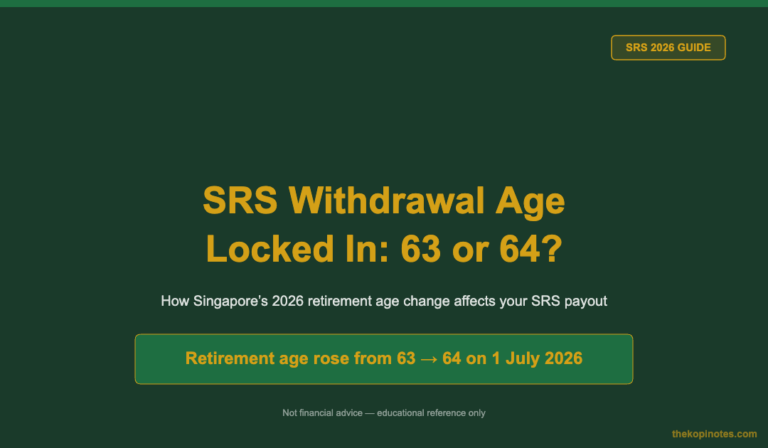
Withdrawals are penalty-free from the statutory retirement age prevailing at the time of your first SRS contribution — currently 63, rising to 64 from 1 July 2026. If you’ve already made your first contribution, later increases to the statutory retirement age don’t affect you. Withdraw earlier than that and you’ll face 100% tax on the withdrawn amount plus a 5% penalty (with limited exceptions for death, terminal illness or physical/mental incapacity).
Once you hit your locked-in retirement age, only 50% of each withdrawal is taxable, and you can stagger withdrawals over up to 10 years to spread — and often eliminate — the tax bill. For the full mechanics and worked examples, see our SRS Withdrawal guide.
Common Mistakes to Avoid
- Leaving contributions as idle cash — the single most common mistake; at 0.05% p.a., inflation erodes your balance in real terms every year it sits uninvested.
- Opening a second SRS account elsewhere — you can only hold one SRS account across all banks; a duplicate application will be rejected.
- Forgetting the annual foreigner declaration — foreigners must re-declare their status at a branch each year to keep the higher $35,700 cap.
- Contributing right before withdrawal age with no investment plan — tax relief is only half the benefit; funds still need time invested to compound.
- Withdrawing in one lump sum — a single large withdrawal can push more of it into a higher tax bracket than a staggered 10-year drawdown would.
Ready to Put Your SRS Funds to Work?
Low-cost platforms like Endowus and FSMOne accept SRS funds directly for diversified investing, while Syfe offers managed portfolios if you’d rather not pick individual funds.
Frequently Asked Questions
”Is
”How
”What
”Can
”How
”Can
”What
”When
”Is
”Should
This article was researched with the help of AI. While we strive to keep all information accurate and up to date, there may be errors. If you notice any discrepancies, please contact us.