SRS Account Interest Rate Singapore 2026: Why 0.05% Isn’t the Full Story
The real return on your SRS account has almost nothing to do with the interest rate — here’s what actually matters in 2026.
The SRS account interest rate in Singapore is just 0.05% per year on uninvested cash — the same low base rate at DBS, OCBC and UOB, the three appointed SRS operators. That’s far below CPF’s 2.50%–4.00% or even a 6-month T-bill’s 1.55%. The real value of an SRS account comes from the upfront tax relief and what you invest the funds in, not the interest sitting idle.
Not financial advice. All figures are for educational reference only. Data as at July 2026 unless noted.
- SRS cash earns just 0.05% p.a. if left uninvested — far below CPF OA (2.50%) or CPF SA (4.00%).
- The real payoff is tax relief: up to $3,366 saved per $15,300 contributed at the 22% bracket — 440x a year of SRS interest.
- Don’t let SRS cash sit idle. Put it into T-bills, SSBs, unit trusts or SGX-listed ETFs so it actually grows.
Free download: The Singapore Money Playbook — 7 money mindset shifts written for Singapore, with the CPF-adjusted retirement number most guides get wrong (PDF + Notion).
Table of Contents
Contents — Click to expand
- What Is the SRS Account Interest Rate in Singapore?
- SRS Interest Rate vs CPF and T-Bills: How It Really Compares
- Why the Real Return on SRS Isn’t the 0.05% Interest
- How to Earn More Than 0.05% on Your SRS Funds
- DBS vs OCBC vs UOB: Which SRS Account Should You Open?
- Common SRS Mistakes to Avoid
- Frequently Asked Questions
What Is the SRS Account Interest Rate in Singapore?
Every Supplementary Retirement Scheme (SRS) account pays a base interest rate of 0.05% per annum on any cash sitting uninvested in the account. This applies uniformly whether you opened your account with DBS, OCBC or UOB — the three banks appointed as SRS operators. There’s no tiered structure, no salary-crediting bonus, and no way to negotiate a better rate on the cash itself.
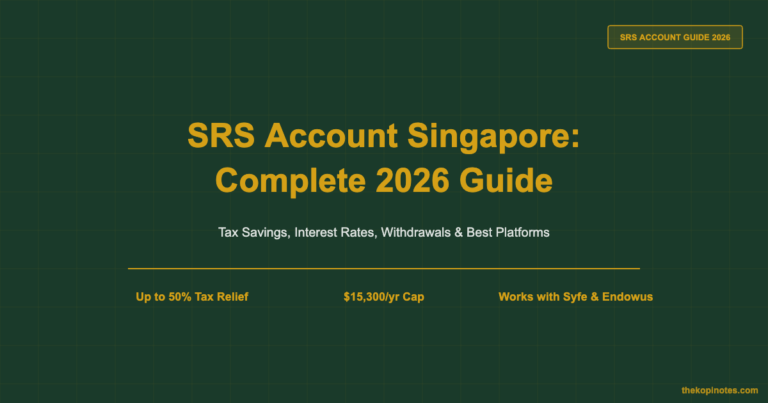
You can contribute up to $15,300 a year if you’re a Singaporean or Permanent Resident, or $35,700 a year if you’re a foreigner working in Singapore, according to IRAS. Every dollar you put in reduces your chargeable income for that year, dollar for dollar, up to the cap.
Here’s the part that catches people out: 0.05% has stayed flat for years. It doesn’t move when MAS tightens or loosens policy, and it doesn’t track the T-bill or Fed funds rate the way your CPF Ordinary Account or a fixed deposit promo might. It’s simply the default rate for money that hasn’t been put to work yet.
SRS Interest Rate vs CPF and T-Bills: How It Really Compares
0.05% only means something once you see it next to the other “safe” places you could park money. Here’s how the SRS base rate stacks up against CPF and the latest Singapore T-bill yield.
| Account / Instrument | Rate (p.a.) | Notes |
|---|---|---|
| SRS uninvested cash | 0.05% | Fixed base rate, same at DBS/OCBC/UOB |
| 6-month T-bill | 1.55% | 16 Jul 2026 auction cut-off yield, resets every auction |
| CPF Ordinary Account (OA) | 2.50% | Government-guaranteed floor rate |
| CPF Special, MediSave & Retirement Account | 4.00% | Floor extended to 31 Dec 2026 |
Source: CPF Board interest rate release (Q3 2026), MAS T-bill auction results (16 Jul 2026), OCBC SRS investment guide.
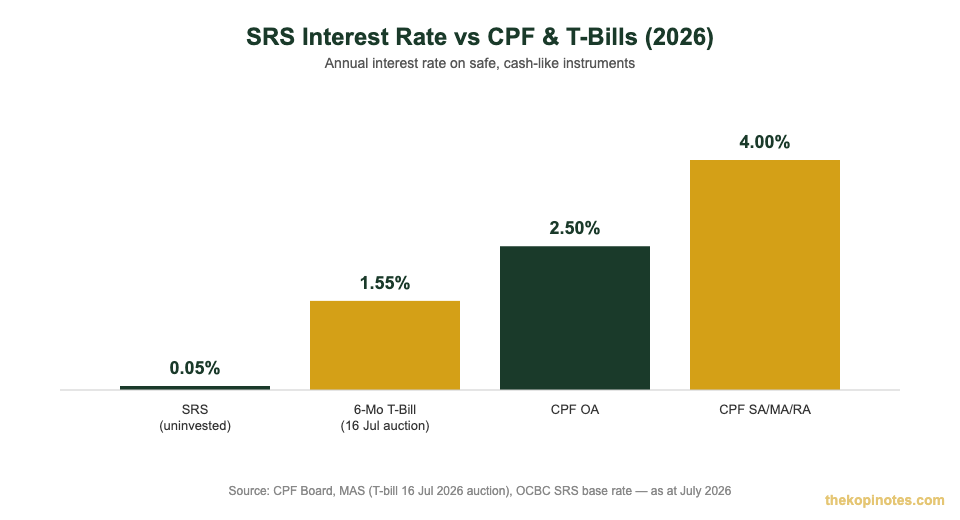
However, this isn’t a fair fight, and that’s the point. CPF OA and SA are government-backed retirement savings you can’t easily access before age 55. T-bills need you to actively apply at each auction. SRS cash, by contrast, is money you already decided to set aside — it’s just sitting there earning almost nothing unless you tell it to do something else.
Why the Real Return on SRS Isn’t the 0.05% Interest
Here’s why the interest rate is almost a distraction. When you contribute to SRS, IRAS reduces your chargeable income by the same amount, up to the annual cap. That tax relief lands the year you contribute — you don’t have to wait, invest well, or take any risk to get it.
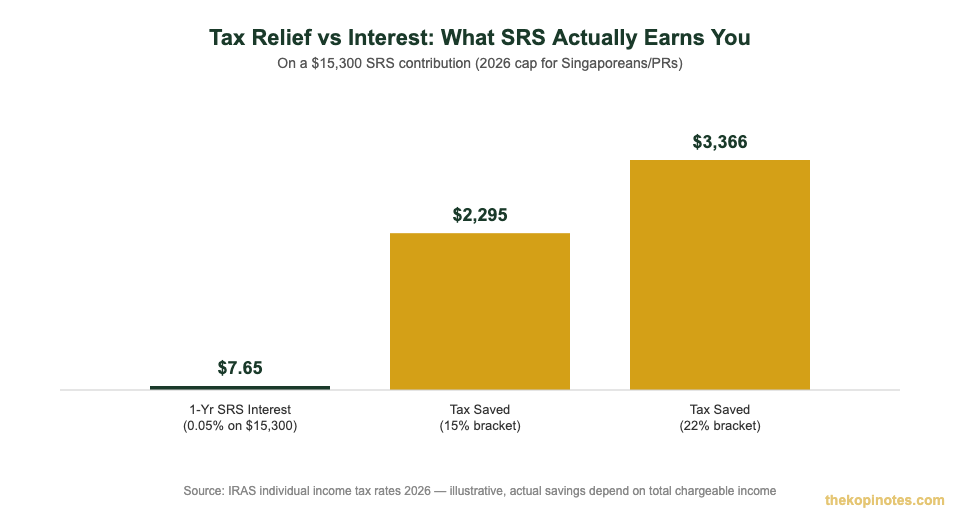
Say you’re in the 15% marginal tax bracket and you contribute the full $15,300 for the year. You save $2,295 in tax immediately. If you’re in the 22% bracket, that same contribution saves you $3,366. Compare that to $7.65 — a full year of SRS interest on the same amount — and the math isn’t close.
| Marginal Tax Bracket | SRS Contribution | Tax Saved |
|---|---|---|
| 15% | $15,300 | $2,295 |
| 22% | $15,300 | $3,366 |
Source: IRAS individual income tax rates, Year of Assessment 2026. Illustrative — actual tax saved depends on your total chargeable income and applicable bracket.
There’s a second layer to this too. Any interest, dividends or capital gains you earn inside your SRS account are not taxed as they accrue — growth compounds tax-free until you withdraw. Tax only applies at withdrawal, and only 50% of the withdrawal is taxable if you withdraw from your statutory retirement age (63 now, rising to 64 from 1 July 2026) onward, spread over up to 10 years. Withdraw earlier and 100% is taxable plus a 5% penalty. For the full breakdown, see our guide on SRS withdrawal rules and tax concession.
How to Earn More Than 0.05% on Your SRS Funds
You’re not stuck at 0.05%. SRS funds can be invested in a specific list of instruments through your SRS operator’s internet banking or a linked broker — you just have to actively apply, rather than assume it happens automatically.
| Option | Typical Return | Risk Level |
|---|---|---|
| T-bills / SGS bonds | ~1.5%–3.0% | Very low (government-backed) |
| Singapore Savings Bonds (SSB) | ~2.5%–3.0% (step-up) | Very low, redeemable anytime |
| Fixed / structured deposits | ~2.0%–3.0% | Low, tenure-locked |
| Unit trusts / robo-advisors | Market-linked, no guarantee | Medium |
| SGX-listed stocks, ETFs & REITs | Market-linked, no guarantee | Medium–high |
Source: MAS Singapore Savings Bonds FAQ, OCBC/UOB SRS investment guides. Not a recommendation — match any choice to your own risk tolerance and time horizon.
A few things worth knowing before you pick: SSBs have been purchasable with SRS funds since 1 February 2019, applied for through your SRS operator’s portal rather than the usual CDP route used for cash purchases. Direct stock and ETF access is limited to SGX-listed counters — most US-listed and other overseas ETFs aren’t available through SRS. Robo-advisors like Endowus, Syfe and FSMOne all accept SRS funds and route them into diversified portfolios if you’d rather not pick individual names. Our SRS Tax Savings Calculator can help you work out exactly how much relief you’d get before deciding how much to contribute this year.
DBS vs OCBC vs UOB: Which SRS Account Should You Open?
You can only hold one SRS account at a time, with one of three operators: DBS/POSB, OCBC or UOB. None of them pays bonus interest on the SRS cash balance itself — that 0.05% base rate is identical across all three. What differs is the sign-up experience and any bundled promotions tied to opening or contributing.
| Operator | SRS Cash Interest | Notes |
|---|---|---|
| DBS/POSB | 0.05% p.a. | Widest linked-investment menu via digibank; sometimes bundled with broader salary-crediting or card promos |
| OCBC | 0.05% p.a. | Straightforward online application, integrates with OCBC’s own unit trust and RSP platforms |
| UOB | 0.05% p.a. | Fewer in-house fund options; often paired with UOB Kay Hian for brokerage access |
Source: DBS, OCBC, UOB SRS account pages, as at July 2026. Bundled promos change frequently — verify current terms directly with the bank.
In practice, the choice matters less for the interest rate and more for which broker or robo-advisor you plan to route your SRS funds into. If you already bank with one of the three, opening SRS there usually saves a step. If you’re investing mainly through Endowus, Syfe or FSMOne, all three connect to any of the three SRS operators, so operator choice becomes a minor convenience decision rather than a returns decision.
Common SRS Mistakes to Avoid
Most of the SRS mistakes we see in Singapore aren’t about picking the wrong investment — they’re about the account itself.
- Leaving cash uninvested for years. This is the single biggest one. Money sitting at 0.05% for five or ten years is a real opportunity cost, even if the tax relief already paid off.
- Assuming you can switch operators freely. You’re tied to whichever bank you opened your SRS account with. Switching means closing the account, which has tax implications — check with your bank first.
- Confusing SRS withdrawal rules with CPF’s. The statutory retirement age lock-in, 50% tax concession, and 10-year staggering rules are SRS-specific and different from CPF withdrawal rules. See our SRS withdrawal age and tax rules guide before you plan a withdrawal.
- Overcontributing above the annual cap. Contributions beyond $15,300 (or $35,700 for foreigners) don’t get tax relief and can’t be refunded without penalty in some cases.
- Treating SRS and CPF as interchangeable. They’re separate schemes with separate interest rates, investment menus and withdrawal rules — don’t assume what applies to your CPF Special Account applies to SRS.
Ready to Put Your SRS Funds to Work?
Compare robo-advisors that accept SRS contributions, or check your own numbers first with our free calculator.
Before you plan how far your SRS savings will stretch in retirement, it’s worth checking your overall numbers with our Singapore retirement calculator — it accounts for CPF, SRS and other savings together, not SRS in isolation. And if you’re also tracking short-term rates, our Singapore T-bill auction results guide is updated after every auction.
Frequently Asked Questions
What is the current SRS account interest rate in Singapore?
0.05% per annum on uninvested cash, as at July 2026. This is the base rate at all three SRS operators — DBS, OCBC and UOB — and applies to any balance you haven’t invested elsewhere.
Does the SRS interest rate change with MAS policy rate moves?
No. Unlike T-bill yields or some fixed deposit promos, the 0.05% SRS base rate has stayed flat regardless of interest rate cycles. It’s set by the banks as a default deposit rate, not pegged to a benchmark.
Is 0.05% the same at DBS, OCBC and UOB?
Yes. All three SRS operators pay the identical 0.05% p.a. base rate on uninvested SRS cash. There’s no operator that pays meaningfully more interest on the cash balance itself.
Can I earn more interest by leaving a larger balance in SRS?
No — the 0.05% rate isn’t tiered by balance size the way some savings accounts are. A larger uninvested balance just means a larger amount earning close to nothing. The only way to meaningfully grow a bigger balance is to invest it.
What can I invest my SRS funds in besides letting it sit as cash?
T-bills, Singapore Government Securities, Singapore Savings Bonds, fixed and structured deposits, unit trusts, endowment and insurance products, and SGX-listed stocks, ETFs and REITs. Most US-listed and other overseas ETFs aren’t directly accessible through SRS.
Can I buy Singapore Savings Bonds (SSB) with SRS funds?
Yes. SSBs have been purchasable with SRS funds since 1 February 2019. You apply through your SRS operator’s internet banking portal, not the usual CDP channel used for cash purchases.
Is SRS interest taxable?
Not while it stays in the account. Interest, dividends and capital gains inside SRS compound tax-free. Tax only applies when you withdraw — 50% of the withdrawal is taxable from your statutory retirement age onward (spread over up to 10 years), or 100% plus a 5% penalty if you withdraw earlier.
How much can I save in taxes by contributing to SRS in 2026?
It depends on your marginal tax bracket. On the full $15,300 cap, someone in the 15% bracket saves $2,295; someone in the 22% bracket saves $3,366. Use our SRS Tax Savings Calculator for a figure based on your actual income.
Should I still open an SRS account if the interest rate is so low?
For most people in a taxable income bracket, yes — the tax relief alone usually outweighs a decade of 0.05% interest. The catch is discipline: SRS only pays off if you eventually invest the funds rather than leaving them as cash indefinitely.
This article was researched with the help of AI. While we strive to keep all information accurate and up to date, there may be errors. If you notice any discrepancies, please contact us.