Is DPS Enough Life Insurance? The Coverage Gap Singaporeans Miss
CPF’s Dependants’ Protection Scheme gives you free term life cover — but for most working adults, it covers only a fraction of what their family actually needs.
The CPF Dependants’ Protection Scheme (DPS) automatically covers most working Singaporeans for up to $70,000, dropping to $55,000 from age 60. DPS is technically a term life insurance policy — a fixed payout with no cash value. For a 35-year-old with a mortgage and two young children, the real protection need can top $1.2 million, leaving a six-figure gap most people never realise exists.
Not financial advice. All figures are for educational reference only. DPS coverage and premium data verified against CPF Board, last updated 4 March 2026. Other figures as at July 2026 unless noted.
- DPS is opt-out term life insurance built into your CPF account — fixed payout, no cash value, and cheap.
- Coverage is capped at $70,000 (drops to $55,000 from age 60) — usually far below what a family with debt and dependants needs.
- Use the DIME method to size your real gap, then close it with an affordable private term life top-up.
Table of Contents
Contents — Click to expand
- What Is DPS, Really? (And Why It’s Term Life Insurance)
- DPS Coverage & Premiums by Age (2026)
- How Much Life Insurance Do You Actually Need?
- The DPS Coverage Gap: A Worked Example
- DPS vs Private Term Life Insurance
- How to Close the Gap
- Who Can Rely on DPS Alone?
- 3 Common Mistakes People Make With DPS
- How to Increase or Opt Out of DPS
- Frequently Asked Questions
What Is DPS, Really? (And Why It’s Term Life Insurance)
The Dependants’ Protection Scheme (DPS) is Singapore’s default life insurance safety net. If you’re a Singapore Citizen or PR with a CPF account, you’re automatically covered from age 21 — unless you actively opt out.
Here’s the part most people miss: DPS is a real term life insurance policy. It pays a fixed sum assured if you die, become terminally ill, or suffer total permanent disability (TPD) before age 65. There’s no cash value, no investment component, and no payout if nothing happens. That’s exactly how a private term life policy works too — DPS is just heavily subsidised and bundled into your CPF membership.
Since 1 April 2021, Great Eastern Life has been the sole insurer administering DPS, with CPF Board extending its appointment through 2028. Premiums are deducted once a year straight from your CPF Ordinary Account (OA). If your OA balance is too low, CPF taps your Special Account (SA) instead. You never pay DPS premiums in cash.
Because DPS and a private term life policy work the same way, comparing “term insurance vs life insurance” often comes down to comparing DPS with a private plan. We cover that broader distinction in our guide to term insurance vs life insurance — this article focuses specifically on whether your free DPS cover is actually enough.
DPS Coverage & Premiums by Age (2026)
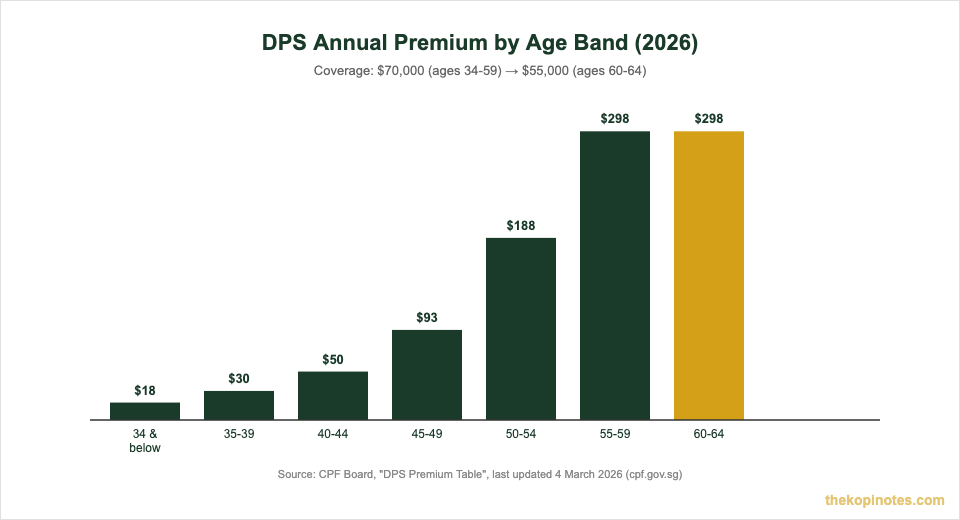
DPS coverage isn’t a flat number for life — it steps down once as you approach retirement. Here’s exactly what CPF Board publishes, verified as at March 2026.
| Age (as of payment date) | Yearly Premium | Sum Assured |
|---|---|---|
| 34 and below | $18 | $70,000 |
| 35 – 39 | $30 | $70,000 |
| 40 – 44 | $50 | $70,000 |
| 45 – 49 | $93 | $70,000 |
| 50 – 54 | $188 | $70,000 |
| 55 – 59 | $298 | $70,000 |
| 60 – 64 | $298 | $55,000 |
Source: CPF Board, DPS Premium Table, last updated 4 March 2026.
Notice something? Your premium rises nearly 17x between your 20s and your late 50s — but your coverage stays completely flat at $70,000 the whole time. Then at 60, the sum assured actually drops to $55,000, even though you’re still paying the same $298. That’s how group term insurance pricing works: it reflects rising mortality risk, not your changing financial needs.
How Much Life Insurance Do You Actually Need?
$70,000 sounds like a lot until you map it against what your family would need if you weren’t around. The DIME method is a simple framework used to size your real coverage gap. It stands for:
- Debt — every outstanding loan you’d leave behind: mortgage, car loan, personal loan, credit card balances.
- Income replacement — how many years of your income your family would need replaced. A common rule of thumb is 10x your annual income.
- Mortgage — your home loan. Some versions of DIME fold this into Debt to avoid double-counting.
- Education — the future cost of your children’s education, from primary school through university.
Add these up, then subtract what you already have — DPS, employer group insurance, existing policies, savings. What’s left is your real coverage gap.
The DPS Coverage Gap: A Worked Example
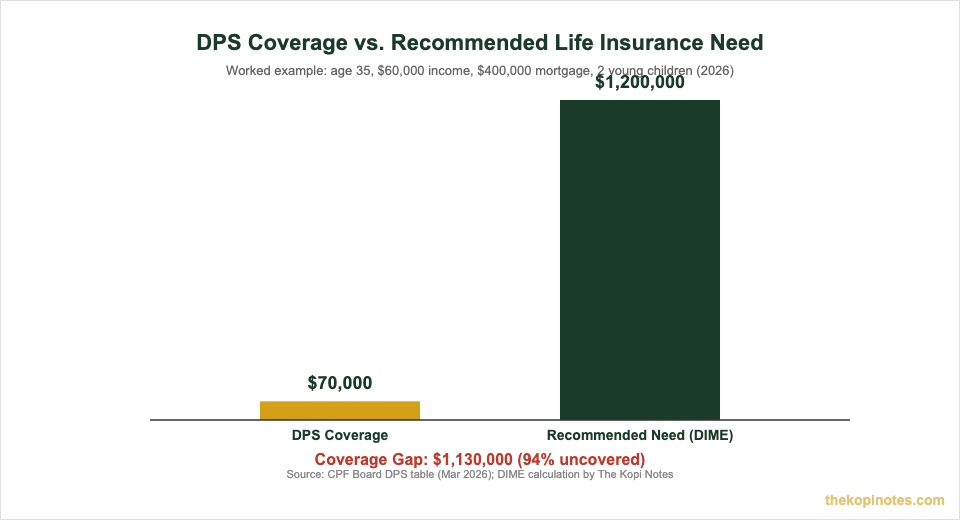
Let’s run a real Singaporean household through DIME. Meet a 35-year-old with a $60,000 annual income, an outstanding $400,000 HDB mortgage, and two young children.
| Component | Calculation | Amount |
|---|---|---|
| Income replacement | 10x annual income | $600,000 |
| Outstanding mortgage | Remaining HDB loan | $400,000 |
| Children’s education | 2 kids, local university estimate | $200,000 |
| Total need | $1,200,000 | |
| DPS coverage (age 35-39) | $70,000 | |
| Coverage gap | $1,130,000 |
Source: DIME calculation by The Kopi Notes, based on CPF Board DPS coverage table (Mar 2026). Illustrative worked example only.
DPS vs Private Term Life Insurance
DPS and a private term life plan are the same type of product — but they behave very differently once you compare them side by side.
| Feature | DPS | Private Term Life Insurance |
|---|---|---|
| Coverage amount | Fixed $70,000 (→ $55,000 at 60) | Customisable, $50,000 to $2,000,000+ |
| Cost | Subsidised, from $18/year | Market rate, from ~$20–40/month for $500k |
| Underwriting | Automatic, no health check | Medical or simplified (DPI) underwriting |
| Coverage age | Ends at 65 | Can extend to 70, 75, even 99 depending on plan |
| Portability | Tied to CPF membership | Fully portable, independent of CPF/employment |
| Payout events | Death, terminal illness, TPD | Death, terminal illness, TPD (some add CI riders) |
DPS wins on cost and convenience — no medical check-up, and premiums come straight from your CPF Ordinary Account. But it loses badly on adequacy. A private term life policy lets you dial in the exact coverage amount your DIME calculation says you need, and extend protection well past age 65 if you’re still supporting dependants by then.
How to Close the Gap
Closing a six-figure gap doesn’t have to be expensive. Term life insurance is the cheapest form of life insurance in Singapore because it has no cash value — you’re paying purely for protection, nothing else.
Real market data backs this up. Manulife’s ManuProtect Term plan starts from around $26.81/month for $500,000 of coverage over 20 years, for a healthy 30-year-old male non-smoker. China Taiping’s i-Protect plan runs about $41.50/month for the same sum assured over a 40-year term. Across insurers, healthy 30-somethings typically pay S$18.67 to S$34.12 a month for S$500,000 of cover over 20 years.
Scaling this up to our worked example’s $1,130,000 gap, a healthy 35-year-old non-smoker is realistically looking at somewhere in the S$60–90/month range — though your actual quote depends on medical underwriting, smoking status, and the insurer you choose. Our affordable term life insurance guide breaks down cheaper options and 7 ways to cut your premium further.
Two buying routes exist. Direct Purchase Insurance (DPI) plans are no-frills, no-commission term policies you can buy online with basic underwriting — usually the cheapest option if you’re healthy. Going through a financial adviser (FA) costs more, since commission is built into the premium, but gets you personalised advice and hands-on help with claims.
Who Can Rely on DPS Alone?
DPS alone works for a narrow group: young, single, no dependants, no debt. Think a 23-year-old fresh graduate renting a room, with no children and no loans. Nobody is financially dependent on their income, so a modest payout is genuinely adequate.
The moment you take on a mortgage, get married, or have children, that changes. Even a modest HDB loan can exceed $70,000 several times over — before you’ve accounted for income replacement or your kids’ future education at all.
3 Common Mistakes People Make With DPS
1. Assuming DPS is “enough” because it’s automatic. Automatic enrolment doesn’t mean adequate coverage — it just means you’re covered for something.
2. Never running the DIME math. Most people have no idea what their real coverage number is until they sit down and calculate it. It usually surprises them.
3. Confusing DPS with MediShield Life. DPS is life insurance — it pays your family a lump sum if you die or become disabled. MediShield Life is health insurance — it covers your own hospital bills. They protect against completely different risks, and you need both.
How to Increase or Opt Out of DPS
You can’t top up DPS itself — the $70,000 cap is fixed by CPF Board and can’t be increased. To get more coverage, you need a separate private term life policy on top.
You can opt out of DPS if you already have adequate private life insurance, though most people should think carefully before doing so — DPS premiums are heavily subsidised and hard to replace at the same price elsewhere. If you want to opt out, you’ll need to submit a request directly to Great Eastern Life, the scheme’s administrator since April 2021.
Frequently Asked Questions
Is DPS the same as life insurance?
DPS is a specific type of life insurance — a basic, government-administered term life scheme. It works exactly like a private term life policy: a fixed payout with no cash value, covering death, terminal illness, and total permanent disability. It’s not the same as whole life, endowment, or investment-linked life insurance, which include savings or investment components.
How much does DPS cost?
DPS premiums are deducted yearly from your CPF Ordinary Account, ranging from $18/year if you’re 34 or younger up to $298/year from age 55. You never pay in cash — CPF Board and Great Eastern Life handle the deduction automatically each policy anniversary.
Is $70,000 in DPS coverage enough for a family with a mortgage?
Usually not. Once you factor in income replacement, an outstanding home loan, and your children’s education costs using the DIME method, most families with a mortgage need coverage well into six or seven figures — far above DPS’s fixed $70,000 sum assured.
How do I top up my life insurance beyond DPS?
Buy a separate private term life insurance policy sized to cover your DIME gap. You can go the Direct Purchase Insurance (DPI) route for a cheaper, no-commission plan bought online, or work with a financial adviser for personalised recommendations and claims support.
Does DPS coverage reduce as I get older?
Yes. Coverage stays at $70,000 from age 21 to 59, then drops to $55,000 from age 60 to 64, even though your premium stays at $298/year. DPS coverage ends entirely once you turn 65.
Can I opt out of DPS?
Yes, if you already have sufficient private life insurance coverage elsewhere. You’ll need to apply directly through Great Eastern Life, which has administered DPS since April 2021. Most financial advisers recommend keeping DPS as a cheap baseline and topping up separately rather than opting out entirely.
Find Out Your Real Coverage Gap
Run the numbers with our free calculators, then compare term life plans to close the gap affordably.
Get Free Insurance Advice
Speak with a licensed insurance advisor. No obligation, no cost.
By submitting this form, you agree to our Privacy Policy.
This article was researched with the help of AI. While we strive to keep all information accurate and up to date, there may be errors. If you notice any discrepancies, please contact us.