Term Insurance vs Life Insurance Singapore: Key Differences (2026)
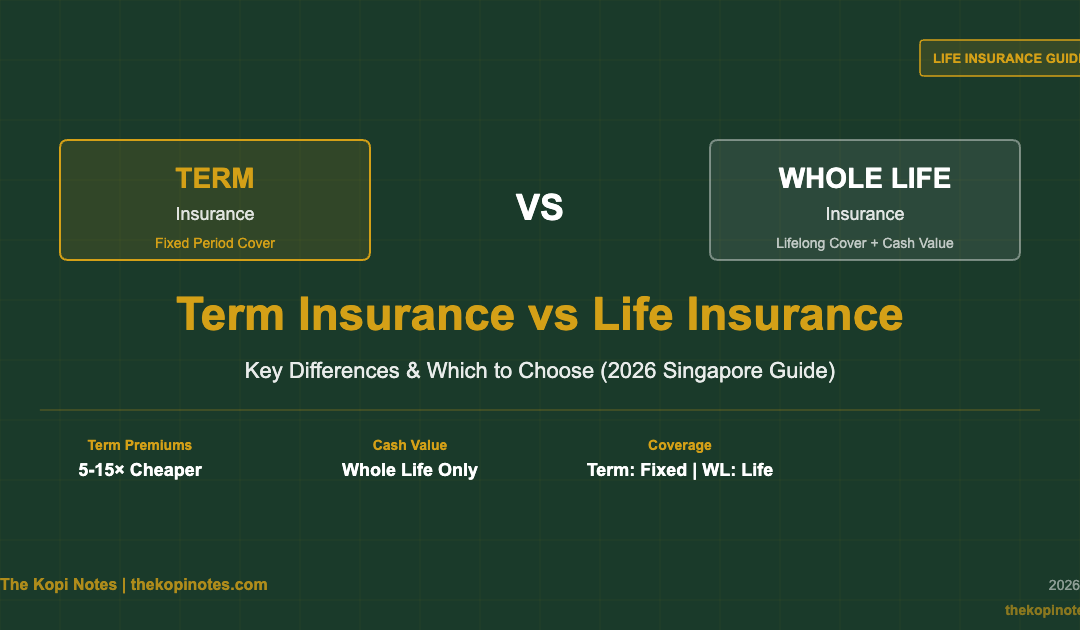
Term insurance covers you for a fixed period — typically 10 to 30 years — and pays a lump sum only if you die within that term. Whole life insurance covers you for your entire life and builds a cash value you can access later. Term costs far less; whole life acts as both protection and a savings vehicle. This 2026 guide explains which suits Singapore residents better.
Not financial advice. All figures are for educational reference only. Data as at July 2026 unless noted.
- Term insurance is 5–15x cheaper than whole life for the same S$500,000 coverage
- Whole life insurance builds a cash value you can withdraw or borrow against later
- Most Singapore planners recommend “Buy Term, Invest the Rest” for young earners
What Is Term Insurance?
Term insurance is the simplest, most affordable form of life cover. You pay a fixed monthly premium for a set number of years. If you die during that term, your beneficiaries receive the agreed sum assured. If you survive the term, the policy ends — no payout, no savings returned.
Think of it like car insurance. You pay every year for protection. If there’s no accident, you don’t get a refund — but you were covered the whole time. Term insurance works the same way: pure protection, nothing else.
In Singapore, common term durations are 10, 20, 25, and 30 years. You can also buy coverage to a specific age — such as until age 65 or 70. This makes term ideal for income replacement: if you were gone, your family could use the payout to cover mortgage instalments, school fees, and daily expenses during the years they need it most.
Key Features of Term Insurance
- Fixed coverage period — 10, 20, 25, or 30 years (or until age 65/70)
- No cash value — pure protection, nothing returned if you outlive the policy
- Lower premiums — often 5–15x cheaper than whole life for the same coverage
- Simple and transparent — easy to compare across insurers
- Convertible — some term plans allow conversion to whole life later without a medical exam
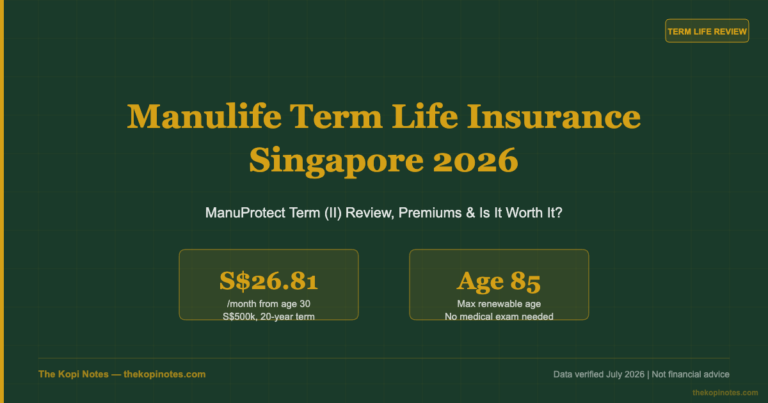
Singapore’s MAS-regulated Direct Purchase Insurance (DPI) scheme lets you buy term coverage online without a financial adviser, keeping costs even lower. Premiums start from around S$25–40 per month for a healthy 30-year-old buying S$300,000 in coverage.
What Is Whole Life Insurance?
Whole life insurance — often called “life insurance” in everyday conversation — covers you for your entire life, typically until age 99 or 100. As long as you keep paying premiums, the policy never expires and your family will always receive a payout when you pass.
But there’s more to it than just coverage. Whole life insurance also builds a cash value (also called surrender value) over time. Part of your premium goes into a savings or investment component. After 5–10 years of paying, you can access this cash through a partial withdrawal or a policy loan. If you cancel the policy, you receive the accumulated surrender value back.
Key Features of Whole Life Insurance
- Lifelong coverage — pays out whenever you die, with no expiry date
- Cash value accumulation — builds surrender value you can borrow against or withdraw
- Higher premiums — typically S$300–700/month for S$500,000 coverage
- Limited-pay options — some plans are fully paid up after 10, 15, or 25 years
- Participating vs non-participating — participating plans share in insurer profits (bonuses), non-participating plans have fixed guaranteed returns
Whole life insurance is widely used for estate planning in Singapore. Because the payout is guaranteed — not time-limited — it’s used to pass wealth to the next generation or to fund a business succession plan. For universal life insurance singapore — a more flexible variant popular for high-net-worth planning — the investment component is linked to market returns with greater flexibility.
Key Differences at a Glance
Here’s how term insurance and whole life insurance compare across the factors that matter most to Singapore residents in 2026.
| Feature | Term Insurance | Whole Life Insurance |
|---|---|---|
| Coverage Period | 10–30 years (or to age 65/70) | Whole life (until age 99/100) |
| Monthly Premiums (S$500K) | S$30–100/mth | S$300–700/mth |
| Cash Value | None | Yes (after ~5–10 years) |
| Death Benefit Guarantee | Only if death occurs during term | Guaranteed whenever death occurs |
| Convertibility | Some plans convertible to whole life | N/A (already permanent) |
| Estate Planning Use | Limited (term-dependent payout) | Excellent (guaranteed payout) |
| Best For | Income replacement, mortgage, young families | Estate planning, forced savings, lifelong cover |
Source: Singapore insurer product summaries, MAS guidelines, July 2026.
Premium Cost Comparison
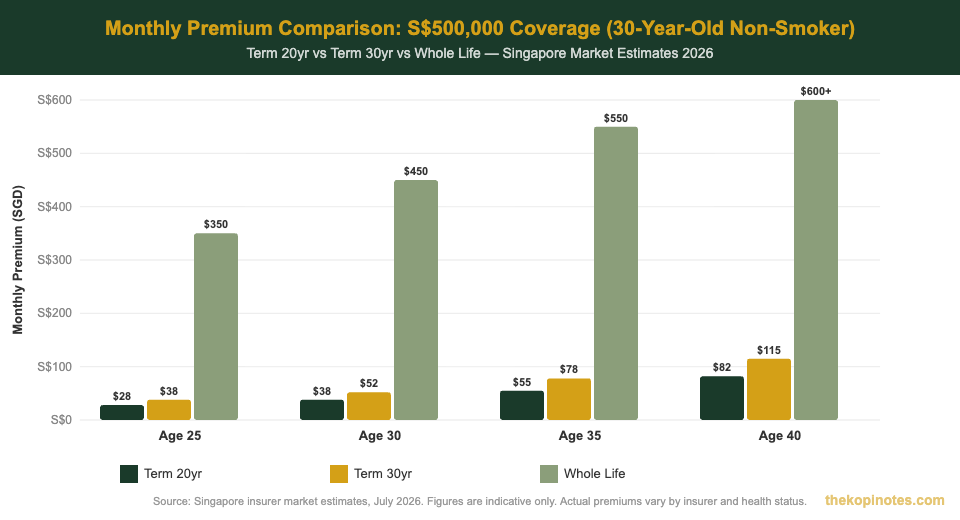
The biggest practical difference between term and whole life insurance is cost. For the same S$500,000 death benefit, you’ll pay vastly different premiums depending on which type you choose. Here’s a comparison for a male non-smoker in good health:
| Age at Entry | Term 20yr (est.) | Term 30yr (est.) | Whole Life (est.) |
|---|---|---|---|
| Age 25 | ~S$28/mth | ~S$38/mth | ~S$350/mth |
| Age 30 | ~S$38/mth | ~S$52/mth | ~S$450/mth |
| Age 35 | ~S$55/mth | ~S$78/mth | ~S$550/mth |
| Age 40 | ~S$82/mth | ~S$115/mth | ~S$600+/mth |
Source: Singapore insurer market estimates (AIA, Prudential, Income, FWD), July 2026. S$500,000 sum assured, male non-smoker. Actual premiums vary by insurer and health status.
That S$400 monthly difference is real money. Over 20 years, that’s over S$96,000 in extra premiums paid for whole life. If you invested that difference instead, compound growth could turn it into considerably more. This is the logic behind the “Buy Term, Invest the Rest” strategy.
Which Should You Choose?
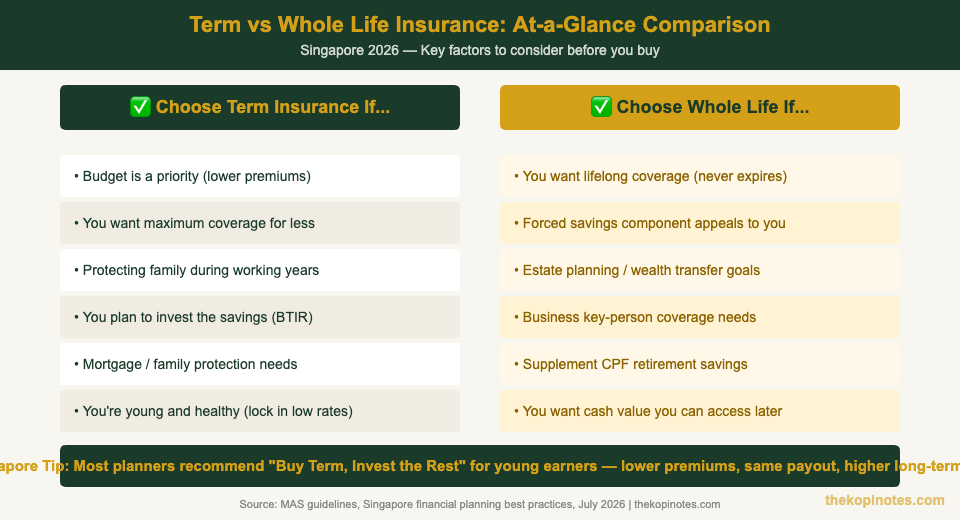
There’s no single right answer. The right choice depends on your financial goals, life stage, and how disciplined you are with investing.
Choose Term Insurance If You:
- Need the highest coverage amount at the lowest possible cost
- Have a mortgage, young children, or dependants relying on your income
- Are disciplined enough to invest the premium savings yourself (BTIR strategy)
- Are early in your career and budget is a constraint
- Want simple, transparent cover with no investment component
Choose Whole Life Insurance If You:
- Want guaranteed lifelong coverage that never expires
- Prefer a forced savings component alongside protection
- Have estate planning needs — passing wealth to the next generation
- Are a business owner who needs key-person insurance
- Can comfortably afford higher monthly premiums
Many Singapore financial planners recommend a hybrid approach for those who want both: buy a smaller whole life policy for lifelong coverage (e.g. S$100,000 sum assured), then top up with a larger term policy for income replacement during your high-responsibility years. This balances permanence and cost.
For most young Singaporeans — especially those with a housing loan and children — term insurance is the right starting point. You can always add whole life later when income grows. See our full life insurance singapore comparison guide for a detailed breakdown across all plan types and providers.
Popular Options in Singapore 2026
Singapore has a well-regulated insurance market overseen by the Life Insurance Association Singapore (LIA). Here are the main providers across both types.
Term Insurance Providers
- AIA — AIA Term Life, strong brand, convertible options available
- Prudential — PRUterm Vantage, tiered premiums by age
- FWD — FWD Term Life, competitive online premiums, easy digital application
- Income (NTUC) — iTerm, integrated with MediShield riders
- Singlife (formerly Aviva) — Singlife Term Life, direct purchase available
- Great Eastern — GREAT Term Protect, long-established insurer with broad network
Singapore also has the Dependants’ Protection Scheme (DPS) — a basic term life plan automatically attached to your CPF membership. It covers up to S$70,000 until age 65. Think of DPS as a foundation, not a complete plan. Most people with family commitments need S$300,000–S$1,000,000 in total coverage.
Employers in Singapore often provide group term life insurance as part of workplace benefits — typically 2–3x your annual salary. This is a valuable bonus, but don’t rely on it alone. Group cover ends the moment you leave your employer.
Whole Life Insurance Providers
- AIA — AIA Guaranteed Protect Plus, participating with bonuses
- Prudential — PRUwealth Plus, limited-pay options available
- Income (NTUC) — VivoWealth Solitaire, participating plan with long-term bonuses
- Great Eastern — GREAT Wealth Advantage, strong track record on bonus declarations
- Manulife — LifeReady Plus II, flexible premium payment terms
The “Buy Term, Invest the Rest” Strategy
“Buy Term, Invest the Rest” (BTIR) is a financial planning approach widely used in Singapore. The idea: buy the cheapest term insurance for maximum protection, then invest the premium savings in higher-return vehicles — ETFs, REITs, CPF top-ups, or robo-advisors.
Here’s the maths for a 30-year-old buying S$500,000 coverage:
- Whole life premium: ~S$450/mth
- Term 30yr premium: ~S$52/mth
- Monthly savings to invest: ~S$398
- Over 30 years at 6% p.a. returns: ~S$400,000+ accumulated
That’s the power of compound interest over time. The cash value inside a whole life policy typically grows at 3–4% p.a. (including non-guaranteed bonuses). The stock market has historically returned 7–9% p.a. over long periods. That gap, multiplied over 30 years, is significant.
However, BTIR requires discipline. If you consistently fail to invest the savings or withdraw them for lifestyle spending, the forced savings of a whole life policy may serve you better. The lower but guaranteed return beats zero.
Use our Singapore retirement planning calculator to model how much you’d accumulate investing the term savings over 20–30 years vs relying on whole life cash value.
For robo-advisor investing, use your Endowus referral code (code: 2V343) for a fee rebate on your first investment — a good starting point for deploying term premium savings.
Frequently Asked Questions
Is term insurance better than whole life insurance in Singapore?
What happens when my term insurance expires?
Can I convert my term insurance to whole life?
Is whole life insurance worth it in Singapore?
What is the cheapest life insurance in Singapore?
Does life insurance cover death by any cause in Singapore?
How much life insurance do I need in Singapore?
The Bottom Line
Term insurance and whole life insurance serve different purposes. For most Singaporeans — especially those in their 20s and 30s with mortgages, young families, and income to protect — term insurance is the smarter starting point. It delivers the highest coverage at the lowest cost, freeing you to invest the savings.
Whole life insurance has its place: lifelong guaranteed cover, estate planning, and a forced savings component for those who value simplicity over return optimisation. Many Singaporeans hold both — a foundational whole life policy for permanent cover, topped up with a larger term plan during high-responsibility years.
Whatever you choose, get covered early. Every year you delay means higher premiums and time spent unprotected. Compare quotes from MAS-licensed insurers, speak to a registered financial adviser (RFA), and make sure your coverage matches your actual income replacement needs.
Not financial advice. Speak to a licensed financial adviser before making any insurance decisions. Premium estimates are indicative only, based on Singapore market data as at July 2026.
Get Free Insurance Advice
Speak with a licensed insurance advisor. No obligation, no cost.
By submitting this form, you agree to our Privacy Policy.
This article was researched with the help of AI. While we strive to keep all information accurate and up to date, there may be errors. If you notice any discrepancies, please contact us.