CSPX vs SPLG (Now SPYM): Why the Cheaper US ETF Still Costs Singapore Investors More (2026)
A side-by-side look at the 0.02% US ETF everyone points to online — and why its tax bill for Singapore investors is bigger than its fee.
CSPX and SPLG (renamed SPYM in late 2025) both track the S&P 500, but SPLG/SPYM is a US-domiciled fund that exposes Singapore investors to 30% dividend withholding tax and up to 40% US estate tax above a USD 60,000 threshold. CSPX, an Ireland-domiciled UCITS ETF on the London Stock Exchange, pays a slightly higher 0.07% TER but avoids both — making it the lower-cost choice overall for most Singapore investors despite SPLG/SPYM’s headline 0.02% fee.
Not financial advice. All figures are for educational reference only. Data verified as at 20-24 November 2026 against the iShares CSPX factsheet and the SSGA SPYM fund page unless otherwise noted.
Table of Contents
Contents — Click to expand
Quick Answer
If you only care about the number printed on the fund page, SPLG — now SPYM — wins: a 0.02% TER against CSPX’s 0.07%. But that comparison ignores the two costs that matter more for a Singapore-based investor: dividend withholding tax (WHT) and US estate tax exposure. SPYM is a US-registered, US-domiciled ETF, which means its distributions are subject to a flat 30% US withholding tax for a non-resident alien (there is no US-Singapore tax treaty to reduce this), and — more seriously — it counts as a “US-situs asset” exposed to US federal estate tax of up to 40% on anything above a USD 60,000 exemption. CSPX, domiciled in Ireland, benefits from the US-Ireland tax treaty’s reduced 15% WHT rate on the dividends the fund receives internally, is not subject to a second layer of withholding tax when you hold it, and sits entirely outside the scope of US estate tax. For a buy-and-hold Singapore investor building a retirement-sized US equity position, CSPX’s extra 0.05 percentage points of TER is a rounding error next to what SPLG/SPYM can cost in tax leakage and estate-tax risk.
Wait — Didn’t SPLG Get Renamed to SPYM?
Yes, and this is worth flagging because most comparison articles online still use the old ticker. State Street changed the SPDR Portfolio S&P 500 ETF’s ticker from SPLG to SPYM effective 31 October 2025 — the fund itself, its index, its holdings and its 0.02% expense ratio are unchanged; only the ticker symbol and fund name were updated (it’s now officially the “State Street® SPDR® Portfolio S&P 500® ETF”). If your broker app, a watchlist, or an older article still shows “SPLG”, it’s the same fund you’ll find today under SPYM on NYSE Arca. For Singapore investors searching for this ETF, the two tickers are interchangeable — the tax and cost analysis below applies identically to both. This kind of ticker change isn’t unique to SPLG/SPYM either; we’ve covered a similar switch with CSPX’s own USD/GBP share-class tickers on the London Stock Exchange.
Key Differences at a Glance
| Feature | CSPX | SPLG / SPYM |
|---|---|---|
| Full Name | iShares Core S&P 500 UCITS ETF | State Street SPDR Portfolio S&P 500 ETF |
| Index Tracked | S&P 500 Index | S&P 500 Index |
| Domicile | Ireland (UCITS) | United States |
| Exchange | London Stock Exchange (CSPX/CSP1) | NYSE Arca |
| Structure | Accumulating (no distributions) | Distributing (quarterly) |
| TER | 0.07% p.a. | 0.02% p.a. |
| AUM | USD 144.6 billion (fund), as at 20 Nov 2026 | USD 171.2 billion, as at 20 Nov 2026 |
| Number of Holdings | 504 | 505 |
| US Dividend WHT (for SG investor) | 15% (embedded, via US-Ireland treaty) | 30% (no US-Singapore treaty) |
| US Estate Tax Exposure | None (not a US-situs asset) | Yes — up to 40% above USD 60,000 |
| CPF/SRS Eligible | SRS-compatible via eligible brokers; not CPF-OA investable | SRS-compatible via some brokers; not CPF-OA investable |
Source: iShares Core S&P 500 UCITS ETF factsheet (ishares.com), 20 Nov 2026; SSGA SPYM fund page (ssga.com), 20-23 Nov 2026.
Tax Comparison: Withholding Tax and US Estate Tax
This is the section that actually decides which ETF is cheaper for a Singapore resident, so it’s worth walking through both tax layers in detail.
Dividend withholding tax. The S&P 500’s underlying companies pay real dividends — roughly a 1.2% index dividend yield as at November 2026, per S&P data cited on the SSGA fund page. What happens to that dividend income before it reaches you is where the two ETFs diverge. CSPX is domiciled in Ireland, which has a tax treaty with the US; under that treaty, the fund itself only loses 15% of the US dividends it receives to US withholding tax before reinvesting the rest (CSPX is accumulating, so there’s no second withholding event when the fund compounds that income into its NAV — we’ve broken down the full mechanics in our CSPX withholding tax guide). SPLG/SPYM is a US-registered fund; a non-resident alien holding it directly faces the default 30% US withholding tax rate on the “ordinary dividend” portion of each quarterly distribution, because Singapore has no estate or income tax treaty with the US that would reduce this rate.
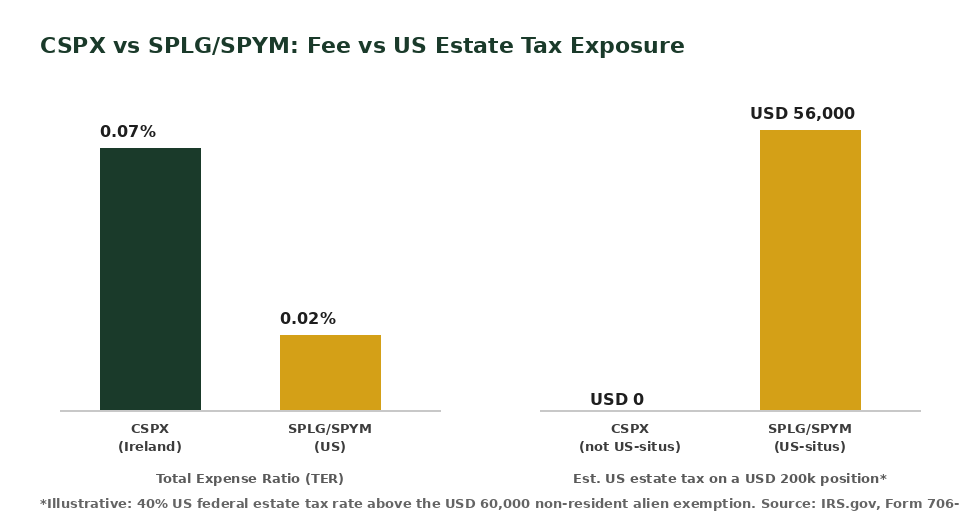
US estate tax. This is the bigger risk and the one most comparison articles skip. The US Internal Revenue Service treats shares of a US-domiciled fund as a “US-situs asset” regardless of where the shareholder lives. A non-resident alien’s estate gets only a USD 60,000 exemption against US-situs assets — unchanged and not indexed for inflation — versus roughly USD 15 million for a US citizen. Anything above that USD 60,000 threshold in SPLG/SPYM (or any other US-listed ETF, including SPY and VOO) can be taxed at rates climbing to 40%, and the estate’s executor may need to file IRS Form 706-NA before US assets can be released to beneficiaries. CSPX, because it is an Irish-domiciled fund traded on the LSE, does not carry this exposure at all — its shares are not US-situs property, no matter how large the position grows. We go through the mechanics, exemption thresholds and practical workarounds (like insurance and smaller position sizing) in our dedicated US estate tax guide for Singapore investors.
| ETF Type | Domicile | US Dividend WHT | US Estate Tax Risk |
|---|---|---|---|
| CSPX (LSE) | Ireland | 15% | None |
| SPLG / SPYM (NYSE Arca) | USA | 30% | Yes (above USD 60,000) |
Source: IRS.gov — Some nonresidents with US assets must file estate tax returns, accessed Nov 2026.
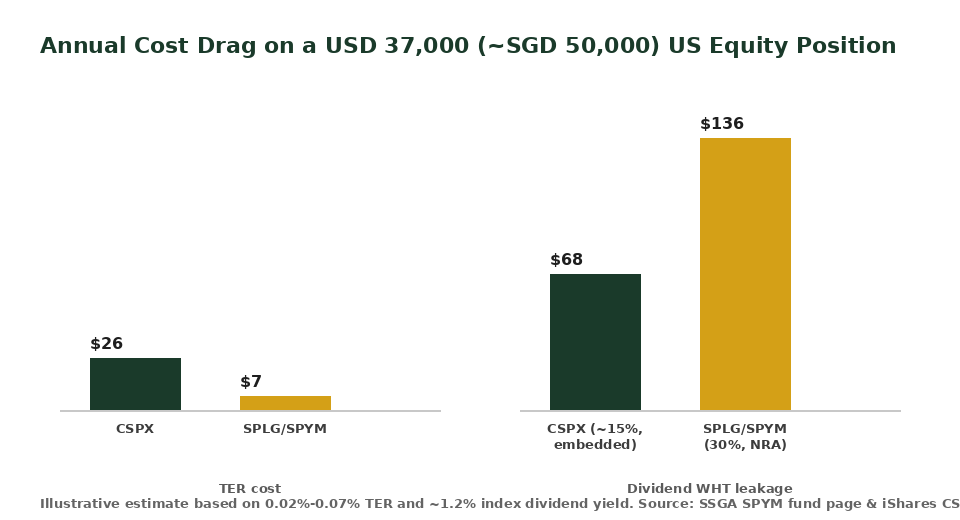
Worked example. Take a Singapore investor with roughly USD 37,000 (about SGD 50,000) in US large-cap equities. On CSPX, the 0.07% TER costs about USD 26 a year; on SPLG/SPYM, the 0.02% TER costs about USD 7 — SPLG/SPYM is cheaper by USD 19 on fees alone. But on the dividend side, at a ~1.2% index yield that position generates about USD 444 of gross dividend income a year. CSPX’s embedded 15% WHT works out to roughly USD 68 lost to tax; SPLG/SPYM’s 30% NRA withholding on distributed dividends works out to roughly USD 136. That’s a USD 68 WHT disadvantage for SPLG/SPYM — more than three times the TER saving — before estate tax risk is even factored in. Scale the same position to USD 150,000 (about SGD 200,000) and the estate tax exposure alone could mean a US tax bill of roughly 40% × (USD 150,000 − USD 60,000) = USD 36,000 payable by your estate if you hold SPLG/SPYM and pass away while still holding it — CSPX carries zero equivalent risk at any position size.
Historical Performance Comparison
Because both funds track the same S&P 500 Index, their total returns are very close before fees and currency effects — the small gap you’ll see comes almost entirely from TER, tracking method, and currency hedging drag (CSPX is also available in EUR- and GBP-hedged share classes). For calendar year 2025, CSPX’s USD share class returned 17.6% on a NAV basis against a benchmark of 17.4%, per the iShares factsheet. SPYM’s NAV return was 11.73% year-to-date and 12.07% over the trailing 1 year as at end-October 2026, per the SSGA fund page, with a 10-year annualised return of 15.44%. 2026 has been a choppier year for US large-caps generally — CSPX’s own USD share class was up only 1.77% year-to-date as at 20 November 2026, reflecting the broader Nasdaq-led pullback we covered when the S&P 500 sold off earlier this quarter. The point to take from this: don’t pick between CSPX and SPLG/SPYM on 1-year performance — the index they both track is the real driver, and the TER/WHT/estate-tax gap above is the only structural, repeatable difference between them.
Total Cost of Ownership
Add the three layers together — TER, dividend WHT, and the expected value of estate tax risk — and CSPX comes out ahead for almost every realistic Singapore investor holding size, despite its headline fee being more than 3x higher than SPLG/SPYM’s. The exception is a genuinely small, short-term position (well under a few thousand SGD) held for only a short period, where the estate tax risk is negligible and TER differences matter more proportionally — though even then, the 15-point WHT gap on dividends usually still favours CSPX. There’s also a practical cost most investors overlook: FX conversion. CSPX trades in USD on the LSE, so Singapore investors typically convert SGD to USD once; SPLG/SPYM trades in USD on NYSE Arca, so the FX step is identical on that front — this isn’t a differentiator between the two, but it is a reminder that broker FX spreads (often 0.03%-0.5% depending on platform) apply regardless of which ETF you choose, and are usually a bigger line item than either fund’s TER.
Who Should Pick Which?
CSPX makes sense if: you’re building a long-term, buy-and-hold core equity position (especially one that could realistically exceed USD 60,000 over your investing lifetime); you want to avoid US estate tax exposure entirely rather than manage around it; you value the lower effective dividend tax leakage; or you already hold other LSE-listed ETFs like VWRA or IWDA and want a single consistent broker/exchange setup — see our guide on why Singapore investors buy ETFs on the London Stock Exchange for the full rationale.
Consider SPLG/SPYM if: your total US-situs asset exposure (across all US-domiciled holdings, not just this one ETF) will stay comfortably under the USD 60,000 estate tax threshold for the foreseeable future; you specifically want the lowest possible headline TER and are comfortable managing the withholding tax drag; or you’re using it as a small satellite position inside a US brokerage account you already maintain for other reasons (e.g. options trading). Even then, most Singapore-based financial advisers would flag the estate tax exposure as something to actively monitor and cap, not ignore.
Where to Buy CSPX or SPLG/SPYM in Singapore
CSPX is LSE-listed, so you’ll need a broker with UK/European market access: Interactive Brokers, moomoo, and Longbridge all support it. SPLG/SPYM is NYSE Arca-listed and accessible through any broker with US market access, including the same three platforms. For investors who’d rather not pick individual tickers at all, Endowus and Syfe both offer globally diversified portfolios (including S&P 500 exposure) without the DIY brokerage step.
Frequently Asked Questions
What is SPLG and why was it renamed SPYM?
SPLG was the ticker for State Street’s low-cost S&P 500 ETF. Effective 31 October 2025, State Street renamed the fund and changed its ticker to SPYM — the “State Street SPDR Portfolio S&P 500 ETF.” The index tracked, the holdings, and the 0.02% expense ratio are unchanged; only the ticker symbol and fund name were updated, so references to “SPLG” and “SPYM” describe the same fund.
Is SPYM (SPLG) cheaper than CSPX?
On headline expense ratio alone, yes — SPYM charges 0.02% versus CSPX’s 0.07%. But for a Singapore-based investor, SPYM’s 30% US dividend withholding tax (versus CSPX’s 15%) and its exposure to US estate tax above a USD 60,000 threshold typically outweigh that fee saving, especially on larger or longer-held positions.
Does SPYM (SPLG) pay dividends, and how are they taxed for Singapore investors?
Yes, SPYM distributes dividends quarterly. As a non-resident alien, a Singapore investor’s distributions are subject to a 30% US withholding tax at source, since there is no US-Singapore tax treaty to reduce this rate — unlike Ireland-domiciled funds like CSPX, which benefit from a reduced 15% rate under the US-Ireland treaty at the fund level.
Am I exposed to US estate tax if I buy SPYM or SPLG?
Yes. SPYM/SPLG is a US-domiciled fund, so its shares count as “US-situs assets” for US estate tax purposes regardless of where you live. A non-US-citizen investor’s estate gets only a USD 60,000 exemption against such assets, with the excess taxed at rates up to 40%. CSPX, being Ireland-domiciled, is not a US-situs asset and carries no equivalent exposure at any position size.
Can Singapore investors buy SPYM through IBKR or moomoo?
Yes. SPYM trades on NYSE Arca in USD and is accessible through any Singapore broker offering US market access, including Interactive Brokers, moomoo, and Longbridge — the same brokers that typically offer LSE access for CSPX.
Which is better for a long-term Singapore retirement portfolio — CSPX or SPYM?
For most Singapore investors building a long-term, buy-and-hold core equity position, CSPX is the more tax-efficient choice because it avoids US estate tax entirely and reduces dividend withholding tax leakage — both of which tend to matter more than a 0.05 percentage point TER difference as the position grows over a multi-decade retirement timeline.
Ready to Start Investing in S&P 500 ETFs?
Open a brokerage account and compare your options before you buy. Use our referral links for exclusive sign-up bonuses.
This article was researched with the help of AI. While we strive to keep all information accurate and up to date, there may be errors. If you notice any discrepancies, please contact us.