Why Singapore Investors Buy ETFs on the London Stock Exchange (2026 Guide)
The tax mechanics behind why CSPX, VWRA and other LSE-listed ETFs are the default choice for Singapore investors over US-listed equivalents like VOO or SPY.
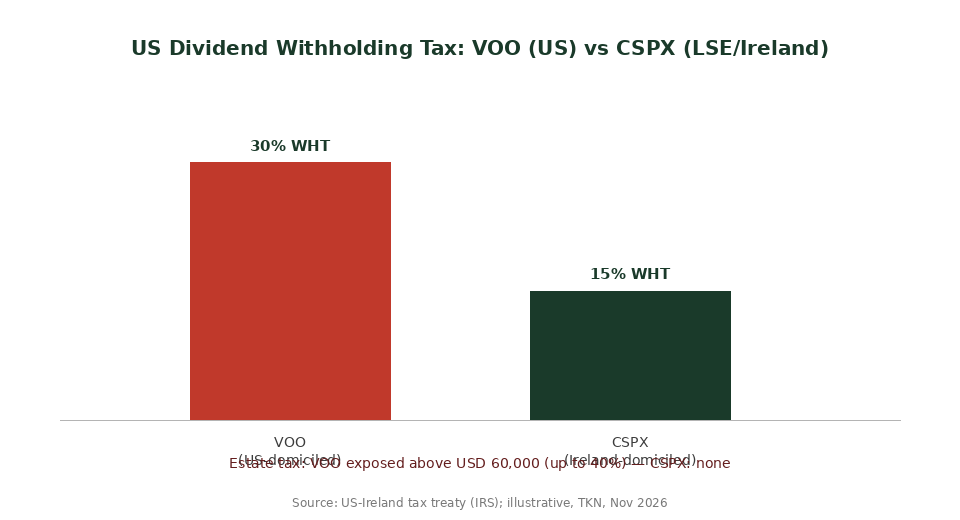
Singapore investors buy ETFs listed on the London Stock Exchange (LSE) — like CSPX or VWRA — instead of US-listed equivalents like VOO because LSE-listed funds are domiciled in Ireland. Ireland’s tax treaty with the US cuts dividend withholding tax from 30% to 15%, and completely removes US estate tax exposure that applies to US-domiciled fund holdings above USD 60,000.
Not financial advice. All figures are for educational reference only. Data as at November 2026 unless noted.
Table of Contents
Contents — Click to expand
- The Problem: US ETFs Look Cheaper, But Aren’t Always Better
- How Domicile Changes Your Tax Bill
- The Singapore Context: CPF, SRS and Local Tax Rules
- What About SGX-Listed ETFs? A Third Option
- LSE-Listed vs US-Listed: Full Comparison
- A Worked SGD 100,000 Example
- What Singapore Investors Should Do
- Frequently Asked Questions
The Problem: US ETFs Look Cheaper, But Aren’t Always Better
Scroll through any ETF screener and US-listed funds like VOO (Vanguard S&P 500 ETF) or SPY often show a lower headline expense ratio than their LSE-listed, Ireland-domiciled counterparts like CSPX. VOO charges 0.03% a year; CSPX charges around 0.07%. On the surface, VOO looks like the obvious winner. It almost never is — not for a Singapore-based investor.
The reason has nothing to do with the index, the holdings, or the fund manager. It comes down to one word most investors skip past: domicile. Where a fund is legally domiciled determines two things that matter far more than a 0.04 percentage point expense ratio difference — how much US dividend withholding tax you lose every year, and whether your estate faces a US tax bill when you die. This guide breaks down exactly why that distinction sends most sophisticated Singapore investors toward LSE-listed, Ireland-domiciled ETFs by default.
How Domicile Changes Your Tax Bill
Every ETF that holds US stocks has to deal with US dividend withholding tax (WHT) — a tax the US government deducts at source before dividends ever reach the fund. The rate depends entirely on where the fund is domiciled, not where it’s listed or where you live:
- US-domiciled ETFs (e.g. VOO, SPY, QQQ): as a non-US-resident investor without a US tax treaty with Singapore, dividends paid by these funds (which themselves don’t suffer WHT, but the onward payment to you does) are subject to 30% US withholding tax when paid to you. There is no treaty relief available to a Singapore resident holding a US-domiciled fund directly.
- Ireland-domiciled UCITS ETFs (e.g. CSPX, VWRA, listed on the LSE): because Ireland has a tax treaty with the US, the fund itself only suffers 15% withholding tax on the US dividends it receives — half the rate. That saving flows through to you whether the fund is accumulating or distributing.
Why Ireland specifically? It isn’t an accident. Ireland built its asset management industry around a specific legal structure — the Irish Collective Asset-management Vehicle (ICAV) — combined with full access to the EU’s UCITS (Undertakings for Collective Investment in Transferable Securities) passporting regime, which lets a single Irish-domiciled fund be sold across the entire European Union without separate national approval. Layer on top of that a long-standing US–Ireland tax treaty originally signed in 1997, and Ireland became the natural home for globally-distributed ETFs that need to hold US stocks efficiently. That’s why the overwhelming majority of LSE-listed, internationally-marketed equity ETFs — not just CSPX and VWRA, but most of the iShares Core and Vanguard range — are Ireland-domiciled rather than domiciled in, say, Luxembourg or the US itself.
On top of the dividend tax gap, there’s a second, often larger risk: US estate tax. US-situs assets (which include US-domiciled ETFs and individual US stocks) held by a non-resident alien above USD 60,000 in value can be taxed at rates up to 40% on death — and that USD 60,000 exemption threshold is not indexed for inflation. Ireland-domiciled UCITS ETFs are not US-situs assets, so holding CSPX or VWRA removes this exposure entirely, regardless of portfolio size. We cover this in detail in our US estate tax guide for Singapore investors.
| Factor | US-Domiciled ETF (VOO, SPY) | Ireland-Domiciled UCITS ETF (CSPX, VWRA) |
|---|---|---|
| Listed on | NYSE / Nasdaq | London Stock Exchange (LSE) |
| US dividend WHT | 30% | 15% |
| US estate tax exposure | Yes, above USD 60,000 | None |
| Typical TER | ~0.03% | ~0.07% |
| Trading currency | USD | USD or GBP, depending on the share class |
Source: IRS treaty guidance on US–Ireland dividend withholding; iShares and Vanguard fund factsheets, November 2026.
The Singapore Context: CPF, SRS and Local Tax Rules
Singapore adds a third layer worth understanding: Singapore itself does not tax capital gains or dividend income for individuals, regardless of where the underlying ETF is domiciled or listed. That means the entire tax difference between US-listed and LSE-listed ETFs comes from the US side (withholding tax and estate tax) — Singapore’s own tax code is neutral between the two.
Where Singapore rules do matter is account eligibility. LSE-listed UCITS ETFs are not on the CPF Investment Scheme (CPFIS) approved list, so you cannot buy CSPX or VWRA with your CPF Ordinary Account savings directly. Many Singapore brokers do, however, support buying LSE-listed ETFs using Supplementary Retirement Scheme (SRS) funds — check with your specific broker. If you’re deciding how to split exposure across your CPF, SRS and cash brokerage accounts, our CPF investment strategy guide walks through which account should hold which asset type.
What About SGX-Listed ETFs? A Third Option
Since October 2026, Singapore investors have a third route worth knowing about: SGX-listed, Ireland-domiciled Xtrackers UCITS ETFs trading directly in SGD, such as XUS (tracking the S&P 500, TER 0.03%) and XWR (tracking the MSCI World, TER 0.12%). These carry the same Ireland-domicile tax benefits as CSPX and VWRA — 15% US dividend WHT, no US estate tax exposure — but settle in SGD on your local SGX account, removing FX conversion entirely. The trade-off is a shorter track record and smaller fund size than the long-established LSE tickers. Our SGX UCITS ETF guide covers the full lineup, including how XUS and XWR compare to their LSE twins on cost and liquidity.
LSE-Listed vs US-Listed: Full Comparison
| Feature | VOO (US-listed) | CSPX (LSE-listed) |
|---|---|---|
| Index tracked | S&P 500 | S&P 500 |
| Domicile | USA | Ireland |
| US dividend WHT | 30% | 15% |
| US estate tax risk | Yes, above USD 60,000 | None |
| TER | 0.03% | 0.07% |
| Trading hours (SGT) | ~9:30pm–4am | ~4:30pm–1:30am |
| Best for | US tax residents, or very large portfolios where the WHT saving doesn’t offset estate planning complexity | Non-US residents, including virtually all Singapore investors |
Source: TKN editorial comparison of Vanguard VOO and iShares CSPX fund factsheets, November 2026.
A Worked SGD 100,000 Example
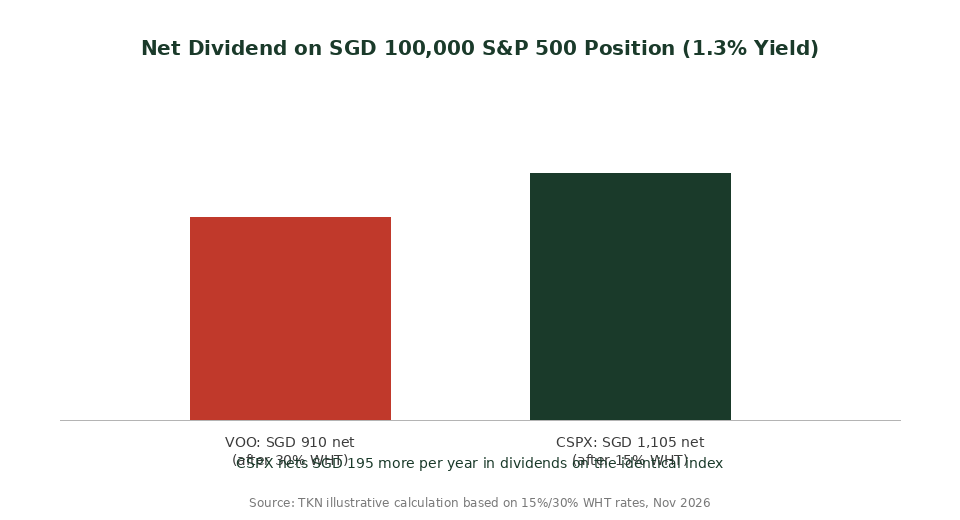
Say you hold SGD 100,000 in an S&P 500 ETF yielding roughly 1.3% a year in dividends — about SGD 1,300 in gross annual dividends.
- Via VOO (US-domiciled): 30% WHT removes SGD 390, leaving SGD 910 net dividend per year.
- Via CSPX (Ireland-domiciled, LSE): 15% WHT removes SGD 195, leaving SGD 1,105 net dividend per year — SGD 195 more every year, or roughly 21% more dividend income for the identical underlying index.
That annual gap compounds over decades if reinvested. Assuming the SGD 195 annual saving is itself reinvested at a conservative 7% average index return, it adds up to roughly SGD 5,200 in extra terminal value over a 20-year holding period on just this one position — purely from the domicile choice, before accounting for price appreciation of the underlying index at all.
But the bigger number is the one most investors overlook entirely: if your SGD 100,000 position were held in VOO and grew to, say, SGD 250,000 in USD-equivalent terms over 15 years, anything above the USD 60,000 US-situs threshold becomes exposed to US estate tax at rates up to 40% on your passing — a liability your family would need to resolve through a US probate process (form 706-NA and related filings with the IRS) before the remaining assets could be distributed to your heirs. That process can take months and typically requires engaging a US-qualified estate attorney. CSPX and VWRA remove that risk entirely, at any portfolio size, because they are not classified as US-situs property.
What Singapore Investors Should Do
Choose LSE-listed, Ireland-domiciled ETFs (CSPX, VWRA) if:
- You are a Singapore tax resident with no US tax residency or US citizenship
- Your portfolio could realistically exceed USD 60,000 in US-linked holdings over your investing lifetime
- You want simpler estate administration for your family, without a US probate step
- You’re comfortable with a marginally higher TER (often under 0.1 percentage points) in exchange for the WHT and estate tax savings
US-listed ETFs may still make sense if:
- You are a US citizen or US tax resident (domicile tax treatment works differently for you)
- Your total US-situs exposure will reliably stay under USD 60,000 for the relevant holding
Beyond domicile, note that the accumulating-versus-distributing decision is a separate, independent choice from the domicile decision — CSPX (accumulating) and a hypothetical distributing Ireland-domiciled S&P 500 fund carry the identical 15% WHT and zero estate tax treatment. If you’re also deciding whether to hold the accumulating or distributing version of your chosen ETF, see our accumulating vs distributing ETF guide for that separate decision.
For most Singapore investors, the LSE route is the practical default. If you’re deciding which specific LSE-listed ETF to start with, our CSPX ETF Singapore guide and VWRA ETF Singapore guide cover the two most popular options step by step, including broker instructions.
Where to Buy LSE-Listed ETFs from Singapore
CSPX, VWRA and most other Ireland-domiciled UCITS ETFs trade on the LSE in USD or GBP. Singapore investors typically access them through:
- Interactive Brokers — via our IBKR referral code, usually the lowest-cost route for larger, buy-and-hold portfolios
- MooMoo Singapore — via our MooMoo referral code, a simple app-based option with LSE access
- Longbridge Securities — via our Longbridge referral code, another SG-friendly LSE access point
If you’d rather not manage individual LSE trades yourself, a robo-advisor through Syfe’s referral programme can give you equivalent global exposure without manual order placement.
Frequently Asked Questions
Why do Singapore investors buy ETFs on the London Stock Exchange instead of the US exchanges?
LSE-listed ETFs like CSPX and VWRA are domiciled in Ireland, which has a tax treaty with the US. That treaty cuts US dividend withholding tax from 30% to 15% for non-US investors and completely removes US estate tax exposure that applies to US-domiciled ETF holdings above USD 60,000.
Is CSPX really the same as VOO?
Both track the S&P 500 index and hold essentially the same underlying companies in the same weights. The difference is fund domicile: CSPX is Ireland-domiciled and LSE-listed, while VOO is US-domiciled and listed on NYSE Arca. The index exposure is the same; the tax treatment for a non-US investor is not.
Can I buy LSE-listed ETFs with my CPF or SRS funds?
LSE-listed UCITS ETFs are not on the CPF Investment Scheme’s approved list for CPF Ordinary Account investment. Many Singapore brokers do support buying them with SRS funds — confirm SRS-linked trading support with your specific broker before funding the account.
What exactly is US estate tax and does it really apply to Singapore investors?
US estate tax applies to US-situs assets — which include US-domiciled ETFs and individual US stocks — held by non-resident aliens, including Singapore citizens and PRs, above a USD 60,000 exemption threshold. Rates run up to 40% on the excess. Ireland-domiciled UCITS ETFs like CSPX and VWRA are not classified as US-situs assets, so this tax does not apply to them regardless of how large your holding grows.
Is the 0.07% TER on CSPX worth paying over VOO's 0.03%?
For almost all non-US Singapore investors, yes. The extra ~0.04 percentage points in annual fees is far smaller than the 15-percentage-point dividend withholding tax saving (30% vs 15%) and the complete removal of US estate tax exposure — both of which matter far more as your portfolio grows.
Do I need a different broker to buy LSE-listed ETFs than US-listed ones?
Most Singapore brokers that support US stock trading, including Interactive Brokers, MooMoo, and Longbridge, also support LSE trading. You’ll typically need to switch the exchange selector in the broker’s app from NYSE/Nasdaq to LSE and may trade in USD or GBP depending on the ETF’s share class.
Should I buy the SGX-listed version instead of the LSE-listed one?
SGX-listed Ireland-domiciled ETFs like XUS and XWR carry the same 15% US withholding tax and zero US estate tax treatment as CSPX and VWRA, and they settle directly in SGD without FX conversion. The trade-off is a much shorter track record and smaller fund size since their October 2026 SGX listing. Many investors split exposure or start with the larger, longer-established LSE tickers and add the SGX versions as they mature.
Ready to Start Investing on the LSE?
Open a brokerage account that supports LSE trading and buy your first Ireland-domiciled ETF today.
This article was researched with the help of AI. While we strive to keep all information accurate and up to date, there may be errors. If you notice any discrepancies, please contact us.