SWRD vs IWDA: Which MSCI World ETF Should Singapore Investors Buy? (2026)
Both track the same index — here’s where they actually differ, with 2026 cost and size data.
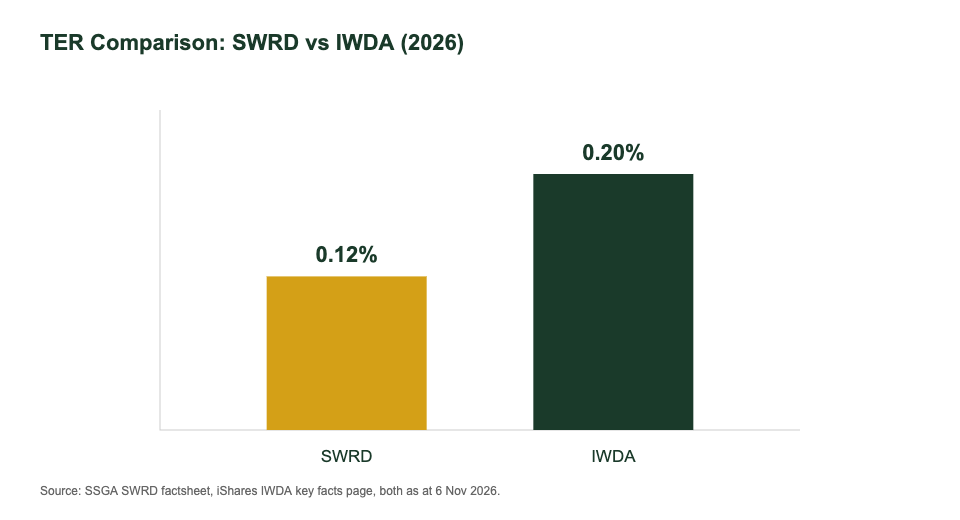
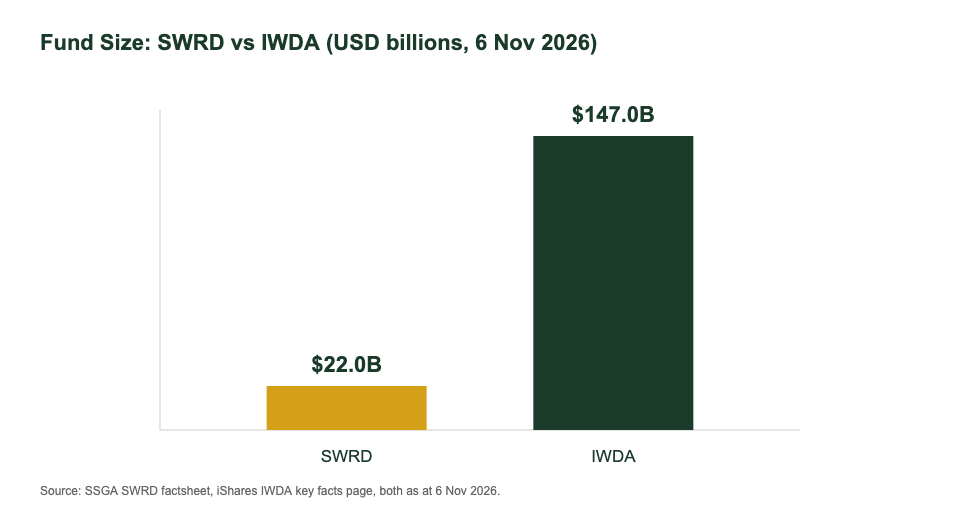
SWRD and IWDA both track the MSCI World Index and are Ireland-domiciled, accumulating UCITS ETFs — so their day-to-day returns are near-identical. The real difference is cost and size: SWRD (State Street) charges a 0.12% TER versus IWDA’s (iShares) 0.20%, while IWDA is roughly 6.7x larger with a seven-year-longer track record. For most Singapore investors starting fresh, SWRD’s lower fee wins; for those prioritising maximum liquidity and the longest history, IWDA remains the default.
Not financial advice. All figures are for educational reference only. Data verified as at 9 November 2026 against the SSGA SWRD fund page and iShares IWDA key facts page.
Table of Contents
Quick Answer
SWRD (State Street SPDR MSCI World UCITS ETF) and IWDA (iShares Core MSCI World UCITS ETF) track the exact same benchmark — the MSCI World Index — so an investor cannot meaningfully “pick the wrong one” on exposure grounds. The decision comes down to two things: cost and fund characteristics. SWRD’s 0.12% TER is 8 basis points cheaper than IWDA’s 0.20%, a real and compounding saving. IWDA, launched in 2009, is roughly 6.7x larger by assets under management than SWRD (launched 2019) as at 6 November 2026, and carries a longer audited track record. Neither answer is wrong; it depends on whether you weight cost or scale more heavily.
Key Differences at a Glance
| Feature | SWRD | IWDA |
|---|---|---|
| Full Name | State Street SPDR MSCI World UCITS ETF (Acc) | iShares Core MSCI World UCITS ETF (Acc) |
| Index | MSCI World Index | MSCI World Index (Net) |
| Domicile | Ireland | Ireland |
| TER | 0.12% | 0.20% |
| AUM (6 Nov 2026) | ~USD 22.0 billion | ~USD 147.0 billion |
| Launch Date | 28 Feb 2019 | 25 Sept 2009 |
| Holdings | ~1,235 | ~1,247 |
| Structure | Accumulating | Accumulating |
| Replication | Optimised sampling | Optimised sampling |
| Currency | USD | USD |
| Exchange (LSE) | SWRD (USD), SWLD (GBP) | IWDA (USD), SWDA (GBP) |
Source: SSGA SWRD fund page (6-8 Nov 2026), iShares IWDA key facts page (6 Nov 2026).
Both funds are issued by major, well-capitalised asset managers (State Street and BlackRock respectively) and both use an optimised sampling replication method rather than holding every one of the index’s roughly 1,400 constituent lines — a standard, industry-wide practice for broad-index funds that keeps trading costs down without materially affecting tracking.
Tax & Cost Comparison
Because SWRD and IWDA are both Ireland-domiciled UCITS ETFs, there is no tax difference between them for a Singapore investor — this is the one area where the comparison is a non-issue. Both benefit equally from the US-Ireland tax treaty’s 15% withholding tax rate on US dividends (versus 30% for a US-domiciled equivalent such as Vanguard’s VT), and both sit outside the scope of US estate tax, which can otherwise apply to US-situs assets above a USD 60,000 threshold for non-resident aliens. Singapore itself levies no capital gains tax and no tax on dividends received by individual investors, so the entire tax discussion for this pair is identical — the only thing that actually differs is the TER.
| Tax Factor | SWRD | IWDA |
|---|---|---|
| US Dividend WHT | 15% | 15% |
| US Estate Tax Risk | None | None |
| Singapore CGT/Dividend Tax | None | None |
Source: IRS non-resident estate tax guidance, MAS, 2026.
Historical Performance Comparison
Because both funds track the same MSCI World Index, their returns move almost in lockstep, and any difference over a given period is driven almost entirely by TER drag and small sampling/tracking variance rather than by stock selection. As at 31 October 2026, SWRD’s fund-net return was 10.99% YTD, 12.24% over 1 year, and an annualised 22.45% over 3 years, against a tracking error of 0.06% versus the index over the trailing 3 years. IWDA’s accumulating share class showed a near-identical discrete calendar-year return of 21.2% in 2025 and 18.7% in 2024, against a standard deviation (3y) of 11.62% — essentially the same risk profile as SWRD’s 11.46%. Over any meaningful holding period, the gap between the two funds’ total returns should track closely to the 0.08 percentage point TER difference, compounding slowly in SWRD’s favour.
Total Cost of Ownership
TER is the main differentiator, but it isn’t the only cost. Brokerage commission and bid-ask spread also matter, and here IWDA’s much larger size can work in its favour: with roughly USD 147.0 billion in assets versus SWRD’s USD 22.0 billion, IWDA is one of the most heavily traded UCITS ETFs in Europe, which can translate into a marginally tighter bid-ask spread for very large or very frequent trades. For a typical Singapore retail investor making periodic lump-sum or monthly purchases of a few thousand SGD at a time, this spread difference is negligible next to the TER gap.
Worked example: on a SGD 100,000 portfolio, SWRD’s 0.12% TER costs approximately SGD 120 per year, versus IWDA’s 0.20% TER at approximately SGD 200 per year — an SGD 80 annual difference. Held for 20 years without rebalancing, and ignoring any difference in underlying returns, that annual SGD 80 gap compounds to a meaningfully larger cumulative drag on the IWDA side, though the exact figure depends on the portfolio’s growth rate over that period.
Who Should Pick Which?
Pick SWRD if: you’re starting a new position and want the lowest ongoing cost among major MSCI World trackers, you’re comfortable with a fund that’s “only” USD 22.0 billion (still a large, liquid, seven-year-old ETF by any normal standard), and the 0.08% TER saving matters more to you than holding the single largest, oldest fund in the category.
Pick IWDA if: you specifically want the largest and longest-running MSCI World UCITS ETF for maximum liquidity and institutional-grade track record, you’re already holding IWDA and want to avoid triggering a taxable disposal or extra brokerage fees by switching, or you’re investing very large sums where the tighter bid-ask spread on a bigger fund could offset part of the TER gap.
For most Singapore investors building a passive portfolio from scratch, the lower TER tips the decision toward SWRD, but switching an existing IWDA holding purely to save 0.08% a year is rarely worth the transaction cost and (for anyone outside Singapore’s zero-CGT regime) potential tax trigger — in that case, simply direct new contributions to SWRD and let the existing IWDA position run. Read our full SWRD ETF Singapore guide and IWDA ETF Singapore guide for the complete breakdown of each fund individually, including step-by-step buying instructions. Investors who also want exposure to emerging markets in the same fund should compare both against our VWRA ETF Singapore guide, and those who’d rather trade in SGD on SGX can read our Ireland-domiciled SGX ETF guide, which covers XWR — the SGX-listed line of this same SPDR MSCI World fund. For broader portfolio planning, see our Singapore retirement calculator.
Frequently Asked Questions
What is the main difference between SWRD and IWDA?
Both track the MSCI World Index and are Ireland-domiciled, accumulating UCITS ETFs, so their exposure is essentially identical. The real differences are cost (SWRD’s 0.12% TER vs IWDA’s 0.20%) and scale (IWDA has roughly 6.7x SWRD’s assets under management and a seven-year-longer track record, as at November 2026).
Which has lower fees — SWRD or IWDA?
SWRD is cheaper, charging a 0.12% total expense ratio versus IWDA’s 0.20%. On a SGD 100,000 portfolio, that’s roughly SGD 120 a year for SWRD versus SGD 200 a year for IWDA — an SGD 80 annual saving that compounds over a long holding period.
For Singapore investors, which is more tax-efficient?
Neither has a tax edge over the other. Both are Ireland-domiciled, so both benefit equally from the 15% US dividend withholding tax rate (versus 30% for a US-domiciled fund) and both avoid US estate tax exposure entirely. Singapore itself does not tax capital gains or dividends for individual investors, so the fee difference is the only real financial lever between the two.
Can I switch from IWDA to SWRD without triggering tax?
For a Singapore tax resident, selling IWDA and buying SWRD does not trigger any Singapore capital gains tax, since Singapore does not tax capital gains for individuals. You would, however, pay brokerage commissions and bid-ask spread on both the sale and the new purchase, which can easily exceed a year or two of the 0.08% TER saving — so switching an existing position purely to save on fees is rarely worth it unless you’re also rebalancing for other reasons.
Which is better for a long-term retirement portfolio?
Both are reasonable long-term core holdings given their identical index exposure. SWRD’s lower TER gives it a small, steady edge for new money over very long horizons, while IWDA’s much larger size and longer history may appeal to investors who weight fund scale and track record heavily. Many Singapore investors simply direct new contributions to whichever fund they don’t already hold the most of, to avoid unnecessary switching costs.
Is SWRD as safe and liquid as IWDA?
SWRD, at roughly USD 22.0 billion in assets as at 6 November 2026, is itself a large, liquid, well-established ETF — it is simply smaller than IWDA’s roughly USD 147.0 billion. Both are issued by major global asset managers (State Street and BlackRock respectively), regulated as UCITS funds under Irish law, and trade on the London Stock Exchange with tight bid-ask spreads. Neither carries materially different counterparty or regulatory risk from the other.
Ready to Start Investing in ETFs?
Open a brokerage account and buy your first ETF today. Use our referral links for exclusive sign-up bonuses.
Not financial advice. TKN may earn a referral fee from some of the links above — this does not affect the data or analysis presented. Data as at 9 November 2026 unless otherwise stated.
This article was researched with the help of AI. While we strive to keep all information accurate and up to date, there may be errors. If you notice any discrepancies, please contact us.